Published: June 10, 2026
Last Updated: October 1, 2026
You have a smart speaker in the kitchen, a smart lightbulb in the bedroom, and a video doorbell at the front door. They don‘t communicate with each other until you take your phone out. It is not automation; these are just a bunch of unrelated devices attempting to act smart.
The fix isn’t another app or another hub. It’s rethinking where control actually lives in your home’s electrical system. In 2026, smart switches have quietly become the architectural backbone of home automation — the layer that connects your intent (a voice command, a tap, a sensor trigger) to coordinated action across every device in your house.
This guide shows how smart switches improve home automation, covering the key protocols, regional wiring, automation blueprints, real energy ROI, accessibility, and security.
Why Smart Switches Are the Control Layer (Not Just Another Device)
Smart Switches vs Smart Bulbs vs Plugs — Where Control Actually Lives
This is the sort of difference that most guides will leave as a footnote. A smart bulb allows wireless control of a single light. A smart socket allows on/off control of whatever is plugged into it. Both require the light or socket to constantly have power.
A smart switch is the actual circuit (like a normal light switch). Turn off at the switch and all plug/web-connected things downstream turn off. Leave power on, and you‘ve got a ‘set and forget’ control point for that whole circuit, regardless of what bulb or device is plugged in.
That‘s the core architectural difference. Bulbs and plugs are endpoints. Switches are infrastructure.
This is important for a homeowner thinking long-term because switches aren‘t replaced when a light fixture is replaced. They don‘t go out when a person flips a physical switch (the “dumb switch problem” in large bulb configurations).
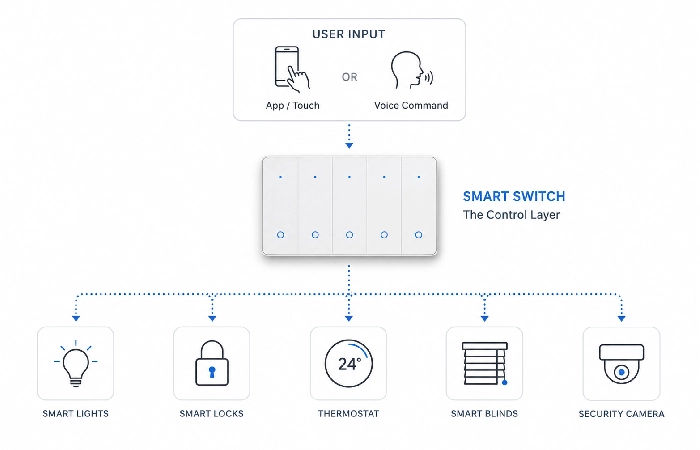
The Architecture: User → Switch/Hub → Local Execution → Devices
Think of your home automation as a signal chain:
- Input: you tap a switch panel, say a voice command, or a motion sensor fires
- How it works: your smart switch (or connected hub) receives the signal and decides what to do based on your automation rules
- Execution – commands go out to lights, locks, thermostats, blinds, and any other connected device
- Confirmation — the system confirms the action (LED indicator, app notification, or audible feedback)
When this chain runs locally (on‑device or on a local hub) instead of round‑tripping to a cloud server, you get sub‑second response times and zero dependency on your internet connection.
Why 2026 Changed the Game for Smart Switches
Two things happened. First, the Matter protocol achieved significant traction with big brands. As reported by the Connectivity Standards Alliance, the OEMs took off shortly after the 1.0 debut, and by the end of 2025, the categories listed had hundreds of Matter‑certified devices, predominantly in an increasing set of smart switch categories.
Second, users had enough failures in the cloud. Clouds went down in 2024–2025, and lights (among other things) stopped listening to voice commands, and scheduled automations quietly stopped running. Local-first switches get around that at the hardware level.
Connected lighting and controls will become essential home infrastructure as the smart home market continues to grow rapidly through the late 2020s.
Smart Switch Technology in 2026 — Protocols That Matter
Wi-Fi, Zigbee, Z-Wave, and Bluetooth (Quick Comparison)
Each protocol handles switch communication differently. Here‘s the honest breakdown:
- The Wi-Fi smart switches are widely available and normally the easiest to deploy since they don‘t require an intermediate hub, and they hook directly to the router. The drawback it‘s much more of a load on your router if you have more than 20 connected; also, they‘re all cloud-dependent unless the vendor built in local execution
- Zigbee switches run on a mesh network, so each switch extends coverage for the entire network. (Yes, another Hub is required for SmartThings or Hubitat work.) But there‘s a caveat: With Zigbee, there‘s no guarantee each manufacturer will work seamlessly without a little fiddling.
- Z‑Wave works a lot like Zigbee as a mesh system, but it uses a sub‑GHz band (around 900 MHz in North America and 868 MHz in Europe), so it tends to suffer less interference from Wi‑Fi.
- Bluetooth Low Energy (BLE) is useful for short‑range, low‑power jobs, such as a scene remote, but on its own it only supports a limited range.
Matter and Thread: The Universal Language Your Switches Need
Matter, the single industry-wide, IP‑enabled smart‑home standard created by the Connectivity Standards Alliance, enables the leading ecosystems from Apple, Google, Amazon, and Samsung to work across a common protocol without unique bridges. It doesn‘t override Wi-Fi or Thread. It goes on top of them.
Thread is the network layer that a large number of Matter devices use to talk to each other. It builds a mesh of self-healing (like Zigbee), this time with native IPv6 addressing, so that devices can talk locally without a proprietary hub as translator.
For smart switches specifically, Matter over Thread means:
- Local execution (default, no cloud round-trip)
- Cross‐platform compatibility (one switch works for Apple, Google, Amazon, and Samsung)
- Lower latency than cloud-based Wi-Fi switches
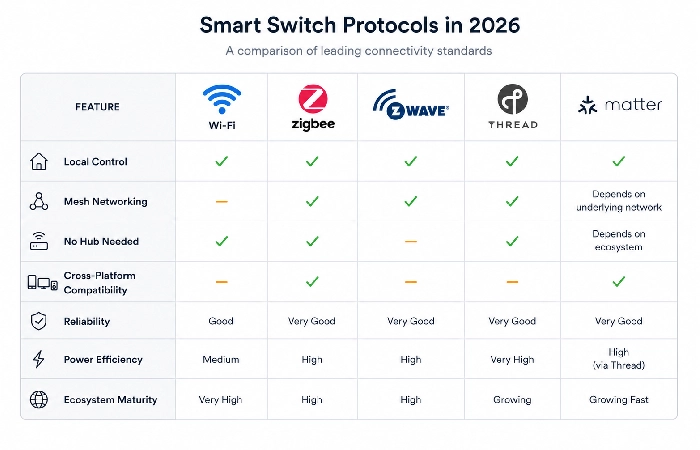
If you‘re buying switches in 2026, the Matter support should be near the top of your checklist. It‘s no longer a promise to look forward to it‘s shipping.
Local Control vs Cloud-Dependent Switches
Local control refers to your automation rules playing out on the switch itself or on a hub sitting in your home, rather than on a company‘s server that might be located far away.
Why it matters:
- Reliability: Is the Internet down? Then, local automations are still functioning. Cloud-dependent automations will cease.
- Privacy: Your patterns are kept within your own home. No records are sent elsewhere for processing.
Not all switches support local control. Many cheaper Wi-Fi switches depend on the manufacturer‘s cloud service for app control and automations. Matter-certified or hub-integrated switches are more likely to support local execution. Matter-certified switches, by definition, support local execution. That‘s one reason the protocol matters so much in 2026.
Types of Smart Switches and How to Choose
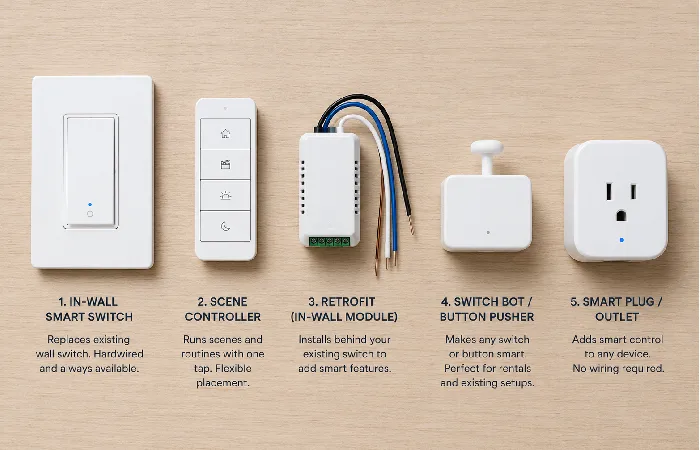
In-Wall Hardwired Switches
These replace your existing wall switch, wiring them into your home‘s electrical system (line, load, neutral, ground). They are fixed in place, unobtrusive and the most dependable long-term options.
Ideal for: homeowners renovating or building new homes who want a clean, finished look.
Major considerations: A neutral wire (newer products may not need one, but there are fewer options available), the correct load capacity for your fixtures, and the correct voltage for your country.
Wireless Scene Controllers and Battery-Powered Options
Can be installed anywhere, mounted, bedside, hall, bath, without touching your wires. Sends commands wirelessly (over Zigbee, Thread, or proprietary radio) to your hub or other switches.
Best for: renters, people who want additional control points but do not wish to run new wiring, and bedside scene triggers.
Limitations: they don‘t control circuits. They are remote triggers, nothing more. They are not substitutes for your house‘s wall switches.
Retrofit Modules, Switch Bots, and Smart Relays
The retrofit modules are installed behind your existing switch plate (inside the backbox) and make it smart without changing the appearance of your switch. Switch bots (such as Adaprox Fingerbot) physically press existing switches using a tiny robotic arm.
Designed for: renters who, for one reason or another, are unable to change their wiring. (or perhaps in a Heritage or ‘old’ style building where the back boxes may be a little unusual)
Trade-offs: retrofit modules need some backbox space and wiring skills. Switch bots are battery-based and less mechanically reliable long-term.
Smart Plugs and Outlet Controls
Smart plugs are inserted between your device & the wall outlet. They offer on/off control (and in some cases, energy monitoring of) whatever is plugged into them–such as a lamp, fan, coffee pot or space heater.
They are used in conjunction with, not as substitutes for, smart switches. Use a plug for a free-standing appliance not on a dedicated circuit. Use a switch for an overhead light, a fixed fan, or anything wired into a circuit.
Comparison Table: Which Solution Fits You?
| Type |
Requires Wiring |
Ideal For |
Reliability |
Aesthetics |
Typical Cost (USD) |
Renter-Friendly |
| In-wall hardwired |
Yes (neutral usually needed) |
Homeowners, renovations |
High |
Clean, flush |
$25–$65 per switch |
No |
| Wireless scene controller |
No |
Additional control points, bedside |
High (hub-dependent) |
Compact, mountable |
$20–$50 |
Yes |
| Retrofit module (behind switch) |
Minimal (fits behind plate) |
Retain the switch look from the traditional model |
High |
Invisible |
$15–$40 |
Sometimes |
| Switch bot/finger bot |
No (adhesive mount) |
Legacy switches, renters |
Medium (battery, mechanical) |
Visible add-on |
$30–$50 |
Yes |
| Smart plug |
No (plug in) |
Lamps, appliances, portable devices |
High |
Visible at the outlet |
$10–$30 |
Yes |
If you are looking to compare particular products across any of these categories, our guide to the best smart switches for the home has more detailed brand-to-brand suggestions.
Regional Wiring and Compatibility (US, UK, India)
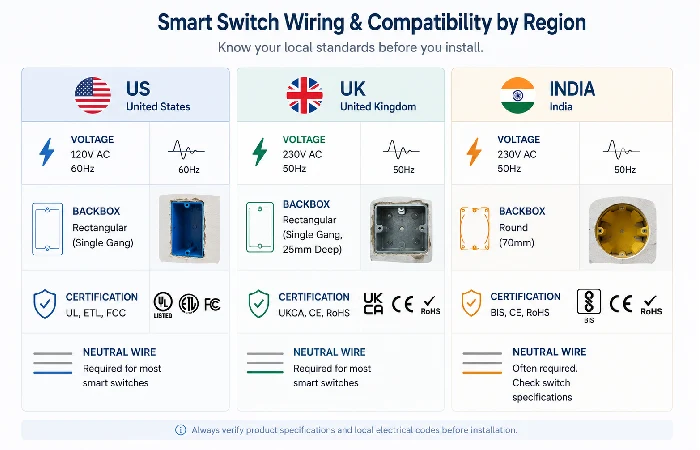
Voltage and Wiring Basics by Region
This is where many ‘universal’ smart home guides tend to lose most readers outside of North America. Your local electrical standards define what switches you can purchase.
US / Canada (120V, 60Hz):
- Standard backbox depth will accept most smart switches.
- Availability of neutral wire (older homes may not have neutral at the switch box, e.g., [pre-1980s homes])
- Safety certification: look for UL, ETL listing
- Standard amp rating: 15A for lighting circuits
UK / EU (230V, 50Hz):
UK homes tend to use deeper square back boxes (25 min for most smart switches, 35 preferred ), whereas other EU countries tend to use round ones. Check for CE marked (EU) or UKCA (UK) boxes & check gang sizes and dimensions of box beforehand.
India (230V, 50Hz):
- Standard (not gang style like US/UK) switch plates are available
- BIS certification is a prerequisite for legal sale.
- Common ratings: 6A for lighting circuits and 16A for heavy appliances such as air conditioners and geysers.
How to Check Smart Switch Compatibility in Your Home
Before you buy anything:
- Find out what your voltage is: 120V (US/Canada/Japan), or 230V (UK/EU/India/Australia). (Never use a switch for the wrong voltage.)
- Identify neutral wire, remove existing switch faceplate (power off before starting). If a bundle of white (US) or blue (UK/India) wires is in a box, then you‘re probably using the neutral line.
- To measure your backbox depth, smart switches are thicker than regular switches. Clearance needed.
- Get load rating confirmed. LED fixtures draw less current, but be certain the switch is rated for your total connected wattage.
- Looking to check for certification UL/ETL for North America, CE/UKCA for Europe/UK, and BIS for India.
If any of those checks leave you scratching your head, call in a licensed electrician. Electrical work has the potential to be hazardous, so whenever you are unsure about voltage, type of wiring, or box capacity, don‘t take a chance; call in a licensed electrician. Better to pay for an expert inspection than have one ruined switch (or worse, a terrible accident). The smart switch installation guide will include the entire wiring process step by step.
Matter Is Protocol-Agnostic — Your Wiring Isn’t
Number 1 myth: “Because it‘s Matter-certified, it‘ll work in my home.” Matter manages software compatibility. It does nothing to physics. A 120V matter switch won‘t work on a 230V circuit. A switch that requires a neutral won‘t work without one, regardless of any protocol.
Electrical specs: always check electrical specs first, protocol features second.
Real-World Automation Blueprints Using Smart Switches
This is where the smart switches stop being “fancy light toggles” and start becoming the control layer of your home. Each blueprint below describes a trigger, the actions that fire, and the switches/devices in play.
“Leave Home” — Security and Energy Savings
Trigger: geofencing (your phone leaves a certain radius around your house) or pressing a scene labelled “Goodbye” on a switch by the front door.
Actions:
- All lights out (rules that turn all the lights off when a conjunction is “something”)
- Front porch light on for 10 minutes, then off.
- Smart lock engages
- Thermostat switches to an “Away” mode, adjusting the setpoint by about 2–3°C for heating or cooling.
- Security cameras arm and start active recording.
Why switches are important here: without smart switches in control of your lighting circuits, all bulbs would have to be smart bulbs. With switches, all of the basic LED lights are included in the automation because circuit-level control is applied.
In reality, existing homeowners tend to try only a handful of hallway, living room, and bedroom switches initially, and then add other circuits once they discover that whole‑circuit control makes mixed “dumb” and “smart” bulbs act as a cooperative whole.
“Good Night” — Bedtime Routines
Trigger: Voice command (“Good night”) or tapping a bedside wireless scene controller.
Actions:
- All main lights off
- Bedside lamp dims to 10% (via smart dimmer switch)
- Blinds close (if motorised)
- Front and back door locks engage
- Thermostat drops 2°C
- Security system arms perimeter sensors
In a local-execution hub, this fires in less than a second. Cloud-dependent setups can often seem a little more sluggish and less dependable.
“Energy Save” — Workday Mode
Trigger: weekday schedule (e.g., 9:00 AM) or geofencing when all in the household are out.
Actions:
- Non-required Circuits off (decorative lights, media room, guest room)
- Lighting is controlled by occupancy only in the still active areas
- HVAC setback mode
Based on U.S. government numbers (from the U.S. Department of Energy and other federal agencies), lighting usually constitutes only a small single‑digit percentage of a typical home‘s electricity consumption. And that number has been on the decline as LEDs replace incandescent and fluorescent bulbs. When occupancy sensors and scheduled shutdowns are added with a smart switch, there can be a 15–25 per cent reduction, depending on your habits and the light fixtures.
Accessibility, Ageing in Place, and Inclusive Design
Smart switches can be helpful to seniors and those with limited mobility. For some users, the control is located on the wall, or on the phone or by voice rather than a hard-to-reach toggle. Large-paddle switches and scene controllers at wheelchair or bedside height minimise the amount of activity required. “All off” scenes simplify the task of turning lights/appliances off before leaving.
ROI, Energy Savings, and Payback Calculations
How Much Energy Can Smart Switches Actually Save?
Of course, it is all down to your starting point. For those of us who are already obsessive about switching lights off, the savings will be proportionally small. For those of us who are the ones with the hall light on all night, the figures are scarily high.
Meta‑analyses and utility‑backed studies indicate that occupancy, scheduling and other lighting controls will typically achieve about a 15–25% reduction in lighting electricity use in most buildings, with the actual amount strongly dependent on initial behaviour and space classification. Lawrence Berkeley National Laboratory has shown that the first-control technology (which is much like occupancy-based controls in simplicity) can reduce residential lighting energy demand by 24%.
Recent U.S. data indicate that lighting accounts for about 6% of home electricity consumption, so for a typical home, lighting automation would generally save tens of dollars a year rather than hundreds.
Sample ROI Calculator (Per Switch and Per Room)
Room-level calculation (3 switches in a living area):
- Total cost: $135 (hardware) + $50–$100 (electrician install if needed)
- Annual savings: $24–$36
- Payback: 5–7 years (or 3–4 years if DIY installed)
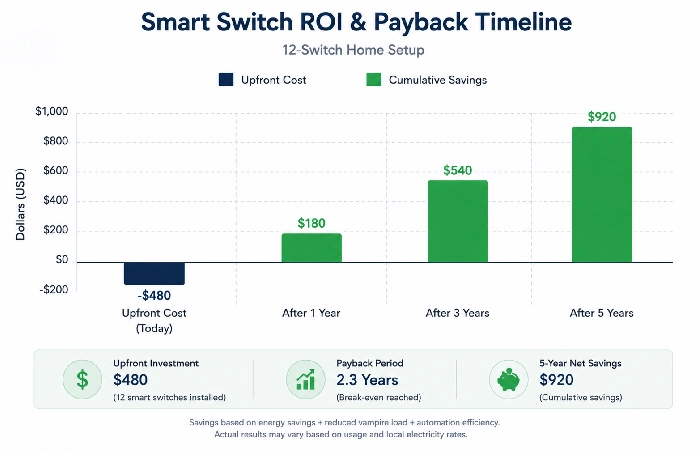
Whole-home calculation (12–15 switches):
- Total cost: $540–$975 (hardware) + $200–$400 (professional install)
- Annual savings: $90–$180
- Payback: 4–7 years
Note: These are just examples, based on normal electricity tariffs and usage; your own savings will depend on what tariffs are available locally, how much you pay to have your house re-wired, and how far you choose to go with automation!
These numbers do not account for avoided bulb replacements (included in smart switches as they prevent hard on/off surges with soft-start dimming) or time savings introduced through automations.
Non-Energy ROI — Time Saved and Reduced Hassle
People in smart home forums often report that once automations are dialled in, they save roughly 5–15 minutes a day by not walking around to toggle devices manually. That adds up to about 30–90 hours a year, and the reduced need to double‑check lights and door locks noticeably improves day‑to‑day comfort over time.
Security, Privacy, and Hardening Your Smart Switch Ecosystem
Realistic Threats (and What’s Overhyped)
Most of the time, when you get phished in the real world the attack vector isn‘t the hacker that gets into your light switch, it‘s the lousy wifi password, reused password from a data breach dump, or current, exploitable firmware version.
Local-first Matter switches have their attack surface cut down drastically since, by default, control endpoints are not exposed over the internet.
The concern that someone will hack my lights is mostly an overreaction for individual homes. The more serious risk is credential stuffing, allowing someone into your entire account, which could encompass entry locks and cameras. That‘s why strong account security is more important than switch-level encryption for most people.
Concrete Steps to Secure Your Setup
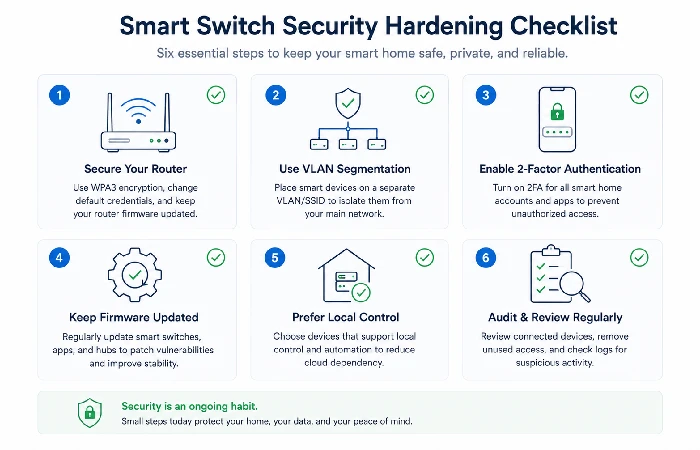
- First router security: WPA3 (if your router allows it), WPA2-AES at a minimum. Change the default admin password. Update router firmware.
- Separate IoT network: Modern routers often have a guest network or even VLAN functionality. Place all smart home devices on a separate network segment so compromised devices can‘t access your computers or phone.
- Turn on 2FA on all smart home services (Google Home, Alexa, SmartThings, apps from the makers, etc.).
- Firmware. Keep current. Use auto-update where possible. If auto-update cannot be set, then check once a quarter to find switches that aren‘t auto-updating.
- Prefer local execution. If possible, execute the automation locally. The less exposed to the cloud, the fewer attack opportunities.
Privacy-First Choices in 2026
Seek out locally processed switches and hubs that have clear, transparent data collection and privacy policies. Matter was designed with a philosophy of local communications and as little reliance on the cloud as possible. This makes it more attractive to privacy-minded people.
Prevents switching to products that need to stay constantly connected in the cloud for basic off/on functionality (with no fallback on local devices). If the company‘s server goes away (merger, shutdown, bankruptcy), your switch‘s smarts go away as well.
Planning Your 2026 Smart Switch Upgrade
Assess Your Current Wiring and Ecosystem
Start by listing what you already have:
- What rooms are the smart bulbs installed in? (It may not be needed when using the smart switches to control the circuit)
- Alternatively, do you already own a hub? (SmartThings, Hubitat, Apple HomePod or Echos with Zigbee)
- What voice assistant ecosystem is the household using?
- Are these wall boxes deep enough to accommodate smart switches?
It‘s about your answers (or your strategy). If you‘re all in on Apple, you want hybrid Matter/Thread switches that work natively with HomeKit. If you run Home Assistant, then most switches will work, but a Zigbee or Thread switch will provide local mesh reliability.
This guide is based on publicly available information about smart switches and home automation standards as of June 2026; always check the latest datasheets and your country’s wiring regulations before buying or doing any wiring.
Choosing Matter-Ready, Future-Proof Switches
Quick checklist before purchasing:
- Certified by the Matter (all packaging should have the Matter logo)
- Select the correct voltage and load rating for your region
- Compatible neutral wire (or validated no-neutral operation if the home does not have it).
- Compatible with your preferred platform (Apple/Google/Amazon/Samsung)
- Supports local execution (consult the manufacturer’s documentation)
- Firmware update path (OTA updates through app/ hub)
Phased Upgrade Plan (Beginner → Intermediate → Advanced)
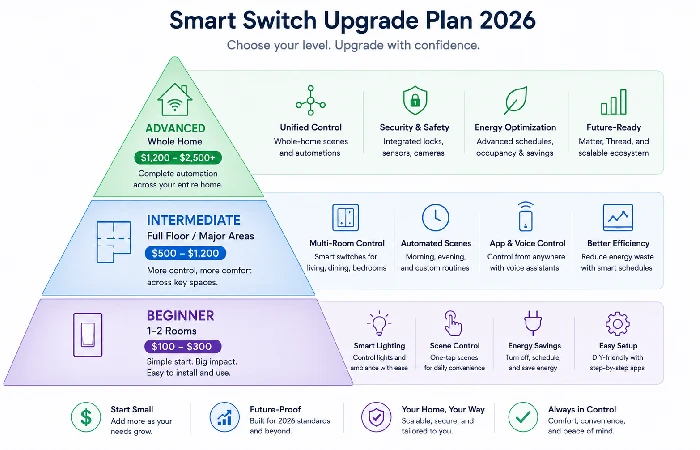
- Beginner (1–2 rooms, ~$50–$150)Start with the rooms you use most, such as the living room or bedroom. Upgrade 1–2 switches and create a few basic “morning” and “sleepytime” scenes.
- Intermediate (full floor, $200–$500): Include a dedicated hub for local execution and extend this to hallway/kitchen/bathroom circuits. Incorporate either occupancy sensors or geofencing so the “Leave home” and “Good night” automations trigger without any intervening action.
- Advanced (whole home, ~$600–$1,500+) Put most lighting and fan circuits on smart switches and add smart locks, a smart thermostat, and smart blinds. Segment your network for IoT devices and create custom scenes for each person.
FAQs
1. Do I need smart switches if I already have smart bulbs?
You don‘t need them, but for the most part, they solve the largest pain point of smart bulbs: when someone flips the physical wall switch off, your smart bulb just powers down, and you can‘t reach it. With a smart switch, your circuit stays live, and it handles that control logic.
2. Are Matter smart switches worth it in 2026?
Yes. Matter switches include cross-platform compatibility (Apple, Google, Amazon, Samsung), local execution that results in faster and more reliable automations, while eliminating ecosystem lock-in concerns. The additional premium over non-Matter switches has compressed to $5–$15/unit for most categories.
3. How many smart switches do I need to “automate” my home?
There is no need to switch everything at the same time. Just begin with 3-5 switches for your most used lighting circuits: living room, bedroom, corridor etc. This will be sufficient to have decent automations for “Good night” and “Leave home”. You can then increase gradually.
4. Will smart switches work if the internet goes down?
Matter‑enabled switches with local execution: yes. They communicate directly with your hub and each other over Thread or local Wi‑Fi without needing the internet. Cloud‑only switches: no — they lose their smart features until the internet is back, although the physical toggle on the wall still works.