Published: June 4, 2026
Last Updated: June 4, 2026
The majority of folks who purchase a savvy dimmer switch are expecting a flicker-free, voice app-enabled light. What they end up encountering is usually some flickering bulbs, random buzzing, or the switch just won‘t holistically connect with their voice assistant. The discrepancy lies in three things, which are bulb compatibility, wiring needs, and ecosystem compatibility. This guide covers the best smart dimmer switches for 2026, breaks down what actually matters before you buy, and helps you avoid the mistakes that fill Reddit threads with frustrated homeowners. Whether you’re in the US, UK, or India, you’ll find a recommendation that fits your setup.
Why Smart Dimmer Switches Are Worth the Upgrade
A standard smart switch provides you with remote/on/off control and scheduling. Besides, a smart dimmer does exactly those same things and also allows you to choose a specific brightness level from your phone, voice assistant, or schedule. This difference is more important than most realise.
Energy Savings You Can Actually Measure
According to research by the U. S. Department of Energy on the efficiency of home lighting, turning your lights down by just 25% cuts energy consumption by about 20%. This is a preferable compromise to turning lights off while still saving energy.
For example, a household that operates 10 9W dimmable LED fixtures and dims to 50% for four hours per day will likely save on the order of a dozen kWh per year rather than a dramatic amount; the real savings are found in scheduling and turning off lights when they‘re not being used. Alone, that savings is marginal; with intelligent scheduling and occupancy-based automation, many households may find that the cost of a smart dimmer will pay for itself within the first year or two of use.
Mood Lighting, Sleep Routines, and Daily Comfort
Always check for neutral support on the current datasheet or product page of the manufacturer before purchasing, when in date June 2026, as specific wiring needs and load capacity supported may be different for new revisions of hardware or firmware. A smart dimmer on a schedule can gradually lower brightness after sunset, and lower evening light levels are generally associated with better sleep hygiene in sleep research.
Beyond health, there’s plain comfort. Movie nights, dinner parties, and reading sessions — each one works better at a different light level. Voice-controlling that without leaving the couch isn’t a luxury anymore. It’s just how lighting should work.
How Smart Dimmer Switches Work (The 60-Second Version)
What is a smart dimmer? It is a device that adjusts the current going to your bulb. It rapidly switches the current on and off with each cycle of the AC to change the overall power that is supplied to the lamp. The faster this switch occurs, the better you will be able to dim the lamp.
Trailing Edge vs Leading Edge Dimming
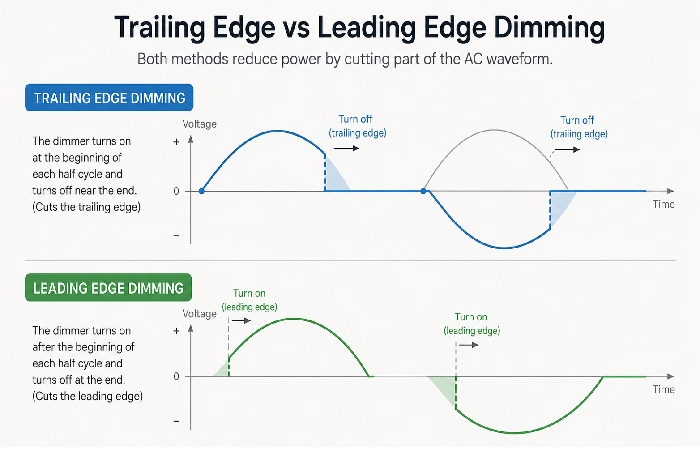
Most modern smart dimmers use “trailing edge” (also known as reverse phase) dimming. With this method, the electrical wave is interrupted at the end of each cycle instead of the beginning, resulting in more elegant dimming with LEDs and minimising the buzzing sound heard as the dimmer is operating.
Older dimmers( and many cheap ones still available) employ leading-edge ( or forward phase) dimming. They were designed for incandescent bulbs and halogen transformers. Combine one with an LED, and you will often experience a slight hum or flickering light at low levels.
It is a good rule of thumb that about 80% of older dimmers, built before the popularity of LED lighting, use leading-edge technology and are therefore more likely to produce a buzzing or flickering LED light.
The Neutral Wire Question
Many homes built before the 1980s in the US were wired without a neutral conductor in the switch box, especially where power was run directly to the light fixture rather than the switch. That matters because most Wi-Fi smart dimmers need a neutral to power their internal radio and processor when the light is off.
Your options if you don’t have a neutral:
- Lutron Caseta — uses its own bridge and doesn’t need a neutral wire
- Lutron Aurora — a retrofit dimmer that fits over an existing toggle switch
- Inovelli Blue series — Zigbee-based, works without a neutral (with some LED loads)
Always check for neutral support on the current datasheet or product page of the manufacturer before purchasing, when in date June 2026, as specific wiring needs and load capacity supported may be different for new revisions of hardware or firmware.
Unsure about neutral? Look behind your existing switch plate. If there’s something resembling the bundle of wires from your other outlets, although the wire is a different color and it’s not attached to the switch could be your neutral. Always consult an electrician!
Bulb Compatibility — The Detail Most Buyers Skip
This is where most smart dimmer frustration actually starts. You buy a well-reviewed dimmer, install it correctly, and then your lights buzz, flicker, or won’t dim below 40%.
The problem isn’t usually the dimmer. It’s the mismatch between the dimmer’s output method and the LED driver inside your bulb.
LED Minimum Load and Dimming Range
Every smart dimmer has a minimum load — the lowest wattage it can handle. Many require at least 10–25W of connected load to function properly. If you’ve got a single 7W LED on the circuit, the dimmer might behave erratically.
Here’s a practical matrix:
| Dimmer |
Min Load |
Max Load |
Best Bulb Pairing |
| Lutron Caseta Diva |
25W LED |
250W LED |
Philips, Cree, Feit dimmable |
| Treatlife SS02 |
15W LED |
300W LED |
Most ELV-compatible LEDs |
| Kasa KS220 |
15W LED |
300W LED |
TP-Link-tested bulbs (see list) |
| Inovelli Blue 2-in-1 |
25W LED |
300W LED |
Works broadly, some min-load quirks |
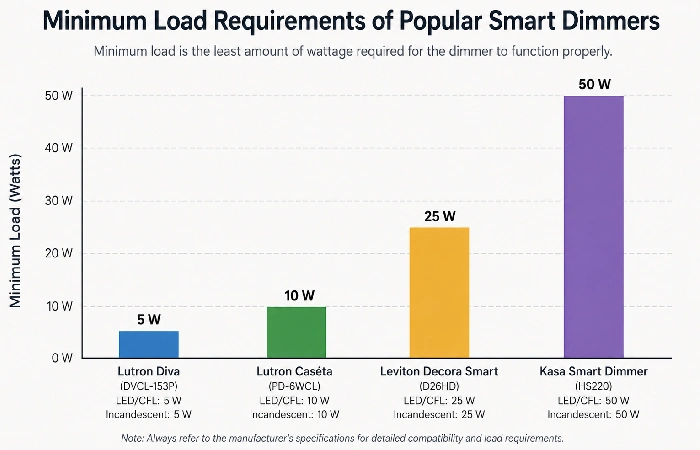
If your total connected load is below the minimum, add another fixture to the circuit or use a dummy load (a small resistor device some manufacturers sell for this exact problem).
What Causes Buzzing and Flickering (And How to Fix It)
Three main culprits:
- Driver incompatibility — the LED’s internal driver can’t handle the dimming signal cleanly
- Minimum load not met — the dimmer can’t maintain a stable output at very low wattage
- Cutting–edge dimmer with trailing-edge bulb waveform mismatch
Fixes:
- Look at the light bulb compatibility table from the manufacturer of the dimmer (Lutron has the best one)
- Switch the bulbs for the ones that are rated for your dimmer type:
- Modify the dimmer low-end trim setting (most Lutron and Inovelli dimmers allow you to set the minimum brightness)
- Add a bypass/dummy load if your circuit is below the minimum wattage by
If you want to delve into more advanced troubleshooting, it is also advised to seek some advice from your dimmer‘s manufacturer about the recommended minimum load and LED compatibility, as this may be documented in the help or FAQ pages of the manufacturer‘s website, which will be continually updated.
From the community discussions on Reddit‘s r/smarthome and r/homeautomation, the most frequent solution for flickering seems to be to switch to a brand of bulb among those that the manufacturer has verified as compatible. While a pain to go through, Lutron‘s compatibility list solves 80% of the problem.
If you’re planning the full install yourself, our smart switch installation guide walks through the wiring step by step.
Top Smart Dimmer Switches for 2026
Here’s where we get specific. These picks are based on long-term user reviews, community feedback, update history, and ecosystem breadth — not just launch-day specs.
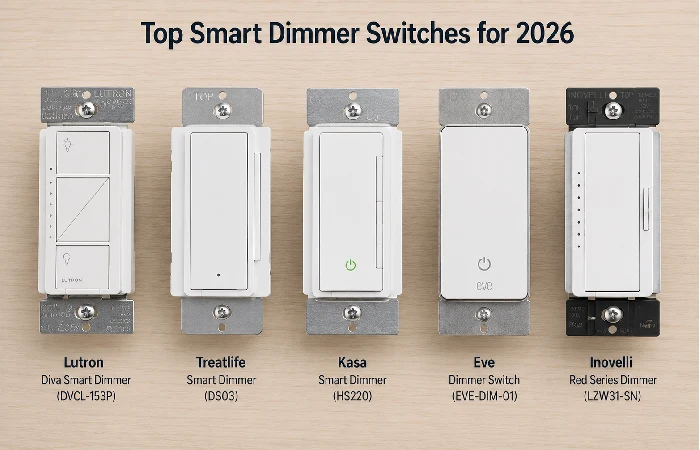
Best Overall — Lutron Caseta Diva Smart Dimmer
Lutron has been making dimmers for decades and is well‑known in the smart lighting space. The Caseta Diva combines a strong reliability track record with support for many older switch locations that lack a neutral wire, a physical dimmer bar (not just buttons), and integration with the major smart home platforms its bridge supports.
It uses Lutron‘s proprietary Clear Connect RF protocol, so you need the Lutron Smart Bridge, which is one more device in your network and costs a little extra. However, this radio protocol does not fight for your Wi-Fi bandwidth and is stable most of the time.
Like all other smart lighting systems, you should also check Lutron‘s up-to-date compatibility lists and platform support pages before purchasing, as integrations and firmware capabilities change over time.
Standout point: The Caseta line has a firmware history stretching back almost ten years, with steady updates and no bricking or serious bugs reported after OTA updates by users on community boards. Not bad for every Wi-Fi dimmer.
Downside: No native Matter support planned for mid-2026. This will require a workaround through HomeKit or a third-party bridge to support full Matter adoption.
Best for Google/Alexa — Treatlife Smart Dimmer (SS02)
If you want a cheap Wi-Fi dimmer with Alexa & Google Home out of the box, Treatlife‘s SS02 can‘t be beaten. Less than $20 in the US, it offers schedules, scenes and groups via the Smart Life app.
The compromise: requires a neutral wire, and the dimming curve isn‘t quite as fine a resolution at the bottom end as Lutron (some claim a “bump” occurs between 1-15%).
Best No-Neutral Option — Lutron Aurora (Retrofit)
This is the dimmer for renters or anyone who doesn’t want to touch their wiring. The Aurora clips over an existing toggle switch and communicates via Zigbee to a Hue Bridge. You twist it to dim, press to toggle. No rewiring needed.
It won’t work without a Philips Hue setup, which limits its audience. But for Hue users in older homes, it’s the cleanest solution available.
Best Budget Pick — Kasa KS220
The TP-Link line of Kasa provides an inexpensive way to do decent dimming. The KS220 requires a neutral and uses Wi-Fi. works with Alexa, Google, and Samsung SmartThings.
The app is simple, and the physical paddle has a little LED dimming indicator on the side. 2025 long-term reviews show fairly consistent results throughout, and there have not been any significant firmware bugs.
Best for Apple HomeKit / Matter — Eve Light Switch Dimmer
Eve‘s dimmer uses Thread and works natively with Apple HomeKit and Matter. No cloud dependency, no account needed. Everything works locally through your Apple Home hub (HomePod or Apple TV).
This one is the obvious choice for privacy-minded users within the Apple universe. The problem is that if you don‘t own a Matter controller, then you‘ll be restricted to Apple-centric devices available in India and some parts of the UK, but not everywhere.
Multi-Way Dimming — 3-Way and 4-Way Setups Explained
A 3-way switch means two switches control the same light (like the top and bottom of a staircase). A 4-way adds a third switch to the mix. Getting smart dimmers to work in these setups trips up a lot of people.
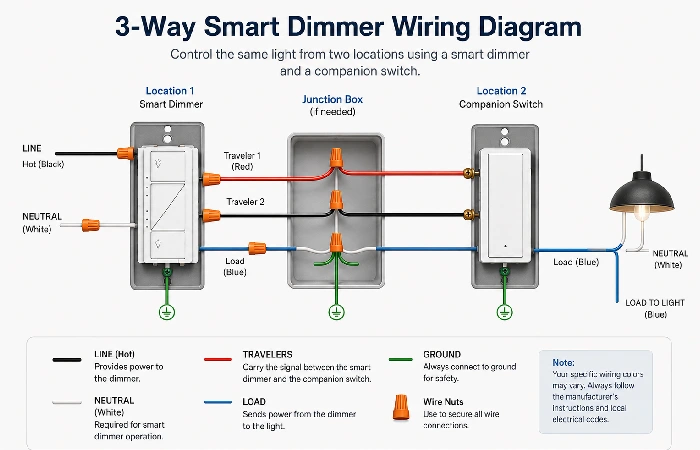
Most smart dimmers require a specific companion switch (not another smart dimmer) on the other end of the circuit. Lutron Caseta uses its Pico remote as the companion. Inovelli lets you pair two smart switches together via Zigbee binding. Treatlife sells a dedicated 3-way kit.
Never assume a single smart dimmer will work in a multiway application until you check the compatibility list. The consequences for a multiway application without the proper companion when using a regular smart dimmer is buzzing, flickering all the time, or total power off.
If you have a 4-way or more (3 or more switches), the possibilities shrink even more. Lutron Caseta does this well with multiple Pico remotes. Most Wi-Fi dimmers have no official way of doing a 4-way.
Smart Dimmer Switches for Renters (No Rewiring Needed)
But when you rent, that doesn‘t mean you have to live with dumb switches. Several products make it easy to install simple smart dimming without rewiring a thing:
- Lutron Aurora – clips onto an existing toggle, compatible with Hue
- Smart bulbs + button remotes Use dimmable smart bulbs (such as LIFX or Hue) with a wireless button on the wall
- Switchbot Bot + smart bulb – existing switch activated by a robot finger, with a dimmable smart bulb.
None of this is as elegant as a hardwired dimmer, but they do the trick.
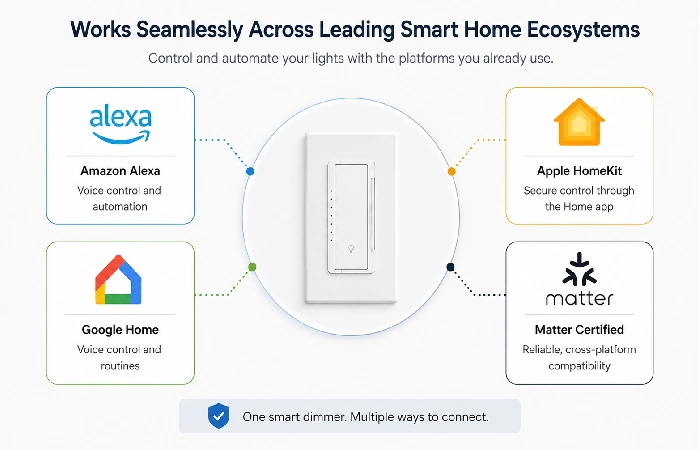
Ecosystem Compatibility — Alexa, Google, HomeKit, and Matter
The dimmer for your voice assistant and platform A needs to be what your platform already supports. See the live compatibility for mid2026 (checking the latest details directly from each brand before buying!):
| Dimmer |
Alexa |
Google Home |
Apple HomeKit |
Matter |
Hub Required? |
| Lutron Caseta Diva |
✓ |
✓ |
✓ |
✗ (bridge needed) |
Yes (Lutron Bridge) |
| Treatlife SS02 |
✓ |
✓ |
✗ |
✗ |
No |
| Kasa KS220 |
✓ |
✓ |
✗ |
Pending update |
No |
| Eve Dimmer |
✗ |
✗ |
✓ |
✓ |
No (Thread) |
| Inovelli Blue |
✓ |
✓ |
Via Hubitat/HA |
✓ (with Thread border router) |
Yes (Zigbee coordinator) |
Why Matter Changes the Game in 2026
Matter is the cross-platform smart home standard supported by Apple, Google, Amazon and Samsung. If it‘s a Matter-capable dimmer, it should work with all of these without dedicated bridges.
Hurry up and wait: Matter implementation has lagged. As of June 2026, most smart dimmer brands were rolling out Matter support via incremental firmware updates, so you will want to check whether a model has Matter enabled rather than just “promised” in promotional literature.
By mid 2026, most Matter dimmers will still need a Thread border router or a hub that supports it. But the direction is clear: if you want to buy something to last you for the next 5+ years, get dimmers that already support Matter or have announced plans to do so via firmware updates.
Statista‘s 2025 smart home market forecast predicts the global market of smart home devices will hit $230 billion by 2028, and one of the top driving factors of growth will be the interoperability (on Matter platform).
US, UK, and India — Regional Differences That Matter
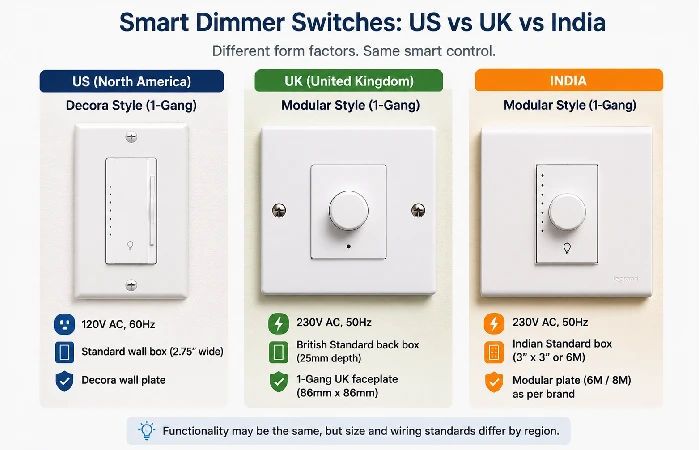
Not all dimmers are created equal. Electrical standards differ quite a bit in different parts of the world, and a dimmer meant to be used in the US is not used in the UK or India. (It could even be dangerous.)
Wiring Standards and Voltage
| Region |
Voltage |
Frequency |
Common Switch Box |
Neutral Wire Prevalence |
| US |
120V |
60Hz |
Single-gang, 14/12 AWG |
~60% of homes (post-1980) |
| UK |
230V |
50Hz |
BS 1363, deeper back box |
Common in modern builds |
| India |
220–240V |
50Hz |
Modular frame (Anchor, Legrand) |
Varies widely |
Regional Product Availability
- US: Widest selection (Lutron, Kasa, Treatlife, Inovelli, GE, Leviton)
- UK: Narrower market (Lightwave, Hive, some Shelly units, Philips Hue accessories)
- India: Growing fast (Wipro Smart, Syska, Atomberg, some Sonoff units), but quality varies. Many Indian smart dimmers lack trailing-edge dimming, which makes LED compatibility patchy.
If you’re in India, check that any dimmer you buy explicitly supports 220–240V, 50Hz operation and has been tested with common Indian LED brands. It‘s not only a pain to have to import a dimmer from the US and use a voltage converter, but it‘s also an obvious fire risk.
Always refer to your electrical code. And never take chances, if you are confused about voltage, earthing, box size, etc., always call a licensed electrician instead of trying to find out on the internet.
Common Mistakes When Buying a Smart Dimmer
After scouring discussion boards, trusted points, and support threads, these mistakes are identified consistently:
- Ignoring minimum load requirements — one 5W bulb on a dimmer that needs 25W will cause flickering every time
- Buying a random “compatible” bulb — not all dimmable LEDs dim the same way. Check the manufacturer’s tested list.
- Assuming all smart dimmers fit standard boxes — some require deeper gang boxes, especially in the UK and older US homes
- Overlooking the neutral wire — don’t discover this after you’ve already opened the package
- Trying to mix dimmer protocols on a single network – running Zigbee, Z-Wave, and Wi-Fi dimmers all together, “is” possible, but “is” also more difficult when troubleshooting.
- Avoiding firmware updates – dimmer bugs are a fact, and manufacturers update their firmware to address them
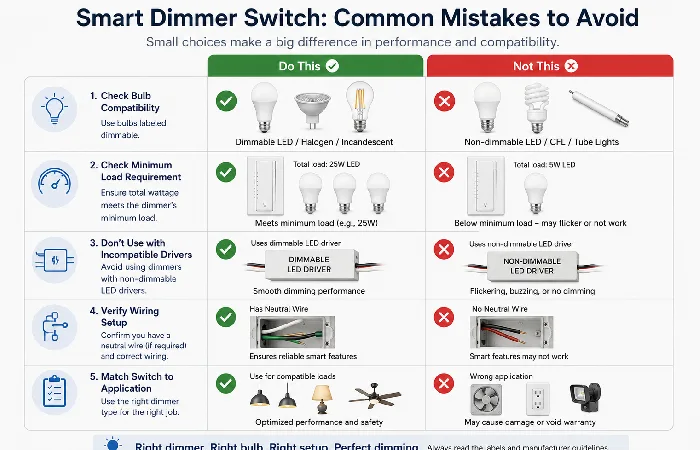
Without a doubt, the most easily prevented problem is not checking the type of bulb you need before purchasing. It is simple just to go to the website of the manufacturer and determine what the bulb will fit before purchasing.
For a more complete overview of smart switches without dimming capabilities, see our main smart switches for home guide.
FAQ — Smart Dimmer Switches
1. Do smart dimmer switches work with all LED bulbs?
Yes, they work with dimmable LED lights. But make sure your dimmable LED is compatible with your dimmer and check the dimmer manufacturer‘s compatibility list before buying. You should not use a non-dimmable LED.
2. Do I need a neutral wire for a smart dimmer switch?
Most Wi-Fi dimmer switches will require a neutral. If not, then you may be able to consider Lutron Caseta (uses their own bridge, so no neutral needed) or see Zigbee options such as Inovelli Blue (can be used without neutral under some loads). As well as different wiring conventions even within a country, check with installation instructions or an electrician before buying several.
3. Can I install a smart dimmer switch myself?
Yes, you are comfortable turning off a breaker and doing simple wiring (line, load, neutral, ground). The job will take 15–30 minutes per switch to install. If you‘re not comfortable, find a licensed electrician. Usually it‘s $50–$100 per switch for installation.
4. What’s the difference between a smart switch and a smart dimmer?
The smart switch offers switching, scheduling, and automation. The smart dimmer offers switching, scheduling, automation, and adjustable brightness levels on top of that. If you have a fixture that takes dimmable bulbs and you want dimming control, then have a dimmer.
5. Do smart dimmers save energy?
Sure. Dimming down to about 75 per cent of bulbs’ output can help you cut your lighting power bill roughly 20 per cent; intelligent controls can make a serious dent in your energy bill if used along with other time- and occupancy-based lighting controls. Dimming and occupancy sensors may carve a small slice from your lighting power bill, depending on your power (orbits, long vacation, you blasphemous, selfishness!) and bulb types.
6. Are smart dimmer switches compatible with ceiling fans?
No, most fan-speed controllers are built exclusively for fans. Do not use a dimmer with a fan as a matter of fact, using a dimmer with a fan motor may even overheat the motor itself. Instead, seek out dedicated smart fan controllers.
7. Which smart dimmer switch works best with Matter?
By mid-2026, Eve‘s Thread-based dimmer and Inovelli Blue (with Thread border router) are currently the most mature Matter support. Other brands have announced Matter support, but either announced via firmware update, or other delivery dates were not so concrete.