Published: July 26, 2026
Last Updated: August 31, 2026
Your car’s dead. Nobody’s around. That’s the moment this whole guide exists for, and it usually happens somewhere less convenient than your driveway.
A small jump starter that can fit in your glovebox can do that in less than two minutes no second car, no random person with jumper cables, no hour-long wait for the tow truck. Most gas motors need 400 to 600 peak amps. SUVs and larger gas engines are in the 1,000 to 2,000amp window. Diesels work at a higher range, in the 1,000 to 3,000+ rating, due to the compression ratios being nearly double on a diesel engine compared to a gas engine. Buy for your engine and the coldest weather you actually drive in, not the biggest number on the box. If you have what you need, skip the next section.
Quick answer: Most gas cars will start with 400-600 peak amps, SUVs and V8s with 1,000-2,000, diesels with 1000-3,000+ (higher compression). Match the jump starter to the engine size and coldest weather anticipated, not the largest number on the box.
Definition
The car jump starter is a portable power pack that provides a high current output of a short surge to the dead car battery. It is used by car drivers without another car to start an engine.
How many amps do you actually need to jump start a car?
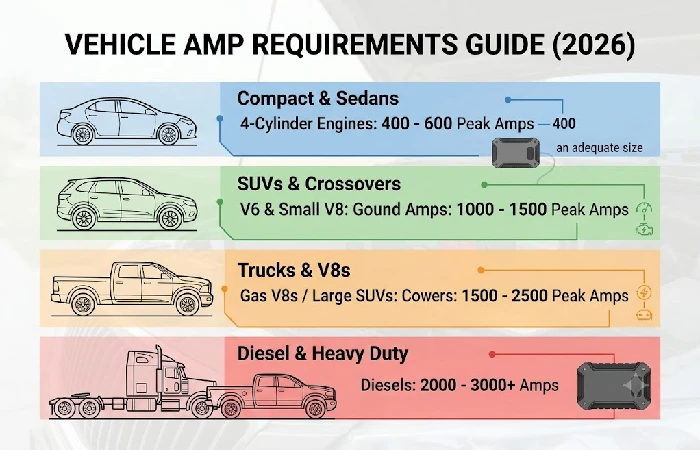
Most owners overpurchase or underpurchase here, and it really isn’t their fault. Amp ratings are displayed differently from one manufacturer to another, so a “2000A” sticker from one manufacturer isn’t equivalent to a “2000A” display from another. A 4-cylinder sedan may start on 400 amps. A V8 gas engine wants between 600 and 900. Diesel is a whole other game: start with 1,000 amps as a minimum, then figure between 2,000 and 3,000 if you want to deal with a full-size diesel truck.
Your car only pulls the amperage it needs. A 4,000 amp unit isn’t going to blow up a Civic, no it‘s just weight, and money you probably didn’t need to spend. The expensive mistake runs the other way. Buying too little, then finding out on the one morning it actually matters.
Peak amps vs cold cranking amps: the number that actually matters
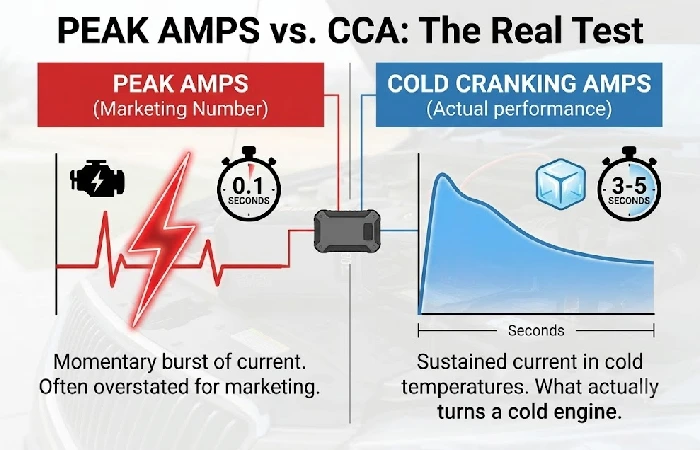
Peak amps is the dramatic number on each box. And it‘s almost irrelevant for whether your engine will turn over because it reports a spike of current in a fraction of a second.
What gets your engine turning over is sustained current of many seconds, which CCA is designed to measure. (Again, not a marketing number. SAE defines the exact test procedure batteries are rated to: be cooled to a set temperature and maintained at a minimum voltage for a specific time.). A jump starter with 4,000 peak amps might only have several hundred amps of sustained current after that initial momentary one. So, fine for a sedan that needs just a nudge. Not fine for a diesel cranking at 16:1 or higher compression for 3-5 seconds.
Some of the most important tests that every buying guide leaves out: if the panel on a product says maximum amps and never mentions cranking amps or continuous output. That’s two parts of the spec sheet you should pay attention to before you pay the price, not always a word that makes or kills a gift decision, but a prompt to look elsewhere for info first.
Jump starter sizing by vehicle type
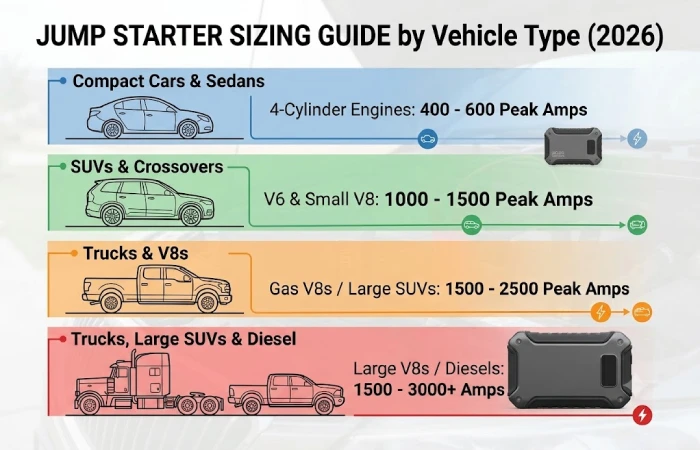
Match the purchase with the actual vehicle, rather than making a lot of guesses.
Motorcycles and small sedans work well with 400 to 800 peak amps. Keep it simple here, something that slides nicely into your saddlebag or glove box without you knowing it’s there.
The more common 6-cylinder crossovers and SUVS tend to require anywhere from 1,000 – 1,500 amps. This is the range that most general–use jump starters available today are designed for and will cover the majority of daily drivers in range with little effort.
Gas trucks and V8s will do that to 1,500– 2,500. Even higher if the truck is pulling a lot or the battery is a few years old.
Diesel trucks and heavy-duty engines need 2,000 to 3,000+ amps, and a unit that states diesel compatibility directly. Not a high peak-amp number with diesel assumed. If you’re setting up your car with other gear worth having on hand, our guide to must-have car gadgets covers what else earns a spot in the trunk.
Diesel engines need more than you think
Diesel engines are about twice the compression of a normal gas motor, which is why it is a separate category here in our engine guide, and not just a footnote away in the primer. The starter has to work more and more for a longer period just to get started and a regular old jumper pack that will fire up any run-of-the-mill gas economy sedan can sometimes fall way short on a diesel pickup; even though the peak-amp number on the box looks the same.
Buy for diesel compatibility only. Never assume a high peak-amp rating suffices just because it sounds impressive. Search for an actual stated diesel displacement rating on the product also, not just an inferred one.
Cold weather changes the math
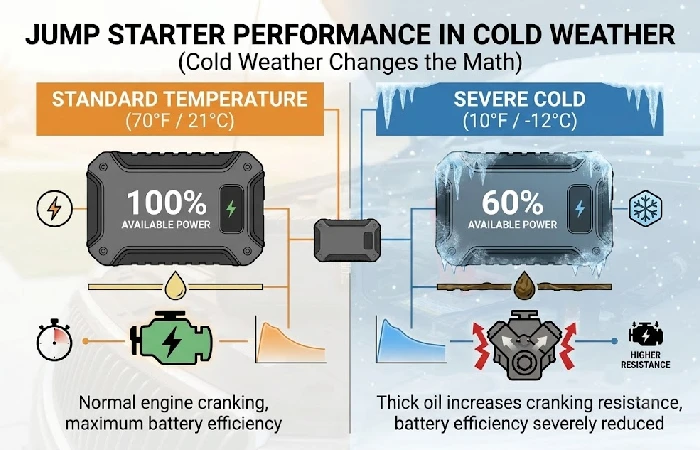
This is the step nearly all buying guides leave out, and it’s when you need the item most. Cold thickens engine oil, so the starter motor has to work harder to turn the engine over. Cold also drags down a battery’s own chemical efficiency, which is why a battery that struggled through summer can conk out entirely when winter arrives. CCA ratings are for this reason. Battery University reports that a battery’s actual cold weather output can’t be read directly from the label, only estimated, as a complete test at freezing point takes a little under a week for each individual battery and isn’t usually carried out.
If you predominantly take your craft to genuinely frozen locations, purchase far higher than the published minimum for your vehicle. Not right at it. A unit that’s technically enough at 70°F can struggle at 10°F, and lithium jump starters have some of their own capacity reduced in severe cold, so keeping the unit somewhere that doesn’t freeze solid for weeks on end means more than people think.
Lithium-ion vs sealed lead-acid: which one to buy
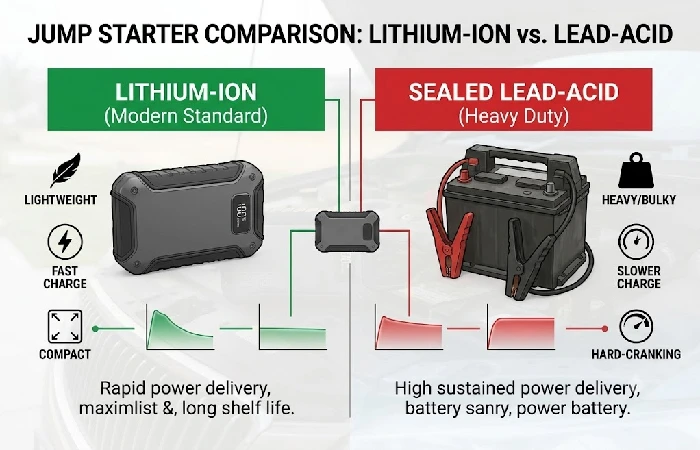
Get lithium-ion. For nearly everybody out there reading this, this is the decision you can make, period.
Lighter, maintains its charge for months with practically no drain, and can be recharged in 1–3 hours over USB-C. Sealed Lead-Acid units are overall much heavier and more bulky but do one thing lithium really can’t do: provide sustained, hard-cranking power for a long-sitting engine or one that is resisting cold, dense oil. If you have a unit living in a home garage rather than a car, and you’re occasionally having to crank an old machine that needs a few seconds of time to get going, lead-acid makes more sense. Everyone else, lithium.
Jump starter and power bank combos worth considering
Fast charging on USB-C was a luxury, but almost standard these days even in middle of the range models, and most ships are between 60-65 watts, which is pretty fast if you need to speed up a phone, or want to keep the laptop topped up once you’re stuck somewhere.
Require one unit to serve as both a portable jump starter as well as an emergency charger? A USB-C output of more than 45W, coupled with a battery of more than 40 Wh should meet the need. Less capacity could be used up far too quickly by continuous device recharging rather than during a jump.
Top picks by use case
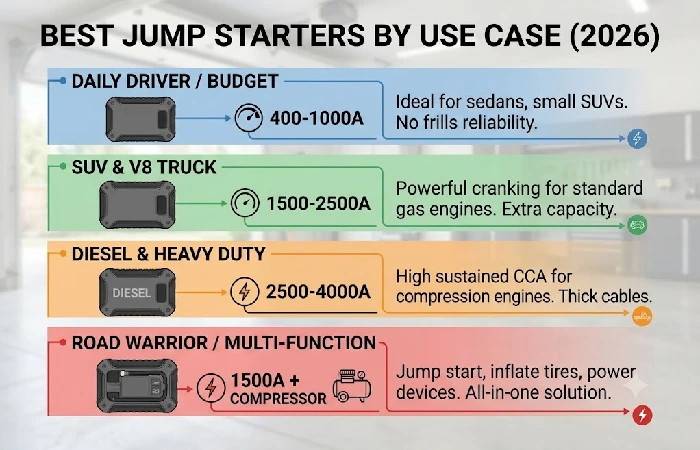
Most drivers will find a lithium-ion jump starter within the 1,000 to 2,000 peak-amp range, with USB-C charging, and bring along a storage case. Covers sedans, SUVs, most crossovers, no wasted potential.
Diesel truck or a larger V8? Go larger. Search for a model marked as diesel capable, commonly 2,000 amps and higher, and be prepared to spend more for it. The extra cranking power and thicker wires needed to make a diesel capable unit actually work cost money.
Dealing with low tire pressure often, not just occasionally? A combo unit with a built-in air compressor is worth the extra bulk. One single piece of equipment rather than two in the trunk.
Tight budget? Still want something reliable? An 800 to 1,000 amp lithium-ion unit will be sufficient for most passenger vehicles, however, remember that it won’t have the margin diesel owners or cold-climate drivers need. Be sure you know where you fit before you decide the smaller unit is “good enough.”
Buying in India: pricing and availability
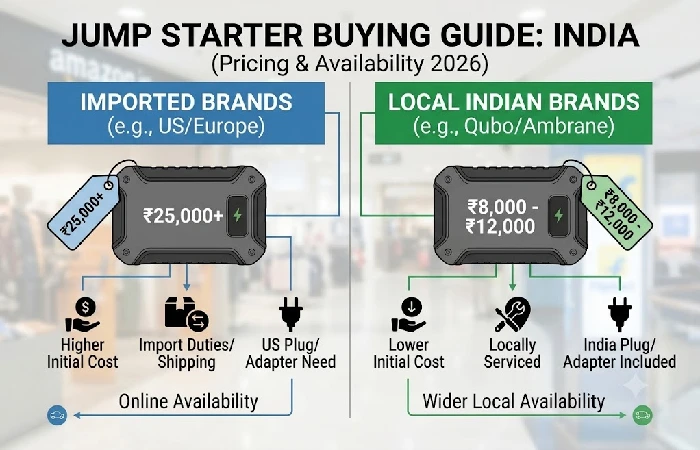
Availability is also different in this part of the world than in the States. Many international brands sell on Indian e-commerce sites but their pricing remains quite a bit above US list prices when added on import duty and shipping charges. India/ locally available brands specific to the country and listed here actually have the same amp ratings at a far lower cost which is worth a comparison rather than assuming the imported name wins hands down!
The charging cable and the included (if any) adapter should be verified prior to purchase. Some imported units come equipped with only US power plugs, leading to the requirement of buying an additional USB-C cable just to use the device locally.
How to use a jump starter safely
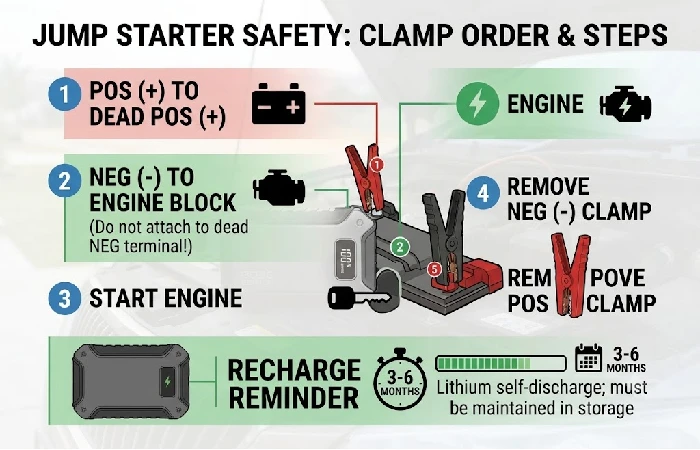
This is where the sequence is critical. Attach the positive clamp to the positive terminal of the dead battery. Attach the negative clamp to an unpainted metal surface of the engine block, avoiding the negative terminal of the dead battery as it will cause sparks. Turn on the unit and try to start the engine, then disconnect in reverse sequence with the engine running.
Recharge every three to six months, whether used or not. Lithium self-discharge when stored; it‘s of no value to you when your jump starter sits dead in your trunk for a year and can’t help you in your time of need. Pointless, in other words.
FAQ
1. Is a jump starter the same as a battery charger?
No. A jump-starter is only meant to give your engine a temporary shot of power to start it now. A battery charger needs hours of time to gradually recharge your battery and will not get you out of a jam right away.
2. What’s the real difference between peak amps and cold cranking amps?
Peak amps is a marketing number a split second burst. Cold cranking amps measure a long tapering onset over several seconds, which seems to match up pretty well with what actually cranks an engine.
3. How many amps do I need for my car?
Gas cars, 400–600. SUVs and trucks, 1,000–2,000. Diesel, 1,000–3,000+, depending on size and how cold it gets where you drive.
4. Can a jump starter have too many amps for a small car?
No, because your car will only use as much capacity as it needs, so a bigger one just sits there unused, which won’t do any harm.
5. Do diesel engines actually need a bigger jump starter, or is that overstated?
It’s not exaggerated. A diesel engine’s roughly double compression ratio translates directly into needing more sustained cranking power, typically 1,000 to 3,000+ amps versus 400 to 900 for most gas engines.
6. How many jump starts before I need to recharge?
Depends on the battery, but 8 to 20 jump starts per full charge is typical for lithium-ion units under normal conditions.
7. How often should I recharge it in storage?
Every 3-6 months. Lithium batteries drain power slowly while sitting idle, so don’t assume it’s fine if you haven’t used it.