Published: June 4, 2026
Last Updated: August 31, 2026
A delivery disappears from your front porch in the middle of Tuesday afternoon. Your neighbor‘s car window is shot out on a Monday morning. And you‘re still relying on a deadbolt installed before the days of streaming.
That space between maybe-what‘s possible, and maybe-what’s adequate? That‘s where home security devices step in. Not the wallet-draining, contract-forced, professionally-monitored things your folks signed up for. Today‘s kids: intelligent video-cameras that identify your face, door-bells that cruise tractors to deliver tea, front-doors you manage on your tablet, and alarms you‘ll be notified of the second a window is entered.
These are the home security gizmos that are actually worth your time in 2026. We will include category overviews, hand-picked suggestions, budget level options, and genuine impressions on subscriptions, compatibility, and other details most reviews miss.
Why Home Security Gadgets Matter More Than Ever
What the Break-in Data Actually Shows
Here‘s an interesting statistic: the FBI’s Crime Data Explorer indicates there were several hundred thousand burglaries in the US in 2023 alone,, and all of those burglaries likely happened when people were at work during the day, according to the published FBI crime data. The rate of burglaries reported has been falling over the last ten years, a trend experts typically dismiss as being related to better home security, economic conditions, policing tactics, etc. Rather than smart devices.
It’s not just cameras. Visible security gadgets act as deterrents. A study by the University of North Carolina at Charlotte’s Department of Criminal Justice and Criminology found that many surveyed convicted burglars reported avoiding homes when they noticed alarm systems or visible security measures, suggesting that clearly visible devices can act as deterrents.
The point isn’t to scare you. It’s that a few well-placed gadgets shift the odds meaningfully.
How Smart Security Has Changed Since 2024
Until mid-2024, the most common thing was that most basic home security cameras would require a monthly subscription to the cloud for a function that could really be considered standard, like longer video history, smarter detection, etc. As of 2026, this is decreasing as many more cameras are getting both a local and on-device capability. Since there is on-device AI, which (mostly if not exclusively) runs locally, you have some form of person detection, package detection, and even pet filtering without sending it to the cloud. Smart home device support across brands has been a problem, so the Matter standard for smart home devices was created. As of mid-2026, more devices support Matter, although it actually varies significantly with the exact model that you purchase, the firmware version that it has, or the platform you are using.
Battery life has improved as well. Many newer battery-powered outdoor cameras advertise multi-month battery life under normal usage, and optional solar panel accessories may reduce the frequency of manual recharge if properly installed and adjusted.
The 6 Categories of Home Security Gadgets You Should Know
Not all homes will need all categories. But being familiar with the options enables you to decide which ones are right for your home.
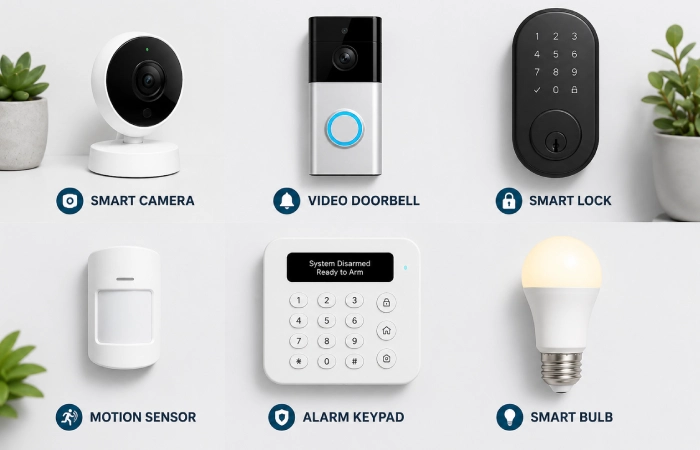
Smart Security Cameras (Indoor and Outdoor)
These are the foundations of any setup. Outdoor cameras monitor your garden, driveway or porch. Indoor cameras oversee your entrance, corridors or protected room.
What to expect in 2026: 2K resolution, color night vision (not IR), person/vehicle/animal detection on the device itself, 2-way audio. For those worried about privacy, look for ones with local storage (microSD or base station) so recordings won‘t be stored on someone else‘s servers.
Video Doorbells
Most package thefts and forced entries occur at your front door. A video doorbell will give you a live video feed, two-way audio, and motion-activated video recordings. Some are now equipped with a radar motion sensor that is much more accurate than the old PIR sensors.
Think about this for a second: if you‘ve got to pick between a doorbell camera and a dedicated outdoor, single device camera, often the doorbell is the better choice.
Smart Locks
Smart locks sit on top of or replace your deadbolt. You unlock by using your finger, a PIN, your phone, or your voice assistant. The top models will auto-lock after you leave and allow you to generate temporary access codes for visitors or delivery folks.
Are they secure? The honest answer is that a decent smart lock is slightly more difficult to pick than a standard deadbolt. The threat isn‘t anyone hacking the Bluetooth signal (which is mostly theoretical). The real threat is a weak PIN or forgetting to enable auto-lock.
Motion and Entry Sensors
They are small, inexpensive and easy to miss: window and door sensors let you know when something is opened; motion sensors monitor a room or hallway; these are the “gadgets” that turn a string of cameras into a security system, sending recordings and alerts from other devices.
Smart Alarm Systems
DIY alarm kits (SimpliSafe, Ring Alarm, Cove) come with a base station, sensors, a keypad, and optional monitoring for 1020/month. The leap from getting “a handful of cameras” to “your entire house protected” is less (though still pretty significant) than it used to be. These generally take less than an hour to install.
Smart Lighting as a Security Layer
This one gets overlooked. Using smart lighting (bulbs and switches) with motion sensors, timers, or geofencing algorithms means that even when no one‘s home, it appears as if someone is. Having your porch light come on when it detects someone‘s footsteps at night can be a very cheap way of frightening away intruders. If you‘ve already jumped into smart switches for home automation, security-related lighting is just as easy to set up.
Best Home Security Gadgets for 2026 (By Category)
Top Picks for Security Cameras
As home security has an impact on your safety and property, feel free to check on the manufacturer‘s official website all gadgets specifications, local regulations and warranty details before you decide to purchase or install any system.
| Camera |
Best For |
Resolution |
Local Storage |
Subscription Needed? |
Approx. Price |
| Arlo Pro 5S 2K |
Overall outdoor |
2K HDR |
Yes (USB) |
Optional (Arlo Secure, ~$8/mo) |
$200 |
| Google Nest Cam (Battery) |
Google ecosystem |
1080p |
No (cloud only) |
Yes for history (Nest Aware, ~$8/mo) |
$150 |
| Eufy SoloCam S340 |
No subscription |
3K dual-lens |
Yes (built-in 8GB) |
No |
$200 |
| Tapo C425 |
Budget pick |
2K |
Yes (microSD) |
No |
$70 |
| Ring Stick Up Cam Pro |
Ring/Alexa ecosystem |
1080p HDR |
No |
Yes (Ring Protect, ~$4/mo) |
$130 |
Quick take: If avoiding a monthly fee is important and you haven‘t invested in one of these other ecosystems, Eufy and Tapo are currently the best options. If you‘re committed to Google or Alexa, Nest and Ring are better integrated with your current environment.
Top Picks for Video Doorbells
The Ring Battery Doorbell Plus (150) and the Google Nest Doorbell(Battery,130) still remain the default recommendation for their respective platforms.
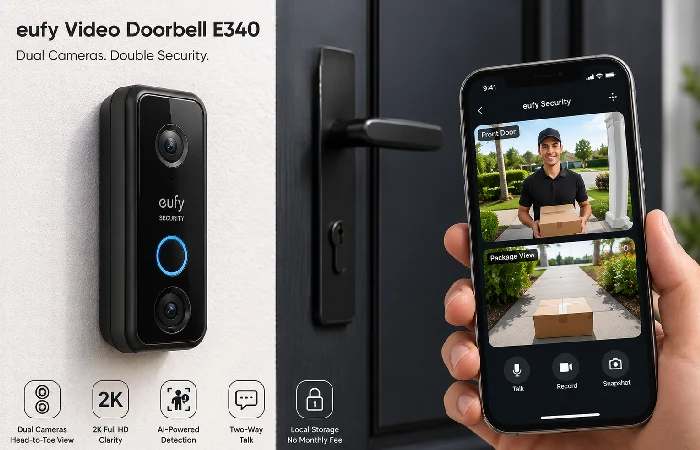
However, the Eufy Video Doorbell E340 ($180) stood out having two cameras (front-facing + downward-angled for packages), 2K resolution and no subscription fees & local storage.
In India, the Qubo Smart Doorbell (on the order of 5,000) is one of only a handful of smart doorbells with local support and Hindi language alerts.
Top Picks for Smart Locks
The August Wi-Fi Smart Lock (4th Gen) is still great because it clips on top of your existing deadbolt, so you don‘t give up your physical keys. Get the Schlage Encode Plus if you want Apple Home Key support (unlock with Apple Watch or iPhone). The Yale Linus L2 is a native HomeKit lock here in the UK, with a slick European-compatible appearance.
For renters: the August retrofit design is ideal because you remove it when you move out without leaving a mark.
How to Build a Home Security Stack on Any Budget
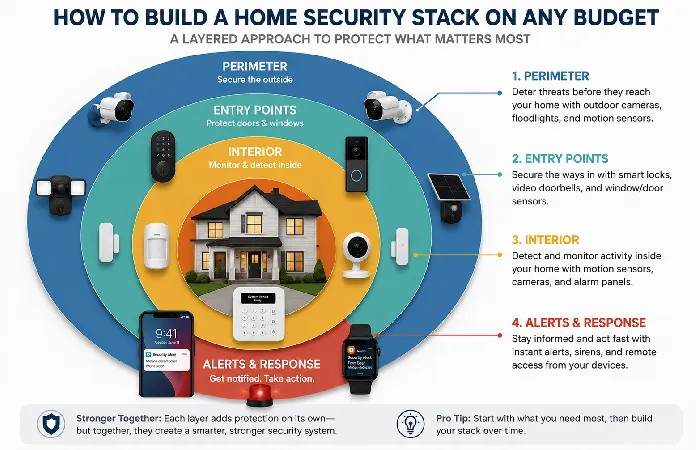
Imagine home security as layered. You‘re not buying tools that want to sneak in. You‘re covering zones.
- Layer 1 — Perimeter: Smart lighting. Outdoor cameras
- Layer 2 — Entry Points: Door/Window sensors, Video doorbell, Smart lock,
- Layer 3 — Interior: Motion sensors, Indoor camera, Motion sensors
- Layer 4 — Alerts: Alarm base station, phone notifications, and optional professional monitoring.
The $100 Starter Stack
- 1x Tapo C425 outdoor camera ($70)
- 1x Tapo smart plug + lamp for automated lighting ($15)
- 1x Window/door sensor pack ($15)
This is your online front entrance with a camera, which gives you some simple lighting automation and notifies you if a door or window is opened. It‘s a little stripped down, but it really does work.
The $300 Mid-Range Stack
- 1x Eufy Video Doorbell E340 ($180)
- 1x Eufy Indoor Cam S350 ($60)
- 1x Smart lock (August 4th Gen, ~$50 refurbished)
- 1x Door/window sensor kit ($15)
Now you’ve got entry-point coverage, interior monitoring, keyless access, and contact sensors. No subscriptions needed.
See the budget gadgets roundup for more information on additional fair-sized budget picks for your home tech.
The $500+ Full Coverage Stack
- 1x Ring Alarm Pro kit with base station, sensors, keypad ($300)
- 1x Ring Stick Up Cam Pro for outdoor ($130)
- 1x Ring Video Doorbell Plus ($100)
- Ring Protect Plus subscription ($20/mo for all devices, includes cellular backup + professional monitoring)
Full-system setup with professional monitoring, cellular backup (yes, that will work if your Wi-Fi is out), and recording to the cloud on every device. The yearly fee tacks on another $240/year, so just something to consider.
Subscription Plans vs. Local Storage — What’s Worth Paying For?
Here’s the honest breakdown.
Subscriptions are worth it if:
- You want video history beyond 24-48 hours
- You want professional monitoring (someone calls the police for you)
- You want cellular backup so your system works during power or internet outages
- You have 3+ cameras and want centralized cloud storage
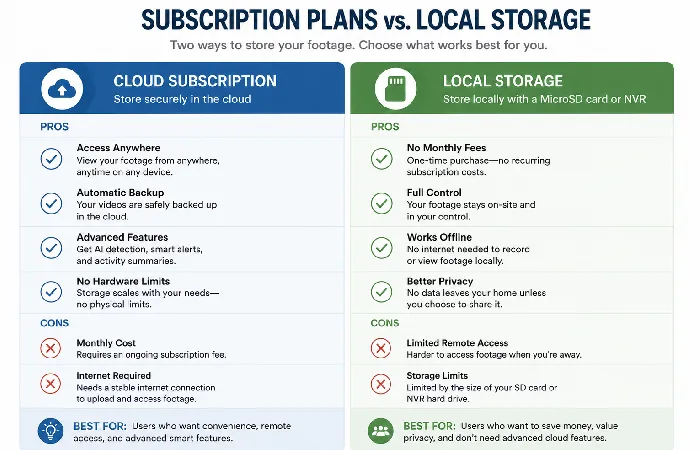
Local storage is worth it if:
- You’re privacy-focused and don’t want footage on a company’s servers
- You only have 1-2 cameras
- You’re on a tight budget and don’t want recurring costs
- You’re okay with checking a microSD card or NVR manually
The middle ground? Eufy’s HomeBase systems and Reolink NVRs offer local recording with app access, so you get remote viewing without cloud fees. That’s where a lot of informed buyers are landing as of mid-2026.
Common Mistakes People Make With Home Security Gadgets
Buying Gadgets That Don’t Work Together
You hear this constantly in community forums. Someone purchases a Ring doorbell, Google Nest camera and Apple HomeKit lock and can‘t get any of them to talk to each other or work together. Decide which ecosystem you want to buy into, or pair Matter-enabled devices to cover multiple ecosystems.
Ignoring Wi-Fi Dead Zones and Power Backup
Your outdoor camera is pointless if it is 40ft from your router through 2 walls. A 2025 study by Parks Associates identified connectivity as the number one reason consumers get rid of smart home devices within a year. Make sure you buy a mesh Wi-Fi system, or at least check signal strength at each of the locations you‘re considering for cameras.
Now, consider a power outage. Many Wi-Fi cameras will stop recording when the internet goes down. If you live in an area where the power isn‘t always steady, buy a system with a cell backup or a UPS (uninterrupted power supply) for your router and base station.
Notification Fatigue and How to Fix It
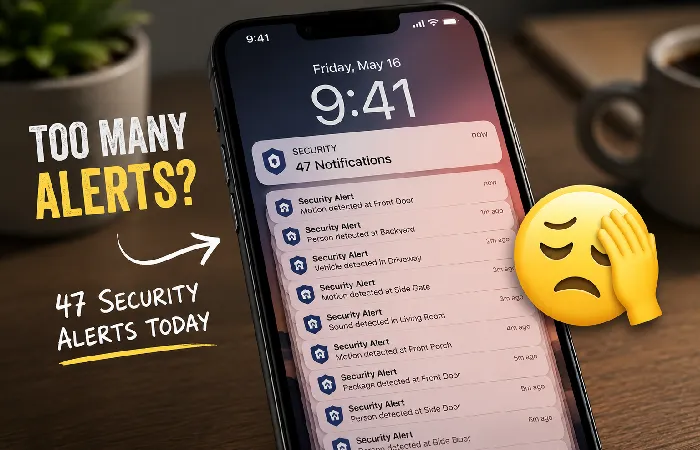
Here‘s what you know if you‘ve ever had a very basic motion camera. You get 47 alerts in a single day because a tree branch moved, a car passed, and a cat crossed the driveway. A week goes by, and you now ignore all the alerts.
Solve it by having detection zones (drawing a box around the area you actually care about), person-only detection (most 2026 cameras have this) and scheduled alert times (no alert when you are at home). It takes 10 minutes to set up and turns it from a nightmare to effective.
Renter-Friendly Home Security Gadgets (No Drilling Required)
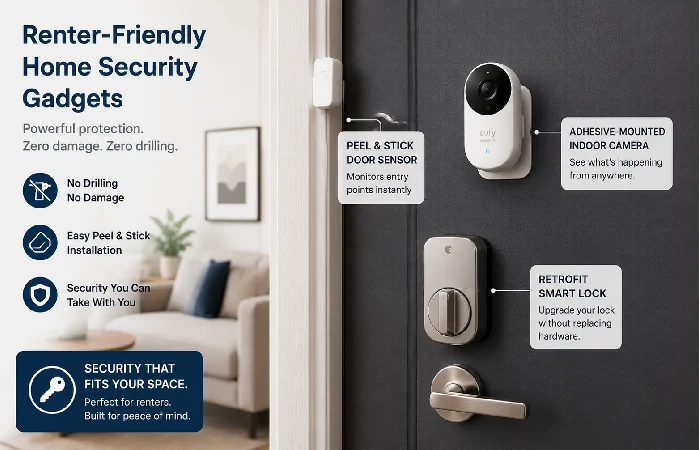
If you‘re renting, you probably can‘t just drill into door frames or exterior walls. However, all is not lost; there are more options for renters than you may think.
- Battery-powered cameras (Arlo, Ring Stick Up, Eufy SoloCam) mount with adhesive or magnetic mounts
- Retrofit smart locks (August) install over existing deadbolts with no modifications
- Peel-and-stick sensors (Ring, Samsung SmartThings) need zero tools
- Portable alarm base stations (SimpliSafe, Ring Alarm) sit on a shelf or table
It all goes with you when your lease is up. No holes to deal with, no confrontations with the landlord.
Regional Picks — US, UK, and India
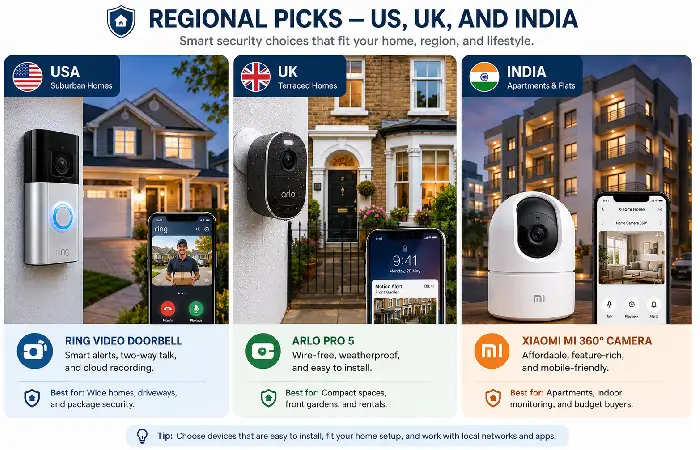
Security gadget availability varies more than most guides acknowledge.
- US: The widest selection. Ring, Arlo, Nest, Eufy, SimpliSafe, Wyze, all supported with same-day shipping, local support when you need it, and the most competitive prices there are.
- UK: Ring and Nest are widely available. Yale is the dominant smart lock brand (with HomeKit support). Eufy is strong here, too. SimpliSafe was launched in the UK market in 2024. It‘s taking off. Ensure that any product that is marketed within the U.S. supports UK plug standards and frequency bands.
- India: The market is more limited but growing fast. Qubo (by Hero Group) offers affordable cameras and doorbells with local cloud servers. Mi Home Security Camera 360° is popular for indoor use. Godrej offers smart locks designed for Indian door standards. For cameras, Tapo and Imou provide strong budget options available on Amazon India and Flipkart.
What’s Coming Next in Home Security Tech
Matter protocol adoption is the biggest shift to watch. By late 2026, we’ll likely see the first truly cross-ecosystem security systems where a Google camera triggers a Yale lock and an Apple notification in the same automation, without hacks or third-party bridges.
The on-device AI is becoming more intelligent. You will soon see cameras that can differentiate a pizza delivery rider from a burglar, or identify members of your family and notify you only if there are unknown visitors.
Radar-based sensing (already in some Ring and Nest units) will become more common, as cameras will be able to sense movement through windows and in total darkness without infrared illumination.
And a trend to be aware of in the smart gadgets arena in general: security is being integrated into non-security devices. Smart speakers that utilize ultrasonic presence detection (such as the Amazon Echo Hub) function as a motion sensor by themselves.
Frequently Asked Questions
1. What are the must-have home security gadgets for beginners?
Begin with one video doorbell and one outdoor camera. They will cover your biggest threat areas – the front door and perimeter – and maximize impact for dollars spent. When you‘re ready, include a smart lock and door sensors.
2. Do home security gadgets work without Wi-Fi?
The smart security devices that require WiFi to alert and preview images while away are limited. Many of the smart devices are reliant on 4g LTE for cellular connectivity (Reolink Go Plus, Arlo Go 2). Many of the cellular backup options that stand alone will still be operating when the power goes out.
3. Which home security gadgets don’t require a subscription?
Eufy, Tapo, and Reolink are the best no-subscription brands. They have local storage to microSD or Base Station, accessible over the app. You lose long-term cloud history but retain complete core features.
4. Are smart locks safe enough for home security?
Yes. Current smart locks encrypt with AES-128 or AES-256, and most have a mechanical keyhole for backup. The more likely point of failure is using an easy-access PIN (don‘t use 1234) or leaking the code to friends. Picking a smart deadbolt is usually more difficult than picking a standard lock.
5. Can renters use home security gadgets?
Certainly. Battery-operated cameras, sticky-mount sensors, and retrofit smart locks don‘t require drilling at all. And they can be taken with you when you move.
6. What’s the best ecosystem for home security — Alexa, Google, or Apple?
Totally depends on your devices. If you have Echo speakers, Ring connects very well. If you have Nest speakers and Chromecast, it works better with Google. Apple HomeKit is more privacy-centric, but has even less camera selection. Matter-compatible hardware is starting to connect the three.
7. How much do home security subscriptions cost per month?
Ring Protect Basic starts at 4/monthperdevice.NestAwareis8/month. Arlo Secure is 8/month.Full-home plans with professional monitoring typically run $20-25/month. Over a year,that′s48 to $300, depending on your plan.
The right home security devices don‘t merely note what went wrong. They alter what takes place in the first place. A clearly visible camera on your porch, a smart lock that auto-bolts behind you, a sensor that buzzes your smartphone when a window goes up at 3 a.m. These aren‘t fancy stuff anymore. They‘re the default for peace of mind in 2026.
If you’re building out your connected home beyond security, the full home gadgets hub covers everything from kitchen tech to smart switches. And if you want more recommendations that won’t break the bank, the budget gadgets roundup is a good next stop.