Published: June 5, 2026
Last Updated: August 31, 2026
The average person is in their bedroom roughly 1/3 of their lives. And if you‘re like most people, you‘d probably agree that you have put much more thought into the case on the back of your phone than the space where your body actually heals.
That‘s beginning to change. By the mid-2020s, industry estimates said the broader sleep and bedroom comfort tech market was already a global worth several billion dollars and growing, based on an obvious insight: tiny environmental adjustments, the right glows, the right degree of cool, the right noise can pile up into sleep that‘s not just good, but fantastically so.
This guide will help you identify the best available bedroom and comfort gadgets now, categorised by use-case and price. Most crucially, it provides an approach for integrating these into a holistic sleeping system and not simply accumulating a pile of unconnected devices. It uses available product reviews, community chatter via Reddit and sleep-focused forums, and extensive long-term user declarations to serve up gadgets that will actually be used beyond the initial trial period
The information and recommendations here are based on published research (ideally mostly from June 2026), established health authority sources, and community wisdom as of June 2026. The area of focus in most detail here is on sleep environment elements such as temperature, light exposure, and noise. Be sure to verify by the current product pages and medical recommendations before making serious health decisions.
If you‘re interested in looking at it from a more global perspective of home gadgets, this is the in-depth review of the bedroom genre.
Summary
Bedroom and comfort devices now integrate sleep monitoring, intelligent lighting, modulation of heat and cold, and sound therapy into more affordable solutions that can significantly enhance sleep quality as long as you have a real issue to overcome. Here is our list of the best products for 2026, what to look for so you spend wisely, and how to choose a bedroom technology suite suited to your personal sleeping habits.
Why Your Bedroom Setup Matters More Than You Think
Here‘s a statistic that ought to scare you: CDC sleep statistics show that well over a third of Americans knowingly get less than the minimum recommended amount of sleep every night (that‘s seven). That‘s not a comfort; that‘s a health concern.
Poor sleep links to everything from weight gain to reduced cognitive performance to weakened immunity. You already know this. What‘s not so clear, though, is how much your environment in the bedroom plays a role, regardless of behaviors like residual caffeine or lingering exposure to computer screens.
The Cost of Bad Sleep (and How Gadgets Can Help)
Temperature is one of the biggest factors in sleep disturbance. As shown by the National Institutes of Health, lower ambient temperatures can alter sleep latency (the time that it takes to doze off) and majorly impact the structure of sleep. An utterly warm room dampens insulin sleep stages.
Light is one of these things. Research has shown that even modest amounts of light levels in the night (e.g., LED standby lights, streetlight spillage) affect melatonin cycles and change normal sleep.
These gadgets won‘t make miracles. But they will help overcome certain specific, scientifically proven factors relating to the environment. That‘s their value. Nothing magical, just physics in your bedroom.
The Bedroom Comfort Stack: A Framework for Choosing Gadgets
The typical consumer of bedroom gadgets is a bottom-up buyer. They will see some sensational TikTok, buy the crazy gadget, test it for a week, and then put it away. Sound familiar?
A better approach: think in layers.
Foundation Layer (Physical Comfort)
This is your mattress-in-the-mouth technology. Cooling pads, smart pillows, and a weighted blanket that keeps the temperature down. These are the products that make contact with your body‘s surface and provide the most noticeable comfort effects.
Start here if you wake up hot, cold, or physically uncomfortable.
Environment Layer (Light, Sound, Air)
This controls what your senses experience. Smart lighting that dims on a circadian schedule. Sound machines that mask disruptions. Air purifiers to eliminate allergens in your bedroom.
Start here if you have trouble falling asleep or waking up congested.
Intelligence Layer (Tracking and Automation)
This is the ‘know thyself’ layer. Sleep trackers (wearable, or under-mattress), smart routines that set off your environment layer automatically, and AI sleep coaching.
Start here if you’re unsure what’s actually disrupting your sleep.
The main insight: You don‘t have to have all three layers to get results. But combining two layers tends to create a compounding effect that single gadgets can’t match.
For those interested in how artificial intelligence plays into these systems, our guide on AI-powered gadgets covers the broader category.
Smart Sleep Trackers Worth Your Attention
Sleep trackers have changed dramatically since 2024. The gap between consumer sleep trackers and a clinical level recording has become much narrower, especially among newer non-contact devices.
Contact vs. Non-Contact Trackers
Contact trackers (rings, wristbands, watches, etc.) make more direct measurements of changes in heart rate variability, blood oxygen levels, skin temperature, and movement. While giving more accurate sleep staging information, they do require you to wear something.
Non-contact trackers (under-mattress pads, bedside radar sensors) detect breathing or movement without any contact. They’ve gotten remarkably good. The Withings Sleep Analyzer and Google Nest Hub’s Soli radar both detect sleep stages with reasonable accuracy now, and you never have to charge them.
The trade-off: Contact trackers give you daytime data too (stress, activity). Non-contact trackers are invisible and zero-maintenance but only work in bed.
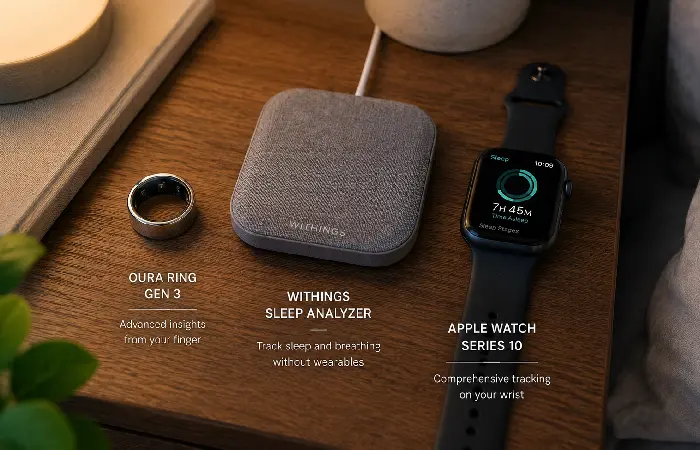
Top Picks for 2026
| Device |
Type |
Key Strength |
Price Range |
Best For |
| Oura Ring Gen 4 |
Contact (ring) |
Sleep staging + daytime readiness |
$299–$399 |
People who want 24/7 data |
| Withings Sleep Analyzer |
Non-contact (under-mattress) |
Set-and-forget, medical-grade snoring detection |
$129 |
Those who hate wearing devices |
| Apple Watch Ultra 2 |
Contact (wrist) |
Ecosystem integration |
$749+ |
Existing Apple users |
| Eight Sleep Pod 4 |
Non-contact + climate |
Integrates tracking and cooling/heating
|
$2,049+ |
Serious sleep optimizers |
| Amazfit GTR 4 |
Contact (wrist) |
Decent accuracy, Budget-friendly |
$149 |
Budget-conscious buyers |
Users consistently report that the biggest factor isn’t the accuracy differences between trackers. It’s whether you’ll actually check the data. A $129 under-mattress pad you ignore is worth less than a $299 ring that becomes part of your morning routine.
Smart Lighting That Actually Improves Sleep
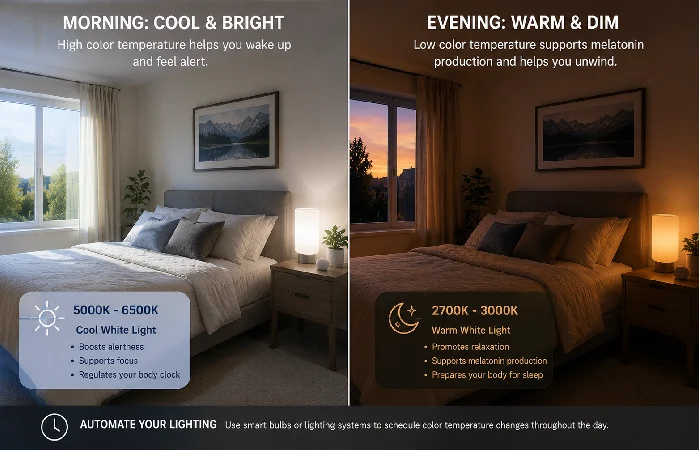
Most “smart bulbs” enable the user to change the colour temperature of the light through a phone/tablet. This is not the kind of sleep-enhanced lighting we‘re referring to. Instead, it mimics the changing colour temperature of the sun throughout the day.
Circadian Lighting Systems
Your body uses light colour and intensity as its primary clock-setting signal. Cool, bright light in the morning signals alertness. Warm, dim light in the evening signals melatonin production.
Circadian smart lighting automates this shift. The Philips Hue system, paired with the Hue app’s “Natural Light” scene, does this well. So does the Nanoleaf Skylight, which integrates circadian scheduling directly into ceiling panels.
The difference between “smart bulb that can turn orange” and “circadian lighting system” is automation. You shouldn’t have to remember to change your lights. The system handles it.
Sunset and Sunrise Simulation
Alarm clocks that simulate sunrise have been available for many years, but the models in 2025–2026 are a noticeable improvement. The Lumie Bodyclock Shine 300 and the Philips SmartSleep Wake-Up Light HF3520 both simulate sunrise over a half-hour period that users say is “life-changing for dark winters.
For the UK and northern India (where winter mornings are dark), sunrise simulation gadgets tend to make an outsized difference compared to sunnier regions.
Climate Control Gadgets for Bedroom Comfort
Temperature might be the single most impactful variable for sleep quality that people underinvest in. Your body needs to drop about 1–2°F in core temperature to initiate sleep. If your bedroom fights that process, everything else suffers.
Cooling and Heating Mattress Pads
In 2026, the Eight Sleep Pod (marked now that it has a fourth generation) is considered in reviews and forums as the best offer in this. It pumps water through a pad layer and cools or warms each side of the bed separately. It‘s expensive. And it‘s the gadget that committed wearers argue most fiercely about on forums.
Budget alternative: the BedJet 3.5 uses directed airflow rather than water circulation. It’s less precise but significantly cheaper ($449 vs. $2,000+), and reviewers from warmer climates (India, southern US) often prefer it during summer months.
Here’s the thing. You don’t necessarily need a $2,000 mattress pad. A good bedroom fan with a timer, combined with breathable sheets, can get you a large share of the comfort benefits at a fraction of the cost.
The premium gadgets help to even out the last 40%, which is the most important for hot sleepers or for those sharing a bed with a thermally incompatible partner.
Smart Thermostats and Fans
One can program the temperature of the bedroom in a distinct way from the temperature in the rest of the house with the use of the Ecobee Smart Thermostat Premium or Google Nest Learning Thermostat. The temperature of the bedroom could be, for instance, set at 65 degrees F (18 degrees C) when you want to go to sleep, and then increased by 1 degree per hour before awakening. The different cue various mechanisms can use during the deep sleep stage to increase sleep quality, which can be achieved mainly by sleeping more, can lead to a higher increase in the length of life.
Smart fans like the Dyson Purifier Big Quiet+ combine air purification with adjustable airflow and can be scheduled or triggered by room temperature sensors.
Sound and Relaxation Devices
Noise is the sleep disruptor that many people feel they “get used to” mentally, even though their brain can still register sounds during the night and fragment normal sleep patterns. Your brain still registers disruptions even when you don’t consciously wake up. They fragment sleep architecture.
White Noise vs. Pink Noise vs. Adaptive Sound
White noise (constant energy distribution over frequency) is a powerful masker, but some people find it “harsh” to their ears. Pink noise (a more natural sound with a deeper tone, more natural, similar to rainfall) offers promising results for the enhancement of sleep in older people. Some adaptive sound machines (Hatch Restore 2, Adaptive Sound Technologies LectroFan) mix the two approaches.
From community comments on sleep-related subreddits, forums, etc. that we found in early 2026, the most liked recommendation seems to be: pink noise at first if sensitive to noise; if you want to mask out (certain sounds, traffic, snoring partner); and adaptive if your noise environment is constantly changing.
Best Picks Under $100
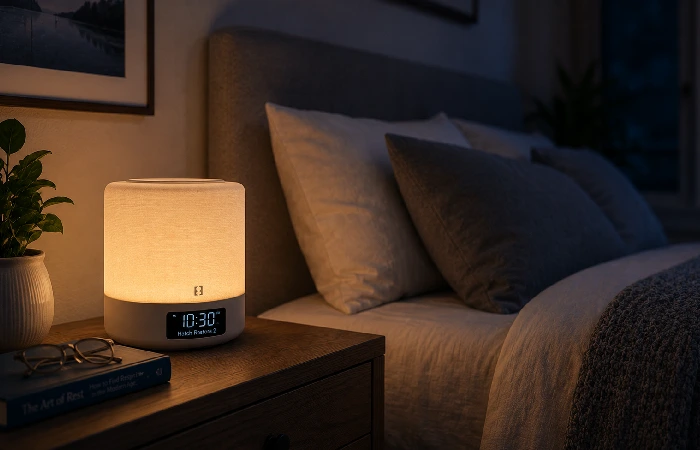
- Hatch Restore 2 ($129, frequently discounted below $100): Sunrise alarm, sound machine, and wind-down routines in one. As of early 2026, one of the most popular bedroom devices recommended in prominent sleep-focused Reddit communities.
- LectroFan EVO ($59): Pure sound machine, no frills. 22 sound options, including fan sounds. Highly rated for durability.
- Yogasleep Dohm Classic ($45): Mechanical fan-based. No electronics, no apps. Produces real airflow sound. People who hate digital sound loops love this one.
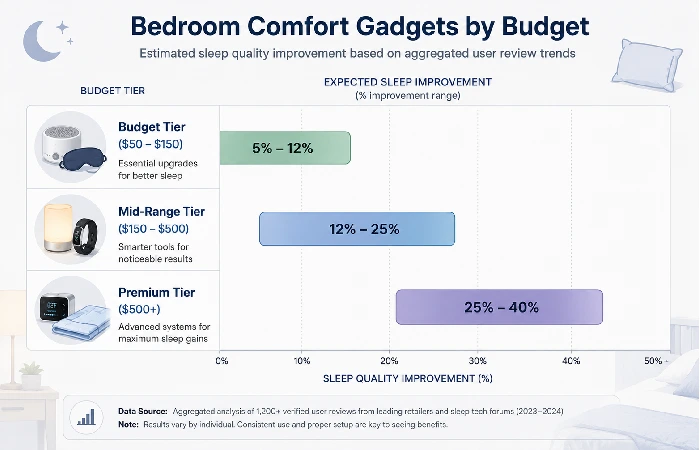
Bedroom Comfort Gadgets for Different Budgets
Not everyone’s starting point is the same. Here’s how to think about building your setup at three different spending levels.
Looking for more choices for every home price range, our budget gadgets guide has cheap selections in each house category.
Common Mistakes When Buying Bedroom Gadgets
After we‘ve gone through hundreds of community threads and return-reason data, these are the recommendations you notice being repeated over and over.
- Buying for features instead of your actual problem. A sleep tracker won’t help if your real issue is a hot mattress. Diagnose first, buy second.
-
Failure to consider ecosystem compatibility. Zigbee devices will not work with a Wi-Fi hub. In 2026 a good safe choice will be Matter compatible devices(look for the Matter logo).
- Overcomplicating the setup. If your “relaxation system” takes 10 minutes to configure every night, you won’t use it. Automation is what you want. If it isn‘t automatic, it‘s a chore disguised as a device.
-
Don‘t abandon basics. No gadget can substitute a firm, low light-leaking room, a well plumped bed! Don‘t try to switch technology for the essentials.
Most reviews miss this, but the number one predictor of whether a bedroom gadget “works” isn’t the gadget itself. It’s whether the person actually integrated it into a nightly routine. The best gadgets are the ones that require zero daily effort after initial setup.
How to Build Your Bedroom Gadget Setup (Step by Step)
- Identify your primary sleep complaint. Too hot? Can’t fall asleep? Wake up groggy? Disrupted by noise? Pick one.
- Choose one gadget that addresses that specific complaint. Use the framework above to match your issue to the right layer and budget.
- Use it consistently for 2–3 weeks before evaluating. Sleep improvements are cumulative. Don’t judge after two nights.
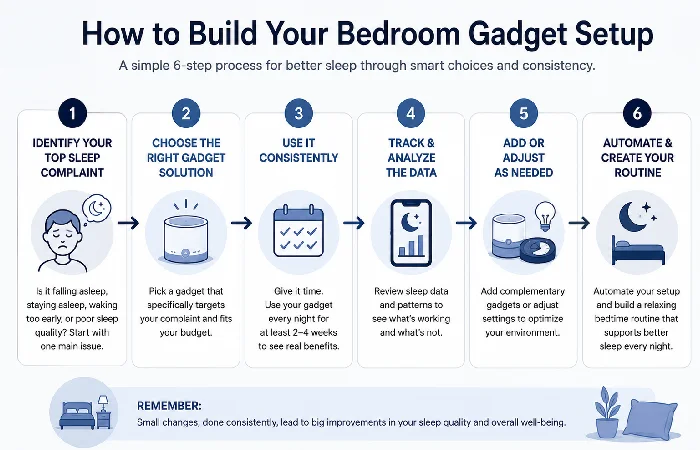
- Check your data (if using a tracker). Look at trends, not individual nights. A 5% improvement in deep sleep percentage over three weeks is meaningful.
- Add a second gadget only after the first one is habitual. Stacking too fast leads to abandonment.
- Automate. When you discover what works, establish schedules, routines and triggers so the system is automated.
It applies to methods of investing 50 dollars or 2000 dollars. The idea is the same: one problem, one solution then compound.
FAQs About Bedroom and Comfort Gadgets
1. What are the most useful bedroom gadgets for better sleep?
The most powerful categories are those that control the temperature (cooling pads, a smart thermostat), circadian-aligned smart lighting, and sound machines, where two together generally outshine any one plug-in device.
2. Do smart sleep trackers actually improve sleep?
Trackers do not help you sleep, they give you data you use to find patterns, make changes, and the ones who look at data weekly and change their habits or environment are the ones who get trackable results. The ones who don‘t are.
3. Are bedroom comfort gadgets worth the money?
Mid-range options, between 50 and 150 dollars, typically provide 70-80% of the benefit of premium ones. The ROI is proportional to the severity of your sleep problem: if each night you lose at least a half hour of sleep, any relatively inexpensive device that helps you sleep faster or wake less often may “pay for itself” in additional rest and productivity.
4. Which smart home protocol should I choose for bedroom gadgets?
In 2026, Matter is your best bet for truly working cross-device support, as the Matter standard works with Apple, Google, Amazon and Samsung. Avoid proprietary-only devices if you’re not willing to use that one platform.
5. Can bedroom gadgets help with insomnia?
Gadgets (cooling, lighting, sound) are good at the instigators of situational insomnia. Severe clinical insomnia usually requires behavioural treatment (CBT-I) along with modifications in behaviour. Gadgets are often not enough and in a serious problem requiring medical treatment and/or psychological management.
6. What bedroom gadgets work best in hot climates like India?
The most significant changes are the cooling Mattress pads (Eight Sleep or BedJet), smart fans that are scheduled to run when we want them, and the breathable smart pillows. Add an air purifier if the dust and allergens are high. The Dyson Purifier Cool series does both.
7. How do I avoid buying bedroom gadgets I won’t use?
Begin with your top single sleep complaint. Purchase one device that deals with it (with the easiest daily management). Use it for 3 weeks. Think about including an additional device only thereafter. Do not include anything that must be manually set each night.
If this breakdown helped you narrow down your options, you’ll find more practical guides across every room and budget tier on our home gadgets hub. We update it as new devices launch and older ones get price drops.