Published: July 7, 2026
Last Updated: August 31, 2026
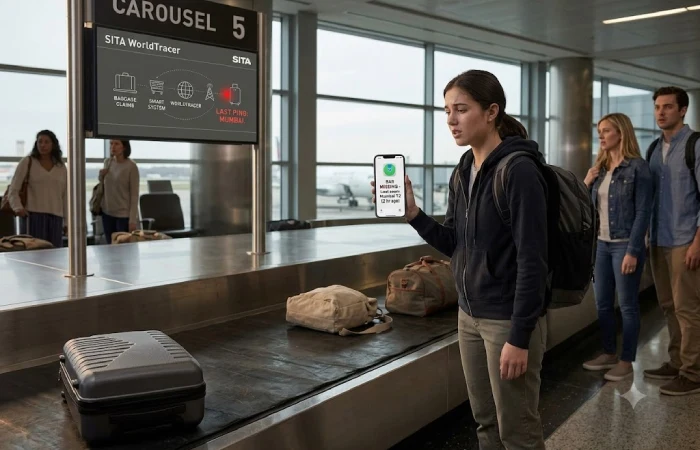
Your bag doesn’t come out on the belt. Everyone else’s did, the carousel’s slowing down, and the person at the baggage desk starts typing into a system that, honestly, knows less about where your suitcase is than a ₹3,500 tag inside it would have told you back at your layover. That gap is the whole reason these devices exist. Airlines mishandled 6.3 bags per 1,000 passengers in 2024, and transfer connections accounted for 41% of all mishandled bags that year — the single biggest cause. None of that stops your bag from getting misrouted. It just decides whether you’re informed or guessing. What follows is a set of smart luggage trackers matched to your phone, your budget in rupees, and the rules Indian airlines genuinely enforce, and it pairs with our wider guide to the best travel gadgets if you’re kitting out from scratch.
Key points: Two kinds of trackers exist: Bluetooth tags that ride on crowd-finding networks and cost almost nothing to run, and GPS units that report their own location for a monthly fee. Most flyers don’t need the second kind — an AirTag if you’re on iPhone, a Samsung SmartTag2 if you’re on Galaxy, either under ₹4,000, covers it. Save the GPS spend for routes that actually leave the crowd behind. And yes, trackers fly fine in India. It’s the battery inside a rechargeable one that airlines care about, not the tag itself.
Definition
A smart luggage tracker is a coin-sized device that reports a bag’s location to your phone using Bluetooth crowd-finding networks or cellular GPS, used by travellers to find checked or delayed luggage when an airline can’t.
What a smart luggage tracker actually does
Strip away the marketing and it’s a small transmitter you zip inside a bag. Bluetooth versions, AirTag being the obvious one, don’t cost anything to run because they piggyback on other people’s phones through crowd-finding networks. GPS versions work differently: they carry their own cellular connection, which means real-time location anywhere, but that connection isn’t free.
Here’s the part that trips people up. A Bluetooth suitcase tracker has no clue where it is by itself. It just shouts, and any stranger’s phone on the same network that wanders past picks up the shout and reports the spot back to you, silently. So the tag is only ever as good as the crowd around it. Terminal full of travellers? Constant pings. Cargo hold over the Arabian Sea? Nothing, until it lands somewhere with people and phones again.
Bluetooth or GPS, and where the AirTag alternatives for luggage fit
Most travellers overspend right here. They reach for live GPS when a cheap tag would’ve done everything they needed.
A Bluetooth tag is usually plenty
Trips through big airports and cities? A tag has you covered. Apple’s Find My and Samsung’s SmartThings Find both run on enormous numbers of phones, so your bag refreshes quickly wherever crowds gather. No subscription. A battery that lasts about a year. Under ₹4,000. For the average flyer, that closes the case, and the strongest AirTag alternatives for luggage still work exactly this way.
GPS, but only sometimes
A GPS tracker earns its price in a few situations. Shipping a bag as unaccompanied cargo. Routes through remote stretches where almost nobody carries a compatible phone. Wanting to watch the bag move in real time instead of catching a last-seen ping. These carry their own cellular link, so they report from nearly anywhere, and that link costs you, usually a yearly plan or an eSIM fee on top of a pricier device. On thin-network international legs, that’s money well spent.
The trackers compared at a glance
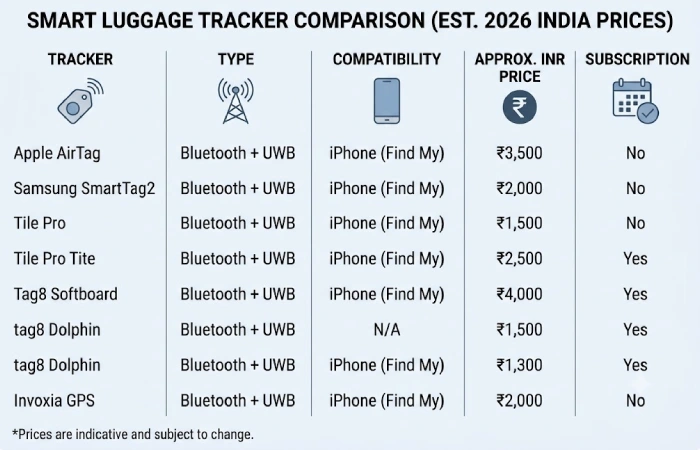
Prices are rough 2026 India street figures and they drift, so check Amazon.in, Flipkart, or the brand store for the live number before you tap buy.
One line worth remembering: only the coin-cell Bluetooth tags in this table are checked-baggage-safe outright. Anything with a rechargeable battery, including every GPS option here, travels in your cabin bag.
The picks, matched to your phone
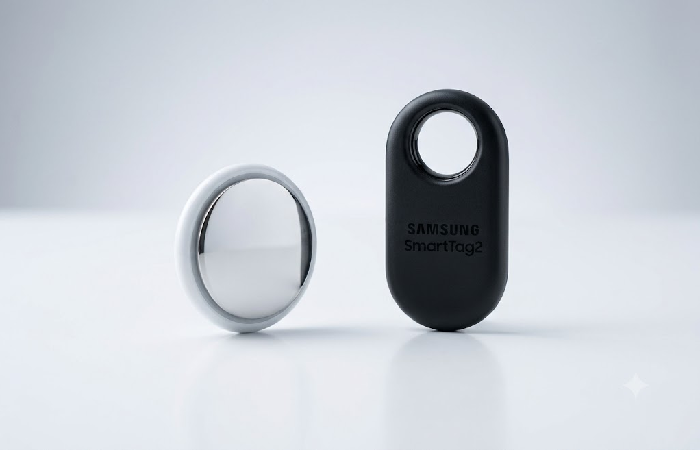
Forget the spec sheets for a second. Your phone decides more than any single feature does, because a tag lives or dies on the finding network your phone happens to feed.
iPhone household: Apple AirTag
Everyone at home on an iPhone? Buy the AirTag and move on. It plugs into the densest crowd-finding network across metro India, pairs in seconds, and runs about a year on a CR2032 coin cell you swap yourself. Get within a few metres and Precision Finding, powered by the U1 chip, points you straight at the bag. And the downside is genuine. Hand an AirTag to an Android user and it does almost nothing for them.
Samsung household: Galaxy SmartTag2
Galaxy owners get the same sweet deal iPhone people do, except inside SmartThings Find. It tends to last longer, often quoted near 500 days, and usually costs less than an AirTag. The wall is hard, though. It talks to Samsung Galaxy phones only. Pair one with a Pixel and you’ve basically bought a keyring.
Mixed phones: Tile Pro
One iPhone, one Android, nobody willing to switch? Tile runs on both. Its network is thinner than Apple’s or Samsung’s, and you’ll feel that as slower updates out in quieter areas, but for a household that won’t standardize on one brand, it’s the reasonable call. The free tier tracks luggage fine. Paid plans pile on alerts you don’t really need for a suitcase.
Tight budget: Chipolo
Chipolo tags cost little and do more than the price suggests. The Chipolo One goes cross-platform through its own app, while the Card Spot and Pop hook straight into Apple’s Find My. Need a second or third tag to scatter across bags? This is the value buy.
When you want a GPS luggage tracker for international routes
This is where GPS finally pulls its weight, and where two India-focused options deserve a look. The tag8 Dolphin, made by an Indian company, skips the recurring subscription and ties into SITA WorldTracer, the baggage recovery system airlines run across thousands of airports. That pairing is unusual, since most GPS trackers gate live tracking behind a monthly fee. Invoxia’s GPS trackers flip the trade the other way, strong hardware and long battery modes, but you’re paying an ongoing plan for the cellular link. There’s also MYLOC8, another 4G option sold in India, covering 150-plus countries with geofencing and a light sensor that pings you the moment a bag is opened. Reach for GPS only when your route really does leave the crowd network behind — and remember it’s a cabin-bag device under current DGCA rules, not a checked one.
Pairing a tracker with a TSA approved luggage tracker lock
A tag tells you where the bag sits. It won’t keep the bag shut. Check bags through the US and a TSA-approved luggage tracker lock lets security open and relock it with their master key rather than snipping it off. A handful of products fuse both jobs into one, a Bluetooth tag baked into a TSA-compliant padlock, like the tag8 Dolphin padlock or KeySmart’s tracking lock. Two jobs, one device. You give up a sliver of tracking range for the lock hardware, and for a lot of travellers that’s a fair swap.
What a long range luggage tracking device really reaches
“Long range” gets stretched past breaking point in product listings. A Bluetooth tag has no real range of its own worth naming. Whatever range it has belongs to the nearest participating phone, three metres or three hundred, entirely down to the crowd. When a listing brags that a tag tracks worldwide, it means the network spans the world, not the little radio inside. A true long-range luggage tracking device is a cellular GPS unit, because it isn’t sitting there hoping a passing phone notices it. Anyone selling you a Bluetooth tag on a long-range promise with no network behind it is selling you air.
Flying with a tracker in India: the DGCA and airline battery rules
What Indian rules police is the battery, not the tag, and the rule for power banks is no longer a judgment call (DGCA advisory, November 2025; Air India dangerous goods policy). As of a BCAS Aviation Security Circular 02/2024, spare lithium batteries and power banks — including any built into a smart suitcase — cannot go in checked baggage at all on Indian flights, full stop; they travel in the cabin only, capped at 100Wh without approval and banned outright above 160Wh. A coin-cell tag like the AirTag is a different category entirely and clears checked baggage easily, its lithium content far under the limits for installed batteries. But a smart suitcase with a non-removable power bank isn’t a maybe. If the battery won’t come out, that bag flies with you in the cabin, not below. Since November 2025, DGCA has also banned using power banks in-flight and won’t let you stow them in overhead bins, so keep any rechargeable tracker’s power source in reach at your seat.
Several international carriers, including British Airways, Lufthansa, Qantas, Cathay Pacific, and Virgin Atlantic, now let passengers share an AirTag’s live location with the airline’s own baggage desk through Apple’s Share Item Location feature.
Set it up before you fly, not at the gate
Pair the tracker to your phone at home. Give it a name your whole family account will recognize. Bury it deep in the bag instead of an outer pocket where it’s easy to lift, then confirm it shows in Find My, SmartThings Find, or the Tile app before you head out. After that, glance at it at every layover, since transfers are where most bags wander off. Do this, and the next time a belt grinds to a halt without your suitcase on it, you’ll already know whether it’s one carousel over or still parked at your origin airport. That’s the entire argument for smart luggage trackers, and it’s why one belongs in your bag before the trip, not after the loss.
FAQ
1. Are smart luggage trackers allowed on flights in India?
Yes, the tracker’s fine. Coin-cell tags like AirTag or SmartTag2 travel in checked bags without issue, but any tracker with a rechargeable power bank has to stay in your cabin bag under DGCA rules — that part isn’t optional.
2. Is AirTag banned in checked baggage?
No. A short-lived 2022 scare convinced a lot of people otherwise, but airlines and regulators confirmed low-power trackers are safe to check.
3. Which luggage tracker is best in India?
Depends on the phone in your pocket. iPhone users want the AirTag for that thick Find My coverage across Indian metros, Galaxy owners should grab the SmartTag2, and a mixed-phone home is better served by Tile.
4. Do luggage trackers need a subscription?
Bluetooth tags don’t, so AirTag, SmartTag2, Tile’s free tier, and Chipolo all run at no ongoing cost. Live cellular GPS trackers usually do charge a plan, though a few India options like tag8 dodge it.
5. Does AirTag work without an iPhone?
Barely. Without Apple’s Find My network it’s close to useless, so an Android-only traveller is better off with a Tile or a Samsung tag.
6. How many trackers should I put in one bag?
One solid tag per bag does it. Spread the spares across your other bags instead of stacking two in the same suitcase.
A note on how this guide was made
We didn’t put hands on every tracker on this list — that’s worth saying upfront. What you’re reading here comes from manufacturer specs, aviation authority documents, and reporting we cross-checked as of July 2026. Battery rules move fast, and DGCA has updated them twice in the past year alone, so treat this as a starting point, not gospel. Check the current circular yourself, and your airline’s own policy too, before you pack anything with a battery in it.