Published: July 6, 2026
Last Updated: August 31, 2026
Airport outlets fill up fast, your phone’s nearly dead, and you’ve still got hours before boarding. That’s the exact moment a charger quits being some accessory you tossed in as an afterthought and becomes the one thing standing between you and a dead phone at the gate. What actually matters in 2026 is simpler than it sounds. Something that keeps you inside airline rules, charges fast enough to matter during a short layover, and doesn’t add dead weight to your bag, that’s the whole list. For most people, a 10,000mAh USB-C power bank clears it easily, sitting comfortably under the 100 watt-hour limit and plenty for how most people actually travel. Travel with a laptop, though, or pull long-haul days often? Push that up to 20,000 or 24,000mAh, and you’re still within the range that makes sense.
This one’s part of our broader best travel gadgets coverage, focused specifically on the charger decisions that can make or break an entire travel day.
Key points:
Speed, weight, and the 100Wh limit. That’s what actually separates a good travel charger from a mediocre one right now. The Anker Nano 10K at 45W covers everyday carry just fine, and you won’t outgrow it unless you’re gone more than a night or two. Once a trip stretches past that, the CUKTECH 20,000mAh is the one to reach for instead. American Airlines and Delta’s new two-power bank-per-passenger rule doesn’t touch either of these, so you’re not getting flagged at the gate either way.
Definition
A power bank, basically, though that undersells what it’s actually doing for you. No outlet at the gate during a six-hour layover, no free plug in the hotel room because the one outlet’s buried behind the nightstand, this is the thing bridging that gap. Lithium-ion or lithium-polymer cells inside, USB or USB-C out. There’s not much more to it than that, honestly.
What makes a portable travel charger actually worth packing
Two things separate a charger worth packing from one that just takes up space. It has to clear security without a second look, and it needs enough power in reserve to cover a real travel day, not just a top-up while you’re waiting to board.
Size doesn’t win this one. Heavy chargers stay home. So do ones that recharge too slowly to be useful, or that sit close enough to airline limits to need double-checking at the gate. Once a bank crosses into any of that, it’s stopped earning its spot in your bag.
10,000mAh is the number most travelers should actually default to. Two phone charges out of that capacity, comfortably light enough for daily carry, and nowhere close to the flight ceiling that would get it pulled aside at security.
Can you fly with a portable charger in 2026?
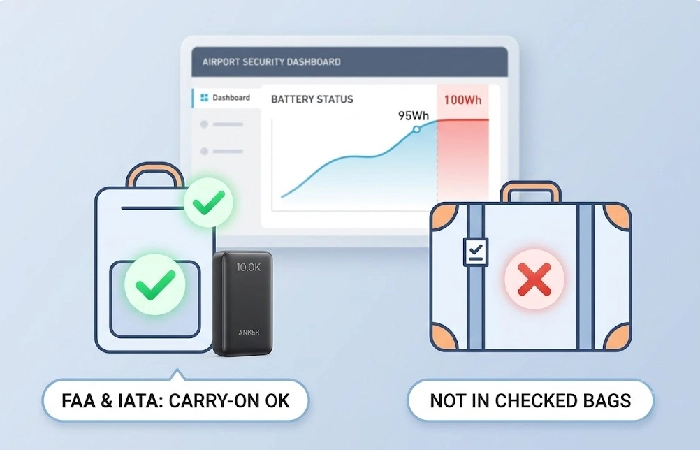
Yes, but airlines don’t actually care about the mAh number printed on the box. Watt-hours are what matters. The FAA treats power banks as spare lithium-ion batteries, which means carry-on only, never checked baggage (see the FAA’s lithium battery guidance for current rules). IATA’s traveler guidance lands on the same watt-hour thresholds and is just as clear: cabin baggage, not checked luggage.
The practical rule set breaks down like this:
- Up to 100Wh: normally allowed in carry-on without airline approval.
- 101Wh to 160Wh: may be allowed with airline approval, and limits often apply.
- Over 160Wh: generally not allowed for passenger travel.
Weight and capacity aren’t what TSA checks. Watt-hours are. That trips people up constantly, since a 20,000mAh power bank running at 3.7V actually comes out to something like 74Wh once you do the math, comfortably under the cap. Add another 7,000mAh and the number stops being comfortable. It’s creeping toward 100Wh by then, close enough that eyeballing it isn’t smart. Or at least that’s been the case with every power bank worth checking. Read the label before the bag goes through the scanner.
Rules have only gotten stricter heading into mid-2026. Most carriers now treat cabin baggage as the default, full stop. Some go further still. Seat-area storage only, no overhead bin, is one restriction showing up more often. Charging mid-flight isn’t always allowed either, depending on the airline. Practically, that means three habits: keep the bank under 100Wh, keep it within reach instead of stowed above you, and check your airline’s actual battery page before you fly. Do that, and a charger never becomes something a gate agent needs to have an opinion about.
Disclaimer: This article is based on publicly available guidance for flying with power banks as of July 2026, including FAA PackSafe documentation and IATA battery rules. Always check your specific airline’s latest battery page before you travel, as carrier‑level policies can change without much notice.
The watt-hour math nobody explains clearly
Honestly, most people never check this. They just glance at the mAh number, trust it, and move on. Don’t. mAh times 3.7, divided by 1,000, that’s the actual formula, and watt-hours are what an airline actually looks at, never the number stamped across the front of the box in bold font.
A 24,000mAh power bank run through the same math comes out to about 88Wh. Close to the 100Wh limit, closer than most people expect, but it clears. Twenty to twenty-four thousand mAh isn’t an arbitrary range either, it’s just where the math keeps landing people who want headroom. Nothing arbitrary about it. At that capacity you can get a full phone charge or two, sometimes enough for a laptop top-up, without pushing anywhere near the ceiling that gets a power bank pulled aside at security. Go much bigger than that and you’re carrying weight you probably don’t need, for a margin of safety you already had at 24,000mAh.
The mAh to watt-hour math you actually need
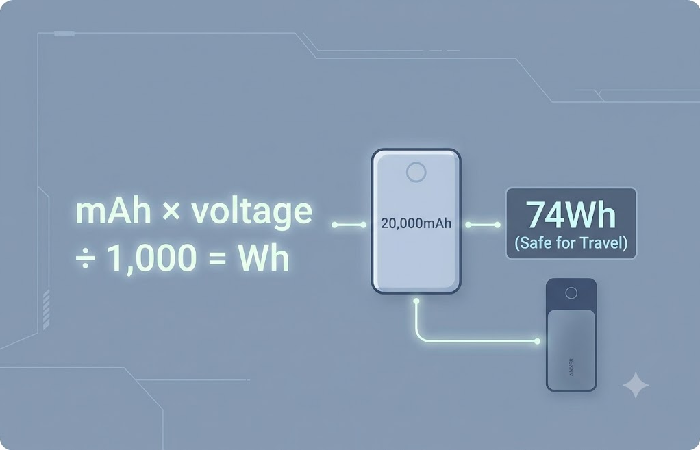
Here’s the thing nobody mentions on the product page: mAh isn’t the number that matters for flying. Watt-hours are. The conversion itself isn’t complicated; one line does it.
mAh × voltage ÷ 1,000 = Wh
Most power banks run a nominal 3.7V, so plug that in and the picture gets clear fast:
- 10,000mAh × 3.7 ÷ 1,000 = 37Wh
- 24,000mAh × 3.7 ÷ 1,000 = 88.8Wh
- 25,000mAh × 3.6 ÷ 1,000 = 90Wh
Notice how close that last one sits to 100Wh. It’s no accident. 25,000mAh keeps turning up as the practical ceiling for anyone also trying to charge a laptop. Skip this math and you’re guessing. Do it once, and you’ll know exactly where your bank actually stands before an airline ever asks.
What actually made this list for 2026
Nothing here comes from guesswork. Manufacturer specs get checked against recent reviews for every pick, real capacity confirmed, weight verified, output tested against what the box actually claims.
| Pick |
Capacity |
Weight |
Max Output |
Why It Stands Out |
| Anker Nano Power Bank (10,000mAh) |
10,000mAh (~37Wh) |
~215g |
30W |
Compact everyday travel power bank with a built-in USB-C cable for convenient charging. |
| Anker 737 Power Bank (PowerCore 24K) |
24,000mAh (86.4Wh) |
~630–635g |
140W |
Ideal for long-haul travel and charging laptops at full speed while remaining under the 100Wh airline limit. |
| UGREEN Nexode 25K (145W) |
25,000mAh (~90–92Wh) |
~513g |
145W |
High-performance USB-C power bank built for fast charging laptops and other power-hungry devices. |
| Slim 5,000mAh MagSafe Power Bank |
5,000mAh (~18.5Wh) |
~130g |
20W |
Ultra-slim magnetic power bank that’s perfect for a quick phone top-up while sightseeing or commuting. |
| BigBlue 28W Solar Charger |
Solar panel only |
~670g (1.48 lb) |
28W |
Foldable solar charger that works best as an off-grid backup for camping and multi-day trips, not as a primary daily charger. |
Why the Anker Nano 10,000mAh wins for most people
Most people should just get the Anker Nano 10,000mAh and stop overthinking it. Do the math and it comes out to roughly 37Wh, nowhere close to the flight limit that trips other power banks up. The built-in USB-C cable is genuinely useful because it removes one more thing you can lose in transit. It is also enough for about two phone charges, which covers a normal travel day well.
Real test of this: a Hyderabad–Delhi flight, a layover with only 40 minutes on the clock, and my phone sitting at 9% right as the gate changed. The Nano was already in my jacket pocket. Plugged it in while I was walking, no stopping, and it pulled the ride app back up, reloaded the new boarding pass, and kept me online through the whole flight without ever hunting for a wall outlet.
Best for long-haul travel
The Anker 737 is the one to look at when your travel day includes a laptop, multiple layovers, or both. It gives you 24,000mAh—about 86.4Wh—and up to 140W output, enough to actually support a laptop rather than just rescuing a phone. The trade‑off is obvious: at roughly 630–635g, this is not the power bank you throw into a small sling and forget about.
Best USB-C fast charger for laptops
If laptop charging matters most, the UGREEN Nexode 25K stands out. It pushes up to 145W and stays under the airline ceiling at roughly 90–92Wh, depending on how you calculate watt-hours from the 25,000mAh rating. 513 grams isn’t light, but plenty of bricks in this power class weigh more, and the GaN internals earn their keep by keeping temperatures in check during the harder charging sessions.
Put it to actual use and a 13-inch USB-C laptop can run through a full airport-lounge work session, or survive a long-haul flight, and there’s still enough left in the tank to top off a phone once or twice.
Best slim pick for international travel
A slim 5,000mAh MagSafe power bank is not trying to be your only charger. It is trying to be the one you actually keep on you. That matters. One top-up is often enough to get you through immigration, ride-share booking, boarding passes, and the usual travel-day phone drain. If the charger is too bulky, you leave it behind. Then it helps nobody.
Best solar option for off-grid trips
Solar sounds better on paper than it usually feels in practice. A panel like the BigBlue 28W folds down to a compact bundle and weighs about 1.5 pounds (around 670g), which is reasonable for camping and multi‑day trips away from outlets. It makes less sense as your main charging plan for regular travel where wall outlets are easy to find. In strong direct sun, it can help. In cloud, shade, or inconsistent conditions, performance drops fast.
Matching the charger to how you actually travel
Start with what’s in your bag, not what looks impressive on a spec sheet. A phone and maybe a set of earbuds, 10,000mAh is plenty. Throw a laptop into that mix and the number that actually makes sense jumps to 20,000–25,000mAh. The longer you’re away from an outlet, the more that capacity number should matter to you. Weight starts to matter just as much once the trip is mostly city travel, airports, and hotels.
Here’s a fast way to land on a number:
- Short weekend, just a phone: 5,000–10,000mAh covers it
- Week-long trip with a phone and tablet: 20,000mAh
- Remote work travel, phone plus laptop: 20,000–25,000mAh, no less
- Camping or off-grid: a mid-capacity power bank paired with a foldable 20–30W solar panel
None of this is really about buying bigger. It’s about buying what you’ll actually carry every day, what clears airline rules without a second look, and what you can top off again before the next morning.
FAQ
1. Can I bring a power bank on a plane?
Yes. As of July 2026, FAA PackSafe guidance and IATA traveler battery resources both say spare lithium‑ion batteries and power banks belong in carry‑on baggage, not checked baggage.
2. Can I put a power bank in checked luggage?
No. Current FAA and IATA materials state that spare lithium batteries—including power banks—should not travel in checked bags, and must be removed to cabin baggage if a carry‑on is gate‑checked.
3. What is the flight limit in mAh?
There is no universal mAh rule by itself. The real threshold is watt-hours. At a typical lithium-ion voltage, 100Wh works out to roughly 27,000mAh.
4. What size is safest for most travelers?
Around 10,000mAh does the job for almost anyone. It stays under what airlines allow, it won’t weigh down your bag, and one full day of phone charging won’t put a dent in it.
5. What does laptop charging actually require?
More power, plain and simple. A phone-sized charger won’t cut it once a laptop enters the picture. Watt hours are the number that matters here, not mAh, and 100Wh is the hard ceiling security checks, not the capacity printed on the box. The Anker 737 sits at 25,000mAh and stays right under that limit, and UGREEN’s 145W model does the same thing. Neither is chasing raw capacity. Both are built around that 100Wh math, which is exactly why they keep coming up together.
6. Do solar chargers work for travel?
Not really, not as your main plan anyway. They’re fine as a backup. If you’re camping somewhere with no outlets for days, sure, bring one. For a regular trip where you’re bouncing between flights and hotel rooms, it’s just extra weight doing nothing.
7. Do I still need to check the airline policy?
Yes. FAA and IATA rules set the floor, but airlines can add tighter limits or their own handling rules on top of that. Don’t assume the general number applies to your specific flight.
Bottom line
Get a 10,000mAh USB-C charger and stop overthinking it. That covers almost every trip you’ll take. Only size up when you’ve actually run out of juice on a real trip, not because a bigger number looks better on the box.
Stop shopping by mAh. Start shopping by Wh. That’s the only number the flight attendant actually cares about.
Better to have 20% less battery than to have your charger sitting in a TSA confiscation bin while you’re stuck in a foreign airport with a dead phone.