Published: July 6, 2026
Last Updated: August 31, 2026
You booked the trip, and somewhere between the airport gate and now, you’ve ended up staring at a wall of adapters with no idea which one actually keeps your phone alive without frying it somewhere over the Atlantic. Most listicles skip the one thing that matters here — a travel adapter just reshapes your plug. That’s it. The voltage is a separate problem entirely, and confusing the two is exactly how people fry a hair dryer in a Paris hotel bathroom. Nail that distinction and the rest of the buying decision gets almost boring. What follows ranks the adapters actually worth packing in 2026 — by real-world coverage, by how many devices they can charge at once — plus the one check to run before anything gets plugged in.
Key points: A good universal adapter in 2026 fits outlets in 150-plus countries and can charge a laptop alongside a couple of phones over USB-C. Voltage conversion isn’t part of the job, though — that’s a separate check you still have to run yourself. Most travelers are better off with a 65W GaN unit than anything bigger. Only reach for 140W if you’re hauling a laptop heavy enough to actually need it.
Definition
A universal travel adapter reshapes your plug to fit outlets in different countries — nothing more. It won’t touch the voltage running through your dual-voltage gear, but it does let you charge phones and laptops wherever you land, without packing a separate adapter for every stop on the trip.
Disclaimer: This is built from publicly available specs and sources reviewed at the time of writing. Specs change. Confirm the numbers that matter to you on the official brand page before you buy.
What a universal travel adapter really does, and the one thing it can’t
A universal travel adapter is one plug that fits outlets in most countries by switching between plug types, usually with built-in USB and USB-C ports. It changes the plug shape, not the voltage, so confirm your device handles 100–240V first.
That second sentence is the whole ballgame. Best universal travel adapters in 2026 fix the shape problem for an entire trip. What they don’t do is touch the voltage. And honestly, that’s fine, because nearly every phone, laptop, and tablet charger built today already handles 100–240V on its own. Which is exactly why an adapter is usually all you need. The oddballs are high-heat things. Hair dryers. Curling irons. More on those in a second.
One item in your bag decides whether everything else can charge. It’s this one. We cover the rest in our
best travel gadgets guide, but the adapter comes first.
Adapter vs voltage converter: the mix-up that fries gear
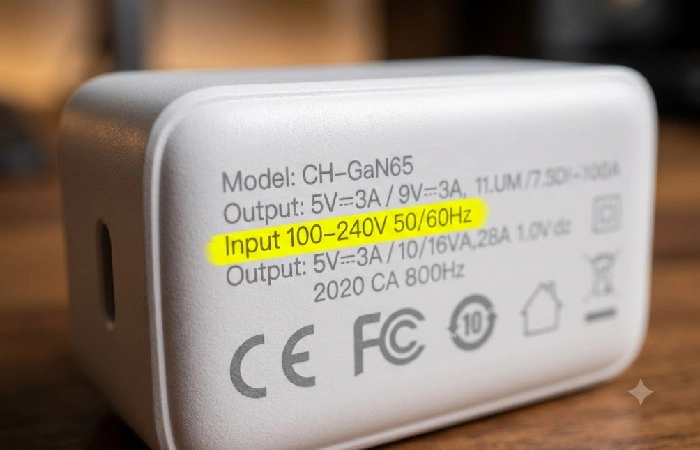
A travel adapter reshapes your plug so it physically fits a foreign outlet. A voltage converter changes the electricity itself, dropping 220–240V down to 110–120V or pushing it the other way. Two different tools. Grab the wrong one and something gets cooked.
So run this check before you spend a cent. Read the fine print on your charger. See “Input: 100–240V, 50/60Hz”? Then it’s a dual voltage situation and an adapter by itself is safe. Phones, laptops, tablets, cameras, most electric toothbrushes- they all clear that bar without a fuss. See a single narrow “120V” instead? That one device needs a converter, not just an adapter.
Look, for almost everyone hauling nothing but personal electronics, a converter is a brick you’ll never use. The real exceptions are few. A US hair dryer headed to a 230V country, say. And even then, buying a dual-voltage travel version beats packing a converter every time.
How much USB-C power do you actually need?
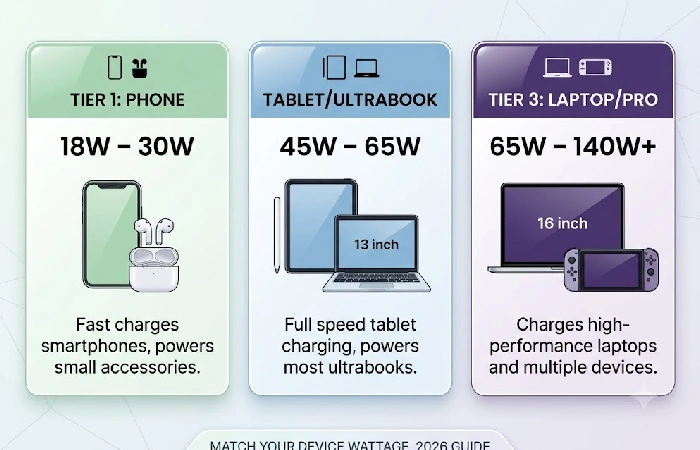
Here’s where people overspend, or worse, underspend, because nobody spells out the wattage tiers. An international power adapter with Type-C ports is only worth what its watts can deliver. So match the adapter to what you actually carry, not to the biggest number on the box.
Just a phone and earbuds (18–30W)
Travel light, charge a phone and earbuds, done. An 18–30W pick covers you. Anything beefier is watts you’ll never spend, and these run cheapest and smallest anyway.
Phone plus tablet (45–65W)
Add a tablet or a second device and you’re into the 45–65W band. It fast-charges the phone and tops the tablet at once. For most travelers, this is the sweet spot.
The laptop replacement (65–140W GaN)
Want the adapter to stand in for your laptop charger? 65W is the floor. Run a 16-inch or a thirsty laptop and you’ll want 100–140W. A worldwide travel adapter with USB and USB-C up here leans on GaN internals, which stay cooler and smaller than the old silicon bricks. This is the only tier that truly earns “all-in-one,” because your laptop charger stays home. And if you also need juice at outlet-free gates and endless layovers, pair it with one of our
portable travel chargers picks. An adapter’s useless without a wall.
Our top universal travel adapter picks for 2026
| Pick |
Max USB-C Output |
Ports |
Countries Supported |
Surge/Fuse Protection |
Best For |
| TESSAN GaN 65W (WTA07) |
65W |
3 × USB-C, 2 × USB-A, 1 × AC |
150+ |
Fuse |
Best overall |
| Epicka Pulse Duo 140W |
140W |
3 × USB-C, 1 × USB-A, 2 × AC |
200+ |
Fuse |
Laptop users |
| Baseus EnerCore CG11 70W |
70W |
2 × USB-C, 2 × USB-A, 2 × AC |
200+ |
Fuse |
Compact all-in-one |
| Epicka TA-105 |
~15–18W |
4 × USB-A, 1 × USB-C, 1 × AC |
200+ |
10A fuse + spare fuse |
Best value |
| Ceptics 11-KU |
45W |
3 × USB-A, 2 × USB-C |
200+ |
Fuse + voltage LED |
Surge/safety-conscious travelers |
Price ranges for these adapters
Approximate prices at the time of writing:
- TESSAN GaN 65W (WTA07): around $20–$30.
- Epicka Pulse Duo 140W: typically $80–$120.
- Baseus EnerCore CG11 (70W): usually $40–$70.
- Epicka TA‑105: often $20–$35.
- Ceptics 11‑KU: generally $30–$50.
Prices shift by country, retailer, and discounts, so treat these as rough ranges and always check the current listing before you buy.
Where to verify specs and prices
For the Baseus EnerCore CG11, it’s safest to link to a stable authority source — ideally the official Baseus EnerCore CG11 product page, or a detailed Pack Hacker review or major retailer listing where you can verify specs and plug coverage.
Best overall for most travelers. The TESSAN GaN 65W (WTA07) lands right on the tier most people actually need. One outlet, and it charges a laptop and two phones. Covers 150‑plus countries. The GaN build keeps it small enough to forget. Only reason to skip it? You’re running a 140W laptop. You can double‑check the port layout and wattage on the official TESSAN WTA07 product page.
Best high‑power GaN for laptop users. Four USB‑C ports, a full 140W, and a little screen showing live charging stats, that’s the Epicka Pulse Duo. It flat‑out replaces your laptop brick. It’s also bigger and pricier, so if you’re a casual traveler, don’t pay for headroom you’ll never touch. For current specs, check Epicka’s site directly via the Epicka Pulse Duo overview page.
Best compact all‑in‑one. The Baseus EnerCore CG11 is the compact all‑in‑one travel adapter to beat: 70W of GaN, a retractable cable, folding plugs that disappear into a jacket pocket. This is the one you reach for when every gram in the bag annoys you, and you can confirm details on the Baseus EnerCore CG11 product page.
Best value pick. Everyone recommends the Epicka TA‑105, and the reason holds up. 200‑plus countries, a real 10A fuse with a spare in the box, and a price well under the GaN crowd. The trade‑off is honest: USB‑C tops out around 15–18W. Great for phones, useless for a laptop. Epicka’s own TA‑105 product page is the place to verify ports, fuse rating, and certifications.
Best with surge protection. Heading somewhere with ancient wiring? The Ceptics 11‑KU throws in safety shutters and a replaceable fuse, which is why it’s the safety‑conscious pick. For dual USB‑C output and exact USB‑A/USB‑C counts, check the official Ceptics UP‑11KU product listing. If a live‑voltage warning LED is the deciding factor for you, Ceptics’ World‑Way kit is the one that offers that feature — worth a look if the indicator matters more than PD wattage.
If a visible voltage warning is the deciding factor for you, that’s the one worth checking against — the 11‑KU’s strength is its dual USB‑C output and compact safety build, not a voltage indicator.
Which plug types you need for Europe and Asia
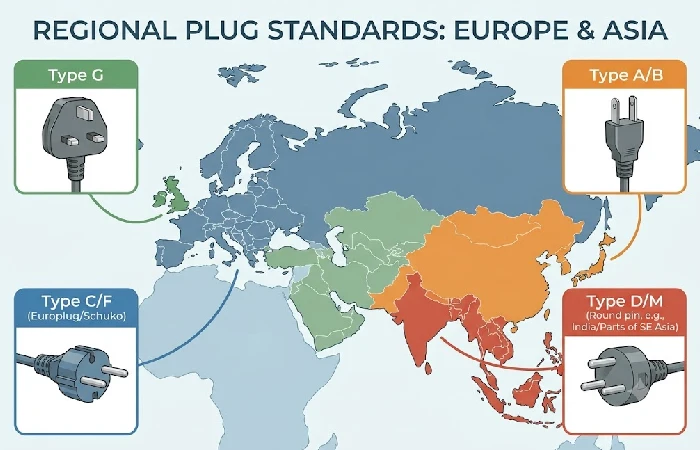
One travel adapter for Europe and Asia covers most of both. Still, the plug shapes shift enough that it pays to know what your adapter is quietly switching between.
| Region |
Common Plug Type(s) |
Standard Voltage |
| UK & Ireland |
Type G |
230V |
| Most of Europe |
Type C / F |
230V |
| Japan |
Type A / B |
100V |
| China |
Type A / C / I |
220V |
| India |
Type D (primary), with some C/M sockets |
230V |
| Southeast Asia |
Type A / C / G (varies by country) |
220–240V |
Plug types can vary by country within a region. Always verify the destination country’s plug type and voltage before traveling, especially if you’re bringing high-power appliances.
A genuine universal adapter packs all these blades, so a London-to-Tokyo-to-Delhi run needs zero hardware swaps. Watch Japan though. At 100V it’s the one stop where single-voltage gear is most likely to sulk. Dual voltage kit sails through. (Plug-type and voltage data:
IEC World Plugs.
Matching the adapter to how you actually travel
Buy for the trip you’re taking, not the spec sheet. One phone, a weekend away? 18–30W and move on. Phone, tablet, laptop, several countries? A 65W GaN adapter is the honest pick — it covers a laptop and two phones charging at once, which is what actually happens on a real trip. Iffy wiring on the route? Spend up for the fused, LED model.
Skip the 140W adapters unless you’re specifically hauling a power-hungry laptop. For almost everyone else, that’s wattage you’ll never touch and bulk you didn’t need to carry.
The one habit worth keeping regardless: check the 100–240V rating on every device before you pack. Skip that, and the fanciest adapter in the world becomes a very expensive way to fry a charger in a hotel room in Lisbon.
FAQ
1. Do I need a voltage converter as well as a universal travel adapter?
Usually not. If the device says 100–240V, the adapter alone has you covered. Converters only come into play for single-voltage stuff like certain hair dryers.
2. What’s the difference between a travel adapter and a converter?
The adapter changes your plug’s shape to fit the wall. The converter changes the voltage running through it. Most people only ever need the first one.
3. Does a universal travel adapter work in every country?
Almost. Four blade types — A, C, G, and I — cover roughly 150–200 countries between them, per data. The exceptions aren’t obscure: India (Type D), Israel (Type H), and South Africa (Type M) are mainstream destinations that need a dedicated adapter, and Italy and Switzerland have some outlets that fall outside the standard set too.
4. Can a universal travel adapter charge a laptop?
Only when its USB-C port does 65W or more. Those cheap 15–18W units are phone-toppers, nothing more.
5. Are these adapters safe in old outlets?
A fused model with surge protection and a voltage LED, like the Ceptics 11-KU, hands you a warning cue. A bare-bones adapter gives you none, so it’s worth the upgrade where the wiring looks its age.
6. What plug types do I need for Europe and Asia?
Type G for the UK, Type C/F across mainland Europe, then a mix of A, C, D, and I once you’re in Asia. One universal unit carries the lot.