Published: July 3, 2026
Last Updated: September 18, 2026
You’ve done this trip. The phone dies at hour six, the adapter you packed doesn’t fit, and your bag has become a cable graveyard. Four chargers, six cords, nothing labeled. That’s the friction most travel gadget lists don’t actually fix. They give you 25 product names and assume you’ll sort out which ones belong in your carry-on.
This one’s built differently. Every pick has a budget tier (Under $25, $25–75, $75+) and a “skip this if” filter.
Skip to the end and you’ll find a cheat sheet matching gadgets to your actual trip type.
If you only grab five things off this list, make it these: start with the GaN adapter, that’s #1 below and worth buying even if you skip everything else, then add a 10K power bank at #3, an AirTag 2 at #6 for anyone who’s watched a bag not show up on the carousel, noise-canceling earbuds at #9 or #10 depending on your budget, and packing cubes at #14. They’re the difference between a suitcase you can dig through in ten seconds and one you have to unpack to find anything.
Key points:
The gadgets worth packing for 2026 do more than one job. They also clear airline security without a hassle, which honestly rules out half the “innovative” gear you see on Amazon right now. A GaN universal adapter, a 10K power bank, a UWB luggage tracker, noise-canceling earbuds, and packing cubes handle what most travelers actually need, whether you’re on a $500 budget trip or dropping serious cash on gear. You’ll find the full 25-item list below. It’s organized by category and price tier, then matched to five trip types based on how you actually travel, not how some list assumes you travel.
These picks come from what actually breaks after six months of real use, the failure patterns that show up again and again with cheap or single-use gear, and where airline and device standards actually sit as of 2026.
Definition
A travel gadget is any portable device or accessory that solves a specific travel friction point using compact, multi-functional design, primarily used by frequent and international travelers to reduce the number of items they carry while keeping essential technology accessible on the road.
Before You Buy Anything on This List
Two questions should kill most impulse purchases. Does this solve a problem you’ve actually had on a trip? Or does it just duplicate something already sitting in your bag?
The Rule Most Travelers Miss at the Gate
There’s a third filter most people skip, and it’s the one that actually trips travelers up at the gate. Since July 2026, the FAA’s PackSafe rules block power banks and other spare lithium-ion batteries over 100 watt-hours from checked luggage entirely, and anything in the 101 to 160 Wh range needs airline approval just to ride in your carry-on. Got a smart suitcase with a battery you can’t pop out? TSA will pull it, no exceptions. Happens at airports worldwide, not just in the U.S.
One Upgrade Worth Making First
Look, the single most useful upgrade in travel tech this year is your charging setup. GaN chargers run cooler than the old silicon bricks, and I mean noticeably; you can actually hold one after an hour of charging without wanting to drop it. They also cram in more ports while weighing less than what most people are still hauling through security. Swap out your wall charger, your laptop brick, and your USB hub, and one small GaN adapter replaces all three. If you change one thing before your next trip, that’s it.
Disclaimer: Everything here pulls from publicly available information — airline rules, regulator guidance, manufacturer specs — as of July 2026. Before a big trip or purchase, check the actual airline and product pages. Things change.
What actually counts as a travel gadget? I’d say it’s anything small enough to shove in a side pocket that fixes one real problem you’ve had while traveling: dead phone, lost bag, noisy cabin, cables everywhere, no signal. If it doesn’t solve one of those, it’s not earning its spot in your bag no matter how cool it looks on Amazon.
Charging and Power
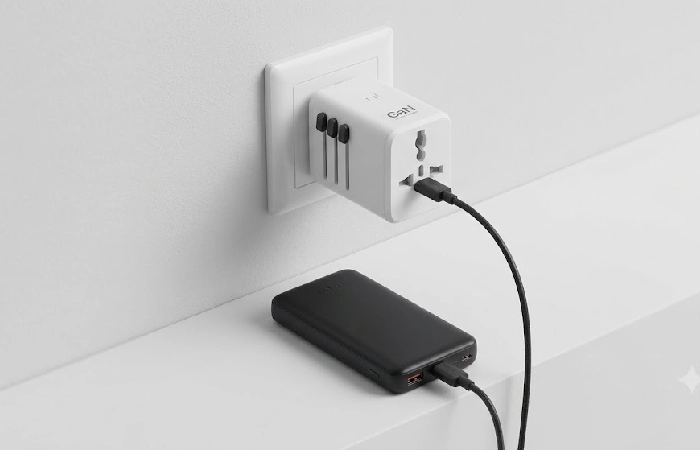
You don’t need five chargers and eight cables. Most travelers do. What actually works is simpler than that. One good adapter covers most of your charging needs, and a reliable power bank backs it up when an outlet isn’t close by. You only need a third device if you’re carrying a smartwatch or wireless earbuds that charge on their own separate pad.
1. Anker Nano Universal Travel Adapter ($25–75)
GaN-powered, covers US/UK/EU/AU outlets, 30W USB-C Power Delivery plus a USB-A port. This single adapter retires the bag of country-specific plugs you’ve been collecting since 2019. Skip it if all your trips are domestic.
2. TESSAN 65W Universal Adapter ($25–75)
Higher wattage, charges a laptop and phone simultaneously through dual USB-C. The trade-off is size. It’s noticeably bigger than the Anker Nano, but 65W output matters if your laptop charges over USB-C. Not worth it if you don’t carry a laptop.
3. Anker MagGo 10K Power Bank ($25–75)
10,000 mAh, MagSafe wireless charging, built-in kickstand, USB-C passthrough. Convenient for iPhone users who want to slap-and-charge. Wireless is slower than plugging in, though, so manage your expectations on a long travel day. Android users without a MagSafe case should look at #4 instead.
4. INIU P50 Power Bank (Under $25)
Same 10,000 mAh capacity at roughly half the price. No wireless, no kickstand. Charges your phone about twice over. That’s the whole pitch, and for most trips it’s enough.
5. Anker 3-in-1 Charging Stand ($25–75)
This foldable pad charges your phone, smartwatch, and earbuds at the same time. Hotel nightstands are where it really pays off, since the only outlet you can reach is almost always jammed behind the headboard. No smartwatch? Skip it, you’d just be paying for a slot you’ll never use.
This whole category exists because of USB-C Power Delivery. Your phone, tablet, earbuds, and most laptops all run on the same cable now, so instead of packing a separate charger for each device, you pack one and you’re done. Still carrying a Micro-USB cable for anything? Replace it.
Which Power Setup Fits Your Trip
| Trip Length |
What to Pack |
| Weekend domestic |
Power bank only (#3 or #4) |
| 1-week international |
Adapter (#1 or #2) + power bank |
| 2+ weeks / digital nomad |
Adapter + power bank + charging stand (#5) |
Luggage Tracking and Security
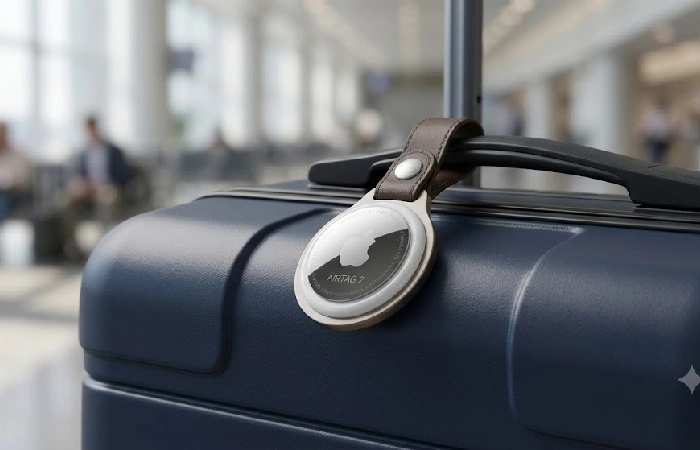
Most people get this backwards. They spend real money on a fancy suitcase and skip the $25 tracker that would actually tell them where their bag is once the airline loses it.
6. Apple AirTag 2 (Under $25)
Updated UWB (Ultra-Wideband) chip. Precision tracking down to a few feet. Backed by Apple’s Find My network and its billion-plus active devices. Drop one in your checked bag and one in your carry-on. That said, this is Apple-only. Android users, see #7.
7. UGREEN Luggage Tracker (Under $25)
Works with Google’s Find My Device network. It can’t pinpoint your bag the way AirTag’s UWB chip can. What it can tell you is which carousel your bag showed up on or which warehouse it’s sitting in right now, and for most people that’s genuinely enough. Already deep in the Apple ecosystem? Grab an AirTag instead; it’ll integrate better with what you’re already using.
8. RFID-Blocking Travel Wallet (Under $25)
Passport, boarding passes, and a few cards, all RFID-shielded. Useful for international trips. If you travel domestically and everything lives on your phone, you don’t need it.
Honestly, one thing worth saying out loud: trackers tell you where your bag is. They don’t get it back. If an airline routes your suitcase to another city, you’re still filing a claim and waiting. The tracker kills the uncertainty. It doesn’t kill the wait.
Audio and Noise Control
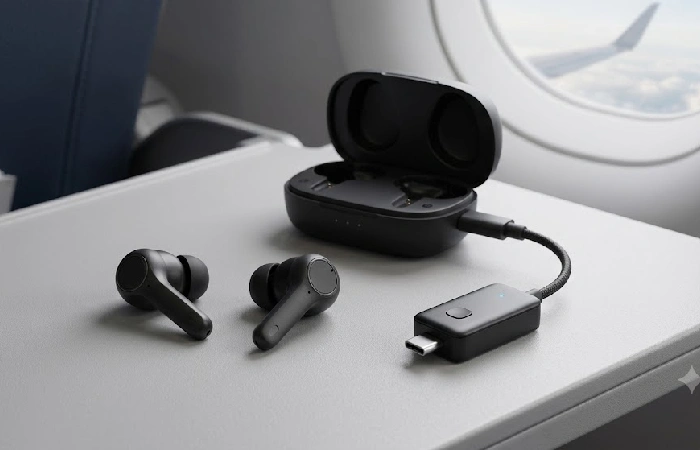
A 10-hour flight with a screaming toddler two rows back changes your priorities fast. Audio gear goes from nice-to-have to non-negotiable.
9. Bose QuietComfort Ultra Earbuds ($75+)
Still the ANC benchmark. Engine noise, announcements, most conversation, gone. About 6 hours of battery with active noise cancellation running. They cost more than every other option here, and they earn it. But if budget is tight, the Pixel Buds Pro 2 get you most of the way there for less money.
10. Google Pixel Buds Pro 2 ($25–75)
Tensor A1 chip, 8 hours of ANC battery, and conversation detection that pauses audio automatically when you talk. The noise cancellation is good. Not Bose-level, but close enough for most flights.
Active Noise Cancellation works by picking up the sound around you through built in microphones, then firing back an inverse wave to cancel it out. Simple mechanism, but it’s the reason a $200 pair of earbuds actually earns its price tag over $20 foam tips from a gas station. You’ll only feel that gap if you’re flying enough to notice engine drone in your sleep, or if a chatty seatmate three rows over is enough to ruin your whole flight.
Long-haul cabin noise wears you down by hour six, no question. What actually matters for your hearing is volume and how long you’re stuck in it, not just the noise itself. Got hearing concerns already? Don’t hand that job to a pair of earbuds. Talk to an actual professional or check official guidance instead of trusting consumer gear to handle it.
11. AirFly SE Bluetooth Transmitter (Under $25)
Plugs into the 3.5mm jack on seat-back screens, streams to your wireless earbuds. Without it, you’re watching movies through the airline’s disposable wired set or on mute. If you only stream from your own phone, skip it.
12. Loop Switch 2 Earplugs (Under $25)
No battery, three modes, up to 26 dB reduction. These aren’t for music. They’re for the hotel room next to the elevator, the red-eye where you need silence, the overnight train. If ANC earbuds handle your quiet needs, pass.
Organization and Packing Gear
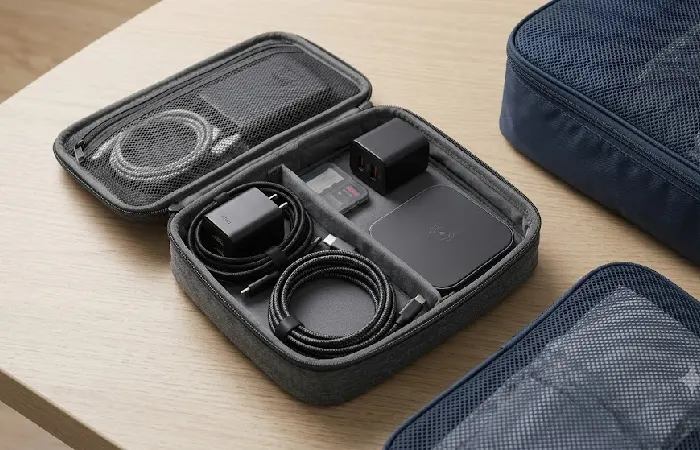
The point isn’t cramming more into your bag. It’s reaching into a side pocket at the security line and pulling out exactly what you need without unzipping everything.
13. Moment Tech Organizer ($25–75)
Weatherproof, lays flat when opened, separate visible compartments for cables, adapters, earbuds, and a power bank. If you already have a packing system that works, don’t fix it.
14. Osprey Ultralight Packing Cube Set ($25–75)
Compression cubes that cut clothing volume roughly in half. Not exciting. Not optional either, if you’re serious about avoiding checked bags. Skip these only if you check your luggage and genuinely don’t care about organization.
Once you consolidate clothes into compression cubes, security checks become faster because you can pull out one cube instead of emptying your entire bag.
15. Bellroy Lite Travel Pack ($75+)
Carry-on backpack, clamshell opening, laptop sleeve, internal dividers. Fits as a personal item on most airlines. If wheeled carry-ons are more your style, this won’t convert you.
16. Peak Design Travel Backpack 30L ($75+)
The premium pick. Better structure, better materials, more pockets. Costs roughly double the Bellroy, so the question is frequency: if you travel out of a bag for weeks at a time, it’s justified. A few trips a year? The Bellroy handles that fine.
The $20 Packing Rule
A $20 packing cube set that prevents you from checking a bag even once has already paid for itself. Most major U.S. airlines charge $35–$50 per checked bag, each way.
Comfort, Connectivity, and Clever Extras
Nine more picks. These move faster. A few are obvious, a few are niche, and some solve problems you won’t recognize until your third or fourth trip.
Comfort
17. TRTL Travel Pillow (Under $25)
Fabric wrap with internal support. Holds your head upright without the bulk of an inflatable donut. Not useful if you can sleep sitting up without help.
18. TORRAS Coolify Neck Cooler ($75+)
Thermoelectric cooling, drops your neck temperature roughly 15°F within seconds. Built for Southeast Asia, the Middle East, any destination where heat is constant and relentless. Temperate-climate travelers can skip it.
19. Jisulife Portable Fan (Under $25)
Clip-on, about 8 hours of battery. Lighter and cheaper than the Coolify, less dramatic. Good for warm weather, not life-changing.
Connectivity
20. Holafly or Airalo eSIM (Under $25)
An eSIM replaces the physical SIM card you’d normally swap at your destination. Buy a data plan online before you fly, activate when you land, and you’ve got local data waiting. GSMA Intelligence reports that eSIM-capable smartphones now make up a growing share of global device shipments, with adoption expected to accelerate through 2026 and beyond, which makes eSIM travel plans increasingly practical in many countries. Skip this if your carrier’s international roaming is already affordable.
21. GL.iNet Travel Router ($25–75)
Creates a private, encrypted WiFi network from a hotel’s public connection. If you work remotely and handle anything sensitive on hotel WiFi, this is cheap insurance. If you don’t, it’s dead weight.
22. Insta360 X5 ($75+)
8K 360-degree video, AI reframing, waterproof to 15 meters (IPX8). Content creators will know immediately whether they need this. Everyone else doesn’t.
23. RovyVon EDC Flashlight (Under $25)
Keychain-sized, 600 lumens, IPX8. For hostel arrivals after midnight, unlit streets, power outages in rural accommodations. Phone flashlight enough for you? Skip it.
24. Digital Luggage Scale (Under $25)
Accurate to 0.1 lb. Weigh your bag before leaving for the airport. If you never check luggage, you’ll never use it.
25. Side A Cassette Speaker ($25–75)
Bluetooth speaker the size of a cassette tape. The sound won’t compete with a JBL Flip, but nothing this small comes close. Earbuds-only travelers don’t need it.
What to Skip
Some popular travel gadgets fail the filter from Section 1. These aren’t bad products. They’re wrong for the way most people actually travel.
Over-ear noise-canceling headphones, for anyone who isn’t a weekly flyer. ANC earbuds cover about 90% of the same ground at a fraction of the size. Ear fatigue on long-haul flights is the one legitimate exception.
Smart suitcases with built-in batteries. If the battery cannot be removed, airlines may refuse to carry the bag or require you to remove the battery at the gate before checking it, in line with IATA guidance on smart baggage.
Portable projectors. Sounds like a great idea until you realize you used it once in a hotel room and never packed it again.
UV sanitizer wands. Soap works. It weighs less, costs less, and actually gets your hands clean.
Most travelers only recognize these mistakes in hindsight: the smart suitcase that gets flagged at the gate, the portable projector that only sees daylight once, or the UV wand that adds weight without doing anything soap and water can’t already handle. In our view, these patterns are strong signals that the gadget failed the “real problem solved” test from the earlier filter section.
Match Your Trip: Quick-Pick Cheat Sheet
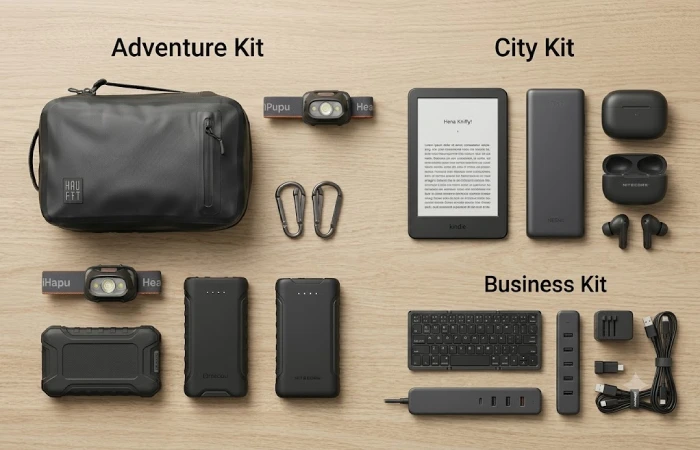
You don’t need all 25. Start with the row that fits your next trip.
| Trip Type |
Power |
Tracking |
Audio |
Organization |
Extras |
| Weekend domestic |
#3 or #4 (power bank) |
Skip |
#12 (earplugs) |
Skip |
#24 (luggage scale) |
| 1-week international |
#1 (adapter) + #3 |
#6 (AirTag) |
#10 (Pixel Buds) + #11 (AirFly) |
#14 (packing cubes) |
#20 (eSIM) |
| 2+ weeks backpacking |
#1 + #4 (budget bank) |
#6 or #7 |
#10 + #12 |
#13 + #14 + #15 (backpack) |
#20 + #23 (flashlight) |
| Business travel |
#1 + #5 (charging stand) |
#6 |
#9 (Bose) |
#13 + #16 (Peak Design) |
#8 (RFID wallet) |
| Digital nomad |
#1 + #3 + #5 |
#6 |
#9 + #11 |
#13 + #14 + #16 |
#20 + #21 (router) + #22 (camera) |
Pick the essentials row first. Add one or two items from other columns after your next trip tells you where the real friction is. Build the kit gradually, not all at once.
FAQ
1. Are power banks allowed on flights?
Under 100 Wh (roughly 27,000 mAh at 3.7V), yes, carry-on only. Most 10K–20K mAh banks fall well under that limit. Between 100 and 160 Wh, you need airline approval before boarding. Above 160 Wh, they’re banned. And never put a lithium-ion bank in a checked bag, regardless of size. These limits come directly from FAA PackSafe and IATA guidance: up to 100 Wh is generally allowed in carry-on baggage, 101–160 Wh may be allowed with airline approval, and anything over 160 Wh is usually banned on passenger flights.
2. What’s a GaN charger and is it worth paying more?
GaN stands for Gallium Nitride. It converts power more efficiently than silicon, so the charger runs cooler and fits more ports into a smaller shell. Worth the premium if you’re charging a laptop and phone off the same adapter. For phone-only travelers, a standard USB-C charger is fine.
3. Do I need a universal adapter for every country?
No. One good universal adapter covers 150+ countries. Ditch the collection of country-specific plugs.
4. AirTag 2 vs. other trackers?
iPhone users: AirTag 2. Apple’s Find My network is the largest globally. Android users: Samsung SmartTag 2 or the UGREEN tracker.
5. What travel gadgets are a waste of money?
Portable projectors, UV wands, and any suitcase with a battery that can’t be removed at the gate. Full reasoning is in the “What to Skip” section above.
6. How do I keep all this tech organized?
One pouch for cables and electronics. Packing cubes for clothes. Two containers, that’s the system. Overcomplicating it defeats the point.
7. Is an eSIM worth it for a 2-week international trip?
If your destination has coverage, yes. Check Airalo or Holafly before buying. You’ll pay less than carrier roaming, and you won’t spend your first afternoon hunting for a SIM shop.
These limits come directly from FAA PackSafe and IATA guidance: up to 100 Wh generally allowed in carry‑on, 101–160 Wh only with airline approval, and anything over 160 Wh usually banned on passenger flights.