Published: July 9, 2026
Last Updated: August 31, 2026
You have a trip coming up, and you don’t want to come home with photos that look exactly like everyone else’s phone snaps. The camera market doesn’t make this easy — it’s a mess of models, and telling which small camera is worth the money from which is just a spec sheet dressed up as a bargain takes actual work. So this guide skips the spec dump. It matches cameras to the kind of trip you’re taking instead.
Compact travel cameras in 2026 range from pocketable zoom compacts to vlogging cams, action cameras, and instant film. This guide matches each type to your trip, with current global and India pricing.
Definition
A compact travel camera is a small, portable camera that delivers better image quality than a phone using a larger sensor and dedicated optics, used by travelers to capture higher-quality photos and video on the move.
The best compact travel cameras in 2026, at a glance
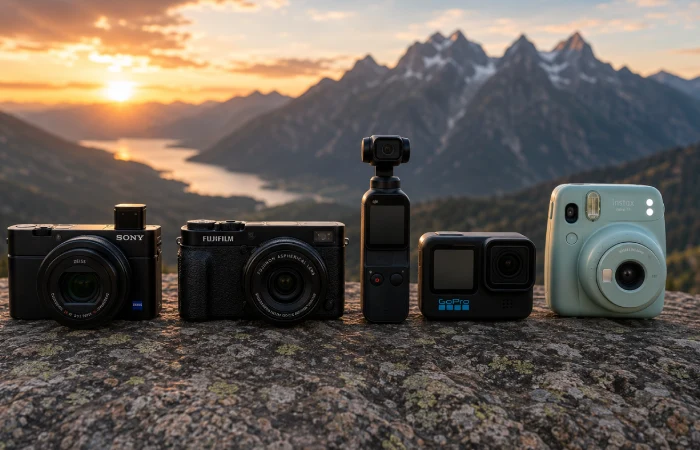
The best compact travel cameras in 2026 all do one thing a phone can’t: pack in a sensor bigger than what’s in your pocket already. Which one’s best depends entirely on what you’re shooting. Want reach in a pocket-sized body? The Sony RX100 VII. Chasing image quality above everything else? That’s the Fujifilm X100VI’s whole reasofn for existing. Video’s a different question — the DJI Osmo Pocket 3 wins that one outright — and if the trip involves sand, water, or anything likely to break a normal camera, the GoPro Hero 13 is the only real answer.
Do you actually need a dedicated camera, or is your phone fine?
For a lot of travelers, honestly, the phone is already good enough. A recent flagship handles daylight, casual street shots, and social sharing without complaint. If that’s all you want, save your money and put it toward packing the right travel gadgets instead.
A dedicated camera earns its place in three situations, though they’re not equally common. Low light is the big one — a bigger sensor pulls detail out of a dim temple interior or a night market that a phone just smears into noise. Reach matters too: optical zoom lets you frame a distant subject without the mushy digital crop a phone gives you. And then there’s control, for when you want manual settings and RAW files to edit properly later. None of those apply to you? You probably don’t need to keep reading.
How to match a compact camera to how you actually travel
Sensor size is the single spec that matters most. It drives low-light performance and image quality more than megapixels ever will. Small to large, you’ll see 1-inch sensors in premium compacts, then APS-C in the higher-end fixed-lens cameras — bigger sensor, better photos in hard light, but usually a bigger and pricier body to go with it.
After that, think about your trip. City breaks and general sightseeing reward a versatile zoom. Vlogging and video want a camera built for talking to a screen, with real stabilization. Beach, diving, or ski trips need something waterproof and rugged. And if what you actually want is the fun of a physical print to hand a friend, that’s a completely different kind of camera altogether.
The shortlist: top compact travel cameras compared
Here’s how the main picks stack up.
| Camera |
Sensor |
Best for |
Weight |
Approx. price |
| Sony RX100 VII |
1-inch |
Zoom in a pocket |
302 g |
~$1,500 / ₹1,25,000 |
| Panasonic Lumix ZS99 |
1/2.3-inch |
Budget zoom |
322 g |
~$700 / ₹60,000 |
| Fujifilm X100VI |
APS-C |
Image quality |
521 g |
~$1,800 / ₹1,80,000 |
| Ricoh GR IV |
APS-C |
Truly pocketable |
~257 g |
~$1,500 / ₹1,30,000 |
| DJI Osmo Pocket 3 |
1-inch |
Video/vlogging |
179 g |
~$520 / ₹45,000 |
| GoPro Hero 13 Black |
1/1.9-inch |
Adventure / waterproof |
154 g |
~$399 / ₹40,000 |
| Fujifilm Instax Mini 99 |
Instant film |
Physical keepsakes |
305 g |
~$200 / ₹15,000 |
For zoom and pocket size: Sony RX100 VII
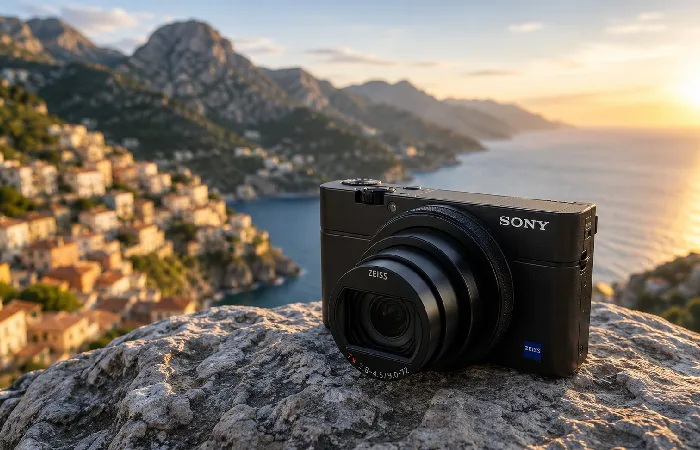
Pair a 1-inch sensor with a 24-200mm equivalent lens, stuff it into a body that still slips into a jacket pocket — that’s the entire pitch for the RX100 VII, and it’s a good one. That zoom range is what phones, and most rivals, simply can’t match. Sony hasn’t replaced it in years — DPReview confirms it’s still the current model— so stock can be patchy and the price has stayed high, but nothing else does pocketable zoom this well.
$1,500 is a real number to swallow, and if it doesn’t sit right, the Panasonic Lumix ZS99 is worth a look. It reaches further too — 24-720mm on a 30x zoom, more than anything else on this list — and costs under $700. What you give up is sensor size: 1/2.3-inch, well short of the RX100’s, and it shows up first in low light and in how much background blur you can pull off. Fine trade if reach matters more to you than image quality after dark.
For image quality: Fujifilm X100VI and Ricoh GR IV
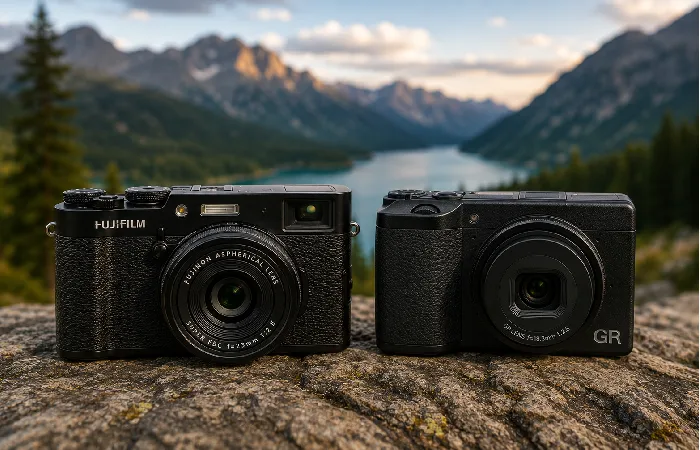
Both use large APS-C sensors and fixed focal lengths, so forget about zoom here. The X100VI packs a 40.2MP sensor and became enough of a cultural phenomenon that Fujifilm raised its US price from $1,599 to $1,799 — and it still sells above that. The Ricoh GR IV packs a 25.74MP APS-C sensor into roughly 262 grams, which makes it the pick when you want something that genuinely disappears into a trouser pocket. If you have to pick one, take the X100VI — the extra weight and higher price buy you a viewfinder and film simulations worth having, and the GR IV only wins if pocketability is non-negotiable for you.
Best pick for travel vlogging
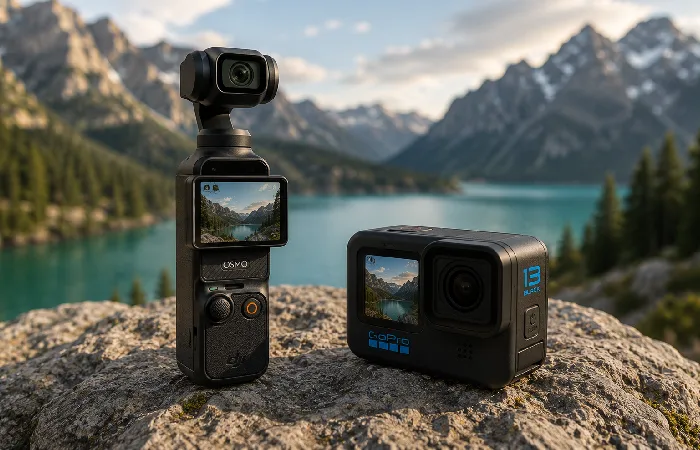
The DJI Osmo Pocket 3 addresses travel vlogging by combining a 1-inch sensor with a built-in gimbal, and honestly, a mirrorless camera isn’t where most travelers should start if video is the priority. DJI’s spec sheet confirms that 1-inch sensor, along with 179 g of weight and 4K/120fps recording — and the stabilization is smoother than anything you’ll get handheld from a normal camera. For talking-to-camera travel content, it’s the easiest recommendation on this list.
If you want something more camera-shaped, with a wider grip and mic options, the Sony ZV-1 II is the alternative. It carries a 1-inch sensor, an 18-50mm equivalent wide lens built for vlogging, and weighs 292 g. No viewfinder, but for vlogging that doesn’t really matter.
Canon’s back in this game too — the PowerShot V1 is built specifically for talking-to-camera content and is worth a look if you’re already in the Canon ecosystem.
For water, snow and adventure
The GoPro Hero 13 Black addresses adventure travel by staying waterproof to 10m without a housing, which covers most of what could drown a normal camera: the sea, a pool, snow. It’s the best 4K action camera for travel for most people. GoPro confirms that 10m/33ft waterproof rating with no housing needed, and at 154 g it still shoots up to 5.3K with stabilization that’s become the benchmark for the category. Deeper diving just means adding a housing rated to 60m.
The DJI Osmo Action range is the main rival here, and worth comparing on price wherever you shop.
Waterproof without the action-cam trade-offs: OM System Tough TG-7
The GoPro’s built for mounting on your head or your bike. If you just want something you can toss in a beach bag without a second thought, that’s a different job, and it’s where the OM System Tough TG-7 comes in. It’s waterproof to 15m without a housing, freezeproof to -10°C, and can survive a 2.1m drop or 100kg of crush weight — so sand, a dropped bag, a kid who doesn’t believe in gentle handling, none of it matters. The sensor’s small compared to the rest of this list, which shows up in low light. But for snorkeling, a ski weekend, or just refusing to worry about your camera for a week, it earns its spot.
Lightweight cameras with wifi for instant sharing
Nearly every camera on this list qualifies as lightweight with wifi, which matters more than people expect going in. Wifi transfer means you shoot on the good camera, send shots to your phone in a couple of taps, and post them before you’ve even left the café. The RX100 VII, X100VI, ZV-1 II, Osmo Pocket 3, and Hero 13 all handle this through their companion apps. If instant sharing is central to how you travel, confirm the app actually works well on your phone before buying — app quality varies more between these cameras than the hardware does.
For physical keepsakes: instant film
An instant film camera for travel memories does one thing no other camera here does: it hands you a physical print on the spot. Pricing sits around $200 as of mid-2026 for the Fujifilm Instax Mini 99, and for that you get color effects, brightness control, and manual-ish modes — more than most Instax models bother offering. It’s not free to run, though. Every shot costs money in film, so this stays a companion to your main camera rather than a replacement for it. People keep buying them for trips anyway, and once you’ve handed someone a physical print on the spot, you’ll understand why.
What to check before you buy
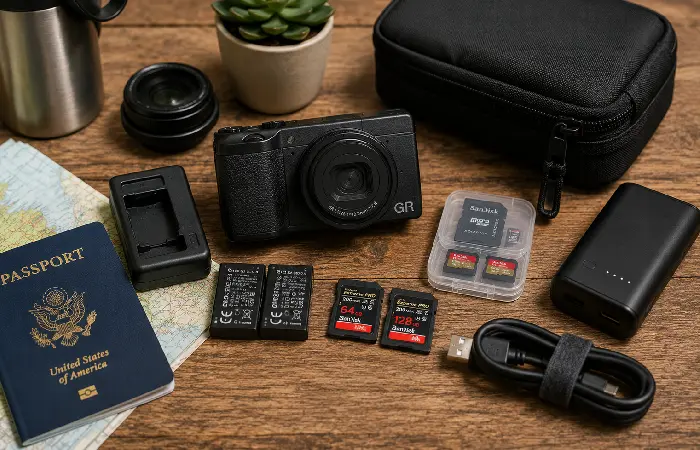
Before you commit, check three things. Battery life, because compacts run down fast — the GR IV manages around 200 shots a charge, the RX100 VII about 260 — so a spare battery is cheap insurance against a dead camera on day two. Storage matters just as much, since a fast SD card with enough capacity is what saves a ruined day. Pricing gets trickier if you’re buying in India: import duties and availability tend to push the RX100 VII and X100VI above their global price, while the Osmo Pocket 3 and Hero 13 stay easy to find and reasonably priced by comparison. Figure out which camera fits your trip before you worry about where it’s cheapest — chasing the lowest price on the wrong camera doesn’t save you anything.
If even that stings, used is a legitimate path here — a used RX100 V or VI typically runs $400–500 and still shoots well above phone quality. Stick to dealers like KEH or MPB who grade conservatively and take returns, since you can’t test a compact camera’s sensor before it arrives.
Camera sorted? There’s still the rest of the bag to think about — our guide to the best travel gadgets covers that part.
Frequently asked questions
1. Are compact travel cameras still worth buying in 2026?
Depends what you’re shooting. Low light, real zoom, print quality — yes, a compact still earns its keep. Daylight social snaps? Your phone’s already doing that job, for free.
2. What is the most pocketable compact travel camera?
The Ricoh GR IV, hands down. An APS-C sensor that still fits in a trouser pocket is a combination nothing else on this list pulls off.
3. Which camera is best for travel vlogging?
Most people should just get the DJI Osmo Pocket 3 — the built-in gimbal and 4K/120fps do the heavy lifting. If you want a more traditional body with mic inputs instead, grab the Sony ZV-1 II.
4. Do I need a waterproof camera for a beach or diving trip?
Yes. Full stop, if the camera’s actually going near water. The GoPro Hero 13 Black handles beach, pool, and snorkeling down to 10m with no housing required.
5. Is an instant film camera practical for travel?
As a fun extra, sure. The Instax Mini 99 hands you a physical print on the spot — just don’t expect it to replace your main camera, since every shot costs money in film.
6. Which compact camera has the best image quality?
The Fujifilm X100VI, no contest, running on a 40MP APS-C sensor. You pay for it two ways: no zoom, and pricing that tends to run above list because demand won’t quit.
7. Should I just get a small mirrorless camera instead?
If you don’t mind carrying a lens or two, a small APS-C mirrorless like the Sony a6700 will out-focus and out-flex anything here long-term. But that’s not really what this list is for — these cameras exist so you have something that lives in a pocket and comes out in two seconds flat.
Pick by what you’ll actually do with it, not by what tops a spec sheet. A GR IV that stays in a drawer because it’s one more thing to carry loses to a phone every time — the best camera on this list is the one you’ll actually have in your pocket on day three of the trip, tired, not really in the mood to think about settings.