Published: May 29, 2026
Last Updated: August 31, 2026
If you search “kitchen gadgets” in 2026, you’ll get a flood of shiny tools that promise faster dinners and less stress. Some are genuinely great. Others just move the work from “cooking” to “cleaning the gadget.”
This guide is for people who want weeknight cooking to feel easier—without turning their counters into a gadget museum. You’ll get a simple way to pick what’s worth buying, plus a shortlist of smart kitchen gadgets and practical cooking gadgets for home that save time where it actually counts.
Why kitchen gadgets feel “worth it” in 2026 (and why some don’t)
The real goal: fewer bottlenecks, not more stuff
The best kitchen gadgets aren’t “cool.” They remove the step you dread. For most home cooks, that’s one of these:
- Prep (chopping, peeling, measuring)
- Monitoring (timers, temperatures, stirring)
- Cleanup (grease splatter, stuck-on mess, too many tools)
- Storage (leftovers that leak, produce that spoils, freezer chaos)
- If a gadget doesn’t reduce at least one of those without creating a new problem, it’s not a time-saver.
The 4 time drains: prep, monitoring, cleanup, and storage
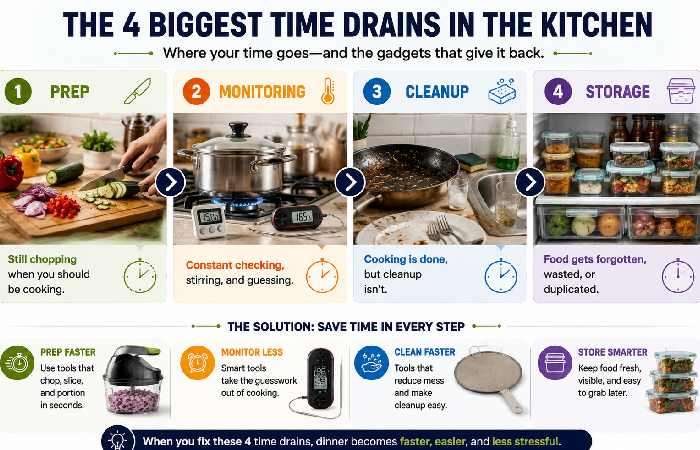
Here’s a quick self-check. When dinner feels slow, what’s the real reason?
- Prep time ballooned (you’re still chopping when you should be cooking).
- You are babysitting the stove (stirring, flipping, checking “Is this done yet?”).
- Cleanup punishes all in here (big pans, splatter, sticky sauces).
- You didn’t plan, so you’re making it up as you go along (and the fridge is not helping).
Pick your biggest drain first. Then buy the one tool that fixes it.
A quick “buy this first” checklist (3–5 kitchen gadgets you’ll use weekly)
If you want the shortest path to a smoother kitchen, start here. These are the “no-regrets” categories for most people.
Think of this as the quick start kit; it is not a shopping list you can complete in a weekend – choose one or two items that directly link to the bottleneck you respond to most frequently.
If you cook 3+ nights a week
- Multi-cooker (pressure + slow + sauté) for hands-off mains
- Instant-read thermometer for “is it done?” confidence
- Vegetable chopper for fast prep
- Stackable food storage for leftovers you’ll actually eat
If you meal prep on Sundays
- Large cutting board + sharp knife (prep goes twice as fast)
- Freezer trays + labels for portioned meals
- Digital scale for consistent portions and baking
- Blender or food processor (sauces, soups, chopped veg)
If you have a tiny kitchen
- Use one multi-cooker rather than 3 different ones.
- One countertop convection instrument (choose one: Toaster oven or Air fryer)
- Collapsible strainer and silicone liners (inexpensive storage)
- You can store many ingredients in these clear, stackable containers (fridge space becomes usable)
If you want to browse for wider picks outside of the kitchen, you can also view our main section on home gadgets.
Kitchen gadgets that save the most time (2026 picks)
This section is intentionally “big wins first.” These are modern kitchen devices that remove entire steps from the process.
Smart multi-cooker / pressure cooker
If you want the fastest “set it and walk away” upgrade, this is it. A good multi-cooker can:
- Pressure-cook a weeknight protein fast
- Slow-cook while you work
- Sauté in the same pot (less cleanup)
- Keep food warm without overcooking
Who it‘s for: families, meal preppers and those who hate washing multiple pans.
Watch-outs: pot size, lid storage, and whether the app actually helps (some do, some don’t).
Air fryer or convection toaster oven
An air fryer earns its spot when it replaces a pattern: “I’d cook at home more if it didn’t take forever.” It’s great for:
- Crisping frozen foods fast
- Roasting small batches of veggies
- Reheating leftovers so they taste fresh
If you‘re looking for one device to do everything other than air fry, a convection toaster oven could be the best choice.
High-torque blender (for sauces, soups, smoothies)
This isn’t just a smoothie thing. A blender can “delete” time by making:
- Pasta sauces in minutes
- Soft soups with no extra tools.
- Quick marinades and dressings
If you‘re a big cook, you would be using it more often than you realize.
Smart kitchen gadgets that actually work
Smart kitchen gadgets are everywhere in 2026, but the best ones do two things:
- Provide you with more information: ( time, temp, alerts, etc) and
- reduce hovering.
Smart thermometer (instant + predictive)
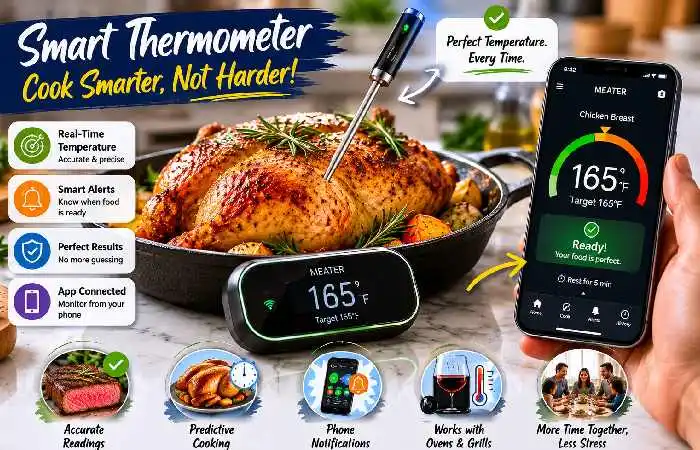
This is the “stop guessing” tool. It helps with:
- Chicken that is cooked thoroughly but not dry
- Steak timing you can trust
- Faster workflow you do not have to cut the food to check it in
Choose models with visible temperature signals and probe cables safe to have in the oven so that you can see when they are done without opening the door for check after check.
Food safety also falls within the value here when you‘re keeping an eye on doneness with a thermometer, USDA‘s safe minimum internal temperature chart is a straightforward guide (USDA safe temperature chart).
Smart scales and timers
Smart scales are not necessary, but having a decent digital scale (preferably a good one), is one of the most underappreciated time savers particularly if you like to bake or do any kind of meal prep. Less measuring, fewer bowls, more consistency.
A simple digital kitchen scale (that measures in grams and ounces) will do for most home chefs- you don‘t need a professional baking scale unless you are doing high volume or exotic types of baking.
Timers matter for speed because they reduce re-checking. A kitchen timer you can set hands-free (voice or a dedicated device) can be surprisingly helpful.
Connected appliances: what’s useful vs what’s noise
Connected features are useful when they:
- send you a meaningful alert (door left open, cycle finished)
- help you schedule runs (dishwasher, laundry) so your routine flows
ENERGY STAR notes that connected appliances can offer convenience features like alerts for an open fridge door and cycle‑status notifications (ENERGY STAR smart appliances).
If the feature requires you to open an app mid-cook for no good reason, skip it.
If you want a broader “smart living” list, see our guide to AI-powered gadgets for smart living.
Cooking gadgets for the home that make prep faster
Prep is where weeknight time disappears. These are the practical, low-drama tools that get you from “fridge to pan” faster.
Vegetable chopper (the “Tuesday-night” MVP)
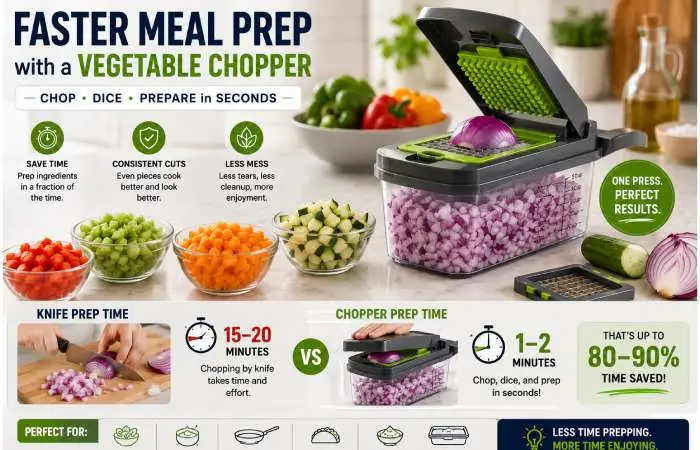
If you regularly cook with onions, peppers, carrots, potatoes and cucumbers in particular then a good chopper will save you precious minutes every week. It is also particularly useful for:
- salsa and salad prep
- Uniform cuts allow food to cook uniformly
Tip: Something easy to take apart and rinse. If you‘re making it a pain to clean you won‘t use it.
Garlic press/citrus press / microplane—small wins that quickly accumulate
These are tiny but they decrease resistance.
- Garlic press: faster than mincing and less sticky to clean up
- Citrus press: fast acidity lift without the seeds
- Microplane: quick zesting, ginger, and hard cheeses
You don‘t have to have all variations of this. Simply select the copy that you find yourself reaching for the maximum.
Quick set knife and cutting board to make all the following tasks quicker
This is the least glamorous upgrade, but it’s a real one:
- A large cutting board gives you room to work
- A sharp chef’s knife makes everything faster (and safer)
- If you’ve got dull knives, even the fanciest kitchen gadgets won’t fix your prep time.
Kitchen automation tools for cleanup and less mess
Time-saving is not only from the actual cooking process, but it can also be from the speed at which your following means of getting the kitchen back to normal.
Oil sprayer (fewer pans to scrub)
An oil sprayer can save you from overusing oil and usually prevents sticky, burnt-on ash. It can also be used for air roasting and frying.
Silicone liners, splatter screens, and strainers
These are quiet heroes:
- Silicone air fryer liners: easier basket cleanup
- Splatter screen: fewer grease spots on the stove
- Clip-on strainer: fewer bulky colanders
This is also where “modern kitchen devices” aren’t always electronic—sometimes they’re just smarter versions of old tools.
Storage that prevents “what’s for dinner?” chaos
Good storage saves time because it prevents re-cooking and re-shopping.
- Stackable containers
- Leak-proof lids
- Clear sides so you can actually see what you have
Modern kitchen devices to reduce decision fatigue (meal planning + storage)
Decision fatigue exists. If your fridge appears to be a mystery box, then cooking can feel more like hard work than it’s worth.
Portioning + freezer trays
Portioning tools are boring until you use them. Then they’re “how did I live without this?”
- Freeze sauces in 1-cup portions
- Freeze stock in smaller cubes
- Label with date + what it is
Labelling systems that don’t feel like homework
Keep it simple:
- masking tape + marker
- “date cooked” + “what it is”
If it requires more than 10 seconds to label something, you don‘t.
Typical errors people tend to make when purchasing innovative new kitchen products
The single-use trap
If it only does one thing, it has to do it so well that you’ll use it weekly. Otherwise, it becomes drawer clutter.
Guideline: If you don‘t think you would use a tool you purchased for any recipe at least once a week, then it shouldn‘t stay permanently in your kitchen.
Overbuying smart features
Smart functions are great when they eliminate hovering and additional steps, but it rapidly becomes a pain when they require more taps and app loading to accomplish much.
If you‘re creating an overall more automated house, smart kitchen gadgets work well with the standard home automation package of smart switches for home automation, but only if you keep it as simple as possible.
Ignoring cleanup time
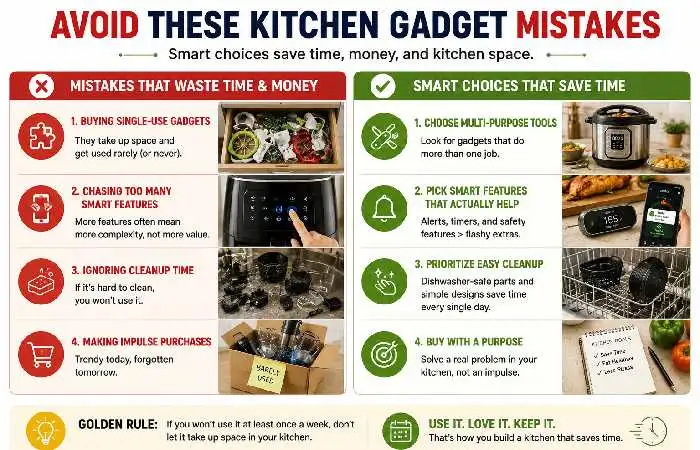
And this is the biggest miss. A little device that saves you 3 minutes of prep, but then takes another 10 minutes to clean, isn‘t a win. So when you‘re making your comparison, take a look at how many bits will go in your dishwasher, and whether you can rinse all the rest under the tap in under a minute.
As you shop remember if I buy [this] how late I will be up cleaning it.
FAQ
1. What are the Top Time Saving Kitchen Gadgets of 2026?
Start with a decent thermometer, multi-cooker, and vegetable chopper, and stacking storage. The four will cover the prepping, checking, and storing of leftovers.
2. Are smart kitchen gadgets worth it?
A handful of them. As we become more of a connected home, useful alerts or smart thermometers can be welcomed (i.e. fridge door open). Don‘t offer anything that adds steps to a task within an app when there is no time saving.
3. What’s the one gadget that saves the most time?
For most its a multi-cooker (pressure + Slow + saute) it replaces many different implements (example. Pressure and Slow cookers) and minimises time hands-on.
4. Do I need expensive brands to save time in the kitchen?
Not necessarily. Most of the “midrange” brands will have one or more decent multicookers, air fryers, and blenders that do the job for day-to-day cooking, it‘s really a matter of build quality, capacity and how easy everything is to clean.
5. How do I avoid wasting money on gimmicks?
Only buy equipment that will assist you with a problem you have on a weekly basis, and that is also easy to clean. If it is a pain to wash, you won‘t use it.
6. What is the maximum number of kitchen gadgets I should purchase at a time?
Start with 3 to 5. Two weeks and see what still isn‘t allowed to send in your momentum then try again.
7. What’s better: toaster oven or air fryer?
If you prefer the crispiest result with minimal fuss when cleaning up, then purchase an air fryer. If you want a multi-function counter-top oven that toasts, as well as doing its usual roasting and baking functions, purchase a convection toaster oven.
Build Your Time-Saving Kitchen Roadmap
Rather than purchasing all the appliances you need at once, purchase one appliance at a time, beginning with the worst offender, a prep, monitoring, cleanup or storage item. Incorporate new tools slowly as your system improves. This layered solution will save you more time and money and will help keep counters clear of clutter.
Final take: build a “time-saving kitchen” in layers (not all at once)
In our view, the smartest way to buy kitchen gadgets in 2026 is to build in layers:
- Fix prep,
- Fix monitoring,
- Fix cleanup,
- Fix storage.
Start with the bottleneck you face this week, then introduce the next tool as the first one becomes second nature. That‘s how to have a kitchen that operates more quickly and without clutter.