Published: July 8, 2026
Last Updated: August 31, 2026
This guide draws on publicly available sources and manufacturer specifications, along with expert reviews that are already out there.
You get to the hotel, unzip the bag, and there it is: your shirt, looking like it lost a fight somewhere between check-in and baggage claim. The iron in the closet is missing, or it’s crusted with someone else’s starch, or it runs so hot it’ll leave a shine on anything darker than beige. A decent handheld steamer sorts that out in about two minutes, hanging, no board required. The trick is picking one that won’t die the second you plug it into a foreign wall. That’s most of this guide.
Quick gut check: the steamers worth packing in 2026 run dual voltage (100–240V), heat up in under a minute, and stay under two pounds. Get the voltage right for where you’re flying, drain the tank before airport security, and you’ll land with a shirt that looks pressed, not panicked — no hotel iron required.
Definition
Think of a portable travel steamer as the compact, handheld cousin of a full-size garment steamer — it knocks out wrinkles with pressurized steam instead of flat heat, so frequent travelers can freshen up clothes on the go without hauling an ironing board along.
What a portable travel steamer actually does
Steam over flat pressure — that’s the mechanical difference from an iron, and it’s why you don’t end up with a scorch mark or a board to fight with. Dual voltage is what separates the decent 2026 models from the rest, running somewhere between 100 and 240V, so a different country’s outlet stops being a gamble. Fifteen to forty-five seconds to heat up. Under two pounds on the scale. That’s not an accident. It’s built to vanish into a carry-on.
Why hotel irons keep letting you down
Honestly, the hotel iron is a gamble you lose more often than you win. Half the time it’s not in the room. When it is, the plate’s scorched or spitting brown water onto a white collar. A steamer skips all of that. You hang the garment, run the head down it, and the wrinkles relax. No board to wrestle open, no scorch mark to explain at the front desk.
What to look for before you buy
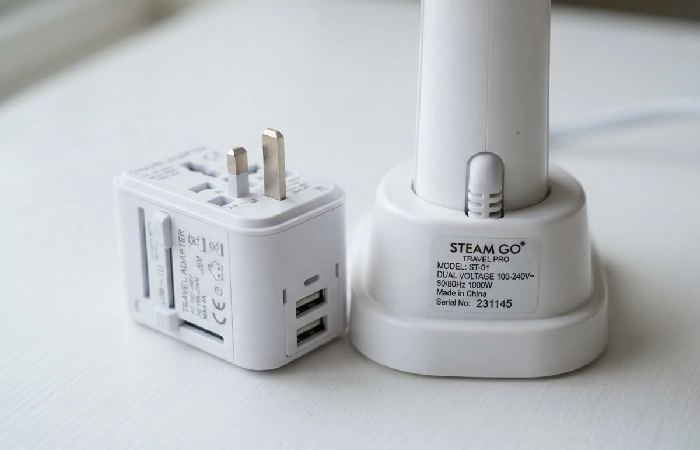
Most people get this part wrong: dual voltage and a plug adapter are not the same thing. An adapter only reshapes the prongs so they fit the socket — it does nothing to the current running through them, which is the part that actually matters. Try a 120V-only steamer on a 240V European outlet with just an adapter, and you’ll smell it before you see it. The device itself has to handle the higher current, and that’s what dual voltage (100–240V) actually does. This isn’t a nice-to-have for anyone flying internationally. It’s the whole decision.
If you’re not sure which voltage a country uses, a quick check on a site like the World Standards voltage guide before you pack beats guessing at the airport.
Heat-up and steam output. Under 60 seconds is the bar, and plenty of 2026 models hit 15. Steam output matters more than the spec sheet lets on. A steam output in the mid-to-high teens (grams per minute) is usually enough to work through thick cotton instead of just dampening it — check the spec sheet rather than assuming, since output varies more between models than tank size does. Wattage is worth a glance too. Most travel steamers land somewhere between 700W and 1800W, and as a rough rule, more watts means faster, stronger steam, though it’s the combination with tank size and heat-up time that actually tells you how the thing performs, not wattage alone.
Size, weight, tank. Under a pound, six to nine inches, and it slides in beside your shoes. Bigger tanks mean fewer trips to the bathroom sink mid-steam. That’s the trade: capacity against bulk. In practical terms, most portable tanks buy you somewhere between 8 and 15 minutes of continuous steam before you’re refilling, which matters more than the raw milliliter number on the box. And check for a leak-proof or anti-drip design before you buy. Cheaper models are notorious for dribbling hot water partway through a session, which is a bigger long-term annoyance than a slightly smaller tank.
Best portable travel steamers for 2026
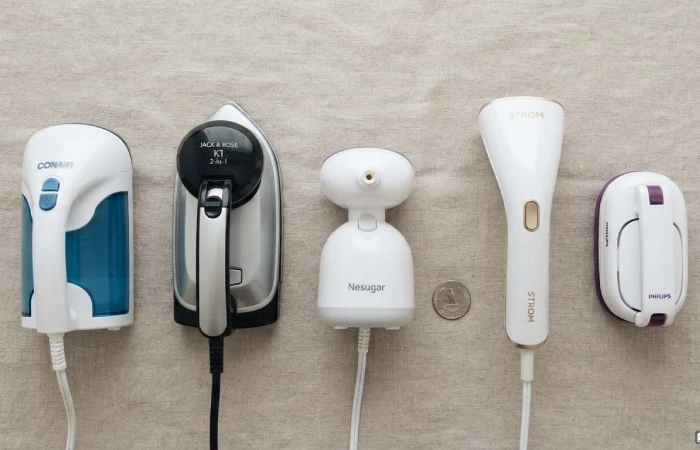
Specs and prices below are drawn from publicly listed manufacturer and retailer information as of mid-2026 — worth double-checking the live listing before you buy, since these shift.
| Model |
Voltage |
Heat-up |
Weight |
Tank |
Price (USD / INR) |
| Conair Power Steam GSC24 |
Dual 120/240V |
35 sec |
1.4 lb |
100 ml |
~$45 |
| Jack & Rose K1 (2-in-1 steam + iron) |
Dual 100–220V |
15 sec |
1.6 lb |
155 ml |
~$60 / ₹4,000 |
| Nesugar G2 Pro |
Global 100–240V |
15 sec |
0.8 lb |
75 ml |
~$40 / ₹12,200 |
| STROM GO v2 |
Dual voltage |
30 sec |
ultra-light |
120 ml |
₹3,099 |
| Philips STH5030 5000 Series |
240V (India) |
35 sec |
~0.7 lb |
70 ml |
₹6,499 |
Best overall goes to the Jack & Rose K1. It’s a hair heavier at 1.6 pounds, but the 15-second heat-up and the 2-in-1 head that flips between steaming and pressing earn the weight.
Best budget is the STROM GO v2 at ₹3,099, cabin-legal and light.
Best for international is the Nesugar G2 Pro, palm-sized at 0.8 pounds and genuinely global on voltage, though the imported INR price stings. And look, if you want the smallest possible thing that still works, the Philips STH5030 is barely over half a pound.
One caveat on the tiny models. Small tank, frequent refills. A 70ml reservoir on the Philips gets you through a shirt and maybe a jacket before it’s asking for more.
Prices shift constantly on these — check the retailer listing before you buy rather than trusting a number printed months ago.
Steamer or travel iron: which one you actually need
Most people don’t need both. A steamer handles light to medium creasing, delicates, viscose, the polyester blends most travel clothes are cut from. An iron was built for a different job entirely — the knife-sharp trouser crease, cotton that’s been crushed into submission, pleats that need to lie flat and stay there. Tailored trousers on the itinerary? Pack the iron, or split the difference with a 2-in-1. For nearly everyone else, the steamer’s faster and safer on more fabrics.
Here’s the part people don’t think about until they’re staring at a pair of dress pants: steaming will never give you the crisp line an iron leaves behind. If the outfit depends on a sharp edge, no amount of steam time gets you there.
How to use a travel steamer without ruining your clothes
Start with demineralized water if you can get it — tap water works, but the minerals build up in the head over time and clog it. Don’t rush the first pass, either. A steamer that hasn’t come to full heat yet just spits lukewarm water at the fabric instead of steaming it. Once it’s ready, work vertically, top down, fabric pulled taut in your free hand.
One rule people forget until an airport bin swallows their steamer: empty the tank before you fly. Airport security won’t wave a full tank through, either — TSA’s carry-on liquids rule caps any container at 100ml (3.4oz), and a steamer reservoir blows past that fast. Drain it before you’re anywhere near the belt, pack it with the rest of your essential travel gadgets, done.
Buying and pricing in India
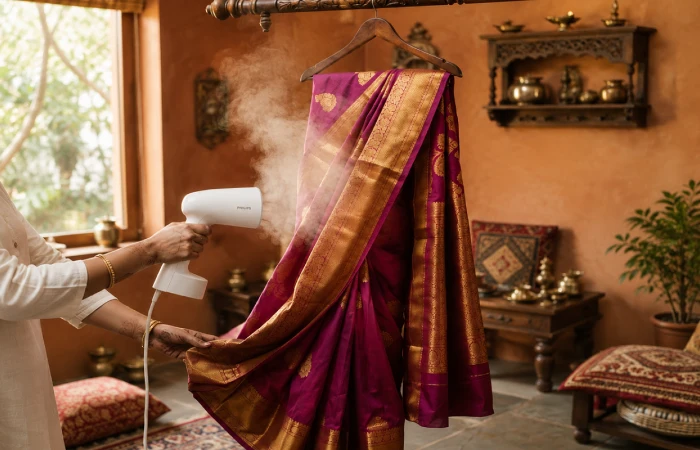
Indian buyers have it easier than the imported-gadget crowd assumes. Local-voltage models start around ₹3,000 with the STROM GO and climb toward the mid-thousands for locally stocked options like the Philips 5000 Series, sold on Amazon.in without the customs-duty markup that pushes imported units like the Nesugar well past ₹10,000.
There’s a use case Western guides miss entirely, too. Steamers are excellent on sarees and layered suits, refreshing the drape while the garment hangs instead of fighting yards of fabric across a board.
FAQ
1. Can you bring a travel steamer in your carry-on?
Yes, in either carry-on or checked. Just empty the water tank first — TSA’s 100ml carry-on liquids rule applies, and a full reservoir draws scrutiny at the belt.
2. Do they work on every fabric?
No. Steam is great on cotton, linen, viscose, and most blends. Silk and heavily structured pieces need a gentle hand and some distance, and a few delicate synthetics don’t take steam at all, so check the care label.
3. Steamer or iron for travel?
Steamer, for most people. It’s lighter, safer on more fabrics, and faster to set up. Reach for an iron only when you need a pressed crease.
4. If it’s dual voltage, do I still need an adapter?
Yes. Different question entirely. Dual voltage handles the electricity; the adapter just makes the plug physically fit the socket. Abroad, you usually need both.
5. How fast do they heat up?
The 2026 models are quick. Fifteen seconds on the fastest, up to about 45 on older designs.
Tap water or not?
Tap works in a pinch. Demineralized is better long-term, because hard-water minerals build up and clog the steam holes.
The right portable travel steamer is simply the one you’ll actually pack. Nail the voltage for where you’re headed, glance at the heat-up time, and pick one now so the next trip starts with a shirt that’s ready before you are.