Published: June 9, 2026
Last Updated: September 18, 2026
Your energy bill doesn’t care about your good intentions.
Most of the “ecogadget” recommendations, however, never actually help you answer the question that really has homeowners stuck: Will this pay for itself before it breaks? This guide shows typical “payback” periods on all common eco home gadgets using the best available prices, incentives, and real-world US, UK, and Indian examples.
Here’s what you’ll get: specific gadget recommendations matched to your region, real payback timelines (not marketing fluff), compatibility checks for older homes, and the hidden energy drains that most guides completely ignore. In this guide, we use real‑world examples from the US, UK, and India as reference points, but the ROI framework applies broadly to other regions with similar climates and energy prices. If you’re exploring the full range of home gadgets available in 2026, this is where sustainability meets the spreadsheet.
Why Eco-Friendly Home Gadgets Matter in 2026 (& What’s Changed)
The 89% Consumer Shift: Why Now Is Different
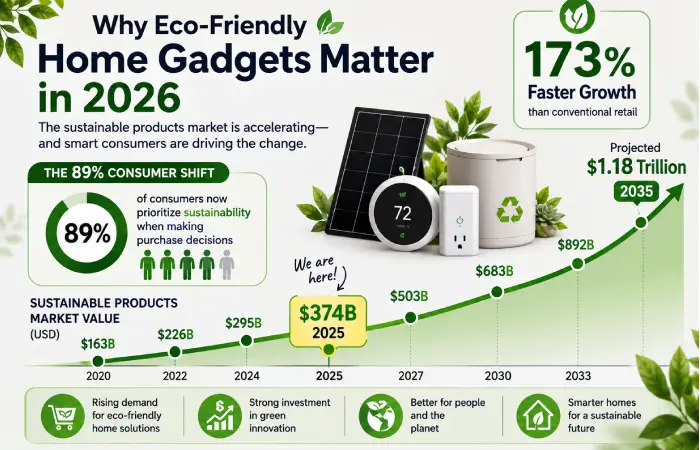
Some change took place between 2023 and 2026. 89% of consumers worldwide claim they have changed the way they buy things in favour of more environmentally friendly goods. That‘s not niche anymore. That‘s mainstream.
The sustainable products market supports this. Precedence Research‘s valuation of the sustainable materials market was USD 374.67 billion in 2025, with a 12.19% CAGR projected between 2022 and 2035, reaching a value of USD 1.18 trillion. The US eco-friendly retail industry is growing 173% more quickly than traditional retail.
But what finally changed for home eco-devices: the prices plummeted, the compatibility became higher,, and the incentives became more attractive. A smart thermostat that in 2022 cost $ 350 could be bought at $180–250 with compatibility with the HVAC systems of the last 15 years. In many states, the solar+storage prices are now comparable or even lower than a grid connection in the life of the system, considering the peak pricing and incentives. Were the other barriers easily lowered so that, in 2023, most eco-gadgets felt like a luxury buy? Almost all.
Hidden Energy Drains Most Homeowners Miss
Firstly, you need to find out what is leaching money from your wallet. Phantom loads (power used by appliances when they are “off”) are around 5–10% of the electricity consumption in a US home, which works out at around $100–150 a year for the average family, according to the US Department of Energy. That‘s your TV on standby, your microwave clock and your mobile charger with nothing plugged into it.
Most ecogadget guides that you encounter have ‘smart plugs’ in the list, and then they leave. They don‘t tell you that your ‘on standby’ gaming console uses 10–15watts all the time, that your set top box uses 25–35watts all day, and that, if you leave five chargers plugged in all year, this will send you back about $30.
But that knowledge would certainly alter your order of preference. There are times when a $500 solar panel isn‘t the best environmental device. Rather, it‘s a $25 smart power strip that eliminates phantom power suctions automatically.
Carbon Debt vs. Gadget Investment: The True Cost of Waiting
Every device has embodied carbon (the emissions from its manufacturing and shipping). Lifecycle analyses of small consumer electronics suggest that a smart thermostat can come with tens of kilograms of CO₂ in embodied carbon before you even install it. But it can avoid well over a ton of CO₂ per year through reduced heating and cooling in many homes, depending on your climate and current energy use.
In many cases, that means the carbon payback period can be very short, often measured in weeks rather than years. After that, you’re in net-positive territory for the rest of the device’s 8–12 year lifespan. Waiting a year to “save money” actually costs you 1.5–2.5 tons of emissions you could have avoided.
A similar pattern often holds for other major eco‑gadgets that cut energy use significantly over many years. Solar panels take 1–3 years for carbon payback. Electric composters, about 6 months. The only exception is electronic devices with a very short life span or equipment replacing functioning items.
Smart Thermostats: The Energy-Saving Workhorse
How Smart Thermostats Actually Save Money (Real Numbers)
Smart thermostats also mean that you have control of your temperature from your mobile. They will also learn people’s behaviour around the house and when you are likely to leave, turn the heating/air conditioning off depending on the real-time energy price and market rates, and also take into consideration the weather forecast.
In typical homes, real‑world savings often fall into ranges like these:
| Scenario |
Annual Savings |
Key Factor |
| US household (gas heating) |
$150–$250/year |
Heating runtime reduced 15–23% |
| UK household (gas central heating) |
£180–£320/year |
Heating degree days, insulation level |
| Indian household (AC-dominant) |
₹8,000–₹15,000/year |
Cooling optimisation, peak avoidance |
| Well-insulated home |
Lower end of the range |
Less room for improvement |
| Poorly insulated, older home |
Higher end of the range |
More waste to eliminate |
According to ENERGY STAR, average savings on heating and cooling costs for certified smart thermostats are approximately 8%. For those living in homes with unpredictable schedules, multiple people or ageing HVAC systems, savings are likely to be greater.
Regional Payback Timeline: US vs. UK vs. India
- US (heating-dominant regions): Device costs $180–$250. DIY installation. Average savings $200/year. Payback: 12–15 months. IRA doesn’t cover thermostats directly, but some state utility rebates offer $50–$100 back.
- UK: Device costs £130–£250. Professional installation often costs £60–£120 extra. Average savings £250/year at current gas prices (£0.07/kWh gas, £0.245/kWh electricity as of Q2 2026). Payback: 12–20 months. Some energy suppliers offer free or subsidised smart thermostats under ECO4 schemes.
- India: The device is estimated at ₹12,000–₹22,000. An average saving of ₹12,000/year in AC-dense cities (Mumbai, Chennai, Delhi, summers), 2007. Payback period: about 12–18 months
Payback:12 to 18 months. Not directly subsidised by the government, however, BEE-rated ACs combined with smart thermostats increase savings.
Compatibility Check: Will It Work With Your HVAC?
This is the question most guides skip, and it’s the one that causes the most returns and frustration.
It‘ll work if you have a C-wire or can put one in or buy a C-wire adapter (costs $15–$30). Your system was installed after 2008. You have a normal forced-air, heat pump or radiant system.
It may not work if you have a proprietary system (most Mitsubishi and Daikin units). Your boiler uses a non-standard voltage. You have a gravity-fed hot water system (fairly common in old UK homes pre-1970).
Quick check: Look at your current thermostat. Count the wires behind it. If you see 4+ wires, including a blue or labelled “C” wire, you’re almost certainly compatible. Two-wire systems (common in older UK homes) need a relay kit, which adds £40–£80.
Top Picks: Ecobee vs. Google Nest vs. Indian Alternatives
| Feature |
Ecobee Premium |
Google Nest Learning (4th Gen) |
Honeywell Home T9 (India-available) |
| Best for |
Multi-room homes (includes room sensor) |
Hands-off learners |
Indian HVAC compatibility |
| Approximate price range |
$220–$250 |
$230–$280 |
₹15,000–₹19,000 |
| C-wire required? |
No (has Power Extender Kit) |
Yes (or adapter) |
No |
| Works with |
Alexa, Google, HomeKit, Matter |
Google Home, Alexa, Matter |
Alexa, Google (no HomeKit) |
| Standout feature |
Built-in air quality monitor |
Schedules itself in ~1 week |
Humidity-aware (tropical focus) |
Users on Reddit’s r/homeautomation consistently report that Ecobee’s room sensors make the biggest difference in homes with hot/cold spots. Google Nest gets praise for its set-and-forget learning but criticism for its closed ecosystem. For Indian buyers, Honeywell’s tropical humidity management and wider voltage tolerance tend to get better long-term reviews than imported Nest units.
If you’re interested in the automation intelligence behind these devices, our guide to AI-powered gadgets covers how machine learning drives their learning algorithms.
Solar-Powered Gadgets & Home Battery Storage
The 2026 Solar Cost Reality
SOLAR PV costs are an estimated 82% cheaper since 2010, as found in IRENA‘s cost reports on renewable power. However, what is relevant to those using home appliances is not the utility scale price but the relative cost of equipment.
In Q2 2026, here’s where things stand:
- Rooftop panels: (US):$2.50–$3.20/W installed 6kW system: $15k–$19.2k (~$2089–$3199/W) before incentives.
- Rooftop panels (UK): £1,500–£2,500 per k W installed. 4 kW system: £6,000–£10,000.
- Rooftop panels (India): ₹40,000–₹60,000 per k W. For a 3 k W system: from 1.2 lakh to 1.8 lakh.
- Portable solar chargers: $50–$150 for 20–100W panels.
- Solar-powered outdoor lights: $20–$80 per set.
- Home battery storage (per kWh): $400– $600 (US), £350–£500 (UK), ₹35,000–₹50,000 (India).
This is a huge gap -solar gadgets (chargers, lights, power banks) versus “solar energy systems” (rooftop panels). The former are impulse buys, with a 6 to 12 month payback; the latter are 5 to 8 years.
Beyond Panels: Solar Chargers, Lights & Portable Banks
For most homeowners who aren‘t interested in rooftop panels, these three categories offer quick ROI without the installation hassle:
- Portable solar chargers (20W – 100W): Power phones, tablets and small batteries. For use: outdoor, in emergencies and off-grid for small devices. Actual savings: $20 – $50/year. Cost recovery: 6 – 18 months.
- Sunlight pathway and garden lights: Completely replacing wired outdoor lights. No cost for electricians, wiring, or running electricity long term. Can last 3-5 years. Return on investment: instant ( compared to the cost of setting up wired alternatives).
- Solar (20,000–50,000 mAh): Morning recharge, nighttime use. A premium in India, albeit one that pays handsomely, given the cloud-cuckoo-grid system. Operators claim monthly costs for phones/tablets have been cut to near nothing.
Government Incentives That Cut Solar Cost by 30–50%
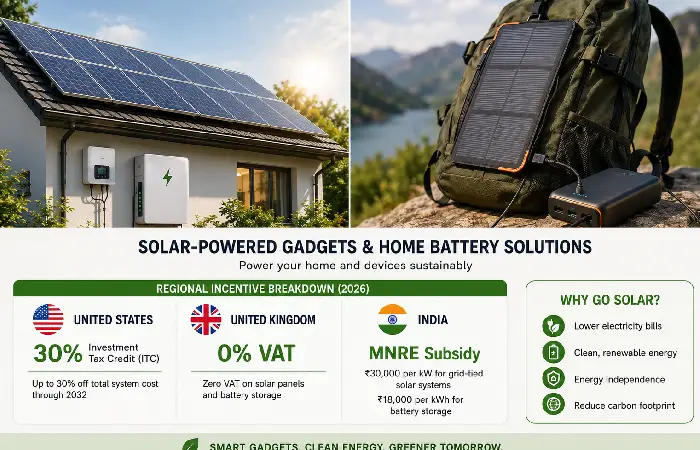
- In the US, the federal Investment Tax Credit, per the Inflation Reduction Act, pays for 30% of the whole system cost for residential solar and eligible batteries through 2032. Battery storage systems also qualify even when retrofitted to existing panels. Additional rebates of an extra 10–25% are available from many states. An $18,000 system could end up with a $12,000–$13,000 rebate.
-
UK: In 2026, there‘s no direct subsidy for solar, but the Smart Export Guarantee (SEG) will remunerate 3–15p/kWh for power exported. VAT on residential solar was reduced to 0% in 2022 and it is still at 0%. Coupled with the imported electricity cost cut at 24.5p/kWh, the effective payback period is between 5 and 7 years.
- In India, incentives under the PM Surya Ghar scheme can reduce the installed cost by 40–60% for systems up to 3kW.
Water Conservation Tech
Smart Irrigation Controllers: 30–50% Water Reduction
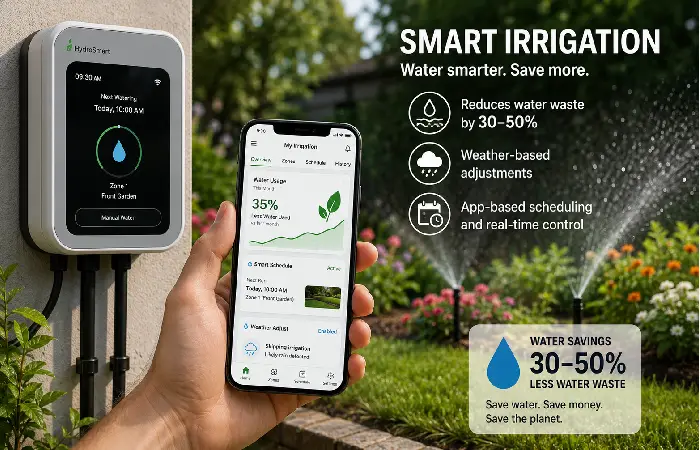
Smart irrigation controllers are based on local weather data, soil moisture and evapotranspiration calculations, and only water if the plants actually require water. Older timer-based systems water on a schedule even if it rained yesterday.
According to EPA WaterSense data, smart controllers reduce outdoor water use 30–50% versus timer systems. For an average US household with $50–$100/month irrigation bill (Burke et al. 2011)–typical for the Southwest–that‘s $180–$600/year from a device costing $150–$300.
In India, smart irrigation is more relevant to homes relying on a borewell. Aquifer overextraction is more rapid in India, Maharashtra or Tamil Nadu. The combination of a smart controller and drip irrigation system can reduce by 40 60% the amount of water needed to sustain a garden during the dry season.
Rainwater Harvesting: Setup, Cost & Payback
Rainwater harvesting varies from a barrel (80-200) to an underground tank (2000-8000). The payback of such depends very much on the region‘s water charge and rainfall.
- UK: The 1,200mm/year average rainfall means it works. The cheapest 200-litre butt is GBP40–GBP80 and should reduce garden watering bills by GBP50–GBP100/year. How long before it pays back? Less than a year.
- India: As in the north-east, there is a mandatory installation in new buildings in some states (Chennai, Bangalore, Hyderabad). Budget for installation: 30,000–1,50,000 depending on capacity. Return on investment for this range is highly variable, depending on water price and the reliability of the monsoon.
- US Southwest: With little rainfall, large-scale harvesting is not feasible, but even small-scale systems (500-gallon tanks) can reduce landscape irrigation by 20–30% in at least one Phoenix or Las Vegas location.
Leak Detection Gadgets
A single unnoticed leak can cost $200-$500 and use 10,000+ gallons/year. Whole-house smart leak detectors ($50-$150) can monitor the main water line and will send a notification through an app within minutes of abnormal water flow.
Users constantly tell us how these pay for themselves after a single toilet flapper leak or slow pipe drip. In India, it is not unheard of to see water bills spike from 500 to 5,000 in one month, and finding a leak early on ensures you do not have to pay for excessive water consumption.
Composting & Waste Reduction Gadgets
Electric Composters vs. Traditional Bins
Electric composters (Lomi, Reencle, Vitamix FoodCycler) compost food scraps into amended soil in a shorter span ( 4 to 24 hours) as opposed to conventional buckets, which take a longer time, from 3 to 6 months. However, the comparison is complex.
| Factor |
Electric Composter |
Traditional Bin |
| Speed |
4–24 hours |
3–6 months |
| Smell |
Minimal (carbon filter) |
Can be significant |
| Space |
Countertop (small kitchen friendly) |
Outdoor garden required |
| Cost |
$300–$600 + filter replacements ($30–$50/year) |
$30–$150 one-time |
| Energy use |
0.5–1 kWh per cycle |
Zero |
| Output quality |
Pre-compost (still needs curing) |
Finished compost |
| Best for |
Apartment dwellers, no outdoor space |
Gardeners with yard space |
Here’s my honest take: electric composters are convenient, not superior. The output from a Lomi isn’t true compost. It’s dehydrated and ground food waste that still needs weeks in soil to break down fully. For apartment dwellers with no outdoor space, they’re genuinely useful.
Any type of garden you own, traditional compost bins produce great compost at low cost and no electric bill.
E-Waste Disposal: Where Old Gadgets Go
For this is the part no one wants to discuss. Any purchase of a new eco-friendly gadget leads to the disposal of the older model. An estimated 62 million tonnes of ewaste were dumped around the world in 2022, 202 of which were properly disposed of, while the rest were dumped, as per the UN Global Ewaste Monitor.
Here‘s the one no one wants to mention. When you buy a new eco- device your replacing the old one. Worldwide, an estimated 62 million tonnes of e-waste were created last year, and less than a quarter of this was effectively recycled. UN Global EWaste Monitor.
Before buying any new eco-gadget, check:
- Manufacturer buyback and trade-in policy? (Yes, Apple, Samsung and Google do; most smart thermostat brands do not.)
- However, are there any R2 or e-Stewards certified e-waste recyclers in your region?
- Is it possible to pass on or trade in your old piece of kit? A functional ‘dumb’ thermostat is still worth something.
Embodied carbon from a new device doesn‘t make sense if the old one isn‘t disposed of appropriately. You‘re just exporting the burden.
Smart Lighting & Phantom Load Killers
The Silent Energy Vampire Costing You $100+/Year
The most underrated energy waste in most homes is the phantom load. US. Department of Energy reports that standby power in the US is 5–10% of all usage.
Here’s what that looks like in real numbers:
| Device |
Standby Power |
Annual Cost (US at $0.16/kWh) |
| Gaming console (rest mode) |
10–15W |
$14–$21 |
| Cable/satellite box |
25–35W |
$35–$49 |
| Desktop computer (sleep) |
3–10W |
$4–$14 |
| Smart TV (off but plugged in) |
1–5W |
$1.40–$7 |
| Microwave (display clock) |
3–4W |
$4–$5.60 |
| Phone charger (no phone) |
0.1–0.5W |
$0.14–$0.70 |
| Total (typical home, 15–20 devices) |
50–100W |
$70–$140 |
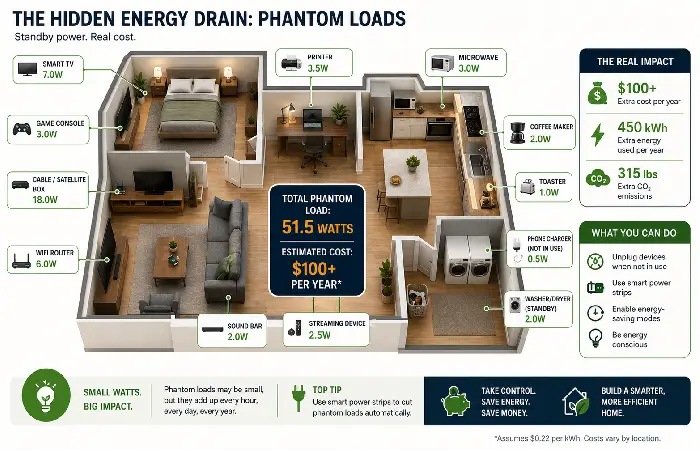
A smart power strip ($25–$45) that cuts power to peripherals when the main device turns off would eliminate 60–80% of power in a single entertainment center. That‘s $40–$80/year from one strip.
Smart Plugs & Energy Monitors
Smart plugs ($15-30 each) allow programmed blackouts, per-device consumption monitoring, and remote standby elimination. The real savings, though, are in whole-home energy monitors ($100-300), which attach to your electrical panel.
These monitors (Sense, Emporia Vue, Shelly) show you exactly which circuits draw power, when, and how much. Many users on r/homeautomation say that the first month of monitoring helps them uncover tens of dollars per month in avoidable energy use they didn’t realise they had.
For readers looking at these from a pure price perspective, our budget gadgets guide covers the most cost-effective smart plugs and power strips available in 2026.
Climate-Specific Gadget Matching: Tropical, Temperate & Arid
Tropical (India): Cooling-First & Humidity Control
The weather in India is so hot that cooling is becoming a high-cost energy. Research in urban Indian households shows that in the height of summer, the share of a household‘s electricity consumption due to air conditioning is quite high in the cities of Mumbai, Chennai and Delhi.
Priority gadgets for tropical climates:
- Smart thermostat and humidity aware (to avoid overcooling the designed heated spaces, both wasting your energy and causing condensation problems)
- As in India, which is one of the regions of the world receiving the highest solar radiation, around 4–7 kWh/m 2 /day on average (generally taken to be 4.7 kWh/m 2 /day). Solar panels are being scaled up all over the country. Moreover, intelligent ceiling-fan controllers can reduce air-conditioning run-times by approximately 20–30% if used in conjunction with appropriately sized fans
- Dehumidifiers with intelligent scheduling (monsoon months create risks of mould; operating only when humidity rises above 60% saves 40% compared to operating all the time)
The biggest mistake Indian homeowners make is purchasing a smart thermostat aimed at a heating-focused market. Opt for those that optimise exclusively for cooling cycles and are tested to operate in 45°C+ ambient.
Temperate (UK): Heating Efficiency & Seasonal Grid
The UK’s energy challenge is heating, not cooling. Gas central heating accounts for roughly 60% of household energy use. Winter months (October–March) account for 70% of the annual energy spent in six months.
Priority gadgets for temperate climates:
- Smart thermostat with TRV control (controls individual radiators rather than just the boiler)
- Affordable TRVs (Thermostatic Radiator Valves) on every radiator ($30–60/each, saves £100–£200/year by not having to heat empty rooms)
- Draught sensors (susceptible to current gaps that allow heat to escape); smart sensors
- Solar with battery (less current during winter but larger overproduction in summer stored for as long in the evening)
The UK grid is also more and more time-of-use priced. Smart battery systems charging at 7p/kWh overnight and discharging at 24.5p/kWh during the day can save £400–£800/year for a solar+battery home. The Future Homes Standard (from 2025) will increasingly require smart controls for new builds, so to start early, avoid redoing so much later.
Arid & Continental (US): Solar Potential & Peak Demand
The developed world has the highest solar potential in the US Southwest (Arizona, Nevada, New Mexico, Southern California). But this region also has peak-demand pricing schemes that penalise high afternoon AC loads.
Priority gadgets for arid climates:
- Solar panels + battery (TAKE Lots of Sun, NO $0.30–$0.50/kWh peak prices)
- Smart thermostat with demand-response ( pre-cools before peak periods; coasts during peak periods)
- Smart window shades (automated so they will block the afternoon sun, thus dropping the air conditioning load by 15-25%)
- Evaporative cooling controllers ( swamp coolers use 75% less power than AC in dry climates)
In the continental US (Midwest, Northeast), another enormous challenge is the cycle of the seasons. All year round, there is value in optimising the smart thermostat for both heating and cooling, and therefore, the payback will be faster in countries such as theirs.
The Real ROI: Payback Calculators & Carbon Footprint
Payback Period Calculator (US, UK, India)
Here‘s a simplified framework. Input your own numbers to estimate payback:
Formula: Payback (months) = (Device Cost + Installation Cost – Incentives) ÷ (Monthly Energy Savings)
Worked examples:
US homeowner in Texas:
- Smart thermostat: $220 device + $0 DIY install – $75 utility rebate = $145 net cost
- Monthly savings: 18 (AC-heavy, 6-month cooling season average)
- Payback: 8 months
UK homeowner in Manchester:
- Smart thermostat + 4 TRVs: £200 + £180 + £100 (install)=£480 (net)
- Monthly savings: £35 (heating season, averaged over 12 months)
- Payback: 14 months
Indian homeowner in Chennai:
- Smart thermostat: ₹18000+₹2000 install=₹20000 net
- Monthly savings:₹1,200 (AC optimisation, 8-month cooling season)
- Payback: 17 months
5-Year Cost-Benefit Model: Real Homes, Real Numbers
| Gadget Bundle |
5-Year Cost (incl. maintenance) |
5-Year Savings |
Net Benefit |
CO₂ Avoided |
| Smart thermostat only (US) |
$250 |
$1,000–$1,250 |
+$750–$1,000 |
7.5–12.5 tons |
| Thermostat+solar+battery(US) |
$8,000–$12,000 (after ITC) |
$6,000–$10,000 |
Break-even to +$2,000 |
25–40 tons |
| Thermostat + TRVs + energy monitor (UK) |
£700–£1,000 |
£2,500–£4,000 |
+£1,500–£3,000 |
8–15 tons |
| 3k W Thermostat + solar ¼ India |
₹1,00,000–₹1,50,000 (after MNRE) |
₹1,80,000–₹3,00,000 |
+₹80,000–₹1,50,000 |
12–20 tons |
The above bundles and savings bands are only indicative scenarios based on current handset prices, regional tariffs, and usage for 2025–2026. Please always punch in your own bill data before you buy.
This pattern is clear: Standalone smart thermostats have the quickest payback and lowest risk. Solar systems take longer with bigger absolute savings. Together, both create the strongest 5-year position.
Common Mistakes Homeowners Make With Eco-Gadgets
Buying Without Checking Compatibility
Most common gripe of verified review sites: “Does not work with my system.” Smart thermostats requiring a C-wire, solar inverters incompatible with legacy PVs, or irrigation controllers that don‘t match non-standard valve sizes.
Before purchasing anything, check three things:
- Does your current system pass the minimum gadget requirements? (Voltage, wiring, connectivity)
- Reliable WiFi in your home‘s location? (Garages, gardens, and outside walls are often the worst for dead spots)
- Will the awesome new gadget effortlessly fit into your existing smart home setup? (Twitter’s current compatibility issues between Google and Apple made things difficult)
Ignoring Regional Incentives
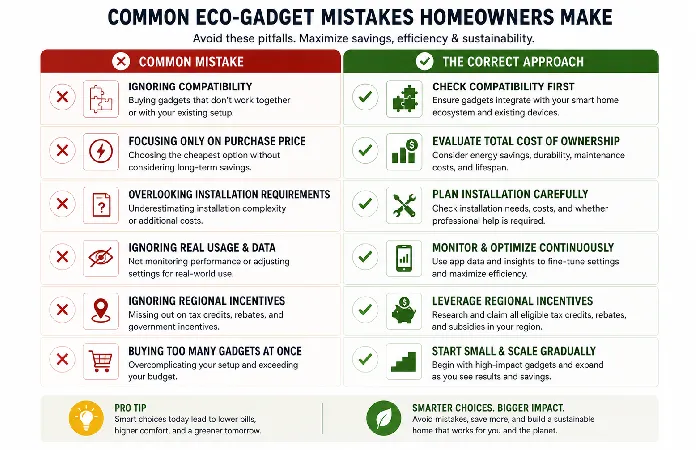
This one genuinely frustrates me. People spend full price on solar panels without checking if their state offers a 30% tax credit. UK homeowners buy smart thermostats at retail when their energy supplier offers them for free through ECO4. Indian homeowners install solar without applying for MNRE subsidies that could halve their cost.
Thirty minutes of research can save you 30–50% of your total investment. Check your national energy department website, your utility’s rebate page, and your local council or municipality’s green incentive programs.
Overestimating Savings
Marketing claims and real-world savings rarely match. A thermostat manufacturer saying “save up to 26%” is citing ideal conditions with a poorly insulated home, extreme weather, and inefficient previous behaviour.
If your home is already well-insulated with relatively new windows, your savings will be at the lower end. If you already manually adjust your thermostat diligently, a smart version adds less marginal value. Be honest about your baseline before calculating ROI.
FAQ: Eco-Friendly Home Gadgets
Q: For how long do the eco-gadgets last?
They will all last different time periods; smart thermostats can expect to last around 8–12 years, solar panels can last for 20–25 years(also, they are pre-paid and sold with a guarantee that they will still have 80% of their original power after this period), Smart plugs and power monitors 5–7 years, electric composters 3–5 years and they have to be changed every 4–6 months.
2Q: Can I install a smart thermostat myself?
In most cases, yes. About 70% of US and Indian homes have compatible wiring. The process takes 20–45 minutes with a screwdriver, and the manufacturer’s app guides you step by step. UK homes with combi boilers sometimes need a professional for the wiring relay, which costs £60–£120.
3Q: What’s the difference between solar panels and solar chargers?
PV solar panels (on your roof) will generate about 3–10 kW of electricity)power required for your whole house. Solar chargers (portable) will generate 20-100W for charging mobiles, iPads, small batteries, etc. Panels cost $10000–20000, and chargers are $50–150. Different size, different functions.
4Q: How do I calculate ROI on eco-gadgets?
Add the cost of the device and the installation costs together and then subtract the incentives, and then divide by the expected monthly savings. This will give you the number of months until it is in the black. Then multiply the monthly savings times the lifespan of the device minus the operating costs to give an estimate of the total net benefit over the lifespan of the device.
5Q: Are potentially green gadgets worth the initial price?
Most of the time, it is, for most people. A smart thermostat (energy saving) only takes 8–20 months to pay for itself and then reduces bills for 8–12 years (it also makes your home more comfortable and easier to control), a solar panel costs 5–8 years to pay for itself and saves you money for 25+. Except that rather than replacing something that is getting more energy efficient, or living in a house where energy prices are very low.
Q6: How effective are eco-gadgets in humid/tropical climates?
For most people’s homes, yes. Most smart thermostats pay back in 8–20 months and then save you money for 8–12 years. PV panels pay back in 5–8 years and then save you money for 25+ years. The exceptions would be gadgets that are replacing something that already works well, or are very cheap to run homes.
7Q: What happens if my smart thermostat loses internet?
Rather than going to a ‘locally controlled’ mode, most will revert to their previous schedule if WiFi is unplugged, thus you temporarily lose remote access and learning capabilities, but your house will continue to be heated or cooled.
8Q: How can I dispose of old eco gadgets properly?
First, see if you can return the product to the manufacturer (Google, Apple and some smart home brands, including Hive, have take-back schemes). If not, find an R2 or e -Stewards approved recycler. Many electronic retail outlets (Best Buy in the US and Currys in the UK) will accept small electronics for recycling for free.
Q9Q: Are my eco-gadgets compatible with my same smart home arrangement?
You need to verify if the device supports the Matter standard. Matter is the de facto smart home standard used by most of the devices released with the version adopted in 2023, and the majority of them have been released after the middle of 2024. Devices supporting the Matter standard are compatible with Google Home, Apple HomeKit, Amazon Alexa and Samsung SmartThings.
Your 90-Day Eco-Gadget Upgrade Plan
-
Days 1–7: Audit your starting point. Gather your energy bills from the last year. Work out which are the most expensive months, and work out an average cost per month. Make notes of when rooms are very hot, cold, or humid.
- Days 8–30: Start with phantom load elimination. Buy 2–3 smart power strips for entertainment centers and home offices. Install a whole-home energy monitor. Track your daily consumption for three weeks. This alone typically reveals $30–$80/month in addressable waste.
- Days 31–60: Fit your smart thermostat. Make sure it‘s compatible with your existing system. Buy the correct model and fit it (or arrange for a technician if you’re in the UK with a boiler). Wait a couple of weeks for it to learn your habits, then compare gas bills.
- Days 61–90: Prepare to make larger purchases. Now that you have 60 days of energy consumption data, you’re aware of your true usage. Employ that information to select technologies like solar panels, battery storage, smart irrigation, and more automation. Ensure you review regional incentives before any purchase.
If this breakdown helped you think differently about which gadgets actually matter, you’ll probably find value in our weekly sustainability tech roundup. We break down one new gadget per week with regional pricing and real-world performance data. No fluff, no affiliate-driven hype.