Published: August 18, 2026
Last Updated: August 24, 2026
The smartest fridges by 2026, are from $1,400 to $4,200, and across 3 tiers of intelligence we have monitoring with an app, internal camera zones, and a full AI kitchen hub with a touchscreen. This comparison guide lays out the best for Samsung, LG, Bosch, GE Profile, and Hisense, and the features that make them worth the price, and the software lifespan problem no other buying guide had.
Definition: A smart refrigerator is a Wi-Fi-enabled device equipped with built-in cameras, AI-enabled inventory analysis and sidekick applications to help organize foods, automate shopping lists, and cut down on household waste aside from refrigeration.
| If you need… |
Buy this |
| The most advanced AI food tracking and a kitchen entertainment hub |
Samsung Bespoke AI Family Hub ($2,800–$4,200) |
| Quiet, energy-efficient daily performance with knock-to-view convenience |
LG InstaView Door-in-Door ($2,200–$3,500) |
| The best raw cooling and produce preservation with minimal tech complexity |
Bosch 800 Series ($2,500–$3,200) |
| A practical camera-equipped smart fridge without full-hub complexity |
GE Profile Smart French-Door ($2,400–$3,400) |
| Core smart features at the lowest price per feature |
Hisense 4-Door Smart Refrigerator ($1,400–$2,200) |
Short answer, 2026’s flagship is the Samsung Bespoke AI Family Hub. Solid refrigeration, nothing else? Bosch 800. Don’t forget to check how long software support runs.
What makes a refrigerator “smart” in 2026?
Connected fridges hook into your Wi-Fi and pair with an app. SmartThings for Samsung, ThinQ for LG, SmartHQ if it’s GE. Remote temp control. Door alerts. Diagnostics, all from your phone.
- Entry level (1,400–1,400–2,000): Wi-Fi based app monitoring, door and temperature notifications, basic energy use monitoring; no cameras or screens. Models: Hisense 4-Door, some GE Side-by-Side models.
- Mid tier ($2,000–$3,000): Internal cameras to view refrigerator remotely, convertible storage zones, sophisticated inverter compressor efficiency. Models: GE Profile Smart French-Door, LG InstaView.
- Top of the line ($2,800–$4,200+): Full touchscreen hubs (21.5-inch or 32-inch screens), AI based food identification, recipe recommendations, streaming and controls of smart home devices. Series: Samsung Bespoke AI Family Hub.
If you‘re researching smart tech for your whole kitchen (and not just your fridge), the smart appliances buying guide includes ovens, dishwashers, and connected cooking systems as part of the same ensemble.
Which smart refrigerators are the best for 2026?
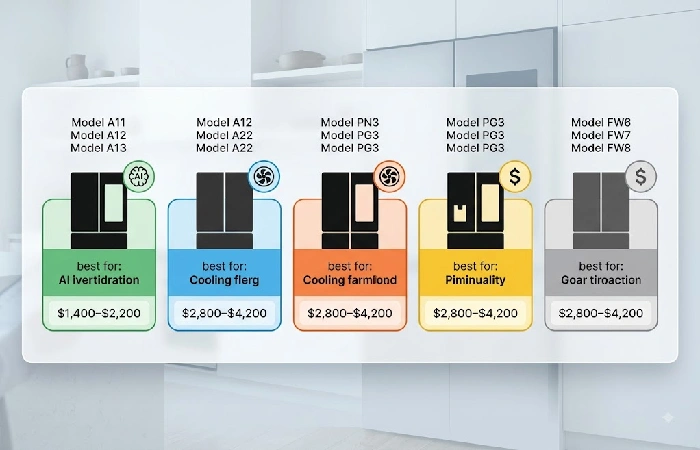
The Samsung Bespoke AI Family Hub is the better choice for features, and the Bosch 800 Series is the best choice for plain cooling ability. The models listed below have been chosen due to reviewer consensus across Forbes, RTINGS, and Reviewed, cross-checked against the manufacturer specifications listed on Samsung.com, LG.com, Bosch-home.com, and GE Appliances as of August 2026. In categories other than fridges, see our entire smart kitchen appliances roundup.
Best overall — Samsung Bespoke 4-Door Flex with AI Family Hub
The existing (2026) richest smart refrigerator in terms of features, this Samsung Bespoke AI Family Hub is equipped with AI Vision Inside cameras that identify up to 37 foods, interpret package label information (using OCR), and connect with a barcode scanner placed at the dispenser to identify items that might be outside of the cameras’ visual range. The 21.5” touch screen is also a SmartThings hub for lighting, locks, and other smart home appliances. Custom Bespoke faceplates can be swapped out, like a car dashboard for the design-conscious home chef. Price: $2,800–$4,200.
Best for practical innovation — LG InstaView Door-in-Door
The LG InstaView emphasizes ordinary smart life convenience rather than a smart screen experience. Simply knock twice on the glass panel, then the interior will be lit up, without opening the door which sharply reduces warm air and compressor cycling. The Linear Inverter Compressor is best known for quietness and long life. The ThinQ app controls the temperature from far away, monitors energy consumption and alerts for maintenance needs. The Full-Convert drawer has five different temperature settings, from deep freeze (−18°C) to wine chilling (5°C). Price: $2,200–$3,500.
Best for core performance — Bosch 800 Series
The Bosch 800 Series has the best temperature uniformity and would get the preservation grade in RTINGS tests. The VitaFresh Pro crisper drawers keep the humidity at a good level automatically. There are no smart features other than remote viewing in the Home Connect app. If you want the best cooling and don‘t care about AI features, get this model. Cost: $2,500–$3,200.
Best mid-range value — Hisense and GE Profile
The Hisense 4-Door Smart Refrigerator ($1,400–$2,200) enables app-based monitoring through ConnectLife and features a reversible My Fresh Choice drawer at the lowest cost of anyone here. The GE Profile Smart French-Door ($2,400–$3,400), which provides a built-in Fridge Focus camera and Hands-Free Autofill dispenser, falls well in between.
What features should you evaluate before buying?
How accurate is AI food tracking?
AI food tracking in 2026 works well, though it isn’t yet an autonomous system. Samsung’s AI Vision Inside is the state of the art, identifying up to 37 foods by OCR label reading via cameras inside the fridge, as described by Forbes on the latest in smart fridge ranges.
Based on manufacturer estimates, the use of AI for inventory management can help diminish household food wastage by 20–40%, according to Haier’s smart refrigerator documentation. But this precision diminishes when products are obscured, unlabeled or placed in milky containers.
- High recognition: such as the branded packs and fresh produce at the supermarket.
- Unreliable recognition: Unlabeled packages (label missing or unreadable), loose items in bulk supplies, left-over items in empty containers, items stacked behind others
- Additional resources: Barcode scanners (Samsung dispenser-mounted), receipt-analysis apps (GE SmartHQ)
What are convertible storage zones?
Convertible zones are a big selling point, allowing you to convert a compartment to fridge or freezer temperatures, or intermediate settings for wine, drinks, or meat. Both Samsung‘s 5-in-1 Convert mode and LG‘s Full-Convert drawer provide this feature. It becomes a worthwhile feature when your needs fluctuate over the course of the year more refrigerator space for holiday shopping, a couple of extra layers in the freezer when you have a lot of batch-cooked meals but may have little value if your needs stay roughly the same.
Do smart fridges actually save energy?
Smart refrigerators fitted with AI Energy Mode customize compressor run cycles to minimize compressor work based on door-opening patterns and room temperature. LG and Samsung specify this dynamic cycling cuts energy use up to 15%. The Wi-Fi radio and touchscreen on smart fridges use 3–5 W in standby, costing less than $5 per year in electricity. That cost is nothing compared to the 100–400 kWh per year of the compressor on a standard-size refrigerator. You pay a $800–$2,000 premium for smart fridge features over an ENERGY STAR one that takes many years to amortize with energy savings; the real reason to buy one is less food waste and real-time convenience.
How do Samsung Family Hub, LG InstaView, and GE Profile compare?
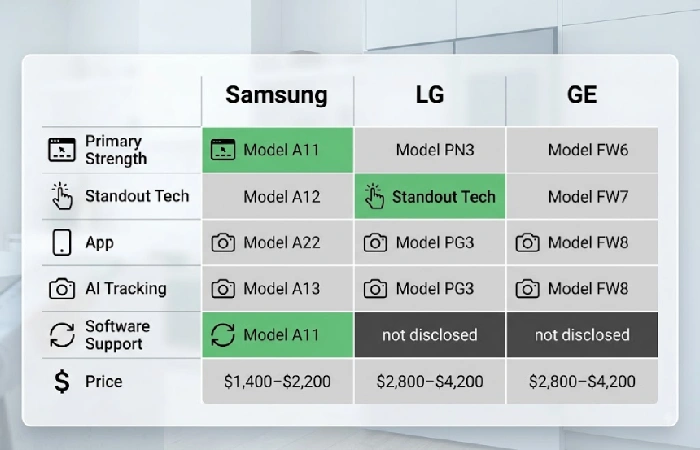
Samsung, LG, and GE Profile serve three distinct buyer profiles. This table summarizes the operational differences that determine which model fits your household:
| Attribute |
Samsung Bespoke AI Family Hub |
LG InstaView Door-in-Door |
GE Profile Smart French-Door |
| Primary strength |
AI-powered kitchen command center with full touchscreen |
Energy efficiency and daily convenience via knock-to-view glass |
Balanced smart features with camera and reliable cooling |
| Standout technology |
21.5-inch Family Hub screen, AI Vision Inside cameras, SmartThings hub |
Knock-twice transparent panel, Linear Inverter Compressor, Craft Ice |
Fridge Focus camera for remote viewing, Hands-Free Autofill dispenser |
| Companion app |
SmartThings (controls fridge + entire smart home ecosystem) |
ThinQ (fridge monitoring + energy usage tracking) |
SmartHQ (fridge monitoring + remote diagnostics) |
| AI food tracking |
Yes – recognizes up to 37 items via camera + OCR label reading |
No – remote temperature monitoring only, no camera-based tracking |
Partial – remote camera viewing, but no automated item recognition |
| Published software support |
7 years (Samsung.com) |
Not disclosed as of August 2026 |
Not disclosed as of August 2026 |
| Price range (USD) |
2,800–2,800–4,200 |
2,200–2,200–3,500 |
2,400–2,400–3,400 |
In a head-to-head comparison, Samsung rules on feature depth and published software support longevity, the only 7-year update promise in the category, while LG wins for energy and compressor life.
GE Profile takes a more practical middle position camera-equipped, reliable, well built without Samsung‘s high-tech hub confusion or utter price ceiling.
How long do smart features last — and are they secure?
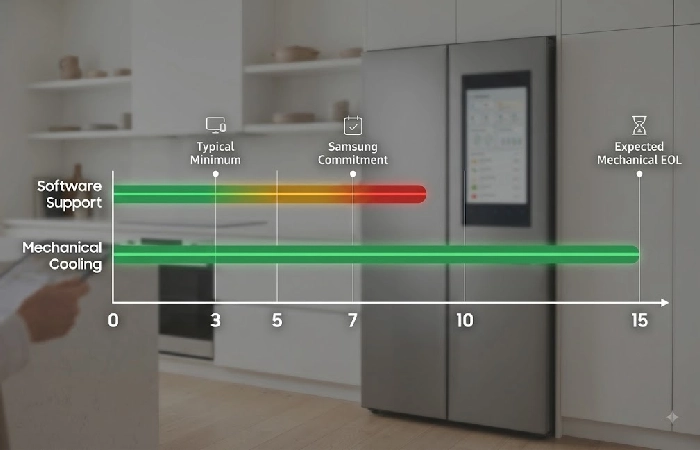
Allow 3–7 years of active software support for the smart fridge features we’re discussing. The device’s mechanical cooling system, necessary regardless of added software, lasts 10–15 years, but touchscreen/apps/AI food logging are manufacturer-dependent. A 2025 FTC probe found that 89% of smart device makers did not tell consumers when their software support timelines would end.
The 7-year published commitment by Samsung (mentioned in the comparative table above) is the category exception as LG and GE had yet to release their corresponding policies in August 2026.
Patches can‘t be applied after software is no longer supported. A hacked smart fridge plugged into your home wifi network is a potential lateral entry vector for an attacker looking to reach any other device on that network (laptops, security cameras, smart home controllers, etc.).
Steps to reduce risk:
- Verify the published update policy of the manufacturer before you buy
- Segregate smart appliances on a separate guest Wi-Fi network to limit exposure.
- Ensure that the basics still work without the smart software so if the screen goes then the fridge still keeps cool.
How do you choose the right refrigerator style for your kitchen?
Your choice of the best refrigerator configuration is to be determined by the size of your kitchen, the number of your household, and type of cold box usage, whether more often in the freezer or in the fridge:
- French door (4-door flex): Most family-friendly choice. Large at eye level, low freezer. Need space for two doors to open? Measure the distance from your kitchen island before you buy.
- Side-by-side: both compartments have equal access top & bottom. Individual shelves are closer together but narrower good if you don‘t need to fit large sheet pans or large platters. In cases with limited swing clearance, this may be preferable.
- Bottom-mount (single door): The most functional for everyday needs fresh food is at eye level. Limited smart features.
- Flex/convertible models: Great for households that experience fluctuations in the amount they need to store, either for flexible seasonal entertaining, frequent bulk cooking, or multiple households sharing one kitchen. Samsung‘s 5-in-1 and LG‘s Full-Convert line are best equipped.
Capacity rule of thumb: calculate for an average of 50–80 liters of capacity/person (Reliance Digital buying guide). For a family of four a minimum of 200–320 liters is needed. Please measure height, width, depth and clearance for door-swing of your kitchen cut-out before deciding on a model.
Frequently asked questions
A smart fridge is worth the $800–$2,000 premium only if you will use food tracking and remote monitoring functions three or more times a week. In doing so, the estimated 20–40% reduction in food waste makes up for the difference over its 10–15 year mechanical life. If you just want a dependable refrigerator that does not require smartphone app management, a $1,200–$1,800 ENERGY STAR French-door model offers a superior long term total cost of ownership.
2. Do smart fridges use more electricity?
No. AI-optimized inverter compressors account for up to a 15% reduction in energy use over comparable fixed speed models. WiFi radio and touchscreen resulted in an additional 3-5 watts of standby power, representing less than $5 annually on your electricity bill. Net annual energy use of a smart fridge is the same as or less than a comparable regular model of the same capacity and configuration.
3. How long do smart fridge features actually last?
Most manufacturers will provide 3–7 years of software support. Samsung has announced a date of 7 years of updates to be provided, but LG and GE had not announced a published update policy as of August 2026. The actual core cooling functions are independent of the software and will last 10–15 years.
4. Can a smart fridge really track my groceries automatically?
Partially. The AI Vision Inside in Samsung works with internal cameras and OCR label reading, and has been tested to recognize 37 typical grocery products. When the item of food is hidden behind another, or is unlabeled leftovers, or residing inside opaque containers, the camera fail to recognize them. Barcode scanner and receipt parsing apps are introduced as complementary, but must be driven by manual input. None of the 2026 models can provide zero-effort inventory tracking with absolute autonomy.