Published: August 18, 2026
Last Updated: August 24, 2026
Most buying guides for smart kitchen gadgets lump anything with a digital screen into the smart category. That conflation is a waste of your time. A sensor cooking microwave modulating power according to the amount of steam is still useful, but it can‘t send you an alert, accept a voice command or be updated with new firmware. This guide defines “smart” as an appliance with a Wi-Fi or Bluetooth connection providing you with remote control through an app or voice assistant. Here are 15 that more or less fit those criteria as of August 2026; choose based on real connectivity, ecosystem fit, and day-to-day usefulness not bill of goods bragging.
Definition: The best smart kitchen devices are Wi-Fi or Bluetooth enabled gadgets that allow you to oversee, plan, and manage cooking, cooling, or washing whenever, wherever via an app or your voice assistant, not simply appliances with sensors.
Quick answer: The best smart kitchen appliance in 2026 is one with app, voice, and Matter, but it’s only worth the high price if it helps you do something you’re already doing daily and doing repeatedly.
Best smart refrigerators
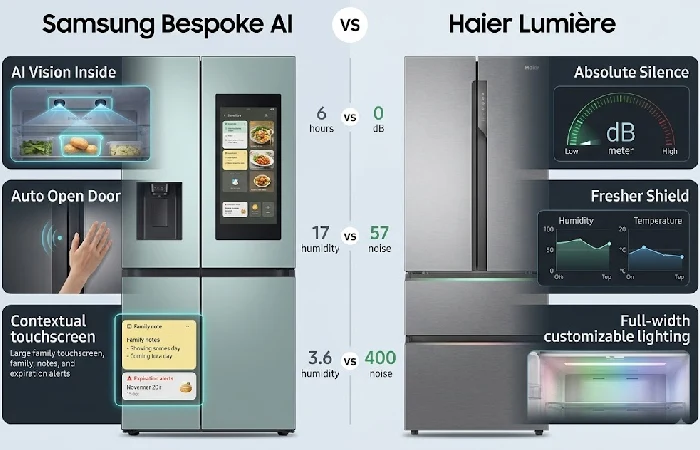
In 2026, smart refrigerators will monitor inventories, propose recipes based on what ingredients you have at home and use AI algorithms to optimize compressor energy consumption. Two leaders in the category:
- Samsung Bespoke AI Family Hub (2,200–2,200–3,500): Interior cameras take shelf photos every time you close a door, and then surface recipe recommendations through the SmartThings app. The 32-inch touchscreen also functions as a family calendar and streaming TV set. A $800+ premium over a similar non-smart Samsung makes sense only if every family member accesses the inventory and calendar every week.
- Haier Lumière Series (1,800-1,800-2,800): Focuses on saving energy in lieu of screen features. Per Haier‘s product documentation, AI Energy Mode can lower cooling energy use by around 10–20% via correlating compressor speed and defrost cycle optimization. The downside is a smaller third-party app ecosystem: less than Samsung SmartThings.
Best smart ovens and air fryers
Smart ovens take the guesswork out of temperature and time. Three different problems are solved by three models.
- Tovala Smart Oven Gen 3 (299-299-349): Scan a barcode on a Tovala meal kit or one of over 900 supported grocery items, and the oven automatically adjusts to the correct cooking cycle. Ideal for busy cooks who can rely on set-and-forget automation. Manual recipe flexibility is more limited than traditional smart ovens.
- Dreo ChefMaker Combi Fryer (329–329–399): Injects water steam while air frying to achieve a crispy exterior with a sous-vide-like interior. Controlled by app, with user-defined temperature curves. Will take up more space than a typical air fryer.
- Sharp Celerity High Speed Oven (400 400 550): Uses microwave, convection and infrared heat through the ” Golden Heater ” technology of Sharp to prepare food 3 times faster than other forms of cooking according to the product specifications.
Best smart multi-cookers and precision tools
Multi-cookers provide the most utility-per-dollar in the smart kitchen as they replace several appliances with a single internet-connected device.
- Instant Pot Pro Plus Wi-Fi (149–149–179): 10-in-1 pressure cooker with app-based scheduling, remote monitoring, and over 1,000 guided recipes. The main smart feature is the ability to log in on the way home and start dinner. Tom‘s Guide readers report that Wi-Fi is problematic on mesh networks, and there is no support for Google Home only Alexa.
- Breville Joule Turbo Sous Vide (249–249–279): An app-only device utilizing visual doneness meters which determine actual cooking time and temperature depending on the type and cut of meat. The device requires a Bluetooth connected smartphone and can never be operated without one intended for accuracy but potentially a liability if the app is ever retired.
Best smart dishwashers
Smart dishwashers have real remote value: you can start washes when electricity is cheaper, get alerts when a cycle finishes, and run diagnostics that flag maintenance issues before you need a service call. This is a category not widely covered in competitor roundups, despite its practical appeal.
- LG ThinQ Series (700–700–1,100): The smart diagnostics inform users about clogged filters, water inlet problems, and uneven loads. This shows up in the ThinQ app. Features like Quad Wash multi-angle spray arms and TrueSteam sanitization. Native Matter support for 2026 models.
- Bosch Series 6 with Home Connect (850–850–1,300) 42 dB is barely hearable (per Bosch specs), practically silent in open plan kitchens. Intensive Kadhai program bathes elements with 70°C+ water, blending it precisely for greasy cookware residues.
Best smart microwave, gadgets, and chimney
Smart microwave
In 2026, the handful of truly Wi-Fi-enabled microwaves are still a niche product. The majority of “smart” microwaves on the shelves have only sensor cooking and no app connection.
Samsung SmartThings Microwave ($250-$400): A rare thing, a microwave with actual Wi-Fi app control, most of them just have a sensor and call it a day. This one plugs into SmartThings, so if you’ve already got a Samsung fridge, a Samsung dishwasher, whatever, it just joins them in the same app. No separate download, no separate login. Only really makes sense if you’re already buying into Samsung’s kitchen lineup though, on its own it’s not worth chasing down.
Smart gadgets
- MEATER+ Wireless Thermometer (69–69–99): Fully wireless probe with Bluetooth range of 165 feet and app notifications when target internal temperature is achieved. Signal weakens behind walls; MEATER Block Wi-Fi bridge is available ($99 extra) to increase range.
- XBloom Studio Coffee Machine (799–799–999): Fully-automated speciality-grade pour-over with water temperature accuracy of ±0.5°C. No voice-assistant guidance as of August 2026.
- GE Profile Opal 2.0 Nugget Ice Maker (549–549–649): App-based scheduling through SmartHQ ensures ice is waiting for you. Quite large on the countertop.
- Emerson SmartVoice Air Fryer (129–129–169): Over 1,000 Alexa voice commands for absolutely hands free operations. Proprietary command library, limited third-party recipe integration.
Smart chimney
Glen / Elica Smart Chimney (300–300–700): Heat sensors sense how hot you‘re cooking and automatically change the suction power accordingly. Motion-sensor activation lets you wave to start or stop it. Filter free auto clean reduce oil burden (automatically). Motion sensor false triggering due to other movement.
What to look for before you buy
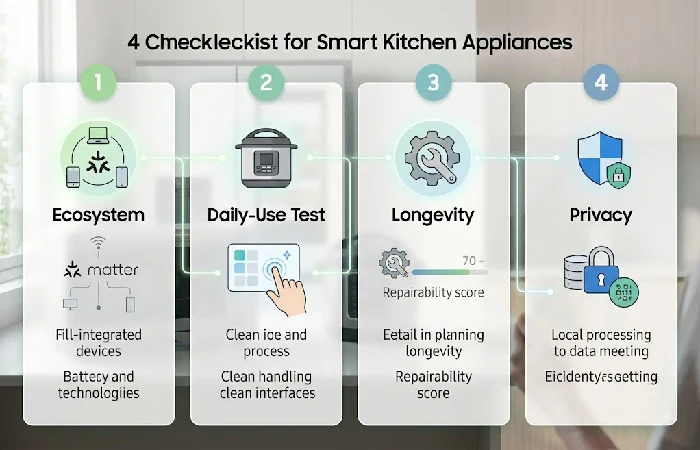
Before choosing any smart kitchen appliance, evaluate these four decision criteria:
- Ecosystem compatibility matters more than people think going in. Check the voice assistant first, Alexa, Google Home, Apple Home, whichever one you’re already using, and make sure the device actually talks to it. Then look for the Matter logo. That’s the certification from the Connectivity Standards Alliance, and it basically means the product works across platforms without you needing five separate apps to run five separate gadgets. Fridges and dishwashers have gotten native Matter support as of August 2026, so that’s less of a gamble now than it used to be.
- Daily-use test: If you will not use the companion app or voice command at least 3/week there‘s no point paying for the smart premium. Purchase the regular version and invest the difference in more robust construction.
- Longevity risk: Manufacturers usually cease app support after 3-5 years from release of a product line. Hardware keeps working long after the smart stuff gets cut off, that’s just how it goes. Matter and Thread support is worth checking for before you buy, closed ecosystems tend to get abandoned faster.
- Privacy trade-off worth knowing about: these devices send a lot back to the cloud. Door open frequency. When you’re cooking. What you’re actually eating. To cut down the risk, keep these devices off your main network. Turn off whatever app permissions you don’t actually need. And don’t let firmware updates sit there for months, that’s usually how the holes get found.
Frequently asked questions
1. Are smart kitchen appliances worth it?
Smart kitchen appliances are worth their premium when they remove a particular daily irritation, such as remote monitoring for long cooking sessions, flexible energy management or voice-enabled timers when you are otherwise busy with your hands. If you cannot see yourself using the app or voice feature at least 3 times/week, get the non-smart better quality appliance.
2. What is the most useful smart kitchen gadget?
In general, the most common suggestion of a smart kitchen gadget by the three reviewer sources (PCMag, CNET, Tom‘s Guide) is the Instant Pot Pro Plus Wi-Fi for its multi-purpose function (10-in-1 with app scheduling), then the MEATER+ wireless thermometer for accurate cooking. Both address real tasks of everyday life rather than fun connections.
3. Do smart appliances save money on energy bills?
Savings are category-specific. Cooling savings for AI-enabled refrigerators with adaptive compressor control such as Haier AI Energy Mode are in the range of 10–20% on cooling energy according to Haier‘s product literature. Smart dishwashers with load-sensing cycles cut water and electricity use per wash. Small devices can have insignificant direct energy savings.
4. Can smart kitchen appliances be hacked?
Yes, more than people think, honestly. Weak default password, unencrypted data floating around, firmware nobody’s touched in two years, any one of those and your fridge is basically a door somebody else can walk through. Separate Wi-Fi network for these things, not the one your laptop’s on. And firmware updates set to automatic, because nobody’s actually going to go check that manually every month. Go through the app permissions once too, microphone, location access, whatever it’s asking for that has nothing to do with cooking.
If you’re weighing a specific category against another, or just trying to figure out which budget pick is actually worth the money, the full smart appliances guide gets into all of that.