Published: August 17, 2026
Last Updated: September 18, 2026
Smart appliances aren’t just costly toys anymore that allow you to preheat an oven from your smartphone. They represent in 2026 the operational layer of a connected home: the shift over the last 18 months has been more structural than definitional: the Matter protocol now certifies over 4000 devices, 80+ categories; Thread mesh does the job of reducing cloud latency-dependent requirements; AI innovation such as fabric detection in washers or food recognition in fridges has moved from marketing slides to shipping products.
In this guide we have rated the top connected products across 6 lifestyle segments: kitchen, laundry, cleaning, climate, security and infrastructure, on their ecosystem compatibility, proven electricity impact and privacy stance. Within each category we detail the top 2-3 most differentiated products to act as a pillar in guiding consumer design or upgrade of the connected home.
Quick answer
- Begin with your ecosystem (Google Home, Alexa, Apple HomeKit, or Home Assistant), not a product.
- See the Matter Certified badge on each buying point, it confirms that everything will work on multiple platforms.
- Smart Thermostats provide the highest ROI, a saving of 10-20% on furnace & air conditioning costs during the first year.
- Smart laundry (such as AI-powered wash cycles, auto-dosing ) is the most underrated category for 2026.
- Privacy is the real issue here, check for FCC Cyber Trust Mark devices and segment your network.
Definition: Smart devices are Wi-Fi and Thread-enabled home appliances and gadgets that use sensors, AI intelligence, home automation and app or voice control to allow more energy savings, reduce wastage, and become connected within 1 common home automation network.
What makes an appliance “smart” in 2026?
Smart appliance: a household appliance that connects to your home network or the internet, takes commands through an app or your voice, and adjusts its own behavior using sensor data or a machine learning model, no instruction needed. That fundamental description has stayed the same, but the list of what counts as definably smart has changed. That fundamental description has stayed the same, but the list of what counts as definably smart has changed.
Separating a truly helpful smart appliance from a Wi-Fi-compatible stove with an abandoned companion application are three traits of smart:
- How will you share information, even across brands? In 2026 this translates to Matter and Thread support. A smart fridge provided with a single, locked app and no ecosystem support is a smart appliance connected, but not smart.
- Automate more than just remote control. Get the convenience of starting the washing machine from your phone. Enjoy the intelligence of the washing machine that knows what kind of fabric it is washing, how much it is washing, and how much detergent to use. Then it should just tell you when it is done.
- Adapting as they evolve. The most sophisticated 2026 examples identify home routines, with intelligent thermostats changing heat schedules after 1 week of access, robot vacuums whose vision enables accurate room-mapping and zone-shielding from obstacles, and refrigerator monitors that warn of expiring foods by tracking purchase dates.
The reality check: if you live up to the hype, then once a day opening a smart device’s app to get value back is time consuming. Smart appliances should be saving you time in 2026, not making you check back every day for value.
How should you choose a smart home ecosystem before buying anything?
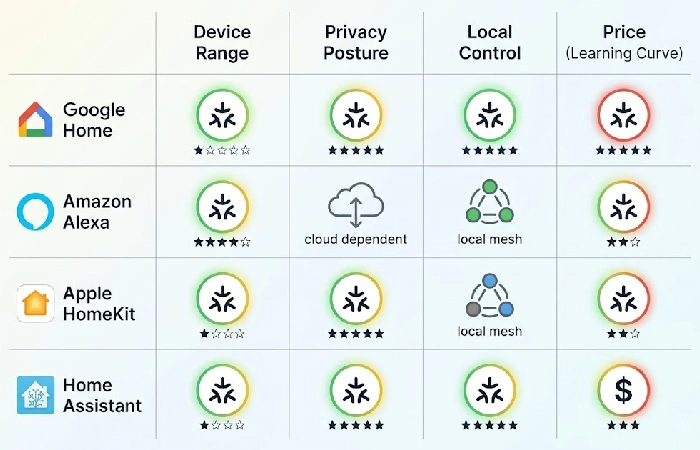
Choose your ecosystem first. Devices second. The number one mistake in the smart home is selecting best of category products that won’t interoperate, four apps, inconsistent automations and no one voice control.
The four major ecosystems in August 2026 each serve a different priority:
| Ecosystem |
Device range |
Privacy posture |
Local control |
Learning curve |
Best for |
| Google Home |
Widest third-party support; over 10,000 compatible devices |
Cloud-centric, your data feeds into Google’s services |
Light, though the Nest Hub can run a few local routines |
Low |
Best if you want the biggest device selection without much setup hassle |
| Amazon Alexa |
Very broad, particularly strong with smart speakers and display devices |
Cloud dependent, you have to opt out to stop voice recordings from being analyzed |
Limited |
Low |
Best if you’re already deep into Echo hardware and the Amazon ecosystem |
| Apple HomeKit |
Narrower catalog, since Apple’s manufacturer certification is stricter |
Most privacy-oriented option, end-to-end encryption with local processing by default |
Strong, HomeKit Secure Video processes on-device |
Medium |
Best if privacy matters most and you’re already in the Apple hardware world |
| Home Assistant (open-source) |
Supports over 2,000 integrations across every brand and protocol |
Fully local, no cloud account needed |
Complete, runs entirely on your own hardware |
High |
Best for power users and hobbyists who want full customization with zero cloud dependency |
Matter is an interoperability safety net between all four platforms. If a device is Matter-certified, it will work in any of these four environments without needing a bridge or proprietary hub this means your ecosystem selection limits your user experience, not your hardware selection. To understand how setup processes and long-term expenses compare across these four platforms, check out this good smart home ecosystem comparison guide.
What are the best smart kitchen appliances in 2026?
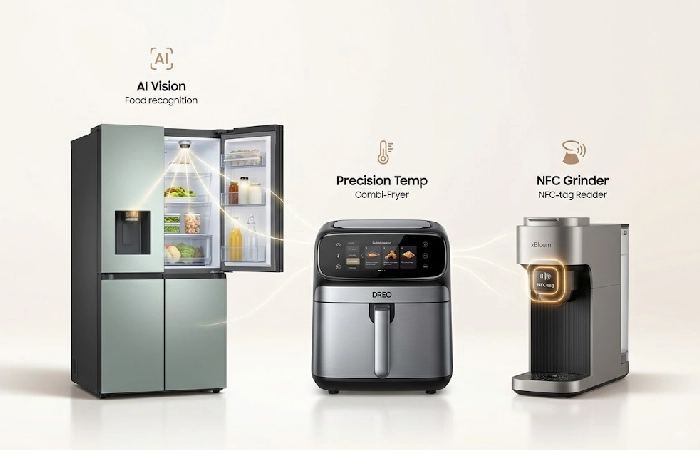
Three kitchen appliances stand out in 2026. The Samsung Bespoke AI 4-Door Flex fridge handles grocery shopping with AI support, the Dreo ChefMaker Combi-Fryer covers precision cooking across multiple methods, and the xBloom automates brewing tuned to whatever beans you’re using. All 3 are solutions to a recurrent task of everyday life rather than just adding a screen to an appliance needing one. All 3 are solutions to a recurrent task of everyday life rather than just adding a screen to an appliance needing one.
Smart refrigerators
The Samsung Bespoke AI 4-door Flex (pricing around $2,200–$3,800) utilizes internal cameras and AI-centric food recognition models to create shopping lists automatically and monitor closely expiring items (Samsung documentation). It integrates with SmartThings, Google Home, and Amazon Alexa, and is Matter-certified, with updates available from early 2026. The LG Smart InstaView ($1,800–$3,200) takes a more practical energy stance: its knock-to-view glass panel saves door-open time LG suggests as much as 40% less cold air escaping versus opening the door and its Door Cooling+ technology keeps temperatures even across zones. By comparison, the Bosch 800 Series ($1,600–$2,400) prioritizes cooling performance over display specs, continuously earning solid reviews from RTINGS for produce protection and internal temp stability.
Smart ovens and precision cookers
The Dreo ChefMaker Combi Fryer (300–300–400) offers a single countertop unit that can do air frying, roasting, and probe-based precision cooking using app-guided recipes. The Tovala Smart Oven (250–250–300) can work with a meal-kit subscription service that uses barcode scanning that will configure the oven automatically. For any temperature-critical application such as sous vide, the Breville Joule Turbo (150–150–200) offers 0.5 degrees F accuracy and Bluetooth/Wi-Fi enabled app control, completing cook time on average about 30% faster than the previous model per published data from Breville.
Smart coffee makers and small appliances
The xBloom series (800–800–1,200) of coffee brewers utilizes NFC-tagged coffee capsules that allow a machine to automatically set the appropriate grind size, water temperature and brew time based on the bean origin a degree of per-bean customization that has only been achieved in commercial devices so far. The Ecozy nugget ice maker (180–180–250) enables app-based scheduling of gumdrop-sized pieces of chewable ice.
What are the best smart laundry appliances in 2026?
The fully integrated smart washing machine is perhaps the single most under-appreciated sector of the connected home in 2026. While competitors have placed emphasis on Wi-Fi-enabled fridges and robot vacuum cleaners, AI-Laundry appliances are now programming wash motions to suit types of fabric, auto-dosing detergent to save waste, and easily getting through long washes in less than 40 minutes real contributions to saving time and resources that tend to go under the radar of most buyer‘s guides.
Smart washing machines
The LG 8 Kg 5-Star AI Direct Drive (c.550–550–750) is the top choice overall for families of 3–5 people. The AI DD 2.0 intelligently learns load weight and fabric feels and makes one of six differing wash motions accordingly so lighter and delicate clothes are protected without a drop of cleaning power lost. TurboWash 360° completes a whole wash in just under 39 minutes (LGE specs). The Samsung Bespoke AI EcoBubble (c.700–700–1,100) dissolves detergent into foam before the wash starts, which makes cold-water washing genuinely effective, and several spec sheets claim up to 60% less heating energy per cycle compared to a hot-water cycle. And the Bosch Series 6 (c.600–600–900) is the pick for a couple living in an apartment due to its i-DOS auto-dosing system and anti-vibration side walls making it a near silent giant.
Smart dryers and washer-dryer combos
The all-in-one washer/dryers are still a ‘space-saver’ for tiny flats, even if their washing load is slightly lower (5 to 7 Kg rather than 8 to 10 kg). Both Samsung and LG put their AI technology drying feature into their all-in-one, detection of dryness in the drum causes the machine to pause, preventing over-drying, which can damage the fabric. If you do have the room, a dedicated heat-pump is worth considering, the Miele T1 or the LG DLHC1455 will dry much faster and use around half the power of a vented dryer.
What are the best robot vacuums and smart cleaning devices in 2026?
Ecovacs Deebot X8 Pro Omni (900–900–1,200). The Deebot X8 Pro Omni is the most autonomous robot vacuum in August 2026. It empties the dustbin, washes and dries mop pads, refills the water tank … a cycle that can be maintained by humans with a consumption of about one time every two or three weeks (In testing by PCMag, August 2026). The Roborock Saros 10R (800–800–1,100) offers equivalent cleaning efficiency while integrating multi-LiDAR navigation, perfectly adapting to irregular room configurations thanks to a lower physical height than its competitors.
Premium options
Overall, the iRobot Roomba j9+ (700–700–900) is the ideal product for targeted use in homes that exclude pet waste, as its obstacle detection system is trained on a set of typical pet articles that other products sometimes cannot consistently avoid.
Budget and mid-range options
Dreame D20 Pro Plus (200–200–280): LiDAR navigation, decent pet-hair pickup, 60–70% cheaper than high-end competitors. TP-Link Tapo RV30 Max Plus (250–250–350): Mid-priced, good suction, self-empty dock. Compare to the rivals in terms of cleaning results:
How much energy do smart appliances actually save?
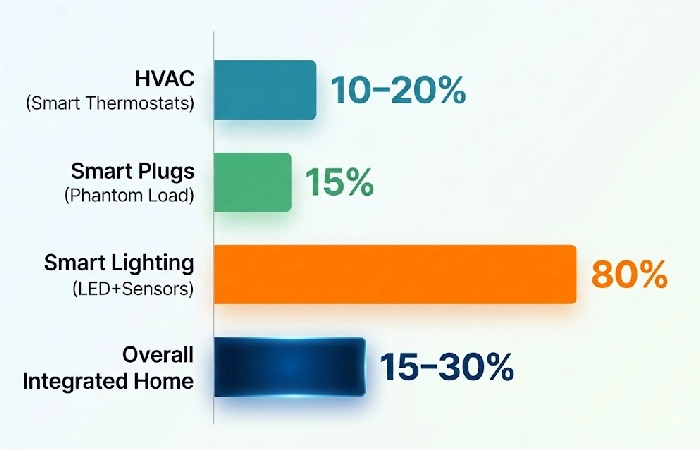
A completely integrated smart house cuts the overall energy use of the household by 15–30% (InAutomations 2026 report). This is not some far-fetched projection this is what observed savings from operational houses using a harmonized smart thermostat, plugs, and scheduling system. The effect varies quite a bit between appliance categories.
- Heating and cooling constitute up to 60% of residential energy bills in most climates. Smart thermostats (especially those that learn schedules (Google Nest, Ecobee)) lower HVAC bills by 10–20% (PointCentral, checked against Energy Star program estimates), which translates to an 180–180–250 thermostat paying itself off in 12–18 months.
- Eliminating phantom load using smart plugs can save up to 15% off customers’ bills by turning off devices in idle mode – TV, gaming consoles, chargers, and cable TV/cell set-up boxes that consume power 24/7 even when “off” ( GM Modular, Okos).
- Installing smart lighting (LED light bulbs on motion sensors, or scedule driven automations) can cut lighting specific energy consumption by up to 80%, but lighting has generally less of a hold on the entire house‘s energy costs than HVAC.
The critical caveat: Devices are just tools, they can not replace structural improvements. An intelligent thermostat in an uninsulated basement will not make you any significant cost savings. Whenever possible, marry device improvements to building efficiency improvements for the maximum ROI (sealing drafts, insulation, etc). Click here for a detailed cost and savings comparison across all device categories.
What smart security and access control devices are worth buying?
The Level Lock Pro (250–250–330) is the best smart lock for people who want an invisible design completely hidden in your existing deadbolt with no visible exterior hardware all while supporting Apple HomeKit, Matter, and NFC key cards. The Ring Battery Doorbell Pro (180–180–230) offers 1536p head-to-toe video with on-device person detection, and the Aqara Camera Hub G5 Pro (130–130–180), functioning as both a security camera and a Zigbee/Matter smart hub, helps cut down on devices.
Choose cameras with local-processing support (on-device AI for person/package/animal detection) rather than cameras that require a paid cloud subscription in order to access basic features. Cloud-dependent cameras cost you more month-to-month (3–3–10/month per camera) and, more importantly, create a privacy surface that local-processing models do not.
What is the Matter protocol and why does it decide what you should buy?
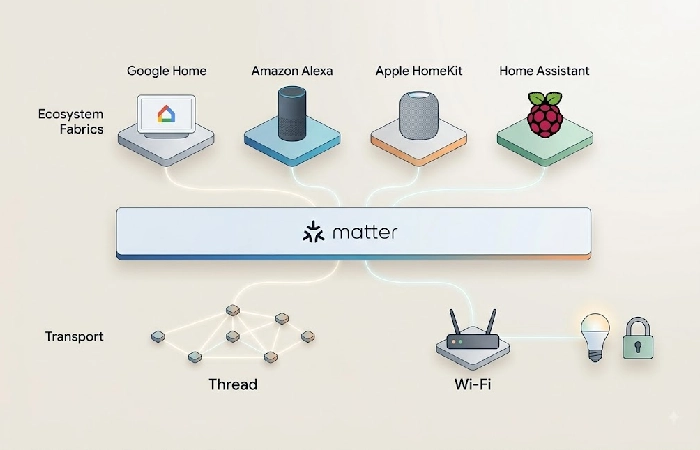
Matter is what makes smart home connectivity actually work across brands, no small thing, given how fragmented this space used to be. The Connectivity Standards Alliance runs it. Look for the Matter Certified label before you buy anything. That’s really the whole trick, if it has that badge, it’ll pair with Google Home, Amazon Alexa, Apple HomeKit, Samsung SmartThings, whatever you’re running, without you needing some separate hub cluttering up a shelf somewhere. As of June 2026 the standard was at v1.6, and there were over 4,000 certified devices out there. Locks, thermostats, cameras, sensors, kitchen appliances, more than 80 categories at this point.
Major adoption milestones in 2026 include NFC device commissioning (tap your phone against a switch to commission it, no more poking around to find a QR code in a jammed closet) and Joint Fabric management (a single Matter fabric managed by multiple platforms in parallel without creating duplicate devices).
- Thread vs Wi-Fi under Matter. Both are supported transport layers, but Thread – a low-power mesh networking protocol is gaining popularity for battery powered, low latency devices. While a Thread device will still create a self-healing mesh network that runs locally without internet access, a Wi-Fi device will need to piggyback on your Router (and, in most cases, to your Cloud service). If offline reliability matters to you, and for most households it should, look for Matter-over-Thread devices where possible.
- The buying rule: Before buying any smart appliance in 2026, look for a Matter Certified badge on the box or on the manufacturer‘s spec sheet. It is by far the best way to tell if your device will stay compatible as platforms change.
What are the privacy and security risks of smart appliances that no one talks about?
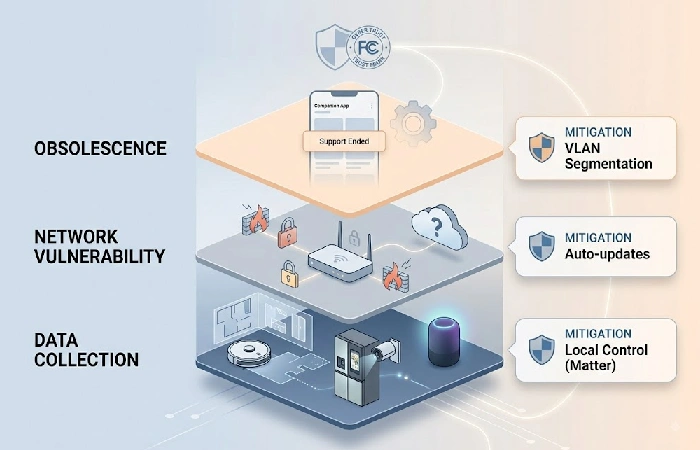
Smart appliances gather more household information than most consumers know. And the security structures for that information are still a bit slow to catch up to the much faster spread of the appliances. There are three types of threats: collection of data, network threats, and the aging of a device.
- Gathering information: robot vacuums map out the room layouts. Intelligent fridges equipped with interior cameras take pictures of the food currently in the fridge, revealing eating habits and diets. Smart speakers, like Amazon Echo, listen to the room waiting for a “wake word” and have recordings of phrases played back to servers in order to improve the algorithm. Most companies won’t say exactly what they’re storing, or whether it ends up with advertisers or other third parties down the line.
- Network vulnerability. Every internet-connected device you add is another point of entry, so your attack surface grows with your device count. And consumer IoT gear doesn’t help matters, weak default passwords, updates that lag for months, unsecured APIs, the kind of stuff that makes a device an easy pickup for a botnet or a way into the rest of your network.
- Regulatory response (2026). Two new frameworks are quickly requiring the attention of manufacturers: The EU’s Cyber Resilience Act, which will require data-bearing device manufacturers to provide security-by-design and rapid security updates as part of its end of 2026 compliance standards. In the US, the FCC’s Cyber Trust Mark advocates voluntary security labeling so buyers can choose verified cybersecurity devices (FCC.gov).
Actionable steps:
- Segregate your network. Place all the IoT devices into their own VLAN, “guest”, “IoT” rather than your primary devices (laptops, phones, workstations).
- Enable automatic firmware updates on all connected devices.
- Favor local-processing devices (Matter + Thread, on-device AI) over cloud-first devices that route your data through outside servers.
- Check for an FCC Cyber Trust Mark or similar security certification before purchasing.
Do smart appliances actually work without internet?
Yes, but only if they allow local execution, and most cloud-dependent smart appliances don’t. When they have failed, cloud-dependent smart plugs, thermostats, cameras, or other network-connected equipment usually become completely inoperable or require manual operation.
Matter-over-Thread devices are the exception. Thread creates a local mesh network between devices that works without your internet connection or the cloud servers. A Thread-based smart lock will still open with your phone over the local network. A Thread-based motion sensor will still activate a Thread-based light not the internet.
How to verify pre purchase: Check the connectivity section for “Thread” or “Matter-over-Thread”, or check if the device is supported by Home Assistant, which has one of the most complete databases of local control devices. If it is listed as “local polling” or “local push” in the Home Assistant integration documentation, then it will work without the internet.
How do you plan a connected home from scratch?
Begin with the infrastructure. Not the devices. A four-step path prevents the haphazard, multi-application configurations that confound nearly everyone when they first get a smart home.
Step 1- Select your ecosystem. Pick one of four: Google Home, Alexa, Apple HomeKit, or Home Assistant. Use the above comparison matrix to make your choice. This choice shackles all your following purchases.
Step 2- Provide Wi-Fi coverage. Every smart device in your house needs a steady signal, and dead zones will cause problems down the line. If you’ve got weak spots, get a Wi-Fi 6E or Wi-Fi 7 mesh system in place before adding devices. Go with a mesh router that doubles as a Thread border router, something like the Google Nest WiFi Pro or an eero model, and you’ve covered both your Wi-Fi and your Thread network in one purchase.
Step 3- Begin with the three devices that matter most: a smart thermostat for the fastest energy ROI, smart plugs to kill phantom loads, and one security device, a doorbell cam or smart lock. You’ll notice the difference within the first week.
Step 4- Add more categories if needed. Add kitchen, laundry and cleaning appliances based on which daily task takes your most time. If laundry takes you each day for five people, a smart washing machine with AI cycles can save you more time than that smart coffee maker put the priorities right.
Frequently asked questions
Smart thermostats save money within 12–18 months by reducing heating and cooling costs 10–20% (PointCentral), while smart washing machines featuring AI-managed cycles can save an average of 10–15% per load in water and energy costs; these savings add up over hundreds of cycles.
2. How much energy do smart appliances actually save?
When everything is added up, an integrated smart home a full suite of thermostat, plugs, lighting schedules, and device automation can lower your entire home‘s energy use by 15–30 percent. The biggest individual device-related savings can be accomplished through smart thermostats: a 10–20 percent reduction of heating and cooling costs, which is often 50–60 percent of home energy costs. Smart plugs offer additional savings by eliminating representative phantom loads, which can be 10 percent or more of electrical use.
3. What is the best smart home ecosystem to start with?
When it comes to device compatibility and ease of setup, no one beats Google Home. Apple is best if privacy matters more, since it securely encrypts everything and handles it all locally, though it’s more limited in device compatibility. Home Assistant is the pick if you’re happy running self-hosted software, since it lets you customize it completely. Amazon Alexa gets you all the same devices that Google supports, just on Amazon’s platform. In all four, selecting Matter certified devices means you can freely move between ecosystems later without changing hardware.
4. Do smart washing machines use less water?
Yes LG‘s AI DD 2.0 load-sensing machine actually weighs each load and identifies the fabric feel before automatically adjusting water level, wash motion amplitude and cycle time for each load. This per-load setting results in a 10–15% reduction in water use compared to fixed-fill machines in a traditional cycle, which can add up to quite a difference over the course of 300 to 400 family loads per year.
5. Can smart home devices get hacked?
Yes. These devices are known to be favorite victims of botnet infection (via the distributed denial of service attack) and network intrusion (to use as a foothold to reach more sensitive devices on the same network). Four measures are required to counter these threats: isolate IoT devices on their own VLAN or in a guest network; require frequent auto-updates for IoT firmware; buy wireless routers that support WPA3 encryption; and buy devices that have the FCC Cyber Trust Mark or other third party security mark.