Published: August 19, 2026
Last Updated: September 18, 2026
The robot vacuum market in 2026 is vastly different from what it was two years ago. The suction power has increased from 5,000 Pa to 5,000 Pa for flagship systems. Self-emptying docks now wash the mop pads in boiling water and dry them with heated air. LiDAR navigation, once reserved for $1,000+ models, now ships standard on machines under $300. Brand trust has been completely reshuffled due to the iRobot bankruptcy and buyout.
This guide rises above the clutter. No chasing a generic “best overall” pick here. We focus on what actually suits specific home types, pulling from published specs and reviews across RTINGS, PCMag, Tom’s Guide, and VacuumWars.
Definition: The top robot vacuum of 2026 checks four boxes. LiDAR navigation. Minimum 10,000 Pa suction. Auto mop lift. Self-empty dock. All of it was flagship-only back in 2024. Now it’s $300.
Quick answer: The Roborock Saros Z70 wins for most households in 2026. Tight budget instead? Go with the TP-Link Tapo RV30 Max Plus at $300.
How we evaluated these robot vacuums
We checked off each item against these criteria: suction power (Pa reported by manufacturer), navigation system (LiDAR vs. camera vs. gyroscope), mopping method (rotating pads vs. roller vs. drag mop), dock automation (self-empty vs. mop wash vs. mop dry vs. water refill). None of these were hands-on tested by us.
- Data sources: RTINGS lab scores, PCMag Editors’ Choice rankings, Tom’s Guide hands-on experiences, VacuumWars YouTube performance videos, documentation from the respective brands
- Price verification: All USD prices stated are based on listings of major US stores as of August 19, 2026.
- Exclusions: Discontinued models as of June 2026 or not sold in the U.S.
The 10 best robot vacuums for 2026
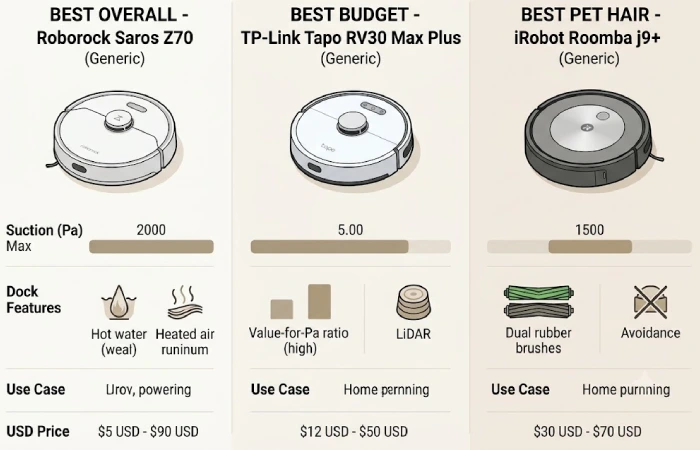
| Model |
Suction |
Navigation |
Mopping |
Dock |
Price (Aug 2026) |
Best For |
| Roborock Saros Z70 |
22,000 Pa |
StarSight 2.0 LiDAR + dual ToF + RGB |
Dual spinning pads, hot-water wash, heated-air dry |
Self-empty, mop wash/dry, water refill |
999–999–1,299 |
Best overall — OmniGrip arm moves socks and cables out of the cleaning path |
| Ecovacs Deebot X8 Pro Omni |
18,000 Pa |
AIVI 3D 3.0 + RGB camera |
OZMO Roller track mop, auto-lift on carpet |
Self-empty, 167°F hot-water mop wash, auto detergent, hot-air dry |
800–800–1,200 |
Best hybrid vacuum-and-mop for hard-floor homes — PCMag Editors’ Choice |
| Dreame X60 Max Ultra Complete |
35,000 Pa |
Laser + wide-angle cameras, 280+ object types |
Extending mop arms for edge cleaning, auto-lift |
Self-empty, 212°F mop wash, auto-dry, water refill |
~$1,599 |
Best for maximum suction and edge mopping |
| Roborock Qrevo Curv |
18,500 Pa |
LiDAR + RGB + 3D structured light |
DuoDivide brush, FlexiArm Arc, dual spinning mop pads |
Self-empty, hot-water mop wash, warm-air dry |
696–696–850 |
Best upper-mid-range value after aggressive 2026 discounts |
| iRobot Roomba j9+ |
Not published (100% stronger than Combo i-series per irobot.com) |
PrecisionVision camera-based |
Vacuum-only |
Clean Base self-empty (60 days) |
~$400 |
Best for pet-waste avoidance on carpet-only homes |
| Mova V50 Ultra Complete |
24,000 Pa |
FlexiRise retractable LiDAR + 3D AI |
Dual rotating mop pads, DuoSolution system, auto-lift |
Self-empty, 176°F mop wash, hot-air dry |
~$799 |
Best value flagship — 220-min runtime, 60mm threshold climbing |
| Shark PowerDetect UV Reveal |
Not published |
NeuroNav AI + 360° LiDAR |
HyperSonic vibrating flat mop pad |
ThermaCharged NeverTouch Pro: self-empty (60 days), 185°F mop wash/dry |
849–849–899 |
Best for invisible-stain detection — UV light reveals dried spills |
| Narwal Flow 2 |
31,000 Pa |
NarMind Pro dual 1080p RGB cameras, 3D recognition |
FlowWash track mop, 212°F hot-water cleaning |
Self-empty, self-refill, 212°F mop wash and dry |
1,100–1,100–1,300 |
Best for deep mopping — track mop maintains constant floor contact |
| Eufy Omni S2 |
30,000 Pa |
3D MatrixEye 2.0 + AI mapping |
HydroJet 2.0, 140°F hot-water self-cleaning, DuoSpiral anti-tangle |
12-in-1 station: self-empty (68 days), mop wash/dry, detergent, sterilization |
1,399–1,399–1,599 |
Best for smart-home integration — Alexa, Google Assistant, and Siri |
| TP-Link Tapo RV30 Max Plus |
5,300 Pa |
LiDAR + IMU dual navigation, 4-floor mapping |
Basic vacuum-and-mop, carpet avoidance in mop mode |
Self-emptying dock, 3L sealed dust bag |
~$300 |
Best budget — LiDAR navigation and self-emptying at an entry-level price |
Do you need a robot vacuum with a mop?
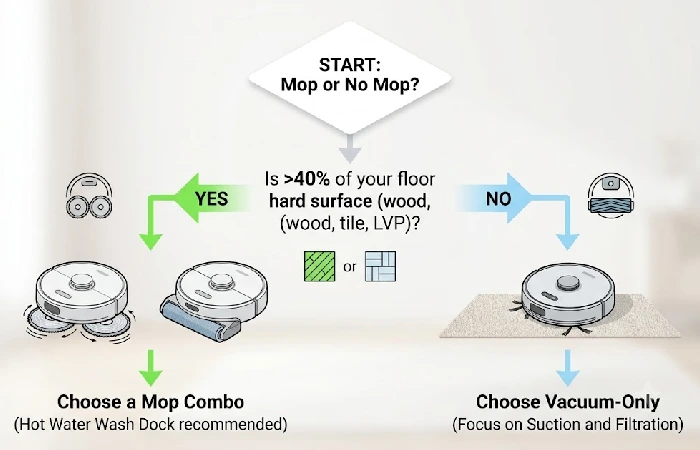
Only if over 40% of your floor space is hard surface — tile, hardwood, LVP. Carpet-heavy home? Skip the mop. A vacuum-only model like the Roomba j9+ avoids the added complexity and maintenance altogether.
- Rotating pads (Roborock, Mova, Dreame) handled dried stains better than older drag-mop configurations
- Track/roller mops (Ecovacs OZMO Roller, Narwal FlowWash) hold continuously against the floor to scrub wet at greater depth
- Automatic mop raising is a must if you have any carpets – without it, the robot pulls a soaked pad across your rugs.
Where do robot vacuums fit in a broader smart-home cleaning setup? They connect with other automated cleaning devices — mopping robots, air purifiers, the works.
What ongoing maintenance do robot vacuums actually require?
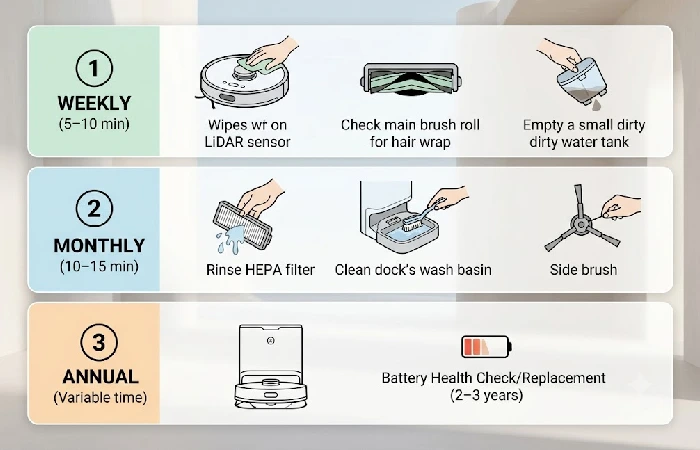
Robot vacuums are not really hands-off, no matter what the advertisements proclaim. Even the best robot vacuum with a high-end dock needs the occasional push from the user to achieve optimal cleaning.
Weekly tasks (5–10 minutes):
- Wipe the LiDAR and camera sensors with a dry microfiber cloth.
- Examine the main brush roller for hair wraps. Rubber rollers tangle less than bristle ones — long hair still builds up, though.
- Empty the dirty-water tank in the dock (mop models only).
Monthly tasks (10–15 minutes):
- Rinse or replace the HEPA filter (replacement filters cost $10–$20 for a 2-pack; replace every 2–3 months)
- Clean the dock’s wash basin and drainage channels.
- Check side brushes for chipping – replace every 3–6 months ($5–$10)
Annual consideration:
Battery capacity usually diminishes after 2–3 years of daily use. Replacement batteries run $30–$80, depending on model and make.
What the iRobot bankruptcy means for Roomba buyers in 2026
The Roomba j9+ still gets the job done. Before buying any iRobot product in 2026, though, check on warranty coverage and parts availability.
Here is what happened:
- December 2025: iRobot declared bankruptcy after the Amazon deal fell through
- February 2026: Technology company Picea finalized its purchase of iRobot.
- July 2026: iRobot launched six new product series, including its first-ever LiDAR-equipped lineup, and also the house cleaner (nonrobotic) Roomba Electro Plus.
Tom’s Guide advises a general wait-and-see attitude for new Roomba acquisitions as the company manages the transition. The new LiDAR-based models (Roomba 115, 415 Combo) are still in testing but there is no public record of a long-term support pledge for legacy models (e.g., the j9+) by Picea.
The end-result: If you get a Roomba j9+ at the ~$400 price point, you are receiving validated hardware at a significant discount. Just make sure the warranty conditions are okay with your seller before you check out.
FAQ
1. Are robot vacuums worth the money?
Yes, for everyday tidying in homes with open floor plans and little clutter. A robot working 20 minutes a day replaces perhaps 2 hours a week of brooming and light vacuuming. Not a substitute for occasional deep-clean with an upright vacuum (notably on thick carpet).
If you’re building a full smart-home stack, our best smart kitchen appliances for 2026 roundup covers the kitchen side of things.
2. Which robot vacuum has the strongest suction?
The Dreame X60 Max Ultra Complete is easily the most powerful vacuum in this roundup at 35,000 Pa (confirmed on this page of Dreame’s official website). To put this into perspective, 4,000 Pa is enough for daily hard floor cleaning, 10,000 Pa+ is enough to suck up embedded carpet detritus, and 30,000 Pa+ is overkill for the vast majority of homes, but certainly useful for deep-pile carpet and large quantities of pet hair.
3. Do robot vacuums work on thick carpet?
All the LiDAR models that have two rubber brushes generally do well on medium-pile carpet (up to about 15mm pile height). The deep shag rug (greater than 20mm pile) has been problematic for all models (a lot of the time) as of August 2026, robots might bog down, slip out, or be unable to suck out embedded debris. If you have deep shag, employ multi-pass mode and back it up with a manual upright vacuum at least once a month.
4. How long do robot vacuums last?
Expect 3–5 years of reliable operation with regular maintenance — filter and brush changes, sensor cleaning. Batteries typically last 2–3 years under normal use. Sometimes less, if capacity fades early. Replacement batteries run $30–$80 depending on the brand. Self-emptying dock stations and mop-wash stations will need descaling or basin replacement after 18–24 months of normal use.