Published: September 2, 2026
Last Updated: September 2, 2026
Intelligent automation, that’s RPA and AI put together, so the software’s doing more than clicking through the same steps, it’s making calls that need some thought. Somewhere between a bot that just follows rules and a fully autonomous agent, and honestly, where your process sits on that line is what tells you which tech to use.
Quick Answer: it’s RPA plus AI and BPM. Automates the stuff that takes judgment, not the repetitive grind.
Definition, roughly: intelligent automation pulls together RPA and AI, machine learning, natural language processing, that kind of thing, to handle decisions that need interpretation rather than just running a script over and over.”
Automation tier comparison
| Tier |
Standalone definition |
Best-fit scenario |
| RPA |
Robotic Process Automation (RPA) is software that mimics human keystrokes and mouse clicks to move data between systems and execute defined steps |
RPA suits simple, high-volume, structured tasks with rapid ROI |
| Intelligent Automation |
The use of AI, natural language processing (NLP) and robotic process automation (RPA) to streamline and scale decision-making across organizations |
Intelligent Automation fits processes needing interpretation and cognitive decisions |
| Agentic Process Automation |
Agentic systems pursue goals rather than follow scripts: given an outcome to achieve, they decide which steps and tools to use, can break large goals into sub-tasks, and re-plan if a step fails |
Agentic Process Automation targets strategic, highly complex work requiring continuous adaptation |
Methodology: Tier structure sourced from Kognitos’s published comparison framework, cross-checked against IBM and Straits Research documentation, September 2026.
What is intelligent automation?
Intelligent automation is modern software built on combining artificial intelligence with robotic process automation so that the machines can understand information and make decisions rather than just blindly following a defined procedure. Intelligent automation is a combination of artificial intelligence and robotic process automation used by businesses to cut costs and work faster by deploying robots that use artificial intelligence to cut down on repetitive tasks.
Vendor documentation converges on the same structure. SAP explains that robotic process automation is a primary component, referring to bots programmed to emulate and copy human actions to complete repetitive tasks; intelligent process automation is the next evolution, integrating machine learning and natural language processing with robotic process automation to perform advanced tasks it isn’t necessarily preprogrammed for.
- It can also infer the business context behind data and learn from its experiences, making it much more flexible and adaptable than older forms of automation
- As it accumulates data, the system learns in an effort to improve its efficiency
What are the core technologies behind intelligent automation?
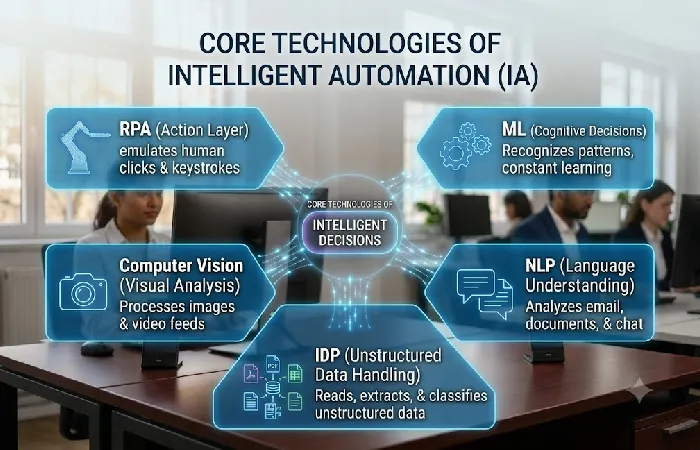
Intelligent automation is five technologies working together, RPA is what actually performs the task, AI/ML is there to recognize patterns, and NLP handles understanding language, on top of that you’ve got computer vision for anything visual and intelligent document processing when the data’s unstructured. Intelligent automation is robotic process automation and artificial intelligence (including Machine Learning, Natural-language processing and Computer vision) work together to allow a system to examine and make decisions on data.
A frequently overlooked distinction is integration method. Workato cautions that RPA software is often seen as the tool needed to implement intelligent automations, but it shouldn’t be the primary solution — it often requires technical expertise, which prevents employees at large from using it, and it integrates applications at the UI level via screen scraping rather than APIs.
Is intelligent automation the same as RPA?
No, and this trips people up a lot, intelligent automation isn’t just another name for RPA. It’s a step further along, sitting one stage up on a three-tiered continuum. Here’s how Kognitos lays out that progression: RPA started out as the tool of choice for automating rule-driven, repetitive tasks that didn’t need much sophistication. As the complexity of business processes increased and structure around data decreased, the market need became evident for an intelligent solution, and Intelligent Automation was born, integrating Robotic Process Automation and Artificial Intelligence to handle more cognitive tasks.
The practical rule for which tier applies to a given process: if you are able to record all of the steps and the inputs are always identical, then RPA will do; if not, because the operations involve reading, interpreting, or deciding, then you should choose the intelligent or agentic tiers.
- RPA: fixed rules, structured data
- Intelligent Automation: unstructured inputs, cognitive decisions
- Agentic Process Automation: autonomous goal-pursuit, self-correction
What are common intelligent automation use cases?
Intelligent automation is most often deployed where structured and unstructured data both feed the same decision. In IBM’s framing, an insurance provider can use IA to calculate payments, estimate rates and address compliance needs.
Other verified deployments:
- Sales operations: In the lead-to-cash process, sales staff can use intelligent process automation to create sales orders from either structured data, like in spreadsheets, or unstructured data, like in scanned PDFs
- Invoice processing: An AI agent can be given the goal to process an invoice and will then autonomously execute all the necessary steps: reading the unstructured document, performing a three-way match in the ERP, routing for approval, and scheduling payment
- IT and workflow orchestration: connector-based automation replacing manual ticket routing, per Workato’s implementation guide
How do you implement intelligent automation?
Implementation follows a phased sequence: identify the right use case, pilot small, test rigorously, then scale. Based on IBM’s documented approach: choosing the right use cases forms the foundation of a solid implementation strategy, and IBM suggests a phased approach to minimize disruption, allowing incremental steps in adopting automation solutions so organizations can start with small projects and gradually expand.
- Identify high-value processes — target work mixing structured and unstructured data, such as claims or invoice handling
- Pilot on one workflow before scaling across departments
- Build a testing framework — a robust testing framework is crucial for verifying automated processes; IBM’s solutions include tools for thorough testing before full-scale deployment, ensuring smooth operations and reducing risks
- Expand incrementally using lessons from the pilot
- Connect the automation layer to AI workflow automation tooling for orchestration across systems
Frequently asked questions
1. What is an example of intelligent automation?
An insurance provider using AI and RPA together to calculate payments, estimate rates, and check compliance is a documented example. Intelligent automation is the use of AI, natural language processing and robotic process automation to streamline and scale decision-making across organizations — for example, an insurance provider can use IA to calculate payments, estimate rates and address compliance needs.
2. What are the components of intelligent automation?
The core components are robotic process automation, machine learning, and natural language processing, combined into one system. It integrates advanced AI techniques, including machine learning and natural language processing capabilities, with robotic process automation to perform advanced tasks for which it isn’t necessarily preprogrammed.
3. What industries use intelligent automation?
Of all the industries adopting this stuff, insurance, manufacturing, and financial services show up in the data most often. On the insurance side it’s usually claims processing that gets automated first, manufacturers lean toward it for fine-tuning production lines and juggling multiple machines at once. Taken together, more than 80% of enterprises have adopted automation, of which 67% incorporate AI-based process optimization to improve efficiency and scalability.
4. How much does intelligent automation cost to implement?
No vendor in the current top ranking publishes a standardized price. Prices here tend to be quote based on a function of process complexity, number of additional systems being connected to, and if an AI model license is included. Assume any flat “starting at $X” claim from a vendor to be promotional until confirmed by a signed quote.
5. What’s the difference between intelligent automation and hyperautomation?
The terms overlap but aren’t identical. The term intelligent automation is similar to hyperautomation, a concept identified by research group Gartner as being one of the top technology trends of 2020; hyperautomation typically refers to the broader, organization-wide orchestration of multiple automation tools, while intelligent automation describes the AI-plus-RPA combination itself.
Enterprises weighing which tier to adopt should start by auditing one process against the Kognitos decision test above — if the steps are fixed and the inputs never vary, stop at RPA. If the work requires reading, interpreting, or judgment, intelligent automation is the minimum viable tier, and broader AI automation strategy planning should happen before any platform purchase.
Outstanding item: The Target Conversion/Money Page URL was not supplied in Topic Details. The closing CTA above routes authority to the Pillar page as an interim measure. Supply the money-page URL to complete the Cluster routing table’s dual-authority requirement (Pillar + Money Page).