Published: September 2, 2026
Last Updated: September 2, 2026
So when businesses analyze investments in automation in 2026, they wonder: is an AI agent truly a substitute for rule-based automation, or an assistant to rule-based automation? In brief: AI agents are an extension of automation into unstructured, judgment-based work that RPA isn’t up to, but RPA is a best bet for fixed, high-volume, rule-based processes. Four in 10 enterprise apps will interface with task-specific AI agents by 2026, according to Gartner Inc., up from less than 5% today. That adoption curve’s reality is clear, as is the high failure rate, something most competing guides on the market fail to mention.
Quick Answer: AI agents can reason through multi-step tasks and act on them, RPA is still faster for anything fixed and rule-based though, and something like 4 in 10 agentic AI initiatives are expected to hit a wall before they ever scale up.
Definition: AI agents for automation are AI systems that plan out steps and pick their own tools to get a multi-step business task done without much human input, unlike rule-based RPA bots, which just run through whatever script they’re given.
At a glance: AI agents vs. traditional automation
| Metric |
Standalone fact |
| Enterprise adoption pace |
Forty percent of enterprise applications will be integrated with task-specific AI agents by the end of 2026, up from less than 5% today, according to Gartner Inc. |
| Project cancellation rate |
Over 40% of agentic AI projects will be canceled by the end of 2027, due to escalating costs, unclear business value or inadequate risk controls, according to Gartner, Inc. |
| Vendor authenticity |
Many vendors are contributing to the hype by engaging in “agent washing” — the rebranding of existing products, such as AI assistants, RPA and chatbots, without substantial agentic capabilities, and Gartner estimates only about 130 of the thousands of agentic AI vendors are real. |
| Enterprise scaling status |
62% of organizations are at least experimenting with AI agents, and 23% report scaling agentic AI somewhere in their enterprise. |
| Operational risk rate |
51% experienced at least one negative consequence, and inaccuracy is the most common, with 30% experienced. |
| Execution model contrast |
Unlike RPA bots, AI agents can perform tasks that involve unstructured data and require flexibility and decision-making. |
| Autonomy differentiator |
The main difference between AI agents and RPA bots is their level of autonomy — agentic AI refers to systems with a high degree of autonomy, capable of goal setting, planning, reasoning and adapting over time. |
Methodology: Figures from Gartner press releases (2025–2026) and McKinsey’s 2025 State of AI global survey, validated by live search in September 2026.
What are AI agents?
AI agents are AI systems based on large language models that perform multi-step planning and execution towards a goal with minimal human oversight, rather than respond to a single prompt. They are different from basic chatbots or copilots in that they can invoke external tools and flexibly determine their next step based on results.
Key structural traits:
- Reasoning core: built on an LLM that interprets goals and unstructured input
- Tool use: calls APIs, databases, or software interfaces to execute actions
- Memory: retains context across steps or sessions to inform later decisions
- Autonomy level: operates with defined guardrails rather than a fixed script
This mirrors the broader shift Gartner describes: adding task specialization capabilities evolves AI assistants into AI agents, and these AI agents have the capacity to operate and perform complex, end-to-end tasks. A cybersecurity example illustrates the mechanism directly — an AI-driven cybersecurity threat response agent scans network traffic, system logs and user behavior patterns in real time, then assesses and initiates a response as appropriate. For a wider view of how this fits into the broader stack, see the broader AI automation landscape.
How AI agents automate tasks
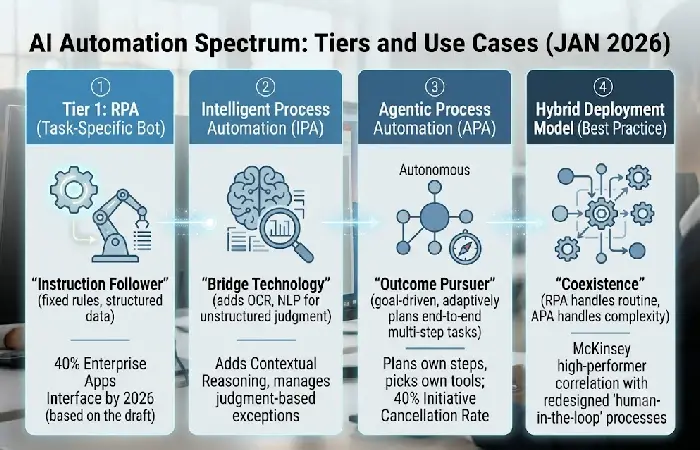
AI agents perform an automated automation loop: sense the input, plan the response, execute the response with one or several connected tools, evaluate the outcome and repeat the loop (with no re-activation of the cycle by a human). This is the single mechanical difference from scripted automation.
The typical execution sequence:
- Perceive — the agent ingests unstructured input (an email, a document, a customer message)
- Plan — the underlying LLM breaks the goal into sub-tasks
- Act — the agent calls APIs, databases, or software tools to execute each sub-task
- Evaluate — the agent checks whether the outcome matches the goal and adjusts if not
Agentic automation systems are systems that constantly evolve as they learn from experiences to make better decisions over time, and are built to do more than copy repetitive tasks, they understand, learn, deduce, solve problems and make decisions by themselves. This is a fundamentally different model from scripted procedures, explored further in AI workflow automation.
AI agents vs traditional automation
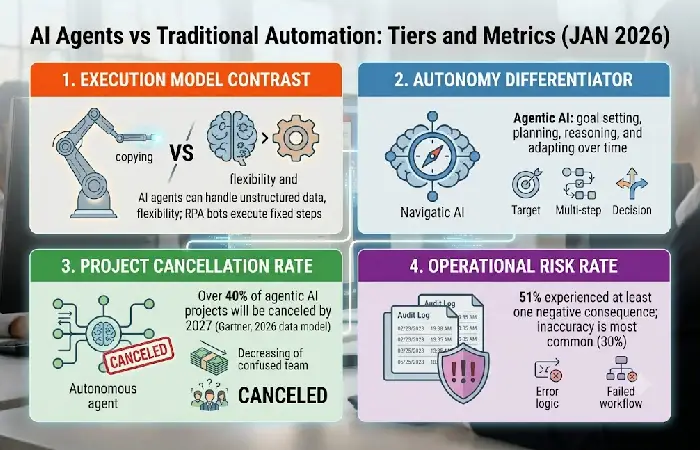
AI agents and traditional RPA solve different problems: RPA executes fixed, rule-based steps reliably, while AI agents handle unstructured input and make judgment calls RPA cannot. Neither fully replaces the other in most enterprise stacks today.
Enterprises looking to automate their operations face a choice between reliable but constrained robotic process automation and adaptive but experimental AI agents — RPA is a tried-and-tested technology designed for automating specific, rule-based tasks that excels at handling structured data and predefined workflows. By contrast, AI agents can perform tasks that involve unstructured data and require flexibility and decision-making, though they are more versatile but also more experimental and error-prone.
Rather than an either/or decision, TechTarget’s comparison notes that the choice isn’t always either-or: as RPA platforms modernize and AI agents mature, the two technologies can complement each other, with RPA handling structured, high-volume steps and agents handling the reasoning layer around them.
Business use cases for AI agents
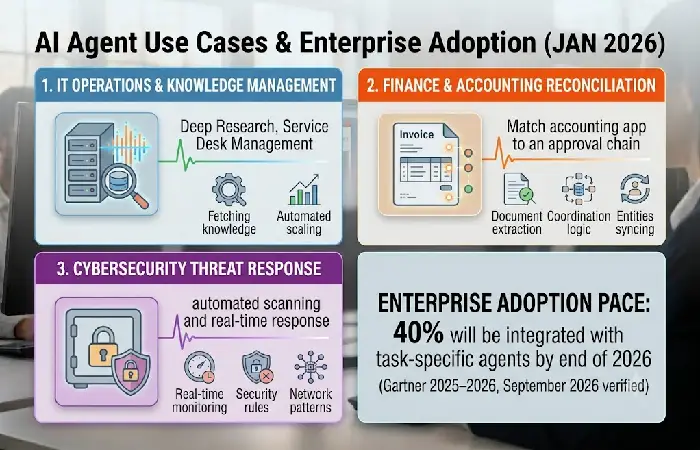
AI agents are currently used for functions that require judgment across unstructured data — customer service triage, IT operations monitoring, financial reconciliation, and marketing content coordination — rather than pure data entry. Adoption concentrates in a small number of functions per company rather than enterprise-wide rollout.
Documented use-case patterns include:
- IT and knowledge management — agents retrieve and act on existing institutional knowledge, where agentic scaling is real but narrow at 23 percent, with agents leading in IT and knowledge management because those functions already run on retrieving and acting on existing knowledge
- Finance and accounting — AI agents manage entire close processes, coordinating tasks across multiple entities while adapting to delays and exceptions, reorganizing workflows when issues arise instead of following rigid timelines
- Cybersecurity threat response — automated scanning and real-time response, as described in the What Are AI Agents section above
Risks and limitations of agentic automation
The primary risks of agentic automation are project cancellation, output inaccuracy, and vendor overstatement of true agentic capability. These are governance and deployment risks, not purely technical failures.
According to Gartner analyst Anushree Verma, quoted in Gartner’s 2025 press release, most agentic AI projects are currently early stage experiments or proof of concepts that are often misused and mostly hype-driven. Regarding agentic AI’s accuracy, McKinsey’s 2025 survey revealed that 51% of the participating organizations recorded at least one AI-related negative incident during the previous 12 months (e.g., output inaccuracies, compliance violations, reputation loss, privacy violations, unintended AI system actions).
Mitigation gap: McKinsey shows high performers are significantly more likely to have defined ‘human in the loop’ validation processes (65% vs 23%). That points to monitoring, not model performance on its own, as what separates successful deployments from the ones that get canceled.
Frequently asked questions
1. What is an AI agent in automation?
An AI agent in automation is an LLM-based system that plans out and carries out multi-step tasks towards achieving a goal in an automated fashion with the least human involvement possible, utilizing external tools if required. An agent is different than a chatbot since an agent acts instead of just responding.
2. How do AI agents differ from RPA?
AI agents reason over unstructured data and adapt their approach; RPA executes fixed, rule-based steps on structured data. Although RPA is well established and provides stability, its capabilities are also more limited; AI agents, in contrast, are more versatile, but also more experimental and error-prone.
3. Are AI agents safe for business use?
They carry measurable operational risk. 51% experienced at least one negative consequence, and inaccuracy is the most common, with 30% experienced — safety depends on human-in-the-loop validation, not the model alone.
4. Can AI agents replace traditional automation entirely?
No. Agentic AI is here, but it’s not replacing RPA — rather, it’s part of enterprise automation, and whether you need AI agents or RPA depends on each process.
Before deploying an agent into any workflow, map the specific decision point where judgment is required versus where a fixed rule suffices — that single distinction, more than any vendor’s feature list, determines whether RPA, an AI agent, or a hybrid of both is the right architecture.