Published: September 2, 2026
Last Updated: September 18, 2026
Most companies aren’t stuck because the technology doesn’t work. They’re stuck because they built a pilot instead of a production system. This guide breaks AI automation into its three real technology tiers, attaches verified 2026 cost figures to each, and explains why most projects never leave the pilot stage — so you can skip the mistakes already documented across thousands of enterprise deployments.
Quick Answer: AI automation covers a lot of ground. On one end you’ve got rule-based RPA, on the other, fully autonomous agentic systems. Right now 88 percent of companies say they’re using AI regularly somewhere in the business, at least one function, that’s up from 78 percent just last year. However, no more than 10 percent of respondents have actually scaled agents out in a specific business unit.
Definition: AI automation is placing machine-learning models and large language models in tandem with workflow software so systems can process unstructured information and make decisions based on context, not simply run on rules.
AI automation at a glance: verified 2026 data points
| Metric |
Standalone fact |
| Overall AI adoption |
88% report regular AI use in at least one business function, up from 78% a year ago (McKinsey, State of AI in 2025). |
| Agent experimentation |
62% of organizations are experimenting with AI agents — foundation-model systems that plan and execute multi-step workflows autonomously. |
| Agent scaling rate |
23% are scaling an agentic AI system somewhere in the enterprise; another 39% are still experimenting. |
| Function-level ceiling |
No more than 10% report scaling AI agents in any single function. |
| Where agents concentrate |
Agent use concentrates in IT and knowledge management — e.g., service-desk automation and deep research. |
| Enterprise financial impact |
Just 39% report EBIT impact at the enterprise level. |
| High-performer advantage |
High performers are nearly 3x more likely to have redesigned workflows around AI. |
| Strategy-to-success link |
Enterprises without a formal AI strategy succeed only 37% of the time, versus 80% with one (Writer, 2025). |
| Deployment vs. intent gap |
Only 17% have deployed AI agents so far; over 60% expect to within two years (Gartner, 2026 Hype Cycle). |
| Projected project failure |
Over 40% of agentic AI projects will be canceled by end of 2027 — rising costs, unclear value, weak risk controls (Gartner). |
| Vendor authenticity |
“Agent washing” is widespread; Gartner estimates only ~130 of thousands of self-described agentic AI vendors are genuine. |
| Chatbot build cost |
Basic AI chatbots cost $5K–$15K, 1–3 week timeline. |
| Action-taking agent cost |
Agents that take actions and access databases cost $15K–$50K over 4–8 weeks. |
| Multi-agent platform cost |
Multi-agent automation platforms cost $30K–$80K over 2–4 months. |
| Enterprise custom-model cost |
Custom ML model solutions start at $80K and can exceed $200K. |
| Mid-market build range |
Most mid-market builds land between $40K and $150K. |
| Where the money actually goes |
Engineering, not LLM API fees, dominates build cost — API costs are only 8–15% of the total. |
| Agency pricing structure |
2026 agency pricing: $0–$5K discovery/audit, $5K–$25K single workflow, $25K–$100K multi-workflow build. |
| RPA’s structural limit |
RPA is static and fragile to change; agentic AI is dynamic, resilient, and self-improving. |
| Best deployment model |
Hybrid models work best: RPA handles routine execution, agentic AI manages complexity and exceptions. |
| Named expert quote |
Gartner’s Anushree Verma: “Most agentic AI projects right now are early stage experiments… often misapplied.” |
Methodology note: figures are drawn from named analyst reports and vendor-published pricing guides current as of September 2026. Costs and adoption percentages should be re-verified at each content refresh cycle.
What is AI automation and how does it work?
AI automation hooks machine-learning models into workflow software. That’s basically what lets it read stuff coming in unstructured, emails, PDFs, chat messages, and actually figure out what to do with it, instead of running some script somebody wrote six months back and forgot about. Context comes first. The model looks at that, figures out what it’s dealing with, then it goes and does something inside whichever system it’s hooked up to. Older automation never had that option. It just followed rules. Nothing else to it.
Core components in a typical AI automation stack:
- A trigger (new email, form submission, database change)
- A reasoning layer (LLM or ML model that interprets the input)
- An action layer (API calls, database writes, notifications)
- A feedback loop (logs, human review, retraining data)
Vendor documentation from AWS and Zapier both frame this as combining generative and predictive AI with existing automation infrastructure rather than replacing it outright. The distinction matters operationally: a workflow only qualifies as “AI automation” once a model — not a static rule — is making at least one decision inside the sequence.
How AI automation processes decisions
The reasoning layer is what separates AI automation from a simple trigger-action script. When new data enters the workflow, the model evaluates context — sender history, document type, sentiment — before selecting an action rather than matching a fixed pattern. This is why the same AI automation system can route a routine invoice one way and an unusual, high-value invoice a completely different way, without a human writing a separate rule for each case. Vendor guides from Make.com describe this as the shift from “if this, then that” logic to “interpret, then decide” logic — the functional definition practitioners use to distinguish AI automation from standard workflow automation tools.
How does AI automation differ from traditional automation?
Conventional Automation, RPA, operates on predefined rules, no judgment calls here. AI automation differs. It introduces an element of decision-making that can adapt when input is unfamiliar or inconsistent rather than simply failing. RPA has been established for some time now, it has already proven to be effective and is designed for doing repetitive, rules-based activities, at the level where the steps stay constant. With structured data, fixed workflows, and little movement, that’s where it does well. AI automation builds on this by managing any issues RPA is incapable of addressing.
The practical decision rule:
- Use RPA when the process is repetitive, rule-based, and the inputs are structured and predictable, nothing that needs a judgment call.
- Use AI agents when the task involves unstructured data, needs ongoing learning and adaptation, or comes down to a judgment call.
Traditional automation’s rule-based ceiling
Traditional RPA bots break the moment their environment changes. RPA is static and fragile to change — a renamed form field, a moved button, or an unexpected document format can halt an entire bot until an engineer manually updates the script. Although RPA is well established and provides stability, its capabilities are also more limited. This ceiling is precisely why organizations layer AI automation on top rather than replacing RPA outright — the older technology still handles the 80 percent of predictable volume reliably and cheaply, while the AI layer absorbs the unpredictable remainder.
Where AI automation adds judgment
AI automation earns its cost premium by handling what RPA structurally cannot. Agentic AI is a newer automation approach that uses large language models and external tools; unlike RPA bots, AI agents can perform tasks that involve unstructured data and require flexibility and decision-making. Common judgment-based tasks include analyzing customer sentiment on social media and responding to customer queries in a dynamic and unscripted way. The distinction is not always as simple as either/or: as RPA platforms mature and AI agents evolve, the technologies can overlap, with RPA providing a bridge between legacy systems and AI-driven processes.
What are the types of AI automation technologies?
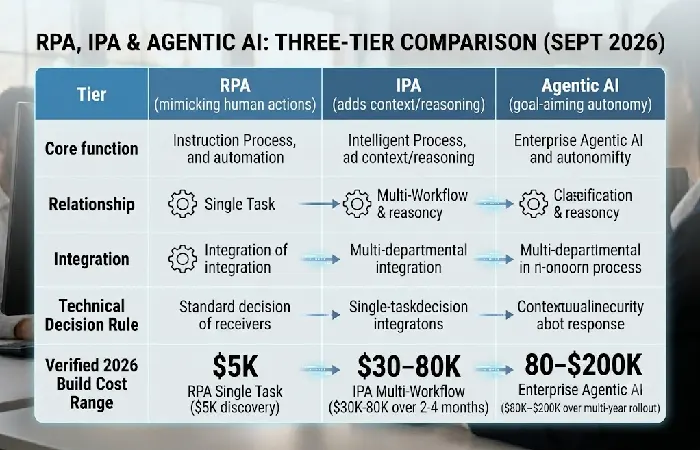
AI automation isn’t a single technology. It’s a three-level spectrum, starting with hard-coded rule following, moving through more flexible middle tiers, and ending with fully autonomous goal-aiming automation. Each one solves a different category of problem. In practice, few large corporations stick to just one tier, most run all three at once.
Robotic process automation (RPA)
RPA is the lowest layer: it’s software robots set to run set steps without exception, based only on rules and no judgment. Robotic Process Automation makes use of bots to accomplish those dull, rule-based jobs a human would usually take, you set the rules, and the bot will act on them. It has no idea about purpose or context, it just follows the set path. RPA jobs are logging into systems and copying data between applications, extracting structured information from e-mails then entering it into databases, processing documents following a static template, such as invoices, and filling data into legacy systems with no API.
Intelligent process automation (IPA)
IPA sits in the middle tier, layering AI capabilities like OCR, NLP, and machine learning onto RPA’s rule engine so it can handle judgment-based processes and unstructured data. When comparing RPA and AI automation, RPA doesn’t learn or improve over time, while AI or agentic automation does — IPA is the bridge technology where that learning capability first gets introduced.
Agentic process automation (APA)
APA is the top tier: systems given a goal rather than a script. Agentic AI uses AI agents to automate end-to-end workflows with minimal human intervention; these intelligent agents can take actions and make decisions — simply give them a goal, and they will set about completing it in the best way possible. Blue Prism’s framing simply restates the transition: “RPA bots are excellent ‘instruction followers,’ while AI agents are ‘outcome pursuers’.” The agent tracks the bigger goal and adjusts its next move as it goes, instead of running through a script written ahead of time.
What are real-world AI automation use cases?
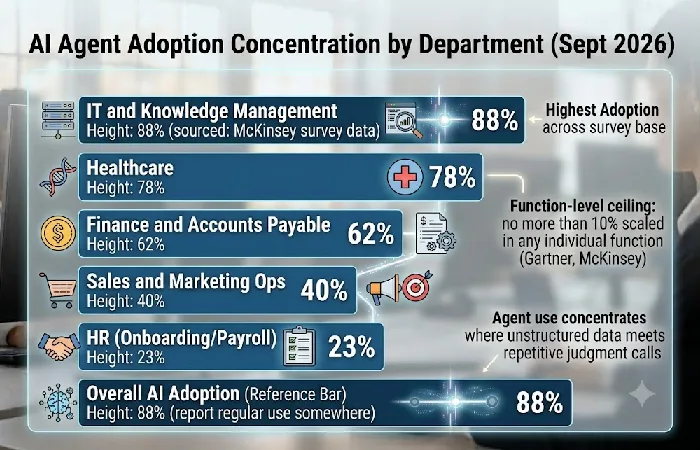
AI automation adoption concentrates heavily in a handful of departments where unstructured data and repetitive judgment calls intersect. Agent use is most commonly reported in IT and knowledge management, and by industry, the use of AI agents is most widely reported in the technology, media and telecommunications, and healthcare sectors.
Where AI automation delivers the fastest measurable returns:
- IT and knowledge management — service-desk management in IT and deep research in knowledge management have quickly developed as agentic use cases, making this the highest-adoption department across the McKinsey survey base.
- Customer service — dynamic, unscripted response handling that structured chatbot scripts cannot manage, per the RPA-vs-agent task split documented by TechTarget.
- Finance and accounts payable — document-heavy, template-based processes where RPA extracts and IPA/agentic layers flag exceptions before human review.
- Sales and marketing operations — lead scoring and outreach sequencing where judgment calls (which lead, which message, which timing) benefit from a reasoning layer rather than a fixed rule set.
Why department-level adoption stays narrow
Even inside high-adoption departments, agent use rarely spans an entire function. At the enterprise level, the majority are still in the experimenting or piloting stages, with approximately one-third reporting that their companies have begun to scale their AI programs. This pattern — deep pockets of adoption inside otherwise untouched departments — is why a use-case inventory matters more than a blanket “AI automation strategy” when planning a rollout.
How do you implement AI automation successfully?
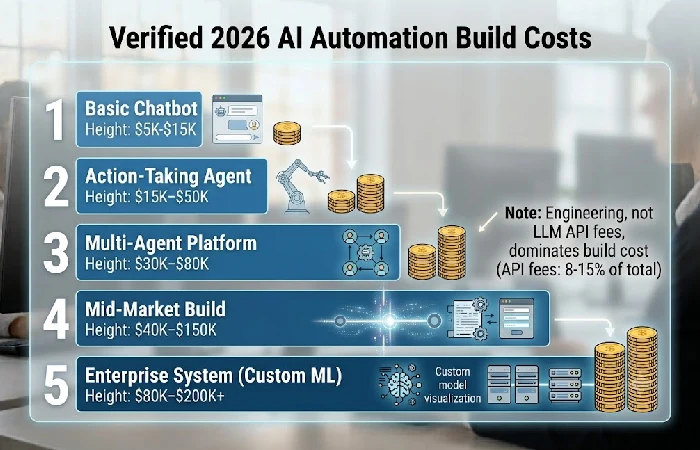
It all begins with selecting the right automation tier for the task complexity, and then budgeting sensibly, not just chasing whoever quotes the lowest price. This one step is the number one cause of most pilots never moving into production.
Budgeting for an AI automation build
Cost scales directly with autonomy and integration depth, according to Cleveroad’s 2026 AI agent development cost guide:
- AI chatbots cost $5K-15K with a 1-3 week timeline
- AI agents that take actions and access databases cost $15K-50K over 4-8 weeks
- Full automation platforms with multi-agent architectures cost $30K-80K over 2-4 months
- Enterprise solutions with custom ML models start at $80K and can exceed $200K
For agencies rather than in-house builds, pricing typically falls into a discovery or audit engagement at $0-$5,000, a single scoped workflow at $5,000-$25,000, or a multi-workflow build at $25,000-$100,000. Notably, the engineering layer is the dominant cost for most enterprise builds — not the LLM API fees, which represent only 8–15% of total build cost, a detail most vendor sales conversations skip entirely.
Why most AI automation pilots stall
The adoption-to-production gap is now the defining problem in AI automation, not the underlying technology. Gartner’s June 2025 analysis predicts over 40% of agentic AI projects canceled by the end of 2027, due to escalating costs, unclear business value or inadequate risk controls. Gartner’s Anushree Verma names the root cause directly: “Most agentic AI projects right now are early stage experiments or proof of concepts that mostly driven by hype and often misapplied. This can blind organizations to the real cost and complexity of deploying AI agents at scale, stalling projects from moving into production.”
Governance and vendor vetting
Not every vendor claiming “agentic AI” has built one. Many vendors engage in “agent washing” — rebranding existing products such as AI assistants, RPA and chatbots without substantial agentic capabilities — and Gartner estimates only about 130 of thousands of agentic AI vendors are real. Before signing a contract, request a live demo of the system handling an unscripted edge case, not a scripted walkthrough — this single test filters out most rebranded RPA tools masquerading as agents.
If you’re ready to scope a build, review an AI automation cost breakdown before requesting vendor quotes. Then compare RPA vs. agentic AI to confirm which tier your use case actually needs.
Frequently asked questions
1. Is RPA the same as AI automation?
No. RPA established technology that is suitable to take over well defined, rule-based processes whereas AI automation brings an additional layer of reasoning for dealing with unstructured inputs. RPA is just one part of the overall AI automation spectrum, not a synonym for it.
2. How much does AI automation cost to implement?
Costs range from $5K-15K for a simple chatbot to $80K-$200K+ for enterprise systems with custom ML models. Most mid-market organizations land in a narrower band — mid-market builds typically fall between $40,000 and $150,000.
3. What is agentic AI automation?
Agentic AI automation gives a system a goal instead of a script. These intelligent agents can take actions and make decisions — simply give them a goal, and they will set about completing it in the best way possible. It’s the most autonomous tier in the automation spectrum, sitting above rule-based RPA and hybrid IPA.
4. Will AI automation replace jobs?
The current data points toward augmentation of specific tasks rather than wholesale department replacement. 9Most organizations are still in the experimenting or piloting stages, and no more than 10 percent of respondents report scaling AI agents in any individual function — adoption remains narrow and task-specific rather than function-wide.
5. Why do AI automation pilots fail to reach production?
Gartner attributes agentic AI project cancellations to escalating costs, unclear business value, and inadequate risk controls, not to model performance. Organizations that treat automation as a strategic redesign rather than a bolt-on tool see better outcomes meaningfully— formal AI strategy correlates with an 80% success rate versus 37% without one.
Pick one workflow where a human currently makes a judgment call using unstructured data — not the cheapest task to automate, the most repetitive judgment call you already trust a junior employee to make. Scope that single workflow against the cost tiers above before requesting a single vendor quote, and use the RPA/agentic decision rule in this guide to confirm you’re not overpaying for autonomy the task doesn’t need.