Published: September 2, 2026
Last Updated: September 2, 2026
Generative AI automation is changing how teams handle repetitive writing, decision-routing, and support tasks — but most explainers either oversell it as a full replacement for human work or bury it in vendor jargon. This piece defines the term precisely, lists what it actually automates today, walks through a documented enterprise example, and states plainly where governance still lags adoption.
Quick Answer: Generative AI automation pairs generative AI with workflow tools to draft, decide, and route tasks — cutting costs and ticket volume in documented cases, but only 39% of CEOs say their governance is ready for it.
Definition: “Generative AI automation is the use of generative AI models within automated workflows to draft, decide, and execute tasks — such as writing, summarizing, or routing — with minimal ongoing human input.”
What is generative AI automation?
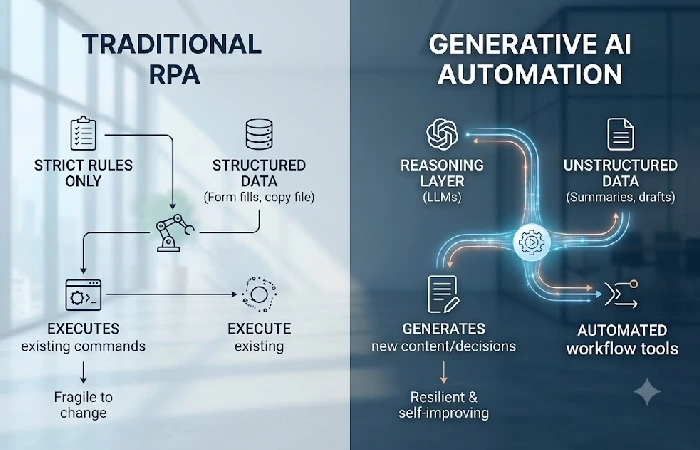
Generative AI automation also involves using large language models with rule-based or agentic workflow systems, enabling a system to produce outputs or perform routing choices without a human authoring each individual element. This distinguishes it from ‘normal’ robotic process automation (RPA) which adheres to pre-encoded rules and is incapable of writing or rephrasing texts on its own.
Key distinctions:
- RPA: Runs on a set of explicit rules to execute commands, applying only to structured data (for instance, copy a file, populate a form)
- Generative AI automation: Starts and continues producing new information or solutions (e.g., drafting a reply, summarizing a ticket) and is able to push that information to an automation tool for implementation.
- Agentic AI: Extends generative AI automation by chaining multiple actions together with limited human checkpoints in between
Most production systems today combine all three layers rather than relying on generative AI alone — a distinction the broader AI automation category groups under one strategic umbrella.
What tasks can generative AI automate?
Generative AI automation currently handles a specific, bounded set of task types — not open-ended judgment calls. The clearest wins are language-heavy, repetitive tasks where a draft or a routing decision can be checked or overridden by a human.
Tasks with documented automation coverage:
- Drafting responses: Customer emails, HR policy answers, support tickets
- Summarizing: Meeting notes, long documents, ticket histories
- Routing and triage: Sorting inbound requests to the correct team or escalation tier
- Content generation at scale: Product descriptions, ad copy variants, internal documentation
- Data extraction: Pulling structured fields (dates, names, amounts) out of unstructured text
Teams evaluating specific platforms for these tasks should compare feature sets and pricing directly rather than relying on vendor marketing claims — see this site’s AI automation tools comparison for a feature-level breakdown before selecting a stack.
What are examples of generative AI automation?
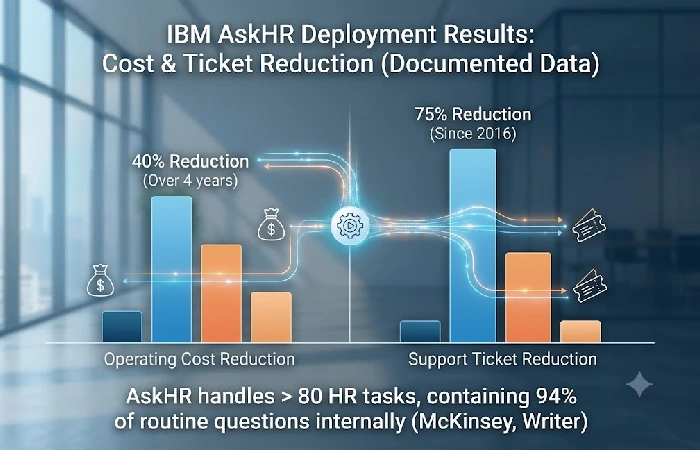
The clearest documented example is IBM’s internal HR virtual agent, AskHR, which shows measurable before/after results rather than projected estimates. Over the past six years, IBM has continuously refined its internal virtual agent, AskHR, to automate more than 80 HR tasks and handle over 2.1 million employee conversations annually.
Documented results from this single deployment:
- The AI agent helped contribute to a 40% reduction in the HR team’s operational costs over the past four years
- AskHR also achieved a 94% containment rate of common questions, has led to a 75% reduction in support tickets raised since 2016, and created more than 11.5 million employee interactions in 2024 alone
- Most recently, in 2025, the team integrated IBM watsonx Orchestrate to enhance AskHR’s gen AI and agentic automation capabilities
What are the benefits for businesses and teams?
The primary measurable benefits of generative AI automation are cost reduction and ticket-volume reduction in support and administrative functions — not blanket “productivity” gains across every department. Benefits scale with how narrowly the task is scoped.
Benefits with named, sourced backing:
- Operational cost reduction: A 40% drop in HR operating costs over four years in IBM’s own deployment
- Support load reduction: 94% containment of routine questions, thus most questions do not have to be handled by a human
- Performance related to governance: Firms that incorporate control into AI architectures use 16x more AI agents, spend 4x less and earn 18% better operating margins than those that do not, according to IBM Institute for Business Value research.
This last point matters for planning: governance is not a cost center slowing deployment down — it correlates with faster, cheaper scaling. Teams building process-level rollouts should review this site’s AI workflow automation guide for sequencing steps before expanding beyond a pilot.
What are the risks and governance considerations?
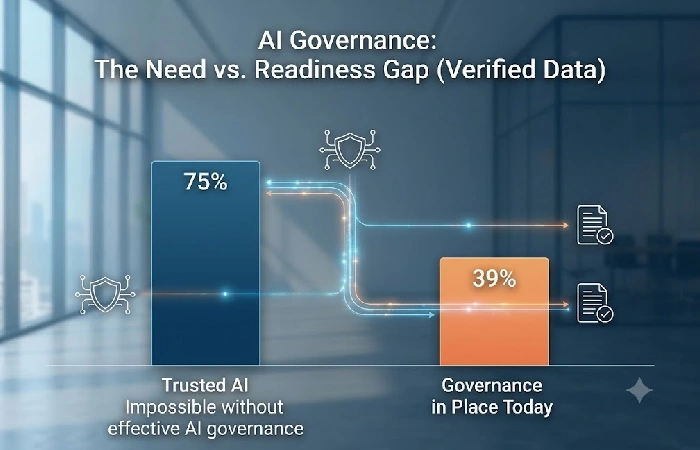
The primary risk in generative AI automation deployment right now is a governance gap, not a technology gap — most enterprises agree governance is necessary but have not implemented it. Although 75% of CEOs surveyed say trusted AI is impossible without effective AI governance in their organization, only 39% say they have good generative AI governance in place today.
Specific risk areas to govern before scaling:
- Timing of governance: More than two-thirds (68%) of CEOs surveyed agree that governance for generative AI must be established as solutions are designed, rather than after they are deployed
- Risk tolerance mismatch: 62% of CEO respondents say they will take more risk than the competition to maintain a competitive edge, and 67% say productivity gains from automation are so great that they must accept significant risk to stay competitive
- Adoption gap: While today 71% of surveyed CEOs are no further than generative AI piloting and experimentation, 49% expect to be driving growth and expansion by 2026
Frequently asked questions
1. Is generative AI automation the same as RPA?
No. RPA applies fixed, pre-programmed rules on structured data and can’t generate new text. Generative AI automation adds reasoning and content generation to that layer its output is often piped through an RPA or workflow tool to be run.
2. How is generative AI automation different from agentic AI?
Generative AI automation typically handles a single task — drafting, summarizing, or routing — with a human checkpoint. Agentic AI chains multiple such tasks together with fewer checkpoints, coordinating several actions toward a broader goal before a human reviews the result.
3. What skills are needed to manage generative AI automation?
Teams need prompt design, workflow-tool configuration, and review/audit skills rather than traditional software development skills alone. IBM’s guardrail pattern for AskHR pairs identity verification with human-in-the-loop checkpoints for high-risk actions.
4. Can small businesses use generative AI automation without an enterprise budget?
Yes, at a narrower scope than IBM’s deployment. Small teams typically start with a single bounded task — email drafting or ticket triage — using off-the-shelf tools rather than building custom agent orchestration from scratch.
Next step: Before scaling any generative AI automation pilot past its first bounded task, document the governance checkpoints — identity verification, audit logging, and human review triggers — in writing, and revisit them every quarter as task scope expands.