Published: August 20, 2026
Last Updated: September 18, 2026
Smart washing machines in 2026 do far more than connect to your Wi-Fi. AI optimized cycles, automated detergent doses, and ventless heat pump combos have made smart washing machines more about technology than laundry day. This buying guide pits the four biggest smart washer brands against each other across technologies that *do* save you money on utilities, the ones that won’t, and the privacy compromises most smart appliance buyer’s guides won’t cover. Looking for the bigger picture on smart home tech? Begin with our overview of smart appliances.
Definition: “Smart washing machines feature AI sensors, app control and auto-dose dispensers that learn about your laundry to improve every wash cycle’s settings for fabric type, load size and energy consumption — automating your laundry by the numbers.”
In a nutshell: Purchase your smart washer for its auto-dose functionality and AI-powered cycle customization features rather than its connected apps — LG leads on motor reliability while Samsung has the broadest smart-home platform. Expect to pay $700–$1,200 for a quality smart front-loading washing machine in 2026.
What makes a washing machine “smart” in 2026?
An intelligent washing machine is a machine that includes in-drum sensors, a companion app and auto-dosing to tailor the wash behavior to the load automatically. It has moved well beyond merely “having Wi-Fi.” By 2026, three layers of technology define the category:
- AI-powered cycle optimization: Sensors programmed in assess load fabric type, weight, and soil level and determine the best combination of water temperature, drum motion, and cycle time. LG‘s AI Direct Drive 2.0 can take any of 6 wash motions for a given load. Samsung‘s AI EcoBubble creates micro-bubbles of air, water, and detergent that penetrate fabrics in cold water. Samsung claims up to 70% energy reduction in AI Energy Mode.
- Auto-dose detergent dispensing: “The machine places detergent and softener from a large reservoir into the dispenser in amounts that are calibrated by sensor for each load”. The LG ezDispense delivers enough for 18-31 loads. The Bosch i-DOS system (the longest-established auto-dose technology in this category) cuts detergent use by up to 38% per load (via Bosch-home.com documentation).
- App connectivity and smart diagnostics: LG ThinQ, Samsung SmartThings, and Bosch Home Connect allow you to start a cycle from anywhere, receive notifications of how the cycle is progressing, and diagnose problems early with in-operation error-code readouts. SmartDiagnosis sends fault codes to the service center without technician guesswork.
Which smart features actually save money — and which are marketing padding?
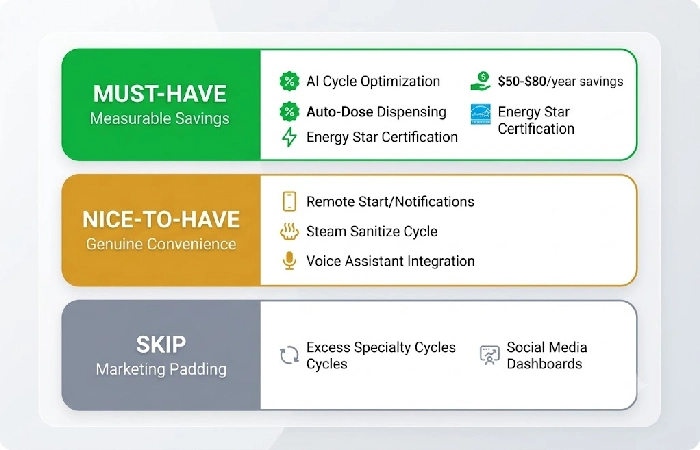
Auto-dose dispensation and AI cycle optimization are two charged-for features that have quantifiable recurring savings. WIFI remote start is convenient but results in no return. An Energy Star certified smart washer with AI load sensing uses ~25% less water and ~20% less energy per cycle versus a traditional top-loader (per Energy Star program data). For a household doing 6 loads/week that‘s on the order of $50–$80/year utility savings.
Feature tier list:
Must-have (measurable savings):
- AI cycle optimization (Water, Energy & cycle time reduction per load)
- Auto-dose dispensing (saves detergent wastage from 30% to 38% per load depending on device, as per Bosch i-DOS literature)
- Energy Star certification(prerequisite for the efficiency gains above)
Nice-to-have (genuine convenience, no direct cost savings):
- Remote start and cycle notifications through app
- Steam sanitize cycle (eliminates allergens – useful if you have allergy sufferers in the home)
- Voice assistant integration (e.g. Alexa, Google Home)
Skip (marketing padding with minimal real-world impact):
- Dozens of specialty wash cycles that you‘ve never used manually.
- Features associated with social media/lifestyle dashboards, such as
- Brand-specific “AI” tags that just rebrand go-alongs that are already driven with sensors
The $150–$400 price premium for a “smart” model over an otherwise equivalent non-smart unit pays for itself in 2–3 years if the model has auto-dose and AI cycle optimization. Without those 2 features, you‘re paying for remote start that‘s rarely worth it.
Should you buy a combo unit or a separate washer and dryer?
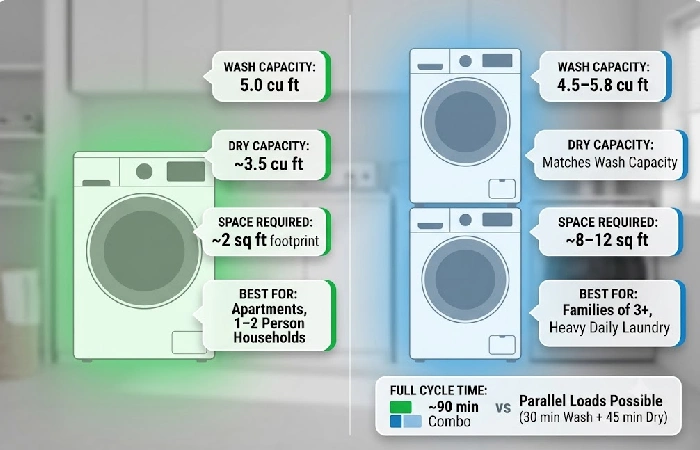
Buy the combo if your laundry area is less than 15 sq. ft and your household is 1–2. If you can afford the space and have a household of 3 or more, buy separate units. The current 2026 generation of heat pump ventless combos has improved significantly — CNET’s hands-on testing found that current models (e.g., LG WashCombo) wash and dry a complete cycle in about 90 minutes, instead of 3–4 hours.
| Factor |
Combo unit (2026 heat pump) |
Separate washer + dryer |
| Space required |
~2 sq ft footprint; ventless installation |
~8–12 sq ft; may require dryer vent |
| Wash capacity |
5.0 cu ft (LG WashCombo) |
4.5–5.8 cu ft (varies by model) |
| Dry capacity |
~3.5 cu ft (30–40% less than wash capacity) |
Matches or exceeds wash capacity |
| Full cycle time |
~90 minutes wash + dry (per CNET, August 2026) |
~30 min wash + ~45 min dry (parallel loads possible) |
| Best for |
Apartments, studios, 1–2 person households |
Families of 3+, heavy daily laundry volume |
The main drawback still stands: the combo drying capacity is 30-40% short of wash capacity; a family of four doing 8+ loads/week would still face a bottleneck in the drying throughput.
How do LG, Samsung, Bosch, and Electrolux smart washers compare?
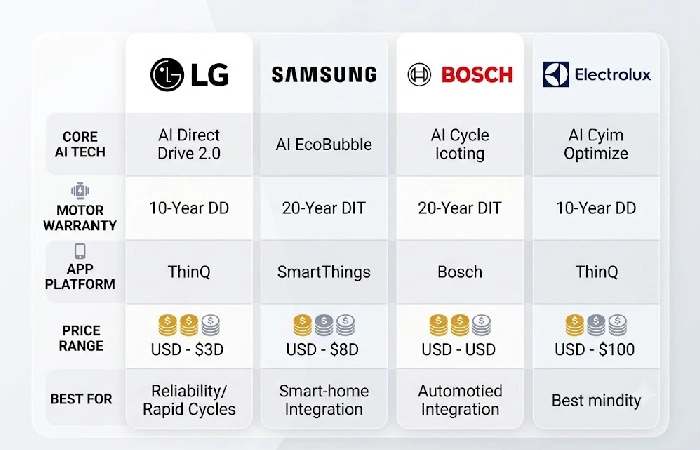
LG alone provides the best combination of motor reliability and AI wash brain power. Samsung is the most advanced by smart-home ecosystem scope. Bosch is the best for run quiet and precisely measured dosing. Electrolux is the best for fabric care, period. No single top-10 ranking page compares all four brands side by side — here is the direct comparison.
| Attribute |
LG |
Samsung |
Bosch |
Electrolux |
| Core AI tech |
AI Direct Drive 2.0 — 6 auto-selected wash motions by fabric, weight, level of soil |
AI EcoBubble — cold-water micro-bubble cleaning; reduces energy use by up to 70% in AI Energy Mode |
i-DOS — sensor-calibrated auto-dosing; 38% reduction in detergent use |
SmartBoost — pre-mixes detergent with water before cycle for even distribution |
| Motor warranty |
10-year (beltless Direct Drive) |
20-year (Digital Inverter, belt-driven) |
Not publicly standardized (model dependent) |
Differs depending on the region |
| App platform |
LG ThinQ (diagnostics + remote start; Google Home, Alexa, HomeKit) |
SmartThings (broad IoT platform; Google Home, Alexa) |
Home Connect (Google Home, Alexa, IFTTT) |
Electrolux app (remote control; limited platform) |
| Price range (USD) |
$699–$2,000+ |
$700–$1,800 |
$900–$1,400 |
~$1,199 (700 Series) |
| Best for |
Families of 3+ concerned about motor reliability and rapid cycles |
Smart-home-first buyers wanting broad IoT integration |
Noise-sensitive apartments and precision-dosing users |
Garment longevity-minded consumers who focus on proper fabric care |
Does any smart washer natively support Matter in 2026?
There have been no large brand washing machines with native Matter-over-Wi-Fi accreditation released up to August 2026. All three major brands of washing machines (LG, Samsung and Bosch) use a cloud-to-cloud bridge (ThinQ, SmartThings and Home Connect respectively) for Amazon Alexa/Google Home integration.
Matter 1.3 officially added laundry appliance device types, per the Connectivity Standards Alliance‘s Matter overview. However, adoption of those appliance device types for washers/dryers is behind the curve on lighting and HVAC device types. If cross-platform interoperability is an important feature, ensure the specific model‘s certification register on the CSA product registry before you buy.
What privacy and security risks come with a smart washer?
Smart washers provide consumption data on how often they are used, average loads, whether people tend to put loads in at night, etc. And then beam that data back to manufacturer cloud servers. An IoT appliance that has been hacked can be the entry point attackers use to access the other targets on your home WiFi.
Mitigation checklist:
- Change the default app/account password immediately after setup — use a unique, strong credential that isn’t reused across other apps.
- Position IoT devices on a dedicated guest network or VLAN – if your router allows for network segmentation.
- Disable features you do not use (e.g., voice assistant access, remote start) to minimize the device‘s attack surface
- Verify the firmware update frequency of the manufacturer brands with frequent OTA updates (LG ThinQ and Samsung SmartThings both enable automatic updates) are not likely to keep known security holes open for long
- Review the app’s permission requests on install — deny access to contacts, microphone, and precise location unless explicitly required for a feature you use.
How do you choose the right smart washer for your household?
Match three variables — household size, available space, and smart-home platform — to the right form factor and brand. Follow the decision flow:
- Capacity first (rough guide): 6–7kg (for 1–2 people), 8–10kg (for 3–5 people), 10+kg (for large families or if you have lots of large items all the time e.g., duvets)
- Form factor: If available space is less than 15 sq ft and loads are not very heavy load combo unit; otherwise separate units
- Motor type: Prioritize inverter or direct-drive motors. They are definitely better for noise emissions, power consumption and durability than belt driven motors.
- Energy rating: 4–5 star (BEE) or Energy Star certified without this the efficiency savings that enable payback for the smart premium will not be delivered.
- App quality: Test the manufacturer’s app reviews before purchase. A badly maintained app cancels out all the smart features
- Warranty/after-sales service: Check for authorized service center availability in your area. No local service center? That’s a liability, not an asset — no matter how smart the washer is.
Frequently asked questions
Yes assuming your model has auto-dose and AI cycle optimization. The savings from these two features would neutralize the smart premium of $150–$400 within 2–3 years by reducing detergent waste (~30–38% of a load, Bosch i-DOS info) and water/energy ($50–$80/year for 6 loads/week) in a typical household (Energy Star information). A model with only wifi remote start (and no auto-dose or AI sensing) fails to justify the cost differential with an otherwise non-smart machine.
2. Do smart washers still work if the Wi-Fi goes down?
Absolutely. All smart washing appliances still have manual control buttons, dials, and onboard cycle selection that work regardless of whether the Wi-Fi is connected. When the Wi-Fi isn’t working, though, you no longer have use of remote start, cycle alerts, diagnostic communications, or app-based energy monitoring. The essential washing and drying operations still work.
3. Is a washer-dryer combo better than separate machines?
The combo works best in small areas with light-to-moderate washing loads for (1–2 person households). Each machine is superior for capacity, cycle speed, and total throughput when used for 3+ person households. The 2026 generation of heat pump ventless combos can finish a full load in ~90 minutes (per CNET testing) a big leap forward versus 3–4-hour machines, but the dry capacity still lags wash capacity by 30–40%, limiting throughput in high-volume households.
4. Which brand makes the most reliable smart washer?
LG’s beltless Direct Drive motor architecture has the strongest reliability signal in this category — the beltless design has fewer mechanical failure points than belt-driven alternatives, and LG offers a 10-year motor warranty (per LG.com specifications). Samsung’s Digital Inverter Motor carries a 20-year warranty but uses a belt-driven design, and Bosch’s EcoSilence Drive is competitive on durability and operates below 50 dB, making it the quietest option for noise-sensitive installations.
Want to discover more connected home tech? Continue modernizing your house using the same approach by reading our list of the best smart kitchen appliances for 2026.