Published: May 27, 2026
Last Updated: August 31, 2026
I’ll be honest — the term “AI-powered” gets slapped on everything these days. Your toaster doesn’t need artificial intelligence. But some home gadgets? They truly use AI in such ways that definitely make a noticeable difference in your routine.
After reviewing the current AI-powered home gadget landscape—comparing features, reading expert reviews. Looking at the way I look at it (which makes sense), actual buyers report—here’s what seems genuinely useful versus what’s mostly hype.
What we’re looking at isn’t a “top 50 list with affiliate links” situation. Based on what I know, it’s a focused look at AI-powered gadgets that learn. Adapt, and — here’s the key (worth keeping in mind) part — actually get better the longer you use them.
Looking for a broader overview of smart home tech? Our complete home gadgets guide covers the full picture.
Methodology: This guide is based on research of AI-powered home gadgets available as of May 2026. More often than not, i think drawing from official product documentation, manufacturer specifications, published (which makes sense) expert reviews from sources like Tom’s Guide, Consumer Reports, PCWorld, and also from users’ or verified buyers’ feedback. Prices, features, and availability can change, so confirm key details on the official product page before buying.
What Makes a Gadget “AI-Powered”?
Here’s something most buyers get wrong. They assume any device with an app or voice control counts as “AI.” It doesn’t.
A regular smart plug turns on when you tell it to. An AI-powered device figures out when you probably want it on — and does it without being asked. That’s the difference.
In this specific editorial, what exactly is AI-powered? It means the devices work beyond simple remote control or permanent automation and their usage of computer vision, natural language processing, and machine learning, or uses adaptive calculations to enhance their responses gradually. The gadgets have only app control, timers, or manual routines, didn’t qualify for completely meaningful Artificial Intelligence.
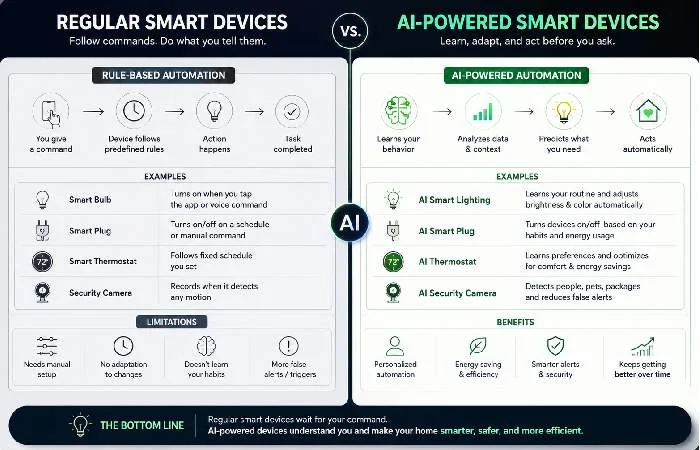
AI vs Regular Smart Devices — The Real Difference
Think of it this way. A smart light follows instructions. An AI light learns your patterns.
When you arrive home every weekday at around 6:15 PM, as you can observe after a couple of weeks, the AI-powered systems turn on the lights in your living room exactly at 6:12 PM. In fact, you didn’t program it, but this is how AI-powered systems figure it out.
The tech behind this is machine learning — specifically, on-device algorithms that process your behavior data locally. Some higher-end devices process part of this data on-device, which can reduce how much information is sent to the cloud, but that varies by brand, feature, and setup. More on privacy later.
Types of AI in Home Gadgets
Not all AI is the same. Here’s what you’ll actually see in consumer gadgets right now:
-
Voice Ai it doesn‘t just look for keywords; it interprets the context using natural language processing. Simply put, the system no longer requires you to speak the precise command. “Turn off the lights” and “kill the lights” can both trigger the control. However, it is actually ideal because it recognizes your intent, rather than just your words.
- Cameras that can tell the difference between a stranger and a dog. And honestly, that matters a lot for security. Here’s the thing: you don’t want alerts every time a pet walks by, but you do want to know when an actual person shows up.
- Predictive AI — Thermostats and appliances that learn your routine and adjust on their own. And honestly, that makes everyday life a lot easier. Here’s the thing: after a while, they start to know when you wake up, leave home, or bed head, so the temperature and settings change automatically without you constantly messing with them.
- Generative AI — These newer assistants can write messages, recap your day, or throw together routines without much effort. It can indeed be helpful at times. And on others, it is just unpolished. There have been occasions where at first the responses were really accurate, only to have it completely miss the point a few minutes later.
Big difference between these. A gadget with voice AI but no learning capability isn’t really “AI-powered” in any meaningful sense.
Best AI-Powered Voice Assistants in 2026
Voice assistants have changed dramatically in the last 18 months more than in the last five years or more. The main reason is that AI has been integrated.
Ever encountered this? Have you seen how your Alexa or Google Assistant can now handle follow-up questions, use contextual information and eliminate its robotic tone? That wasn‘t an illusion.
Amazon Echo (with Alexa AI)
By late 2025 & early 2026, we’ll have started seeing Amazon roll out Alexa‘s Generative AI & multi-step assistant capability into Echo experiences that are supported (rollout varies by supported device & region). Alexa+ (paid tier of Alexa) now supports multi-step requests with no need to be phrased precisely. For example, asking Alexa+ to “set up movie night” will dim the lights, turn on the TV & pause doorbell alerts.
The basic Echo Dot (5th Gen) still is a relatively inexpensive entry point, but any of the Echo devices with larger screens and dashboard-style controls can function a lot more effectively as the centerpiece of a smart home system. Since prices fluctuate regularly, check the actual Amazon listings for the current price in your region.
Google Nest Hub (with Gemini AI)
Google has been gradually launching Gemini-enabled home assistant support for supported Google Home and Nest experiences(availability varies by device, account, and region). For example, the Nest Hub Max now provides a brief rundown of your morning weather, calendar, commute, and news in a very human way as opposed to robotic-driven line reading.
Context memory based on reviews published and user-reported in early 2026 is amazing. You can say “remind me about that thing from yesterday”, and it actually knows what you are talking about. Most of the time.
Sounds kind of, it is still fubles, and might be 20% of the time, with always unclear requests, and that is a big progress from a year ago.
Apple HomePod (with Apple Intelligence)
Apple’s approach is still more privacy-focused and ecosystem-dependent than Amazon’s or Google’s, but this is also the area where buyers should be most careful with assumptions.
HomePod works best for users already invested in Apple devices and services, yet buyers should verify current Siri, HomePod, and Apple Intelligence feature availability on Apple’s official pages because naming and rollout do not always line up cleanly across products.
If you’re already deep into iPhone, iPad, and Mac — this is a no-brainer. Mixed ecosystem? Look elsewhere.
AI Robot Vacuums That Actually Learn Your Home
This is where the presence of AI can be felt the most. We no longer find robot vacuum cleaners behaving as if they are wandering. They map your floor plan, identify furniture, dodge pet bowls, and even adjust suction power based on floor type.
According to professional reviews and comparing testing out of sites like Tom‘s Guide and Consumer Reports, the difference between an entry-level model and an AI one is massive:
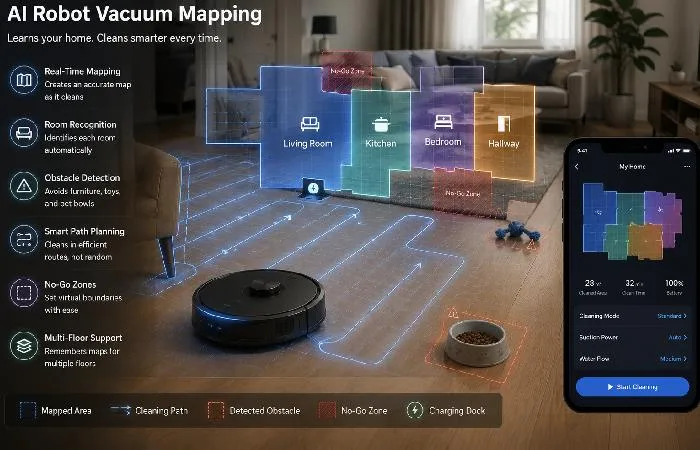
Top Picks for Different Budgets
- Premium: Roborock S8 MaxV Ultra (~$1,400) takes dual cameras + LiDAR for object recognition. It could tell from my kid‘s LEGO bricks on the floor and manoeuvre over them. The AI get better at building its map after every cleaning run.
- Mid-Range: Ecovacs Deebot T30S (~$700) Good AI mapping, auto-empty dock, and reasonably impressive mopping. Obstacle avoidance isn‘t quite on the level of Roborock‘s just yet, but for the price? It‘s tough to beat.
- Budget: iRobot Roomba Combo j5+ (~350). Okay for smaller areas. The AI is more constrained, with simple mapping and few obstacle detections. Still adapts to your cleaning pattern over time.
Quick note: the AI in these vacuums continuously improves (update your firmware). Users on owner forums describe S8 and similar Roborock models receiving regular firmware updates that include better (more accurate) maps and obstacle avoidance.
Smart Thermostats with AI Learning
Here‘s where the AI really saves you money, actually a lot of money. A great AI thermostat will adapt to your home and your behaviour. It will learn what a comfortable temperature is and detect whether you are at home and adjust accordingly. Just the savings will be worth it.
Before purchasing, ensure the furnace/AC being replaced is compatible with the thermostat being purchased. In older buildings or multiple zone systems, brand compatibility can be more important than brand name.
How AI Thermostats Cut Energy Bills
ENERGY STAR reports that smart thermostats can lower heating and cooling bills (on average) by roughly 8 percent each year. Actual savings will vary by area, levels of insulation, how the HVAC system‘s been set up, and how often the device‘s used. In a lot of American houses, that can amount to significant savings over time, but what that figure will end up being really depends on the home.
But here‘s the thing most people miss. That 8% number is an average. If you‘re the type who walks out without switching off the thermostat (and really, who isn‘t?), the savings will be much, much greater.
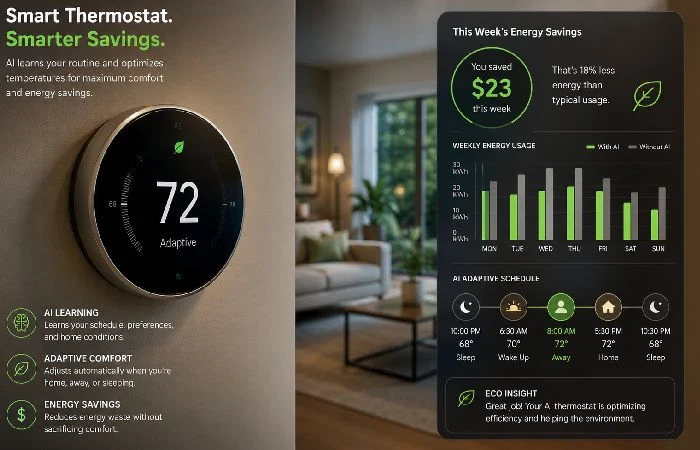
- Google Nest Learning Thermostat (4 th Gen) around $280. Still leading. It learns your patterns within the first week and sets a rule-based plan that runs smoothly. Newer 4 th Gen models are now compatible with Gemini AI, so you can change settings using speech.
- Ecobee Smart Thermostat Premium – ~$250 Has a built-in Alexa speaker and sensors for individual rooms. Its AI is aware of room occupancy and makes suitable alterations. Good idea if you have rooms that aren‘t very active.
But for a home with a simple single-zone HVAC system, no smart vents, a more affordable smart thermostat will still be helpful. Don‘t get too caught up in this.
AI-Powered Home Security
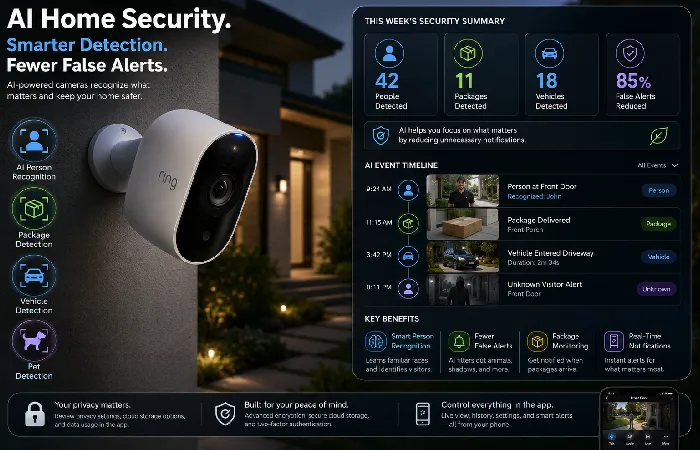
Security is probably where AI gadgets make the biggest practical impact. The difference between a regular motion-detecting camera and one with AI person recognition is night and day.
No more alerts every time a squirrel crosses your driveway.
Smart Cameras with Person Recognition
- Ring Indoor/Outdoor Cam with Ring AI (~$100) The Ring AI now sorts logs into people, packages, animals, or vehicles. You can choose which categories to get alerts for. Many users have theirs set for just people and packages. In practice, category-based alerts can greatly cut down on false alerts, but the benefit will vary with camera placement, traffic patterns, lighting, and which subscription options are active.
-
Arlo Pro 5 with AI Detection (~$200) has comparable AI detection; however, it goes much better in the evening and also has an even broader angle. It additionally keeps an eye on the path of movement, so you recognize where every person walked on your land.
AI Doorbells and Motion Detection
Google Nest Doorbell (Wired, 2nd Gen) ~$180. The ever-present face detection is actually super handy. It takes several weeks of letting it learn your common folks’ faces before it actually labels them with their names. When a new person arrives, you‘ll get another kind of notification.
Fair warning: the face recognition requires a Nest Aware subscription ($8/month). Without it, you still get basic AI detection, but not the face learning.
Privacy note: face recognition and event classification features can involve cloud processing, subscriptions, and region-specific limitations. Check the vendor’s privacy policy and feature availability page before relying on those tools.
Kitchen and Appliance AI Gadgets
Kitchen AI is still catching up to the rest of the house. But a few gadgets are worth mentioning.
- Samsung Bespoke AI Oven (~$3,500) comes with an interior camera that recognizes the food and recommends cook time and temperature. These kinds of features, such as food recognition and default recommendations, sound helpful on paper, but consumers should see them as added convenience functions, not as flawless cooking guidance, and verify the operating modes on the manufacturer‘s landing page.
- June Oven (3rd Gen) — ~$600 — Similar concept at a lower price. The AI identifies over 100 food types. Overkill? Maybe. But if you’re someone who burns things regularly (no judgment), it’s actually helpful.
- GE Profile Smart Mixer with Auto Sense ~$400 Computerized and self-adapting based on what it feels in the bowl. The AI learns your recipes over time.
I know what you’re thinking — “Do I really need AI in my kitchen?” Honestly? For most people, probably not yet. But if you cook daily and want one less thing to think about, these are getting pretty good.
AI Gadgets on a Budget — What’s Worth It Under $100
While not everything needs to cost a fortune, some of the best AI experiences are delivered through surprisingly affordable devices.
- Amazon Echo Dot (5 th Gen) $35(or less). The best way to get a truly functional voice AI into your home at a reasonable price.
-
TP-Link Tapo L530E (4-pack) — ~$30 — supports app-based automation and scheduling, but users should confirm if any “AI” behavior is adaptive learning or just rule-based automation in the current version of the app.
- Wyze Cam v4 — ~$35 — AI person detection at a price that seems too good to be true, but expert reviews from Tom’s Guide and PCWorld confirm it delivers solid AI detection and 2.5K video quality for budget buyers.
-
SwitchBot Hub Mini Matter ~$45 Make your “dumb” appliances smart with AI-control. Converts all IR appliances into AI-controllable household appliances.
- Amazon Smart Plug ~$15 Basic in itself, but some simple Alexa AI routines that allow you to schedule without third-party services.
The genius of the SwitchBot Hub. Aim it at your ancient (by modern standards) AC and, poof, today you‘ve got AI automating (and scheduling) your climate for $50. Now that‘s useful AI.
Quick budget checklist before buying
- Check whether the core feature works without a paid subscription.
- Confirm Matter, Alexa, Google Home, or Apple Home support if compatibility matters to you.
- Review privacy settings before setup.
- Compare sale pricing, because entry-level smart home products often swing heavily during promotions.
Privacy and AI Gadgets — What You Should Know
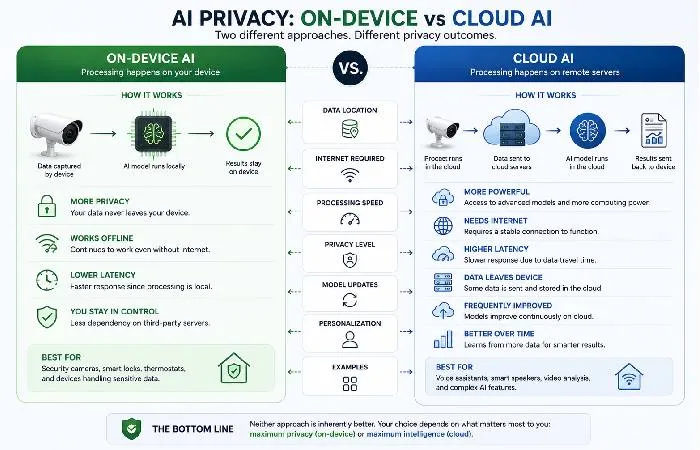
Here’s the thing most review sites skip over. AI gadgets collect data. That’s how they learn. And you should know exactly what’s being collected and where it’s going.
Several AI resources from NIST focus on objectives like transparency, risk management, and clear information management when AI systems are being applied for consumer use, which fits in well with smart home appliances collecting voice, video, or behavioral data.
This matters more than most people realize.
- On-device AI — The data stays on the gadget. Apple Intelligence and some Google Nest features work this way. Your voice commands, routines, and patterns never leave your home. Slower, but more private.
- Cloud AI — The data gets sent to the company’s servers for processing. Alexa, most Ring features, and older Google products use this model. Powerful and faster, sometimes your data gets off somewhere.
Neither approach is inherently bad. But you should know which one your gadgets use.
How to Lock Down Your Smart Home Privacy
Some practical steps that take five minutes:
- Go into each device’s app and check the privacy settings. Most default to maximum data sharing.
- Turn off “help improve our products” in every single app. That’s the “please let us use your data” toggle.
- Delete your voice history periodically. Alexa, Google, and Siri all store recordings by default.
- Different Wi-Fi for smart objects. All new routers have a guest network so that you can separate your smart things from the others.
- Select devices that do on-device processing when privacy is a concern.
Another piece of advice is to look at the privacy policy and product support pages before any AI device purchase (these are often difficult to locate in retail listings). This usually details storage, retention, and voice/video processing procedures most clearly.
How to Choose the Right AI Ecosystem
Here is the crucial thing, and this is where a lot of people get stuck or in a dilemma. And honestly, there’s no perfect answer — just the right answer for your situation.
Alexa vs Google vs Apple — Quick Comparison
| Feature |
Amazon Alexa |
Google Assistant |
Apple Siri |
| AI Capability (2026) |
Strong — Alexa+ with generative AI |
Strong — Gemini integration |
Moderate — Apple Intelligence |
| Device Variety |
Large- wide third-party compatibility across multiple brands |
Huge— strong Nest lineup/Google |
Limited — Apple ecosystem only |
| Privacy |
Cloud-based (some on-device) |
Cloud-based (some on-device) |
Mostly on-device |
| Best For |
Smart home control, skills, shopping |
Information queries, routines, households |
Privacy-focused Apple users |
| Budget Entry |
$15 (Smart Plug) |
$30 (Nest Mini) |
$99 (HomePod Mini) |
Ecosystem compatibility always keeps changing due to the vast majority of vendors dropping their support for features, adding Matter support, and rules of subscription to change. Get the latest compatibility information for the ecosystem you want to build.
The takeaway: if you don‘t have a favourite, go with Alexa. The device compatibility is unmatched, the lowest cost entry points are through the devices, and the AI is a lot better.
If your privacy worries keep you awake, there aren‘t too many alternatives to Apple‘s; you can‘t argue with. You end up paying more and getting less.
What’s Coming Next — AI Home Tech Trends for Late 2026
The smart home industry is advancing more rapidly than ever before. It’s important to watch a few things, as we saw in the second half of 2026, some quite exciting developments.
- Matter remains in development as the main cross-brand smart home standard and should improve in platform support over time, but details in feature support and scheduling will be defined by the Connectivity Standards Alliance and manufacturers.
- On-device generative AI – Chipmakers like Qualcomm and MediaTek are still building upon on-device AI across connected devices, which could seem like future smart home hardware to execute quicker and less reliant on the cloud.
- AI energy management, which includes whole-home AI systems that are smarter than your thermostat and run your home energy overall (solar panels, EV charging, appliance scheduling) from one AI brain.
Then market forecasts like Statista‘s smart home outlook are favorable to indicate robust, continued growth in the smart home category through 2028, but the precise share driven specifically by AI-enabled devices should be viewed as directional unless a source breaks that out clearly.
Remaining watchful. The newest gadgets that came out or were launched in late 2026 are very smart.
FAQs
What does “AI-powered” mean in home gadgets?
A ‘device that uses machine learning or artificial intelligence to study a user’s actions and to generate its own response, rather than merely following instructions. A ‘smarts’ device will perform tasks. An ‘AI’ device will fulfill the user’s requirement.
Are AI home gadgets worth the extra cost?
For some categories, absolutely. AI thermostats pay for themselves through energy savings within 1-2 years. AI security cameras dramatically reduce false alerts. For others — like AI kitchen gadgets — the value depends on how much you cook and how much convenience matters to you.
Do AI gadgets work without the internet?
Some do, but only to an extent. Devices that have some native AI (or local processing of AI), such as the Apple Home Pod, can operate with some AI without even needing internet access.
As many of the AI-powered systems basically depend on cloud connectivity, and the majority of AI features depend on the internet connection
Which AI assistant is best for smart home control?
Best device compatibility and smart home controls: Amazon Alexa. Best at providing information and managing a household: Google Assistant. Most private: Apple Siri. The right choice is the one that best suits the user‘s needs.
Are AI home gadgets safe for privacy?
They can be, with proper setup. Pick smart devices that process things locally on the device, turn off anything that shares information you don‘t need, use a dedicated Wi-Fi for all your intelligent devices, and clear out saved voice data.
Can I mix different AI ecosystems in one home?
Indeed. And if you‘re using the Matter protocol in 2026, cross-ecosystem compatibility is orders of magnitude better than it was a year ago. It’s essential to choose such a designed ecosystem for the most seamless experience.
What’s the cheapest way to start with AI home gadgets?
A low-budget way into the smart home would be to purchase just one display or speaker, and then include one or two smart plugs or lightbulbs that are compatible. Prices differ by seller and even region, so it‘s preferable to say ‘meaning a cheap starter pack’ rather than assign a total.