Published: August 28, 2026
Last Updated: August 28, 2026
HomeAdvisor’s 2026 national cost data shows the cost for a smart home in 2026 ranges from $150 for a self-installed starter kit to more than $150,000 for a professionally wired luxury estate – though most buyers actually land on $770-$820 for a functional mid-range setup. However, the true variable is not the equipment; it’s which ecosystem you buy into, and how much payload you accept.
This guide breaks smart home cost by the metric that matters most: what you will actually spend over five years, including the hidden fees most cost guides leave out.
Quick Answer: A basic smart home costs $150–$500 DIY in 2026; choosing Matter-compatible devices from day one can save 15–25% over five years.
Definition: “Smart home cost is the total investment — hardware, installation, subscriptions, and device replacements — required to automate lighting, security, climate, or entertainment in a residential property using connected devices.”
What does a smart home actually cost in 2026?
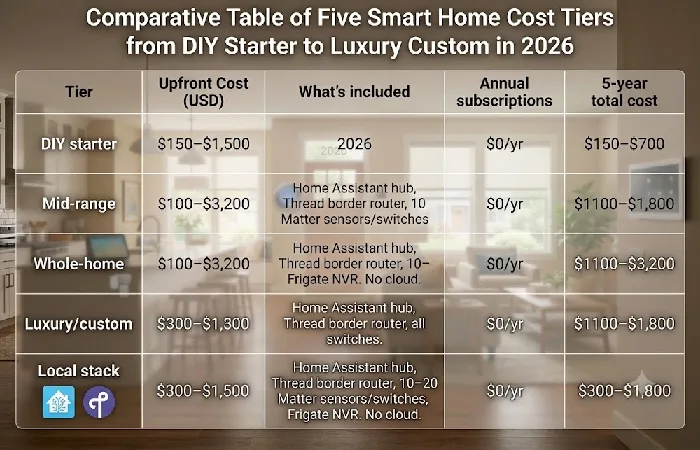
On average, the typical US homeowner is already paying $770-$820 for their smart home installation, with a labor load of about $85 an hour. Taking this national average as a baseline though, there’s a huge spectrum of costs: this table breaks them down into five bands to help you locate your project.
| Tier |
Upfront cost (USD) |
What’s included |
Annual subscriptions |
5-year total cost |
| DIY starter |
$150–$500 |
2–4 smart plugs, 4–6 bulbs, 1 voice assistant, 1 plug-in camera. Installed by self. |
$0–$40/yr (free cloud tier/local storage) |
$150–$700 |
| Mid-range |
$500–$2,000 |
Smart thermostat, video doorbell, 2-4 switches, smart lock, 1 hub. Light professional install. |
$100–$200/yr (1–3 cameras, Nest Aware or Ring Protect) |
$1,000–$3,200 |
| Whole-home |
$2,000–$15,000 |
15–30 switches, 4–8 cameras, motorized blinds, multi-zone HVAC, touch panels. Professional install. |
$200–$540/yr (multiple camera plans + optional monitoring: $10–$45/month) |
$3,500–$18,500 |
| Luxury/custom |
$15,000–$150,000+ |
Wired KNX, Crestron, or Control4. Whole-house AV, motorized shading, landscape automation. |
$750–$7,500/yr (AMC at 5–10% of hardware value) |
$20,000–$190,000+ |
| Local stack (Home Assistant + Thread) |
$300–$1,500 |
Home Assistant hub, Thread border router, 10–20 Matter sensors or switches, Frigate NVR. No reliance on a cloud. |
$0/yr |
$300–$1,800 |
If your budget is under $100, start with the smart home devices under $100 sibling guide for curated picks at the lowest price point.
How much does a smart home cost by automation goal?
The cheapest path is based on why you are automating, not how many rooms you have. An energy savings buyer budgets differently than a security-first buyer. Three goal-based budgets for a typical 3-bedroom house are listed below.
- If security is the priority, budget $200 to $1,200. That covers a video doorbell ($80–$250), two outdoor cameras at $60–$150 each, a smart lock ($150–$300), and four contact sensors at $15–$30 apiece, plus $100 a year for cloud video history.
- For an energy-first setup, expect to spend $250 to $900. A smart thermostat runs $120–$250, six to ten smart plugs for phantom-load appliances cost $12–$25 each, and three occupancy sensors add another $20–$40 apiece. There’s no subscription here, since most energy appliances operate locally.
- Ease of use first, $150–$800, which includes a voice assistant ($30–$100), 8 smart bulbs ($10–$20 each), 2 smart blinds ($80–$200 each), and routines activated through Alexa or Google Home. The subscription costs are between $0 and $40 per year.
Key insight: Energy-first setups deliver the quickest payback – the smart thermostat alone slices 10-26% from average annual HVAC costs, while security/convenience features only bring increased benefit, no additional savings.
What hidden costs do most smart home buyers overlook?
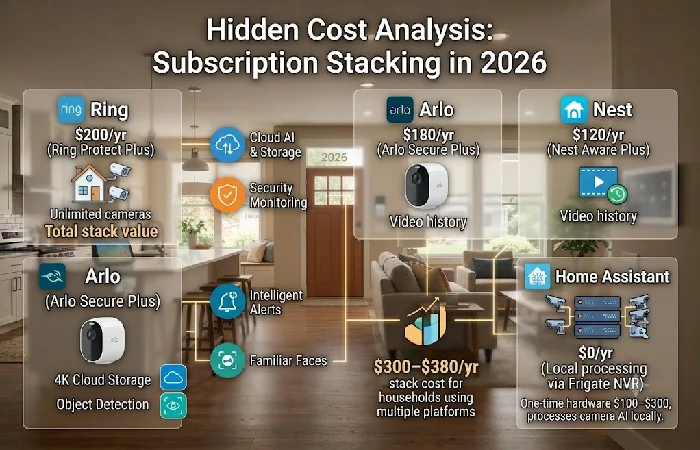
Subscription fees, networking upgrades, and device replacement cycles add 30–60% to the sticker price of smart home hardware over five years. These are the three cost categories most buyers underestimate.
- Subscription stacking: Ring Protect Plus costs $200/yr for unlimited cameras. Nest Aware Plus runs $120/yr. Arlo Secure Plus charges $180/yr. A household running cameras on two different platforms can easily spend $300–$380/yr without realizing it. Alternative: Frigate NVR on a Home Assistant hub processes camera AI locally for $0/yr after a one-time $100–$300 hardware cost.
- Network infrastructure: A home with 30+ connected devices needs a mesh Wi-Fi system ($150–$400) or a dedicated IoT VLAN. Budget an additional $50–$150 for a Thread border router if you are building a Thread/Matter mesh.
- Device replacement cycles: Wireless smart devices have a typical lifespan of 4–6 years. Battery-powered sensors need replacements every 12–24 months ($3–$8 per battery). Professional wired systems (KNX) last 20+ years but carry an Annual Maintenance Contract (AMC) of 5–10% of total hardware value per year.
How does compatibility affect your total smart home cost?
Choosing incompatible ecosystems is the most expensive mistake a smart home buyer can make. A Matter-first purchasing strategy saves an estimated 15–25% on total 5-year costs by eliminating device replacement when switching platforms.
Here is why compatibility is a cost variable:
- Ecosystem lock-in tax: If you buy Zigbee-only devices tied to a SmartThings hub and later switch to Apple Home, those devices require a Matter bridge ($30–$60 per bridge) or outright replacement. A home with 15 incompatible devices faces $450–$900 in bridge or replacement costs.
- Matter price premium: Matter-certified devices currently carry a 10–15% price premium over non-Matter equivalents. On a $1,000 device budget, that is $100–$150 extra upfront. However, that premium is recovered within 2–3 years by avoiding bridge hardware and device replacement.
- Thread benefit: Thread-enabled Matter devices talk to each other over a low-power mesh network that isn’t reliant on Wi-Fi, decreasing the burden placed upon your router and eliminating the demand for “range extenders” which typically cost between $ 30 and $ 80.
Definitive recommendation: If you are beginning a smart home in 2026, purchase Matter-certified, Thread-enabled devices wherever possible. The premium you pay at the start will have paid for itself by year three.
Does a smart home pay for itself?
Yes — for most homeowners, a mid-range smart home recoups its cost within 3–5 years through energy savings alone, before accounting for property value gains. The two primary ROI channels are utility reduction and resale premium.
- Energy savings: Smart thermostats reduce heating and cooling costs by approximately 23% per year on average, per Ecobee’s published product specifications. Automated lighting (motion sensors + LED scheduling) can cut lighting electricity by up to 40%. Combined, a whole-home energy stack saves $200–$600/yr for a typical US household.
- Resale value: Homes with smart enabled technology fetch a 3-5% resale premium. That number comes from the National Association of Realtors — they track this stuff by averaging real sales data. So on a $400,000 home, you’re picking up an extra $12,000-$20,000 in equity, just for having the tech installed.
- Payback math: put $500 into a mid-range energy-efficient install, save $250 a year, break-even hits at 2 years. Scale up to a $2,000 whole-home install saving $500 annually, and you’re still only waiting 4 years to come out ahead.
How should you budget a smart home in three phases?
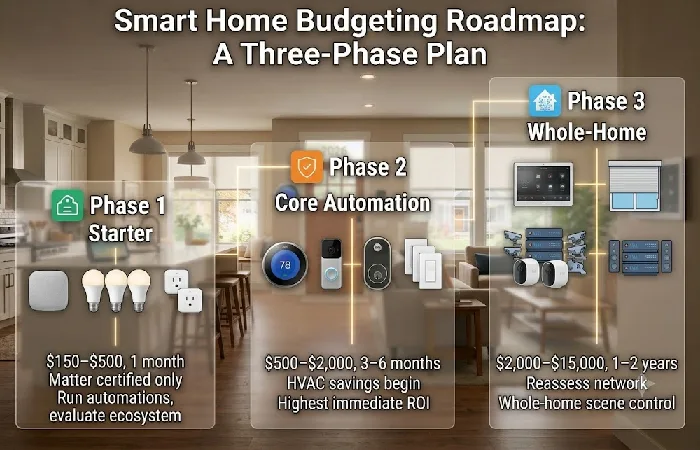
Start with one target, build on the rooms one at a time, and keep the backbone upgrade to the end. This approach overcomes sticker shock up front, enabling you to look at how all of the devices will work together before you shell out for a whole new ecosystem.
- Phase 1 Starter ($150–$500, 1 month): buy 1 voice assistant hub, 4–6 smart bulbs, 2 smart plugs. Only buy Matter certified devices. Run automations for 30 days. Use the smart home starter kit for beginners guide to decide on curated options.
- Phase 2 Core automation ($500–$2,000, months 3–6): Add a smart thermostat, video doorbell, smart lock, and 4–6 wall switches. This phase is the most ROI-positive because HVAC savings begin immediately.
- Phase 3 Whole-home ($2,000–$15,000, year 1–2): Expand to multi-room lighting, motorized blinds, multi-room cameras, and a dedicated automation gateway (Home Assistant or other). Reassess your network if needed and purchase a mesh Wi-Fi system.
In case of a complete ecosystem decision framework, you can refer back to the smart home buying guides pillar hub.
Frequently asked questions
1. Is a smart home worth the investment in 2026?
For the average resident, yes. If a resident installs a mid-range smart home system ($500–$2,000), then it should pay for itself after 2–4 years from energy savings of about $200–$600/year and incrementally increasing the property value by about 3–5%. In terms of return on investment, automation appliances used primarily to control the energy flow within the home have the greatest, fastest results.
2. What is the cheapest way to start a smart home?
Buy 2–4 Smart Plugs, Matter certified ($12–$25 each), and a Voice Assistant ($30–$50). Entry: $54–$150. Automate your light schedules, turn off phantom-load devices, and see if your ecosystem works!
3. Do smart homes increase property value?
Yes. Market research by the National Association of Realtors cites a 3–5% resale premium for integrated smart home systems, with the premium most pronounced when the system is controlled through one application versus several.
4. What are the ongoing costs of a smart home?
A final category is the ongoing costs, which are the cost of subscribing to cloud services ($0–$540/yr depending on camera count and platform), replacing batteries in wireless sensors ($20–$60/yr), and periodic networking equipment upgrades ($150–$400 every 3–5 years). If using a local-first platform such as Home Assistant, there are no subscription fees.