Published: August 20, 2026
Last Updated: August 24, 2026
Smart coffee makers and espresso machines put your smart-home network and your morning cup within reach of your phone. Brew from your phone, schedule your morning cup with Alexa or Google Home, and be notified before your coffee machine gets scaled. Our guide compares 7 models in the drip-coffee and espresso categories, ranked on their potential for app, voice-assistant and mechanical control, so you can find the coffee machine that works for your kitchen and your smart-home network in one place.
Definition: This is a wifi and Bluetooth-enabled coffee maker to be controlled from the app on your phone to make your coffee, save your specific brews, and give you a descale reminder. A programmable timer doesn’t count as smart.
Quick answer: Smart coffee makers are only considered smart if they have Wi-Fi app control not just a timer. This is why these 7 are the best for drip and espresso in 2026.
Smart coffee makers & espresso machines at a glance
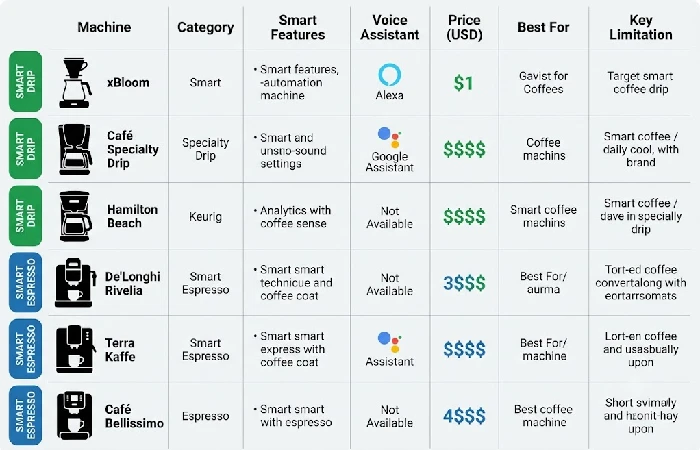
| Machine |
Category |
Smart features |
Voice assistant |
Price (USD) |
Best for |
Key limitation |
| xBloom Studio |
Smart drip (pour-over) |
Wi-Fi app controls grind weight, water temp (+/-1°F), pour flow rate; supports bean pods or custom beans |
None, no Alexa or Google Home integrations |
$549–$599 |
Automated grind-to-brew for the serious pour-over drinker |
No voice controls. Pricy for “drip-class” (not so isolated soundproof). |
| Café Specialty Drip |
Smart drip |
SmartHQ app; adjustable strength, temperature (185°F–205°F), cup size; SCA-approved |
Alexa + Google Home (“Voice-to-Brew”) |
$250–$300 |
101% SCA-quality drip, fully integrated voice. |
Carafe-only; GE SmartHQ ecosystem required |
| Hamilton Beach Alexa |
Smart drip |
Alexa-compatible Wi-Fi; remote brew start and scheduling; 12-cup |
Alexa only |
$70–$90 |
Simplest, cheapest (e..g voice-activated drip |
Tempt or strength no adjustment, steroid use only with Alexa |
| Keurig K-Supreme Plus SMART |
Smart single-serve |
BrewID pod recognition 5 strength settings 6 temp controls multi stream needle |
Alexa |
$170–$220 |
Pod households desiring per-cup customisation |
K-Cup lock-in; ~$0.40–$1.20 per pod |
| De’Longhi Rivelia |
Smart espresso (super-auto). |
– Coffee link app; Over 16+ drink recipes; customizable milk foam temperature and texture; auto descale alerts |
Do they access the web? None, app only |
$1,000–$1,300 |
Café level super-automatic with extensive app customization |
Particularly difficult if with no voice support, also high initial investment. |
| Terra Kaffe TK-02 |
Smart espresso, also called super-auto, is an additional type of semi-automatic operation. |
Wi-Fi to monitor strength, volume, and temperature; to upload firmware updates; and install new features or to proceed with guided maintenance |
Alexa |
$849–$900 |
Box for compact bean-to-cup coffee machine with wireless app and a voice. |
Need to refill 50 oz water reservoir regularly. |
| Café Bellissimo |
Saeco super espresso (semi-auto) 4.3.4. According to Table 6 above, this is either a smart espresso or super espresso model. |
SmartHQ app; customizable pre-infusion and shot volume; step-by-step setup process |
Alexa + Google Home |
$380–$480 |
Affordable smart espresso under $500 |
Semi-auto consists of having the bar ‘tamped’ in manually then having the milk heated with a steam wand. |
Methodology: Specifications obtained from manufacturer product pages and editorial reviews from PCMag, CNET, coffeeness.de and homecoffeeexpert.com as of August 2026. Notes: No actual product experiments performed.
What makes a coffee maker “smart” in 2026?
A coffee machine is “smart” if it is accessible over Wi-Fi or Bluetooth from your phone or voice assistant for remote operation – and not just because it has a timer with a late-start feature. Here‘s why it makes a difference: four of the top-10 ranking pages today feature “smart” and “programmable” side-by-side, giving a false comparison for consumers shopping across categories.
Smart features fall into three tiers:
- Remote brew control: Start, stop or plan a brew cycle from a companion smartphone app (e.g., De‘Longhi Coffee Link, GE SmartHQ, Keurig app) without being at the machine.
- Voice-integrated: Trigger brews in some Amazon Alexa or Google Home routine where you can use “Voice-to-Brew” commands.
- Auto-maintenance alerts: App alerts for descaling, filter replacement and low water before it impacts brew quality.
A “programmable” coffee machine, on the other hand, is simply one with a clock and buttons on the device itself no Wi-Fi, no app, no voice interface. If you‘re looking for more than one connected machine in the kitchen go to our complete best smart kitchen appliances for 2026 roundup.
Which smart drip coffee makers are worth buying?
Those who want the best for most purposes will do best with The Café Specialty Drip or Hamilton Beach Alexa – The Café for its brewing (comes SCA certified at 195°-205°F temperature) and the Hamilton Beach for instant voice-control simplicity under 90.
- XBloom Studio (549–549–599): Lights and automates as you prepare the coffee, with app controls for grind weight and pour flow rate to 1°F accuracy. Designed for single-origin brewing. No voice-integrated support.
- Café Specialty Drip (250 – 250 – 300): Full Alexa and Google Home integration through SmartHQ. Can be set to have a variable brew temp (185–205°F, adjustable in 1-degree increments). This is the only smart drip machine in this compilation to be SCA certified.
- Hamilton Beach Works with Alexa ($70–$90): Alexa-only voice control. No app-based temperature or strength adjustment you say “Alexa, brew my coffee,” and the machine runs its default cycle. Ideal for customers who want the cheapest way to get voice-controlled brewing.
- Keurig K-Supreme Plus SMART (170–170–220): Pod based single serve with BrewID technology that reads each K-Cup to automatically set brew strength and temperature. Constant pod cost of 0.40–0.40–1.20 per cup makes this the most costly per serving, although it has an intermediate initial purchase price.
Which smart espresso machines have the best app control?
The De’Longhi Rivelia has the most extensive app based customization of any super-automatic espresso machine in 2026: with 16+ one-touch recipes and granular milk-foam control but no voice assistant. The Terra Kaffe TK-02 is the top choice for those seeking both app and Alexa control in a small size:
- De‘Longhi Rivelia (1,000–1,000–1,300): Super-automatic bean-to-cup. The Coffee Link application enables access to the entire recipe collection and allows for modifications to milk foam temperature and texture for individual beverages. Automated rinse and descale cycles minimize user upkeep.
- Terra Kaffe TK-02 849–849–900: Compact super-automatic with Wi-Fi app, Alexa voice-start. App delivers firmware upgrades and guided cleaning instructions. Water tank is 50 oz. which is slightly less than many rivals, but means refilling more often: 8–10 cups.
- Café Bellissimo (380-380-480): The sole intelligent espresso making appliance available below $500 in this selection. Has a semi-automatic configuration that allows users to pour the tamp and steam the milk, but the shot volume and pre-infusion are uploaded through the smartHQ application. Compatible with both Alexa and Google Home.
The manufacturer‘s documentation is the only sure source of feature verification for machines that employ a proprietary app ecosystem. Jura‘s J. O. E. (Jura Operating Experience) app, for instance, offers Wi-Fi remote brewing and recipe management for E8 and Z10 but such contenders are disqualified as they start north of $1,800.
Smart coffee maker vs. programmable: what is the real difference?
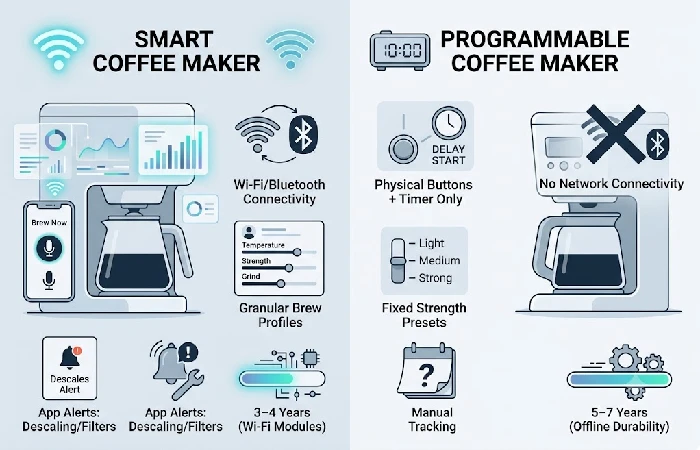
A smart coffee maker is installed on your home network allowing remote and voice activation while a programmable coffee maker provides on-board programmability and does not connect to your network.
The table below highlights the five most significant differences:
| Feature |
Smart coffee maker |
Programmable coffee maker |
| Control method |
Smartphone app + voice assistant + physical buttons |
Physical buttons and on-device timer only |
| Connectivity |
Wi-Fi (2.4GHz) or Bluetooth required |
None |
| Customization |
App-adjustable temp, strength, grind, and drink profiles |
Fixed strength presets and a single delayed-start timer |
| Maintenance |
App-based descale and filter-change alerts |
Manual tracking — no notifications |
| Typical lifespan |
3–4 years (electronics and Wi-Fi modules add failure points) |
5–7 years with standard maintenance |
Do smart coffee makers work with Alexa, Google Home, or HomeKit?
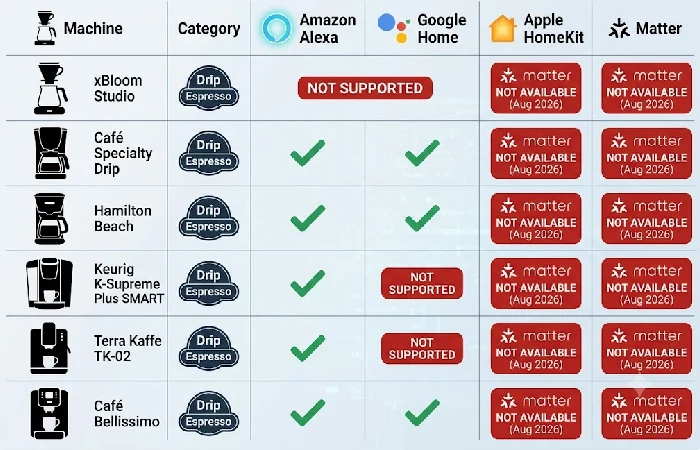
Most smart coffee makers have Amazon Alexa compatibility, some offer Google Home, and none offer native Apple HomeKit or Matter out-of-the-box (as of August 2026). The Matter specification (v1.5+) has added categories for oven, cooktop and microwave but not for coffee maker.
- Alexa supports: Café Specialty Drip, Hamilton Beach, Keurig K-Supreme Plus SMART, Terra Kaffe TK-02, Café Bellisimo.
- Supported by Google Home: Café Specialty Drip, Café Bellissimo.
- HomeKit / Matter native: No models exist at present.
DIY solution for non-smart appliances: Connect any coffee maker with a manual “on” switch into a Matter-compatible smart plug (Eve Energy ~$35). Fill with water and ground the night before and activate through HomeKit/Alexa/Google Home on a schedule. For those with electronic start buttons, a SwitchBot Bot ($28) can physically press the button and is compatible with HomeKit via a SwitchBot Hub.
What are the reliability risks of smart coffee makers?
Smart Coffee Makers implement Wi-Fi modules, touch screens, and cloud-only apps in addition to the basic coffee-making machinery adding more potential points of failure, such as lost connectivity or a discontinued app:
- 2.4GHz Wi-Fi band: All smart brewers described here need a 2.4GHz Wi-Fi band. If you have your bands combined (a single 2.4/5 GHz network), your coffee maker might not be able to connect during setup. How to fix this: set bands separated for the time being! (e.g., create a specific 2.4 GHz SSID).
- Remote app discontinuation risk: The shutdown of the manufacturer‘s remote app or cloud servers will disable remote features even if the machine itself is in perfect working order. Make sure the machine can still brew manually before purchasing all the models in this roundup.
- Ownership cost math: A smart drip maker costs $80–$250 more than an equivalent programmable model. At a 3–4 year wise-device life, that fee turns out to be 0.50–0.50–1.60 per week. It makes dollars and sense only if you utilise the app or speech control during 3 times a week.
How to choose the right smart coffee machine
Narrow your decision with three questions, in order:
- Smart drip or smart espresso? For your plain black coffee with milk and sugar, a smart drip maker (70–70–599) does everything you need. For latte, cappuccino and espresso shots, you need a smart espresso machine (380–380–1,300).
- Voice command or App only? If the new hands free “Alexa, brew my coffee” is at the top of your list, bin the xBloom Studio and De‘Longhi Rivelia (neither supports voice). If an app-only command is sufficient the Rivelia allows the most detailed customization of recipes.
- Budget level? ‹100: Hamilton Beach.100: Hamilton Beach.200-600: CafeˊSpecialtyDriporx BloomStudio.600: CafeˊSpecialtyDriporx BloomStudio.400-900: CafeˊBellissimoorTerra Kaffe TK-02. Over900: CafeˊBellissimoorTerra Kaffe TK-02. Over1,000: De’Longhi Rivelia.
If you‘re interested in how smart coffee machines compare to other smart appliances like the smart oven, smart fridge and the smart dishwasher, you can read our full guide to smart appliances.
Frequently asked questions about smart coffee makers
1. Are smart coffee makers worth the money?
A smart coffee maker is only worth paying more for if you use the app or voice commands at least 3 times a week. The incremental cost over a programmable machine is 80–80–250. Over 3–4 years (average life of machine) that is 0.50–0.50–1.60 a week – more than reasonable for the daily remote start crowd, absurd for the 1-time-a-day set-it-and-forget-it crew.
2. Do smart coffee makers need Wi-Fi to work?
All seven in this round-up of smart coffee makers require a 2.4GHz Wi-Fi connection for app and voice commands. If your internet goes out, all seven models still brew manually using the physical buttons on the machine. You miss out on remote-start, scheduling, and maintenance alerts when not making coffee.
3. What is the difference between a smart and a programmable coffee maker?
A smart coffee maker connects via Wi-Fi or Bluetooth for app-controlled programming, voice-assistant compatibility, and/or automated alerts. A programmable coffee maker has an on-device delayed-start timer and physical buttons but no network connectivity. The full comparison is in the table above.
4. How long do smart coffee makers last?
The best smart coffee makers tend to survive 3–4 years (before electronics, Wi-Fi modules or app support is discontinued), degrading the user experience. Conventional programmable makers have an average life of around 5–7 years with normal service and repair. If longevity is your preference, then downgrade to a full offline manual programmable coffee maker.
5. Can Alexa make my coffee?
Yes, five out of the seven machines in this roundup are compatible with Amazon Alexa voice commands: the Café Specialty Drip, Hamilton Beach, Keurig K-Supreme Plus SMART, Terra Kaffe TK-02, and Café Bellissimo. First you need to perform Wi-Fi setup via the companion app that the specific machine has, then activate the Alexa skill the appropriate way. Once paired just say “Alexa, brew my coffee” or include that command in an Alexa morning routine for automatic brewing.