Published: July 21, 2026
Last Updated: August 31, 2026
Most earbuds fail for one of three reasons. Bad pairing. Noise cancellation that’s really just marketing. Or a battery that dies before your commute home does. Get those three right and everything else, sound signature, app features, case design, is basically a bonus. What follows is sorted by what you’re actually trying to solve, not by spec sheet.
Quick answer: If you just want an answer and nothing else: AirPods Pro 3 for iPhone, no contest. Sony WF-1000XM6 if you’re on Android and actually care about sound. And if $250 sounds like a joke, the EarFun Air Pro 4+ gets real ANC under $100, which honestly shouldn’t be possible yet but here we are. Everything past this point is the case for why, plus twelve more picks depending on what you actually need.
Strip away the marketing and a Bluetooth earbud is just a wireless speaker that talks to your phone over one of a few codecs, AAC, LDAC, AptX Adaptive, depending on what both ends support. ANC, transparency mode, touch controls, all of that got bolted on top once the basic connection stopped being the hard part.
What actually matters in a pair of Bluetooth earbuds
Fit is the one thing no spec sheet mentions. Buy the best-reviewed pair on the internet, and it means nothing if they fall out on your walk to the train or start aching after twenty minutes. Your ear canal isn’t shaped like the reviewer’s. Multiple tip sizes matter more than the marketing copy. Try before you buy, if the store allows it.
ANC pays off on a plane, a loud office, a packed commute. Quiet apartment, quiet street? You probably don’t need it, and paying extra for it is a waste most people don’t admit to themselves. When it matters, AirPods Pro 3, the Sony XM6, and Bose QC Ultra handle the low rumble and most of the mid-range noise well. Budget ANC has genuinely improved. It still isn’t the same thing.
Battery numbers on the box are optimistic by design. That “8 hours” claim usually assumes 50% volume and ANC switched off. Turn ANC on, push volume to 70%, and you’re often looking at 4 to 5 hours instead. Check a few review sites before trusting the packaging.
Codec support matters more than most buying guides bother to mention. iPhone owners want AAC, full stop. LDAC or AptX Adaptive matter if you’re on Android and care about streaming quality. Samsung goes further with its own codec, but only if you’re running Galaxy Buds specifically.
IP ratings sound cryptic but aren’t. IPX4 covers sweat, not submersion. IPX5 handles rain and gym sessions. IPX7 survives a drop in the pool. Anyone training outdoors or in wet conditions should aim for at least IPX5.
Best overall: Apple AirPods Pro 3
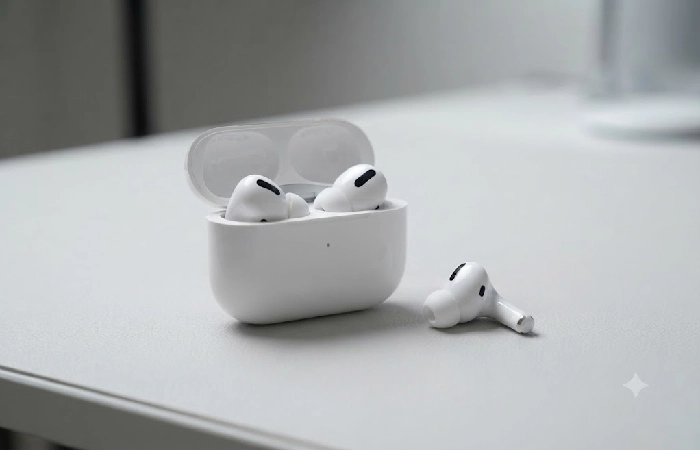
For iPhone owners, this is the complete package, and there isn’t much competition for that title. PCMag’s 2026 testing found the noise cancellation handles both deep rumble and higher-frequency sound well, and the Adaptive Audio mode reads your surroundings more naturally than most transparency modes manage.
Heart rate monitoring is the real headline addition here. Built straight into the earbuds, it tracks a workout without a smartwatch strapped to your wrist. The hearing tools go further than most competitors bother to, adding live translation and hearing protection features you won’t find on rival models.
Battery runs up to 8 hours per charge with ANC on, 24 hours total once you count the case. The H3 chip drives both the ANC and the audio processing behind it. If you’re locked into iPhone, this is the default pick, and it earns that spot.
Android users should skip these. You’ll lose the deep system integration, and some features simply won’t function outside Apple’s walls.
Best budget Apple pick: Apple AirPods 4 (with ANC)
Not everyone wants to spend $249 to get into Apple’s ecosystem, and that’s what the AirPods 4 with ANC exist for. They drop the silicone tips entirely, going with an open-ear design that still manages usable noise cancellation, a rare combination. It’s not as strong as the Pro 3’s sealed ANC, but for anyone who finds in-ear tips uncomfortable, that trade-off might be the whole point.
They land in the $100–$200 range and still get instant pairing and spatial audio, same as the Pro line, minus the fancier case tricks. Want Apple’s ease without Apple’s top price tag? This is where to start before spending more on the Pro 3
Best for audiophiles: Sony WF-1000XM6
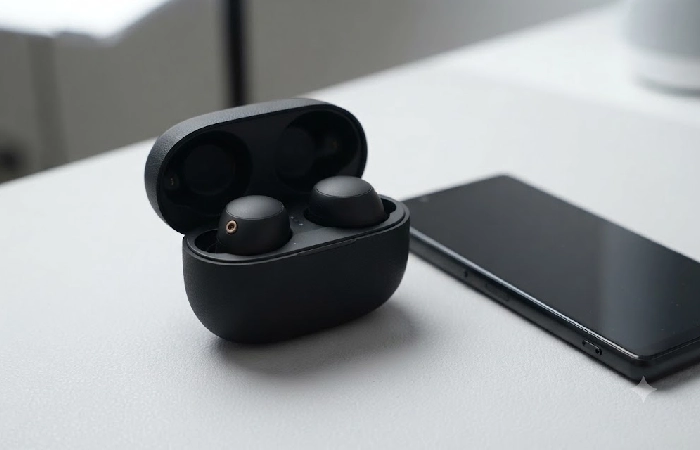
A 25% jump in noise reduction over the XM5, that’s what Sony’s new QN3e processor claims, per the company’s own launch announcement in February. It’s not a modest refresh. Four microphones per earbud now, up from three. The body itself is roughly 11% slimmer.
Sound quality rivals gear that costs twice as much. Randy Merrill and Chris Gehringer tuned this one. Merrill’s mixed for Ed Sheeran, Gehringer for Rihanna and Lady Gaga, and it shows in how the driver’s built: soft material on the edge for bass, a rigid dome for clean highs. The result actually sounds like their involvement mattered.
Android users get the biggest win here: LDAC support for high-res streaming, plus a 10-band EQ in the companion app that goes further than most rivals offer.
Between the XM6 and the Bose QC Ultra below, audiophiles chasing raw detail should lean Sony. The driver work and LDAC support push it slightly ahead on pure sound, even though Bose wins on cross-platform ease. iPhone owners should look elsewhere entirely, since LDAC won’t do anything for you without an Android device behind it, and $250 is a real number to swallow either way.
Best cross-platform: Bose QuietComfort Ultra Earbuds (2nd Gen)
ANC here goes toe to toe with the AirPods Pro 3, sometimes past it, and does it the same way whether you’re on Android, Windows, or Apple. Gen two tightened up low and high-frequency reduction, and the case finally charges wirelessly.
Most transparency modes sound artificial, piped-in, fake. Bose’s Active Aware mode doesn’t. Ambient sound comes through natural enough that you can order a coffee without pausing your music or feeling like you’re listening through a tin can.
AptX Adaptive gives Android users a real quality bump over standard SBC, and the same adaptive noise-cancelling calibration found in the Sony XM6 adjusts in real time here too, reading your ear shape and your environment as you move through it.
Anyone who bounces between an iPhone at home and a Windows laptop at work, with an Android phone somewhere in the mix, should stop comparing and just buy these.
Best budget pick: EarFun Air Pro 4+
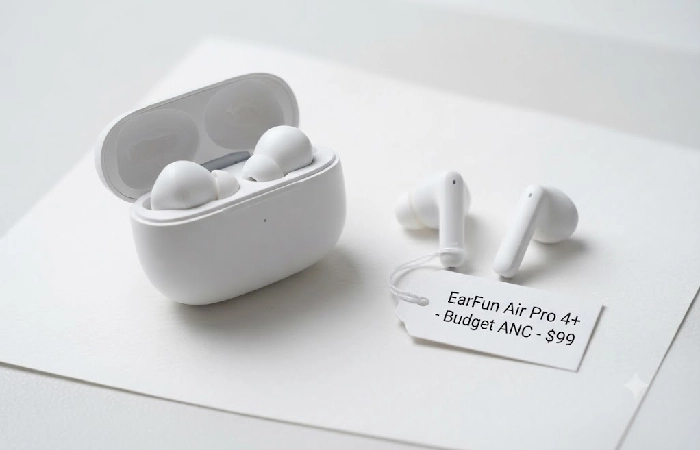
CNET handed the Air Pro 4 Plus an Editors’ Choice award in 2026, calling out its dual-driver setup, a 10mm dynamic driver working alongside a balanced-armature driver, as the first time that combination has shown up under $100. Bass and treble both benefit. The standard Air Pro 4, without the Plus, already won CNET’s Editors’ Choice back in 2025.
Something has to give at this price, and it’s the calling performance. CNET rated voice quality around a B- in noisy environments, and transparency mode reads as average at best. Under $100 isn’t supposed to get you working ANC, 8 hours of battery, and sound that flirts with $200 territory. This does anyway.
PCMag calls it the best ANC near $100, full stop, citing the strong noise cancellation, deep bass, and codec range as the reasons.
Best ultra-budget pick: Anker Soundcore P31i
Under $50 usually means picking two out of three between sound, ANC, and battery. The P31i doesn’t quite break that rule, but it comes close. Active noise cancellation is present and usable, not just a checkbox feature, which is more than most earbuds at this price manage.
It won’t touch the EarFun Air Pro 4+ on sound detail or call quality, and the app is barebones compared to what Sony or Bose offer. But as a first pair of ANC earbuds, or a backup pair that won’t sting if you lose one, it earns its spot on this list.
Best for workouts: Beats Powerbeats Pro 2
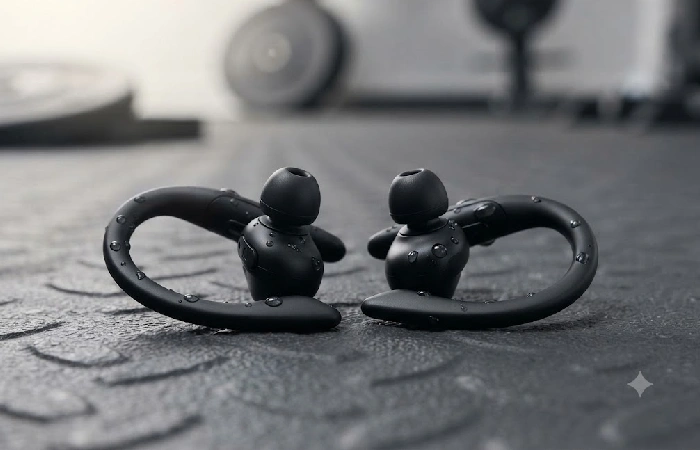
Fitness is the whole design brief here. Running, cycling, mid-set at the gym, the over-ear hooks stay put through all of it. The wingtip’s flex number sounds made up until you actually feel it work. Wear them for an hour and it stops sounding like filler.
Heart rate tracking is built in here too, same as the AirPods Pro 3. Skip the separate watch entirely.
Ten hours per charge. The IPX5 rating shrugs off sweat and rain without complaint. Already on iPhone? The native integration makes this an easy call.
Best for Samsung users: Samsung Galaxy Buds 4 Pro
These are built for Samsung phones and tablets specifically, and the proprietary high-resolution codec only unlocks in that ecosystem. New driver technology sharpens accuracy and warmth, while the mics pull in more environmental noise reduction than the last generation managed.
Samsung owners chasing a seamless setup should buy these without hesitation. Everyone else, iPhone or non-Samsung Android, should skip past them entirely, since the features that justify the price simply won’t switch on.
Best open design: EarFun Clip
Open-design earbuds skip the seal entirely, so traffic, conversation, and ambient noise all stay audible. Runners and cyclists aren’t giving anything up here, hearing the road is the whole point. PCMag’s 2026 testing called out clean audio, real transparency, all-day comfort, and a battery that holds up.
Best open design with ANC: Edifier Lolliclip
Spatial audio. Bluetooth 5.4 multipoint. IP56 protection. Battery that beats most sealed earbuds. And somehow, open design with real ANC layered on top, a combination almost nothing else on the market attempts. Can’t stomach the EarFun Clip’s zero ANC? Start here instead.
Best long battery life: GOBOULT Tenet
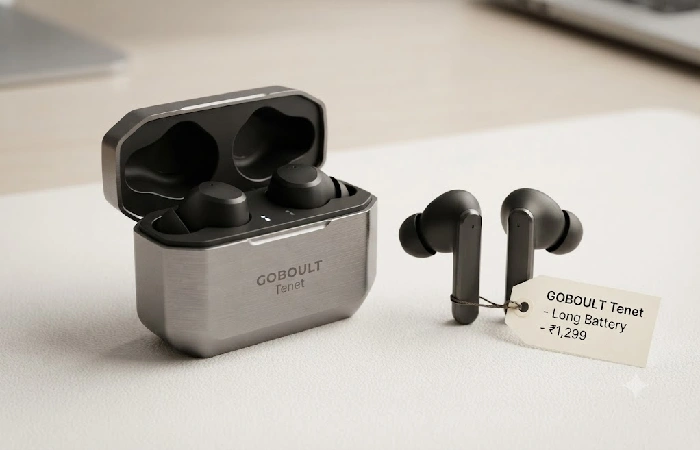
Seventy-five hours total playback with the case, the longest number on this entire list. The earbuds themselves run long, and the case’s oversized battery keeps them going for days between charges.
Designed and built in India, the Tenet is GOBOULT’s first fully in-house TWS earbud, following a brutalist design language the team developed internally. Engineers scanned thousands of ear inlets with LiDAR to nail the fit. It launches at ₹1,299 against an MRP of ₹5,499, available on Amazon.in, Flipkart, Myntra, and GOBOULT’s own site.
Under the hood: 13mm dynamic drivers, ZEN Quad Mic ENC for calls, a Combat Gaming Mode running 45ms latency, Bluetooth 5.4, and IPX5 water resistance. The Amp App handles EQ customization.
Runner-up for battery life: Tribit FlyBuds 3
If 75 hours from the Tenet still isn’t enough, the FlyBuds 3 pushes past it at roughly 95 hours total with the case, the highest number on this entire list. Sound quality drops off past the $100 mark, and the app barely does anything. But if you forget to charge things constantly, or you’re somewhere without outlets for days, that runtime alone earns the pick.
Best noise cancellation under $100: Sony WF-C710N
Budget ANC has a ceiling, low rumble gets handled fine, but mid and high frequencies still expose the gap against a Sony XM6 or Bose QC Ultra. The WF-C710N hits that ceiling too. What it does well: rich bass, a balanced signature, adjustable EQ, all under $100. Most casual listeners won’t notice the gap day to day.
Best all-rounder under $100: JBL Tune Buds
Want sound balance? Take the WF-C710N. The Tune Buds match it everywhere else, ANC, waterproofing, bass-forward tuning, an EQ app, at a price that outruns its spec sheet. Pick the Tune Buds if the stronger water resistance matters more to you.
Best waterproof option: Anker Soundcore Sport X10
IPX7 means full submersion, 1 meter deep, 30 minutes straight. That’s not a downpour rating. That’s a rating for the days you forget these are even in your ears while you shower.
Ear hooks hold them in place through hard movement. Find the default sound too bass-heavy? The app lets you tone it down.
Where your money actually goes: premium vs. budget
| Price Tier |
What You Get |
Best Options |
| Under $50 / ₹4,000 |
Basic sound, limited ANC, shorter battery, lower build quality |
Anker Soundcore P31i, Tribit FlyBuds 3 |
| $50–$100 / ₹4,000–₹8,000 |
Good ANC, decent sound, acceptable battery (6–8 hours) |
EarFun Air Pro 4+, Sony WF-C710N, JBL Tune Buds |
| $100–$200 / ₹8,000–₹16,000 |
Strong ANC, better sound, longer battery, better build |
Apple AirPods 4 (with ANC), Samsung Galaxy Buds 4 Pro |
| $200+ / ₹16,000+ |
Best ANC, audiophile sound, premium materials, advanced features |
Apple AirPods Pro 3, Sony WF-1000XM6, Bose QC Ultra |
Go from the $50–$100 tier to $100–$200 and you’re actually paying for something, sharper ANC, better drivers, sturdier build. Past $200, though, the gains taper off fast. Unless sound quality is genuinely your priority, that third hundred dollars mostly buys a logo.
Making the most of your purchase
Try every tip size in the box before deciding anything’s wrong with the earbuds themselves. The seal does more work than people assume, a bad one kills bass response and lets ANC underperform no matter how good the hardware is. Stuck between sizes? Go larger first.
Grab the companion app before the earbuds even touch your ears. Sony, Bose, Samsung, all of them pack in EQ controls and firmware updates through the app, and skipping it just leaves free tuning on the table.
Earbuds rarely travel alone. A charger that doesn’t take three hours, a case that survives one drop, cables that don’t fray by month two, all of it belongs in the same cart. The best mobile accessories guide covers the rest of that list.
Frequently asked questions
1. Are AirPods compatible with Android?
They pair and play audio, nothing more. Quick pairing, battery pop-ups, the H3 chip’s tricks, all of it stays behind on iPhone.
2. Which Bluetooth earbuds have the best noise cancellation?
Sony WF-1000XM6, AirPods Pro 3, Bose QC Ultra, 2026’s top three. Sony’s 25% jump over the XM5 gives it the edge on paper, but in real use that gap shrinks a lot.
3. What’s the best budget earbud under $100?
CNET’s pick is the EarFun Air Pro 4+. Prefer to save a bit more? The non-Plus Air Pro 4 still holds up.
4. Which earbuds last longest on a charge?
GOBOULT Tenet claims 75 hours total with the case. Tribit’s FlyBuds 3 push that even further at 95 hours, which makes it the one to watch if raw battery life outranks everything else on your list.
5. Can earbuds work with both iPhone and Android?
Every pick on this list, yes. What changes is which extras unlock. Apple gear leans into AirPods and Beats integration. Samsung phones unlock features exclusive to Galaxy Buds.
6. Are expensive earbuds actually worth it?
$150–$250 hits the sweet spot for most people. Budget shoppers do fine in the $50–$100 range. $250 and up mostly serves audiophiles and people who fly often enough that ANC quality becomes a daily concern rather than a nice-to-have.
7. How big is this market getting?
Statista’s 2026 figures put the global wireless earbuds market on track for $120 billion by 2027, with smartphone compatibility ranking as the top purchase factor for 68% of buyers. That’s a lot of competition fighting for your $100, which is exactly why fit and real battery numbers matter more than another spec sheet claim.