Published: July 15, 2026
Last Updated: August 31, 2026
Fifty-plus wireless gaming headsets have launched since January. You’ve probably sat through three comparison videos already, and they didn’t even agree with each other. So no, you still don’t know which one to buy.
Wireless is good enough in 2026, as long as you’re on the right connection type. The real question is narrower than that: does the headset fit your platform, your budget, and what you actually care about, whether that’s tracking footsteps in a ranked lobby or losing six hours to a cinematic open-world where nothing’s trying to kill you.
The gaming headset market crossed an estimated USD 2.87 billion in 2025, and Straits Research puts it at USD 3.15 billion by late 2026. Most of that growth is wireless. Here’s the annoying part: most of those wireless headsets look nearly identical on a spec sheet, right up until you actually plug one in.
Short on time? The comparison table’s a few scrolls down.
Quick take, if you want it without the full breakdown: most buyers should land on the SteelSeries Arctis Nova Pro Omni, since it connects to several platforms at once and swaps batteries instead of making you wait on a charge. Care more about sound than convenience? The Audeze Maxwell 2 pulls ahead there, running planar magnetic drivers and about 80 hours of battery. Budget buyers in India should consider the Cosmic Byte Immortal at ₹2,000–₹2,500 with a 2.4GHz dongle.
Your Short List for Wireless Gaming Headsets in 2026
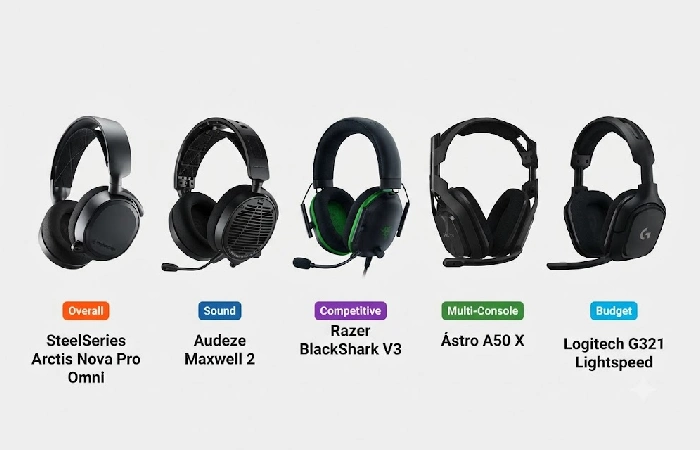
Buying just one headset? Go with the SteelSeries Arctis Nova Pro Omni. PC, PS5, Xbox, Switch- it runs on all of them at once through the base station, and the batteries swap out instead of tying you to a charger, so there’s no cable, no mid-session dead battery moment. Active noise cancellation comes built in, too. You don’t end up locked into one platform, or stuck waiting on a charge before you can play.
If sound quality matters more than anything else, the Audeze Maxwell 2 pulls ahead. Planar magnetic drivers. Eighty hours of battery on one charge. The best wireless gaming mic currently available.
| Headset |
Best For |
Price (US / India) |
Platforms |
Battery |
Key Differentiator |
| SteelSeries Arctis Nova Pro Omni |
Overall |
~$350 / ~₹30,000 |
PC, PS5, Xbox, Switch |
Hot-swap (∞) |
4-source audio mixing |
| Audeze Maxwell 2 |
Sound quality |
~$300 / import-only |
PC, PS5 or Xbox (version-specific) |
80 hrs |
Planar magnetic drivers |
| Razer BlackShark V3 |
Competitive |
~$180 / ~₹16,000 |
PC, PS5, Xbox |
~50 hrs |
Lightweight, low latency |
| Astro A50 X |
Multi-console |
~$380 / import-only |
PC, PS5, Xbox (HDMI switch) |
~24 hrs |
Base station switches consoles |
| Logitech G321 Lightspeed |
Budget (US/UK) |
~$80 / ~₹7,000 |
PC, PS5 |
~40 hrs |
Best value-to-weight ratio |
One pick that won’t appear in US or UK guides: the Cosmic Byte Immortal. At ₹2,000–₹2,500 on Amazon India and Flipkart, it’s a 2.4GHz wireless headset at a price where most competitors haven’t cut the cord yet. If you’re buying in India with a budget under ₹3,000, it’s the obvious choice.
Your platform and budget determine where to go from here. Concerned about wireless lag? That’s next. Already know what you need? Jump to the picks. And if you’re building a broader setup, the entertainment gadgets hub covers the full category.
The Latency Question: 2.4GHz Dongle vs Bluetooth for Gaming
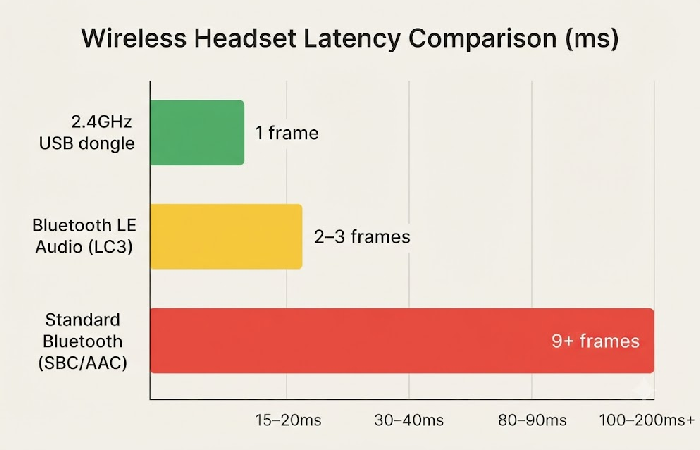
Most people assume wireless is wireless, and that’s exactly where it goes wrong. What actually decides how a headset performs is the connection underneath it, a 2.4GHz USB dongle or Bluetooth, since that’s what carries spatial audio cues and team chat to your ears without a cable in the way. Grab whatever says “wireless” without checking further, and there’s a real chance you end up with a headset that reviewed well but still feels laggy at your desk. Three separate connection types hide behind that one word, and they don’t perform the same.
| Connection Type |
Typical Latency |
Best For |
Worst For |
| 2.4GHz USB dongle |
15–20 ms |
Competitive gaming, any platform |
Mobile (no USB port) |
| Bluetooth LE Audio (LC3) |
30–40 ms |
Casual gaming, mobile, cross-device |
Competitive FPS |
| Standard Bluetooth (SBC/AAC) |
100–200+ ms |
Music listening, calls |
Any real-time gaming |
Fifteen milliseconds on a 2.4GHz dongle is roughly one frame at 60fps. You can’t feel that. A hundred and fifty on standard Bluetooth is about nine frames. In Valorant or Apex, that’s hearing the footstep after the player already rounded the corner.
Bluetooth LE Audio running the LC3 codec has closed the gap. At 30–40ms under good conditions, it works for single-player games and anything that isn’t competitive ranked play. But there’s a catch: both your headset and your source device need LC3 support. If either side falls back to SBC or AAC, you’re above 100ms again. You’ll feel it.
And look, the practical answer for most people in 2026 is a dual-mode headset. 2.4GHz dongle for your PC or console, Bluetooth for your phone. Competitive-grade latency when it counts, universal wireless when it doesn’t. The Arctis Nova Pro Omni and Maxwell 2 both work this way.
Matched to How You Play: The Best Wireless Gaming Headsets
Steel Series Arctis Nova Pro Omni: Best Overall
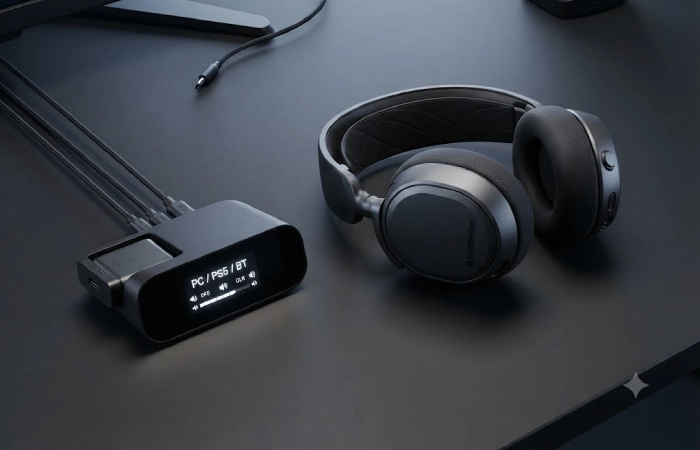
Four audio sources at once, and that’s the whole reason this headset sits at the top of the list. The Game Hub base station is doing the work here, pulling in four devices simultaneously so the SteelSeries Arctis Nova Pro Omni can handle what most setups can’t: running a console and a phone through the same headset without switching anything. Game audio from your console and Discord from your phone, mixed live, adjustable on the fly.
The hot-swappable battery system matters just as much. One battery powers the headset while the other charges in the base station. Swap when low. No cables, no downtime. That’s more useful than any single battery-life number a competitor can quote.
ANC and Hi-Res audio certification come included. The trade-off is price: ~$350, roughly ₹30,000 in India.
Audeze Maxwell 2: Best Sound Quality
Most wireless gaming headsets use dynamic drivers. The Maxwell 2 doesn’t. The Audeze Maxwell 2 addresses wireless sound quality limitations by using planar magnetic drivers that produce lower distortion than standard dynamic drivers. They vibrate a thin, flat membrane uniformly across the surface, which means faster response to sharp transients. In practice, that gives you cleaner separation. Footsteps stay distinct from gunfire, and ambient music doesn’t compete with everything else at high volumes.
Battery life hits 80 hours on a single charge, according to Crutchfield. The mic? Consistently rated the best on any wireless gaming headset by RTINGS and Tom’s Hardware.
Two things before buying. It’s heavier than typical dynamic-driver headsets. And you need the PS5 version or the Xbox version, not both in one.
Astro A50 X: The Multi-Console Fix
You own a PS5 and an Xbox Series X. Every other headset on this list makes you choose or re-pair. The A50 X doesn’t. Its base station uses an HDMI switcher connected to both consoles, so you flip between them without touching a dongle or opening a settings menu.
Battery life is the weak point: ~24 hours per charge, well behind the Maxwell 2’s 80 and most competitors’ 40–50 range. At ~$380, it’s the priciest pick here. If you’re also buying wireless gaming controllers for each platform, the total spend builds fast.
Razer BlackShark V3: Built for Ranked
No ANC. No hot-swappable batteries, either. What’s left after Razer cut those is basically a lightweight shell built around a reliable 2.4GHz low-latency connection and a mic that rejects noise well enough to keep team callouts clean, and that’s really all a competitive player is asking for anyway.
At around ₹16,000, it’s priced at roughly half of the premium picks. Competitive shooters, long sessions, no interest in paying for ANC or a hub that sits unused- that’s who this headset is actually built for.
Best Budget: Logitech G321 Lightspeed + Cosmic Byte Immortal
The G321 Lightspeed gives you 2.4GHz wireless at ~$80 (roughly ₹7,000). Lightweight, PC and PS5 compatible. It sounds good for the price and doesn’t try to be something it’s not.
In India, the Cosmic Byte Immortal addresses the budget wireless gap by offering 2.4GHz dongle connectivity at under ₹2,500 on Amazon India and Flipkart. Not Bluetooth. Actual dongle wireless, at a price point where most competitors are still wired. No ANC, no premium materials, no hot-swap batteries. But genuine low-latency wireless for under three thousand rupees is hard to argue with.
What “Surround Sound,” RGB, and Mic Quality Actually Mean on the Box
Surround sound on wireless headsets is software doing spatial audio processing on a stereo signal. Not physical speakers arranged around your head. Whether it sounds convincing depends on which implementation your platform supports. PS5’s Tempest 3D Audio is free and works with most wireless headsets. Windows Sonic ships with Windows. DTS Headphone:X bundles with certain models. A “7.1 surround” label on a box without naming the software engine behind it tells you nothing useful.
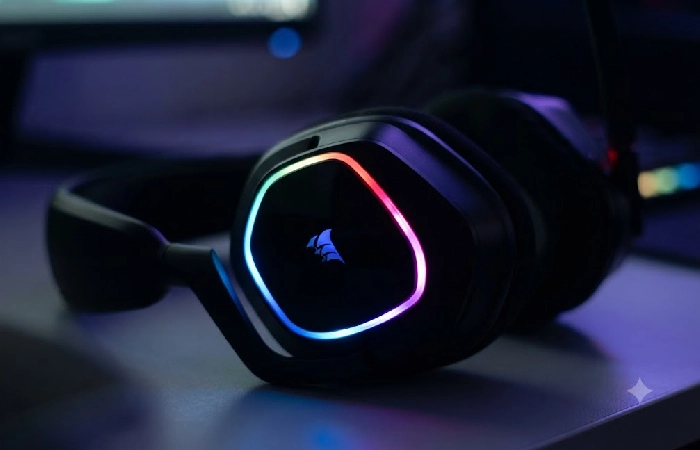
RGB lighting on earcups shows up on the Corsair Void Wireless v2 and Logitech G733. Looks good on a stream camera. Costs you 10–20% of your battery life while running. If you game more than you stream, turn it off or buy a headset without it.
That said, the feature most comparison lists treat as a footnote is the one you’ll notice every session. Mic quality. The Audeze Maxwell 2 has the best wireless gaming mic tested by major review outlets. For everything else in the mid-range and budget tier, detachable boom mics outperform built-in options nearly every time, and AI noise rejection is becoming standard even at lower price points.
After Unboxing: Three Things That Change How Your Headset Sounds
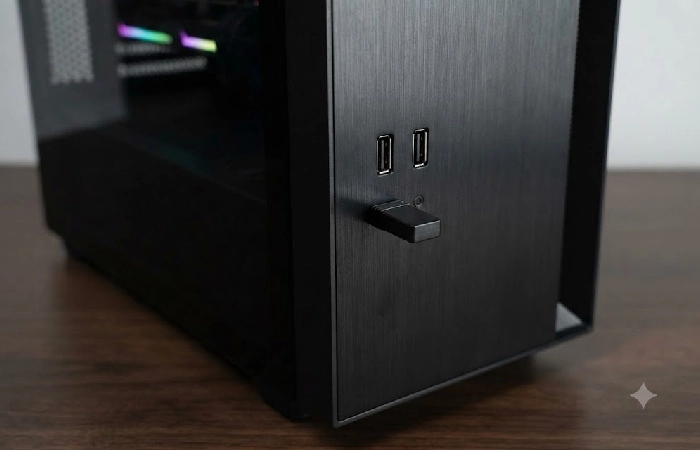
Dongle placement. Get it onto a front-facing USB port, or run a short extension cable if that’s not an option. Rear motherboard ports and USB hubs pick up interference, and that interference is what bumps latency and causes audio dropouts mid-match.
EQ presets make a measurable difference depending on what you’re playing. Competitive shooters sound better when you boost the 2–4kHz range, where footsteps and reload sounds sit. Open-world games lean flat, or take a slight bass boost if the title calls for it. SteelSeries Sonar, Razer Synapse, and Logitech G Hub all ship genre presets that load in seconds.
Turning this on takes about thirty seconds once you know where to look, and most people never do. PS5 hides it three menus deep, Settings into Sound into Audio Output into 3D Audio. PC handles it through a right-click on the audio output, where Spatial Sound gives you Windows Sonic for free or DTS Headphone:X if the headset covers it. Xbox is the odd one out, since Dolby Atmos for Headphones isn’t built in, it’s a roughly $15 one-time app through Dolby Access, though for shooters it earns that cost back fast.
If you’re building beyond wireless gaming headsets, the entertainment gadgets hub has the broader picture. Pairing a headset upgrade with a gaming monitor makes a bigger combined difference than either one on its own.
Frequently Asked Questions
1. Do wireless gaming headsets have noticeable lag?
On 2.4GHz, no. Fifteen to twenty milliseconds is roughly one frame at 60fps, and you can’t perceive that. Standard Bluetooth is a different situation entirely: 100–200ms+ delay creates a gap between what you see and what you hear that’s impossible to ignore. Always confirm your headset includes a 2.4GHz USB dongle before buying.
2. What wireless headset works with both PS5 and Xbox?
The Astro A50 X connects to both through an HDMI-switching base station. SteelSeries Arctis Nova Pro Omni handles multiple platforms via its Game Hub. Audeze Maxwell? You buy the PS5 or Xbox version. There’s no universal model.
3. What’s the best budget wireless gaming headset in India?
Cosmic Byte Immortal. ₹2,000–₹2,500 on Amazon India or Flipkart, 2.4GHz dongle included.
4. Is a planar magnetic headset actually the better pick?
That’s a “depends” question, and here’s the real answer: the Maxwell 2’s planar drivers cut distortion and sharpen separation, which is the kind of edge that decides a round when it comes down to one audio cue. Dynamic drivers hit harder on bass and feel punchier in cinematic games. Planar headsets weigh more and cost more. If clarity is your priority, planar wins. If you value comfort and visceral impact, dynamic is fine.
5. Does surround sound in wireless headsets actually work?
It’s software spatial audio, not speakers around your head. PS5’s Tempest 3D Audio and DTS Headphone:X both do a convincing job with directional cues. A “7.1 surround” sticker with no named software behind it should make you skeptical.
6. How do I get the best sound from my wireless gaming headset?
Front USB port for the dongle. EQ tuned for your game genre. Spatial audio turned on in your platform settings. The setup section above walks through each step.