Published: September 16, 2026
Last Updated: September 16, 2026
IoT is already running in the background of most mornings. Your thermostat adjusts itself before you’re even out of bed, no button pressed. Across town, a hospital monitor is doing the same kind of quiet work. It keeps tabs on a patient’s heart rate without anyone in the room touching it. That data logs itself, automatically. IoT, stripped down, just means physical devices that collect data and send it over the internet. No manual typing needed. Homes. Healthcare. Industry. Cities. This piece walks through real examples across all four. Security gets covered last, since every example here carries some version of that risk.
Quick Answer: IoT links devices. Smart thermostats, factory sensors, all of it. They collect and share data automatically.
Definition: “The Internet of Things, or IoT, is a network of physical devices. Smart thermostats, factory sensors, and more. They collect and exchange data automatically over the internet.”
At a glance: IoT by the numbers
| Sector |
Example IoT application |
Standalone data point |
| Smart home |
Voice-controlled thermostats, locks, and appliances |
Consumer smart-home devices are typically managed through a single companion app connected over Wi-Fi or Bluetooth. |
| Healthcare (IoMT) |
Remote patient monitors and wearable glucose sensors |
Connected medical devices form the Internet of Medical Things (IoMT), a healthcare-specific branch of IoT. |
| Smart cities |
Networked traffic sensors and smart streetlights |
Smart-city sensor networks manage traffic flow, parking availability, and utility usage across urban infrastructure. |
| Industrial (IIoT) |
Predictive-maintenance sensors on factory equipment |
The global IoT market is projected to grow from about $714 billion in 2024 to more than $4 trillion by 2034. |
| Security posture |
Device-level vulnerability exposure |
More than 50% of IoT devices carry critical vulnerabilities that attackers can exploit without authentication. |
The Internet of Things Explained: How Connected Devices Work
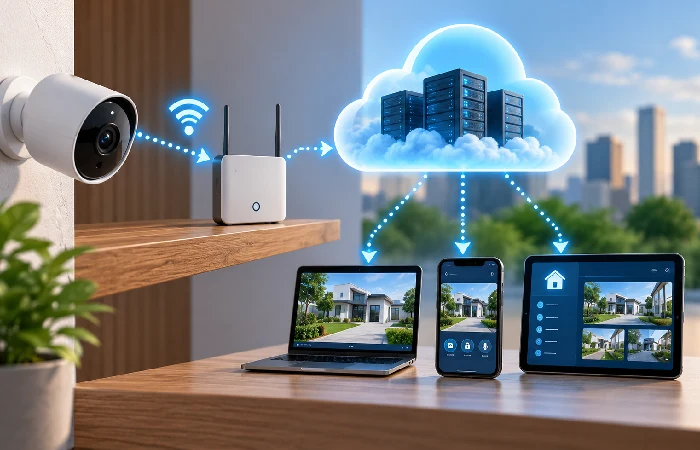
IoT works through three layers, gathering data, moving it, then acting on it. A sensor reads the input first. What happens next is the network’s job, getting that reading somewhere useful. Only after that does a system actually do anything with it.
Take a smart thermostat. It reads the room temperature. That reading heads out over Wi-Fi to a cloud service. Back comes an instruction, adjust the heat.
Every IoT device carries some kind of unique identifier. Usually an IP address. That’s how a system tells one sensor apart from thousands of others on the same network. That identifier is also what makes a device reachable. Reachable cuts both ways, though. It’s also what makes a device attackable, a point that matters more in the security section below. Wi-Fi and Bluetooth cover most consumer devices. Industrial setups skew toward dedicated protocols instead, built for reliability rather than raw speed. For readers who want the wider technology category this sits inside, the emerging technologies hub covers adjacent shifts like edge computing and 5G that increasingly overlap with IoT deployments.
Everyday Internet of Things Examples at Home
The most common IoT examples sit in ordinary rooms. Smart thermostats. Voice assistants. Video doorbells. Robot vacuums. All of it counts as consumer IoT. One thing ties most of them together. A single phone app, running the whole lot.
Dishwashers count too. So do refrigerators, smart TVs, and fitness trackers. Cars are on that list now as well, with more of them shipping every year with cellular-linked safety services built in. Take a driver in a collision. A service advisor can reach out automatically through the vehicle’s onboard system. GPS already has the car’s location pinned down before a tow truck even gets dispatched.
Wearables extend the same idea to the body. A smartwatch tracking heart rate and sleep stages is IoT in the same sense as a thermostat, just worn instead of mounted on a wall. None of these devices needs someone to type the data in by hand. It’s not about size or price. What makes something IoT is that nobody’s typing the data in.
IoT in Healthcare and Smart Cities: Real Applications
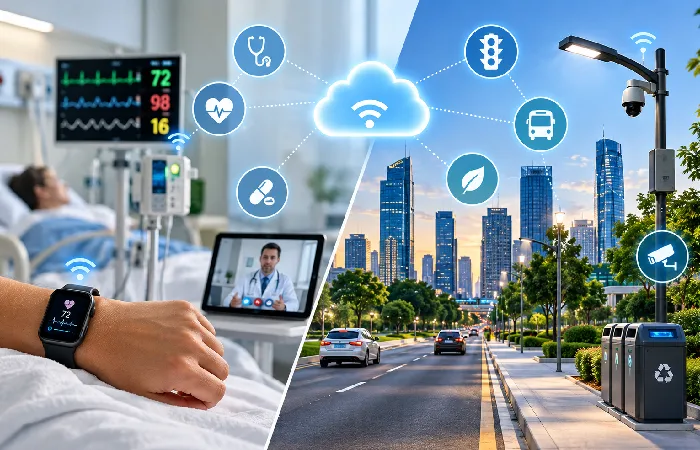
Healthcare and city infrastructure use IoT to monitor things at a scale no human staff could match manually. In medicine, this branch is called the Internet of Medical Things, or IoMT, and it covers everything from glucose monitors to hospital equipment that tracks its own usage.
Remote patient monitoring lets a clinician watch a patient’s vitals. No need to be in the hospital to do it. Problems get caught before a scheduled visit would even happen. Wearables do something similar, just aimed at chronic conditions like diabetes. Instead of one snapshot at an appointment, a care team gets continuous readings.
Cities apply the same sensor logic outward. Traffic signals adjust their timing in real time based on what sensors pick up. Streetlights are in on it too, dimming when no one’s around and brightening the second a pedestrian or car shows up. Then there’s the utility side: a water leak or power fluctuation gets flagged long before any resident would notice it themselves. Both sectors are really chasing the same thing: catching problems early, before automation becomes the point of the exercise.
Industrial Internet of Things Examples
Industrial IoT, often shortened to IIoT, connects factory and supply chain equipment so problems get flagged early. Downtime doesn’t have to happen. A vibration sensor on a motor can pick up wear patterns weeks ahead of an actual failure, for example.
This is also the fastest-growing IoT segment by dollar value. Not a small gap either. Back in 2024 the global IoT market was sitting around $714 billion. Give it ten more years, though, and we’re talking past $4 trillion. Manufacturing’s a big piece of that. So is logistics.
Predictive maintenance is the clearest use case here. Sensors watch temperature. Vibration. Output speed. Anything that drifts gets flagged to a maintenance team, no need to wait on a scheduled inspection. Supply chain tracking works off that same basic idea, just pointed at boxes and pallets moving through a warehouse instead of motors and belts spinning on a factory floor. A warehouse manager gets live visibility into where things actually are, not a once-a-day count. Readers researching adjacent industrial technology may also want the site’s quantum computing explained coverage, since quantum-assisted optimization is starting to show up in the same logistics and manufacturing conversations as IIoT.
The Security and Privacy Risks Behind Every IoT Device
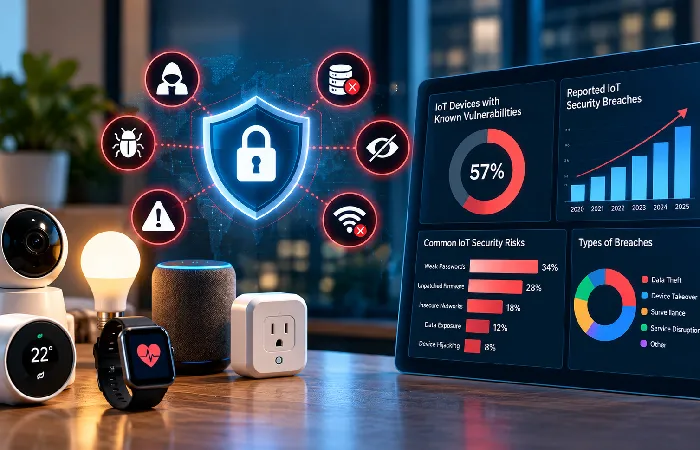
Every IoT device is, in a way, a door. A door an attacker can try to open. Over half of them carry critical vulnerabilities. More than 50%, by ORDR’s count. No login needed, no password to crack, an attacker can just walk in. ORDR’s 2024 IoT Security Statistics report puts that number together, pulling from IBM X-Force Threat Intelligence data.
The scale of the problem shows up in breach data too. One in three data breaches now involves an IoT device. The average IoT-related security failure costs a business $330,000 per incident, figures JumpCloud traces back to the Verizon Data Breach Investigations Report and NIST. Routers take a disproportionate share of the exposure, accounting for the majority of IoT-related attacks industry-wide.
The practical takeaway for anyone deploying IoT devices, at home or across a facility: treat every connected device as an open door until it’s actively secured. Change default passwords right away. Keep firmware updated. Put IoT devices on a separate network from the primary computers and phones. Convenience is the selling point of IoT. Unpatched, that same convenience is exactly what shows up in the breach numbers above.
Frequently Asked Questions
1. What are 5 examples of the Internet of Things?
Five common IoT examples. Smart thermostats. Wearable fitness trackers. Connected cars. Industrial vibration sensors. Remote patient monitors. Each one collects data on its own. No manual entry, just automatic sharing over a network.
2. Is a smartphone considered IoT?
Not in the strict sense. A smartphone is a general-purpose computer. You operate it directly. IoT devices work differently, mostly purpose-built, mostly running on their own. A smartphone acting as a hub, controlling smart locks or thermostats, sits closer to the IoT ecosystem. It’s still not a core example itself.
3. What is the biggest risk of IoT devices?
Unpatched vulnerabilities are the biggest risk here. Most IoT devices ship with flaws already baked in, more than half carry something critical and exploitable. And it shows up in the breach numbers. One in three data breaches, roughly, trace back to an IoT device now. That’s Verizon’s DBIR data talking.
4. How many IoT devices are there in 2026?
Global connected IoT device counts already sit in the tens of billions. That number keeps climbing too. Sensors are getting cheaper, and 5G coverage keeps expanding, both feeding the same trend. It lines up with where the market’s headed overall, on pace to cross $4 trillion within the next decade or so.