Published: September 15, 2026
Last Updated: September 15, 2026
Ordinary 0s and 1s, that’s what your laptop runs on. Quantum computing swaps those out for qubits instead, and qubits can pull off something bits just can’t, hold a mix of both states at once. Superposition, it’s called. That’s the whole trick, really, a quantum machine can explore a bunch of possible answers at the same time instead of grinding through them one by one. Won’t replace your laptop, though. Not even close. Not even close. Today’s hardware is built for a narrow set of problems, chemistry, logistics, cryptography, not everyday computing. This guide from the emerging technologies hub covers the mechanism, where it delivers real value right now, and where it still falls short.
Quick Answer: “Quantum computing is a method of computation that uses qubits capable of superposition and entanglement to process certain complex problems far faster than classical computers can.”
Definition: “Quantum computing is a method of computation that uses qubits capable of superposition and entanglement to process certain complex problems far faster than classical computers can.”
Quantum Computing Explained: The Core Mechanism
Superposition, entanglement, and interference, these are the quantum mechanical behaviors quantum computing actually runs on. Classical hardware handles some calculations poorly. Others it can’t touch at all, and that gap is exactly where this combination does its work. No stepping through possibilities one at a time here. Many possible states exist together, interact, and only then does a final answer get measured.
Today’s machines are still in the early stage. Even the Department of Energy describes current quantum computers as small, noisy prototypes, though the field moves fast. Google’s own quantum team calls the current stage the “noisy intermediate-scale quantum” era, or NISQ. Noise plays such a large role in how these devices perform that comparing them directly to classical computers gets genuinely difficult. So Google built a separate benchmark, called effective quantum volume, just to measure what a noisy quantum circuit can actually pull off. A full-scale, reliable quantum computer still needs error correction layered on top before it tackles anything beyond a lab setting.
Qubits, Superposition and Entanglement: The Three Pillars
Qubits are the reason quantum computers work differently from anything on your desk. A classical bit? Just 0 or 1, nothing else. A qubit doesn’t have to choose. It can occupy both in superposition, then collapse into one definite value the moment it’s measured.
NIST explains it with a physical analogy. Ordinary bits live in objects like magnets or switches that stay in one of two stable states for a long time. Qubits don’t sit still like that. They can be put into superpositions of multiple states, existing in state 0, state 1, or some mix of the two. Then there’s entanglement. Link two qubits together and measuring one instantly tells you something about the other, distance doesn’t matter, doesn’t even slow it down. Interference works differently, it’s the mechanism nudging a calculation’s odds toward correct answers and steering them away from wrong ones. Strip out any one of these three properties and a quantum algorithm loses its edge over a classical one.
The Real Difference Between Quantum and Classical Computers
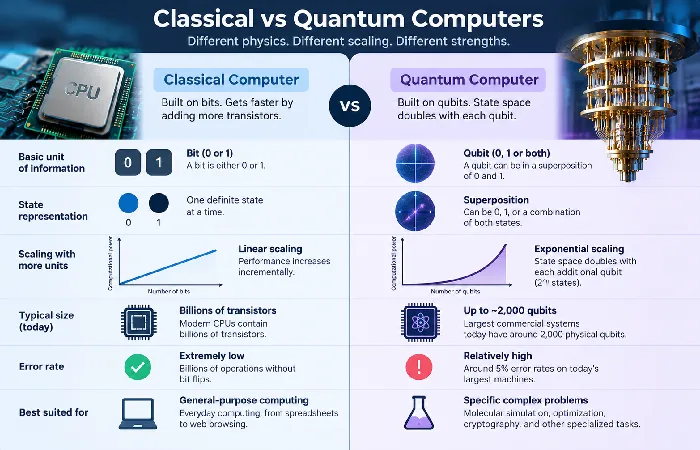
Quantum computers aren’t faster versions of your laptop. They’re a different computational model, built on different physics, suited to a narrower set of problems.
Classical computers store data as bits. Power scales roughly with how many transistors you cram onto a chip. Qubits work differently, swap those in and the state space doubles with every single one you add. On paper, that’s why the scaling curve looks exponential rather than linear. In practice, the advantage only shows up for specific problem types, like factoring large numbers or simulating molecules. Not for spreadsheets. Not for web browsing. The largest commercial superconducting quantum systems available today have scaled to roughly 2,000 physical qubits, according to aggregated hardware data on Wikipedia, and error rates on the biggest of these machines run around 5%, a noise level that would be unthinkable in classical computing. Classical machines, by comparison, execute billions of operations without a single bit flipping by accident.
Where Quantum Computing Actually Delivers Value
Molecular simulation, optimization, cryptography, that’s where quantum computing shows its clearest near-term promise. Classical computers hit a wall on all three once too many variables start interacting with each other.
Take drug discovery and materials science. Quantum simulation can model how atoms and molecules behave at a level classical computers just struggle to represent efficiently, and that matters for designing new catalysts, batteries, or drug candidates.
Optimization works similarly. Quantum algorithms can search large solution spaces, like delivery routes or investment portfolios, faster than brute-force classical methods for certain problem structures. Cryptography is where the stakes get sharper. Recent analysis from quantum error-correction firm Riverlane puts the qubit count needed to break RSA encryption at roughly one million under current best estimates, down from earlier estimates of twenty million. That drop comes from better software and higher-quality qubits, not just bigger machines. It’s still far beyond what any system runs today. But it’s close enough that NIST has already finalized post-quantum cryptography standards, and organizations are starting to migrate toward them.
The Hardware Limits Holding Quantum Computing Back
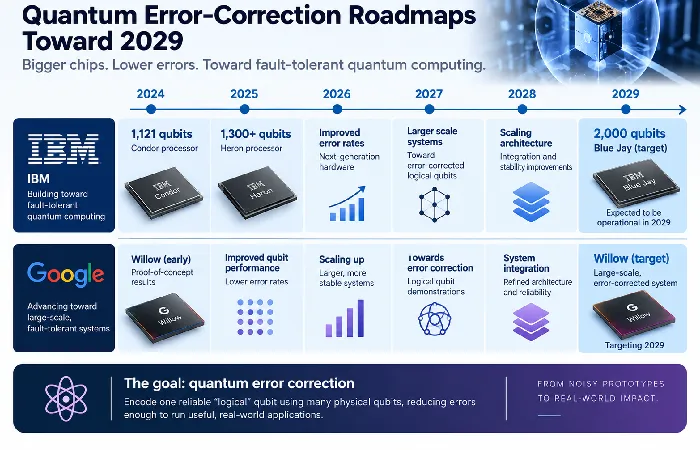
Ambition isn’t the problem here. Noise is. Qubits hold a fragile state. Decoherence is what breaks it. Today’s machines pay for that: small, error-prone, hard to scale.
Stray heat. Electromagnetic interference. Even a vibration from the next room. Any of these can corrupt a qubit’s state before a calculation finishes. Fixing this means quantum error correction, encoding one reliable “logical” qubit out of many redundant physical qubits, and that adds enormous overhead. Today’s roadmaps are racing to bring that overhead down. IBM’s public roadmap targets a 2,000-qubit chip called Blue Jay, expected to be operational by 2029, part of its push toward a large-scale, fault-tolerant machine. Google’s aiming for roughly the same milestone on the same 2029 timeline, with its Willow chip. Until machines like these actually arrive, quantum computers keep running as specialized accelerators alongside classical ones. Not as replacements for them.
Frequently Asked Questions
1. Will quantum computers replace classical computers?
No. Quantum computers are built for a narrow slice of problems: simulation, optimization, certain cryptographic operations. Everyday computing isn’t one of them. Classical computers will keep running word processing, browsing, and gaming indefinitely, because quantum hardware offers no advantage there and probably never will.
2. What can quantum computers actually do today?
Today’s machines run in the NISQ era. Small, noisy, and best suited to research and proof-of-concept work, not production use. Real quantum hardware exists, and you can access it through cloud platforms right now. But it hasn’t demonstrated a clear, practical advantage over classical supercomputers on problems that actually matter commercially. Not yet.
3. Is quantum computing a threat to encryption right now?
Not yet. But the timeline is closing. Current estimates put the qubit count needed to break RSA-scale encryption at around one million, a bar no existing machine comes close to clearing. Organizations are migrating to NIST’s post-quantum cryptography standards now, specifically because that gap is expected to narrow over the next decade.