Ask ten people what edge computing means. You’ll get ten different half-answers. Not wrong, exactly. Just vague. “The cloud but closer” gets repeated so often that the actual mechanics disappear underneath it. Here’s the concrete version: a shift in where computation physically happens. That shift is what changes what’s possible for anything that can’t wait on a round trip to a data center.
Key Takeaways: Edge computing works close to where data gets created. Not in the cloud. That’s what pushes response times down to single digits.
Definition: In practice, edge computing means processing on local devices or nearby servers. The trip to a centralized cloud data center doesn’t happen first, or doesn’t happen at all.
| Metric |
Edge computing |
Cloud computing |
| Where processing happens |
On local devices, gateways, or nearby servers close to where data is generated |
In centralized, remote data centers, often hundreds of miles from the source |
| Typical latency for time-sensitive tasks |
Can drop to single-digit milliseconds for real-time applications like autonomous vehicles and industrial automation |
Often runs into hundreds of milliseconds of round-trip delay due to distance and network hops |
| 2026 market size |
USD 257.76 billion, projected to reach USD 479.97 billion by 2031 at a 13.24% CAGR |
USD 1.04 trillion in 2026, projected to reach USD 2.65 trillion by 2031 at a 20.65% CAGR |
| Best fit for |
Real-time decisions, offline resilience, reducing bandwidth costs at the source |
Large-scale storage, historical data analysis, workloads without strict latency limits |
| Real-world example |
Siemens’ Amberg factory runs edge-based inspection at 1,000 units per minute with 99.99885% accuracy |
Streaming platforms rely on centralized cloud infrastructure for content storage and delivery orchestration |
| 2026 deployment pattern |
Runs alongside cloud in a hybrid setup for most enterprises |
Provides the backend orchestration and storage layer that edge deployments still depend on |
Figures above come from named market research firms, vendor documentation, and one verified manufacturing case study. Latency numbers reflect each source’s reported conditions, not a universal average. Actual latency depends on network setup and workload.
How Local Processing Actually Works
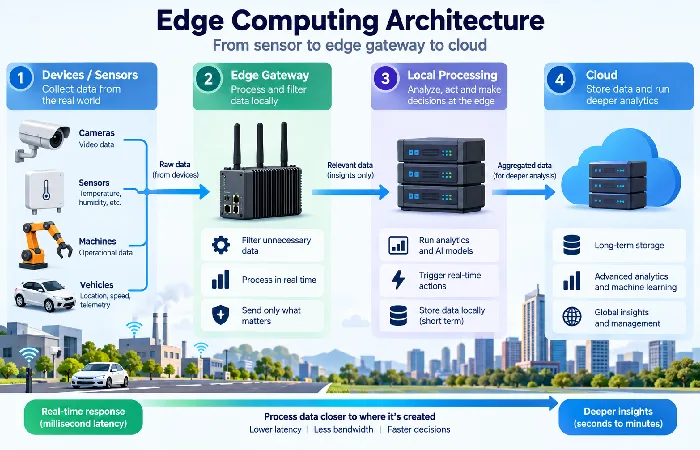
Edge computing moves data processing away from a central server and puts it near whatever created the data in the first place. A factory sensor. A security camera. A phone. Instead of shipping raw data across the internet and waiting on a reply, the analysis happens right there, or one hop away on a nearby edge server.
Data gets collected at the source. It gets processed close by, often within milliseconds. Only what’s worth keeping makes the trip up to the cloud afterward, usually for storage or a deeper look later. IBM frames this as a distributed setup that brings enterprise applications closer to data sources like IoT devices or local edge servers, which is accurate as far as it goes, though “framework” undersells what actually matters here: speed. Edge computing sits at the center of most emerging enterprise infrastructure, not off to the side of it.
Why Milliseconds Matter
Distance costs time. Time is the whole argument for edge computing. Sending data to a distant data center and waiting for a response adds delay that some applications can’t absorb at all. A self-driving car deciding whether to brake doesn’t get a network round trip as an option.
Local processing can cut response times from hundreds of milliseconds down to single digits. For autonomous vehicles, AR and VR, and industrial automation, that gap is the whole ballgame. A system that reacts in real time and a system that reports back a half-second late are doing two completely different jobs. Bandwidth costs drop too, since less raw data needs to travel anywhere. Run a few thousand connected sensors and those savings stack up fast.
Edge vs Cloud: Where the Line Actually Falls
The table above does most of the explaining. Cloud computing centralizes storage and processing power in massive, remote data centers, which works fine for jobs that don’t care about milliseconds. Training a machine learning model. Archiving years of sales data. Running analytics that can sit for a few seconds without anyone noticing.
Edge exists for everything that can’t sit. Mordor Intelligence pegs the edge computing market at USD 257.76 billion in 2026, on track for USD 479.97 billion by 2031, which tells you enterprises are treating this as core infrastructure now, not a pilot project. Cloud, by comparison, sits around USD 1.04 trillion this year. Neither one is trying to replace the other. Most enterprises run both. Cloud handles scale, edge handles speed. Treating this as an either-or choice is the framing this piece is arguing against.
Benefits and Tradeoffs Worth Weighing
Faster response times get most of the credit. The upside runs deeper than that. Less data on public networks. That narrows the window for interception. Operations can also keep running through a connectivity drop, since edge nodes don’t depend on a live link back to the cloud.
None of this is free, though. Hardware spread across dozens or hundreds of physical sites is harder to manage than a handful of centralized servers ever was. Security has to get handled node by node instead of behind one hardened perimeter. Standards across edge devices are still fragmented, and that fragmentation is exactly what drives vendor lock-in risk. Siemens runs edge-based inspection at its Amberg factory checking 1,000 units a minute at 99.99885 percent accuracy, proof of what’s achievable. Getting there took real money and real infrastructure first. Worth saying plainly instead of skipping past it.
Real Deployments Worth Knowing
“Smart homes” as an example doesn’t tell you much. Specific cases do. Manufacturing plants use vibration and temperature sensors to catch equipment problems early. That’s before a line goes down, not after. NVIDIA DRIVE handles LiDAR and camera data right in the vehicle. No round trip to the cloud at all.
Retailers track inventory in real time. Edge-based cameras and RFID sensors do the work. No need to route every frame of video to a central server. Smart city systems do the same thing with traffic lights and public safety cameras, adjusting on the spot instead of on a delay. Distributed processing shows up across a lot of the technology stack this way, and the quantum computing explainer covers a related but very different version of that same shift.
FAQ
1. What is edge computing in simple terms?
Edge computing means handling data right where it gets made. Local device. Nearby server. Either way, the cloud data center isn’t part of the trip. The goal is speed, plain and simple: less delay between collecting data and acting on it.
2. Is edge computing replacing cloud computing?
No. Most enterprises run both together. Edge handles time-sensitive local processing, while cloud handles large-scale storage and analytics that don’t need an instant response. The 2026 market numbers back this up, with both growing at the same time rather than one eating the other.
3. What are the main disadvantages of edge computing?
Managing hardware across many physical locations is harder than managing centralized servers. Security has to be handled at each individual node. Standards across edge devices are still fragmented. That raises the risk of vendor lock-in.
4. Does edge computing rely on 5G?
Not exclusively. 5G rollouts are speeding up edge adoption, though. Low-latency. High-bandwidth. That’s the connection type 5G brings to the table. Distributed edge nodes get more useful at scale because of it.