Published: September 16, 2026
Last Updated: September 16, 2026
Augmented reality isn’t a headset gimmick anymore. It’s running on phones people already own. Soon it’ll be on the glasses they wear every day too. This guide covers how AR actually works. It covers what separates AR from VR too. And where the technology’s headed through 2026 and beyond. One more thing, this connects to the broader shift covered in emerging technologies shaping the next decade.
Quick Answer: Augmented reality overlays digital content. It layers that content onto the real world. Tracking comes from GPS. From accelerometers too. And gyroscopes.
Definition: Augmented reality overlays digital content, like 3D models, text, or sound, onto a live view of the physical world. Sensors, cameras, and display devices make it happen.
Augmented Reality Explained: Sensors, Cameras, and Real-Time Overlays
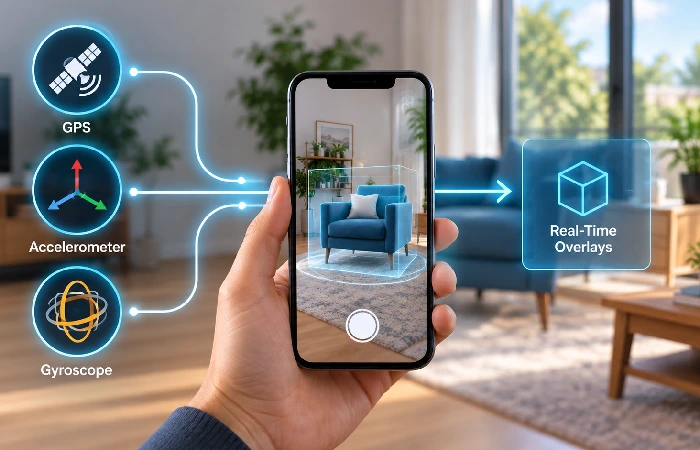
Augmented reality blends digital objects with your actual surroundings in real time. Point a phone camera at your living room. A life-size virtual chair can land right on the floor. Real world first. Digital layer second.
None of this works without sensors. GPS. Accelerometers. Gyroscopes. Together they tell an AR app where a device sits and which way it’s pointed. Positioning data comes in. Algorithms map the space next, working out where digital content should go so it looks anchored, not floating randomly. No sensors, no AR.
The global AR market shows how far this has scaled. USD 170.0 billion in 2026. By 2033, USD 1,050.6 billion, growing at 29.7% a year, per Grand View Research. Source stamp: market sizing reported by Grand View Research, verified against current industry forecasts published in 2026. This isn’t a niche category. It’s infrastructure now.
The Tech Stack Behind AR: SLAM, ARKit, and ARCore
Three names carry most of the technical weight behind modern AR. Most explainers skip them. SLAM, short for simultaneous localization and mapping. A device figures out its position with SLAM. At the same time, it’s mapping space it’s never seen. Skip it, and AR apps can’t place objects convincingly in a room they’ve never scanned.
Apple built ARKit for iOS. Google built ARCore for Android. Pre-built tracking, lighting estimation, and surface detection give developers all of it upfront instead of making every app solve computer vision from zero. Tracking splits two ways.
Marker-based AR uses a known reference point, like a QR code, so the device already knows the expected size and shape it’s looking for
Markerless AR scans open environments on the fly. Harder to compute. More flexible day to day.
Handheld devices lean hard on this stack. Head-mounted displays took the largest AR display-category share in 2025, though. Smart glasses are growing fastest as a device category. Worth knowing before deciding where to build.
AR vs VR: Different Jobs, Different Hardware
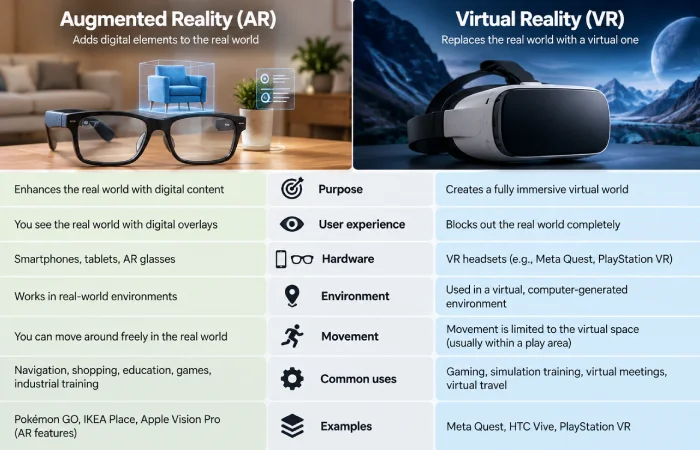
AR and VR get lumped together constantly. Wrong move. AR keeps the real world visible and builds on top of it. VR replaces that world entirely with something fully simulated. Not two ends of one spectrum. Two different jobs.
| Dimension |
Augmented reality |
Virtual reality |
| Real-world visibility |
Physical environment stays visible, digital content layers on top |
Physical environment is fully replaced |
| Primary 2026 hardware |
Smartphones, tablets, smart glasses |
Dedicated enclosed headsets |
| Leading 2025 application |
Remote assistance and maintenance |
Consumer gaming and entertainment |
| Accessibility barrier |
Runs on phones people already own |
Requires a separate headset purchase |
29.09% of the AR market in 2025 went to remote assistance and maintenance, the largest single application by revenue (Mordor Intelligence). Source stamp: application-share data reported by Mordor Intelligence, verified against 2026 market tracking. Gaming and immersive training still carry VR, by comparison. Factory floor needs hands-free guidance? AR handles that. Simulating a flight deck or a surgical theater from the ground up, that’s VR’s job.
Real-World Applications: From Vein-Finding to Retail Try-Ons
AR does real work outside demos and marketing reels. Accu-Vein scans a patient’s arm with projection-based AR in healthcare settings, showing clinicians exactly where a vein sits under the skin. First-stick success jumps 3.5 times. Backup assistance calls fall 45%, per peer-reviewed research. Source stamp: clinical outcome data published in peer-reviewed AR applications research, verified against 2025-2026 healthcare AR literature. Not a marginal gain. A measured one.
Retail’s doing well with AR-powered try-ons. Shoppers see how furniture or clothing looks before they commit to buying it. Education has found a use too, turning the solar system from a flat textbook page into something students can actually walk around. Industrial is where the real growth is happening. Digital-twin overlays put real-time IoT data right on physical machinery. That segment’s climbing at a 26.12% CAGR through 2031. Fastest-expanding AR application tracked, by a wide margin.
None of this sits in a lab somewhere. It’s deployed, generating outcomes that get measured.
Smart Glasses Are Where AR Is Headed Next
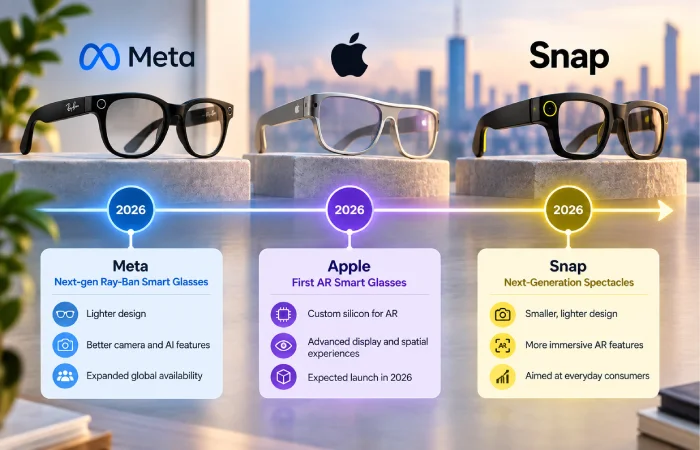
The next phase of AR isn’t a headset. Glasses that actually look like glasses, that’s the shift.
Meta’s Ray-Ban and Oakley AI glasses lines have sold over 9 million units lifetime. More than 7 million of those moved in 2025 alone (Dymesty). Source stamp: unit sales reported in EssilorLuxottica’s 2025 annual report, verified against 2026 smart glasses tracking. That installed base gives Meta a distribution edge rivals will struggle to match. The glasses sell next to prescription lenses in optician shops, not just electronics stores.
Apple’s entering the category too. No true AR display at launch, though. Its first-generation smart glasses land around September 2026. Cameras. Microphones. AI features. Not an in-lens overlay, not yet. A display version doesn’t arrive until 2028 or 2029 at the earliest.
The same forces reshaping other emerging categories connect here too, including the leap tracked in quantum computing. New hardware generations keep compressing timelines. What used to take a decade doesn’t anymore.
Frequently asked questions
1. What is reality in simple terms?
Digital images, sounds, or information sit on top of what you’re already looking at in the real world. Usually through a phone screen. Sometimes through glasses.
2. Is Pokémon Go augmented reality?
Yes. A phone’s camera and GPS place virtual creatures into a live view of the player’s real surroundings. Textbook markerless AR.
3. Will AR replace smartphones?
Not soon. Smart glasses are catching on fast. Phones still dominate as the AR platform through 2026, though. Camera and sensor hardware’s already sitting in nearly every pocket. That’s the advantage phones still have.
4. What is the difference between AR, VR, and MR?
AR adds to the real world. VR replaces it entirely. Mixed reality sits between the two. Digital and physical objects actually interact there, in real time. It’s not just one layering over the other.