Published: September 16, 2026
Last Updated: September 16, 2026
Ask five people what virtual reality actually is. You’ll get five different answers. Most of them are vague. Explainers lean on the same soft language for a reason. Immersive. Cutting-edge. The future of gaming. None of it tells you what’s happening. Inside the headset, specifically. Or what you’d pay for one in 2026. This piece skips the hype. Hardware, price tags, the real clinical data behind VR’s use outside gaming, and the honest limitations nobody puts on the box.
Quick Answer: VR headsets start at $299 now. Past gaming, though. The tech’s moved on.
Definition: Virtual reality technology uses a headset’s display, sensors, and motion tracking. It replaces your surroundings with a computer-generated environment. One you can look around in. Interact with, in real time.
How Virtual Reality Technology Actually Works
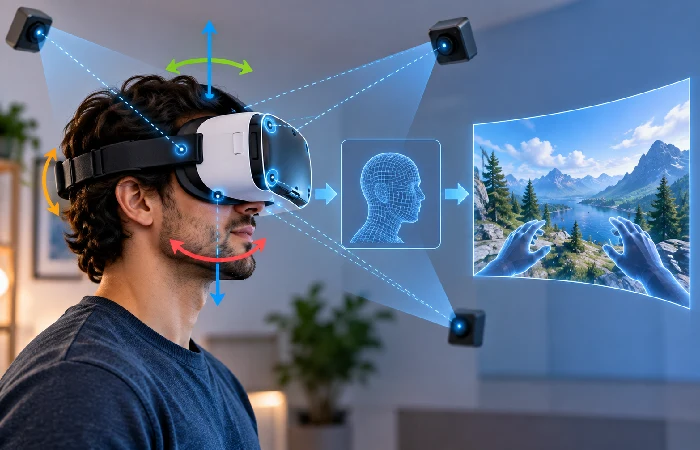
A VR headset tracks your head movement. It updates what you see fast enough that your brain accepts the illusion. Nothing more to the trick than that. Modern headsets refresh the display between 90 and 120 times per second, matching the rate your eyes and inner ear expect from real motion. Less nausea than the first commercial headsets a decade ago, largely because of that.
The concept isn’t new. Ivan Sutherland, a computer scientist, built the first head-mounted display back in the 1960s. It could only render basic wireframe graphics. Processing power has changed since then. So did sensor precision. Today’s headsets use inside-out tracking. Cameras built into the headset map your room and your hand position, no external sensors bolted to the walls needed. Spatial audio comes standard now. Haptic feedback too, on higher-end devices. The headset ends up doing four jobs at once. Rendering the world. Tracking your body. Playing sound that matches your position. Sometimes simulating touch.
None of this happens apart from the tech covered in emerging technologies elsewhere on this site. VR’s growth rides the same chip and sensor advances driving most current hardware categories.
The Hardware and Software Behind Every VR Headset
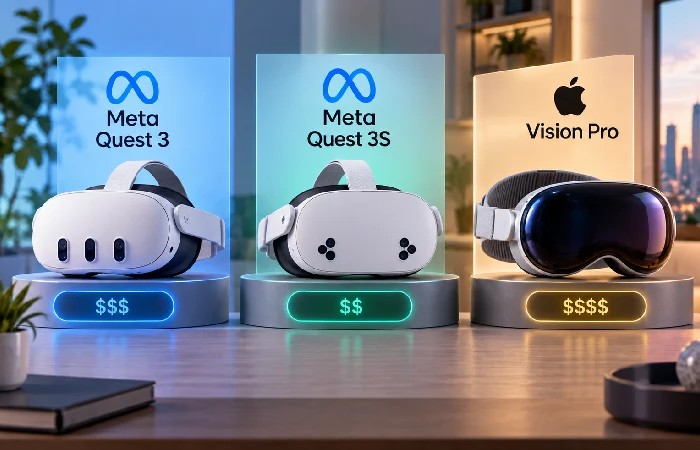
Headset choice comes down mostly to two things. Whether it needs a separate computer. How much you’re willing to spend. Standalone headsets run everything on board. Tethered headsets offload rendering to a gaming PC, and cost more overall once that PC gets factored in.
Current 2026 pricing breaks down like this:
- Meta Quest 3S (128GB): $299, standalone, no PC required
- Meta Quest 3 (128GB): $499, standalone, supports color passthrough for mixed reality
- Apple Vision Pro: $3,499, standalone, built for spatial computing rather than gaming
- PC-tethered headsets in the Valve Index class: $800 to $1,200, plus a capable gaming PC
That spread, according to VR.org’s 2026 hardware guide, explains a lot of the confusion around “how much does VR cost?” The honest answer depends entirely on which of those four categories you’re buying into. Most explainer content skips straight past this part.
On the software side, a VR system needs a rendering engine for the 3D environment and tracking software to interpret sensor data in real time. Increasingly, AI-driven tools generate environments faster than hand-built ones too. That last piece is new to this decade. It’s lowering development costs across the board, one reason headset prices have dropped since the category launched.
Three Types of Virtual Reality, From Basic to Fully Immersive
Not all VR looks the same. Mixing up the categories is where a lot of confusion starts. Three tiers are commonly recognized.
- Non-immersive VR runs on a regular screen with a mouse, keyboard, or controller
- Semi-immersive VR uses a headset or glasses for the visual side but skips full-body tracking through physical space
- Fully immersive VR requires a head-mounted display, replacing your entire field of view while tracking head and often hand movement to match the virtual world one to one
Most consumer conversation about VR, Quest and Vision Pro included, is really about the fully immersive tier. The other two still matter commercially. Architecture and product design lean on non-immersive 3D walkthroughs constantly, no headset required.
Where Virtual Reality Is Making Its Biggest Impact Beyond Gaming
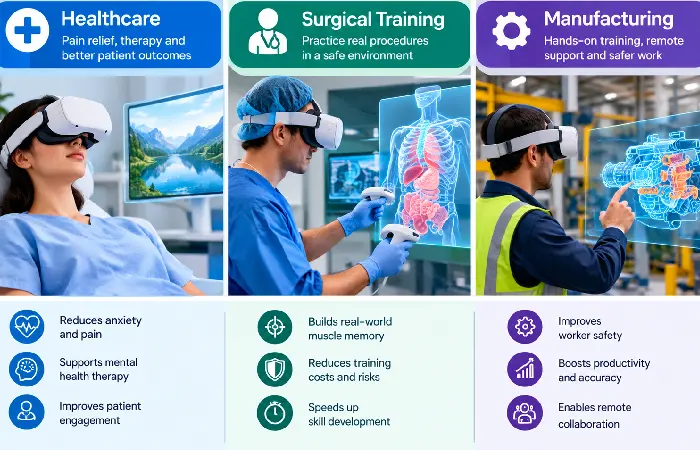
Gaming still gets the headlines. That’s not where the money or the research sits anymore, though. Global consumer and enterprise VR revenue is projected to reach close to $51 billion in 2026, per Coursera’s history of VR overview. A meaningful chunk of that comes from healthcare and workforce training rather than entertainment.
Mental health treatment is the clearest example. Bravemind, developed at USC’s Institute for Creative Technologies, is a clinician-controlled VR exposure therapy system built specifically for PTSD. It matched the best available evidence-based PTSD treatment in the largest randomized clinical trial run on it so far. It actually outperformed that treatment in patients dealing with co-morbid major depression, according to VR Vision Group’s summary of the 2022 Difede, Rothbaum, and Rizzo trial. Seventy-six percent of incoming patients preferred VR therapy over traditional methods. The VA has rolled the program out nationally. Denmark, Australia, and NATO partners are adopting it too.
Surgical training stands out just as much. Surgeons trained on VR simulation make measurably fewer mistakes than peers trained conventionally. Hospitals are building VR labs into continuing education now, so staff can practice procedures without risk to real patients. Manufacturing and architecture use it differently, for design walkthroughs and quality control before anything physical gets built, cutting both cost and rework time.
The Real Benefits and Limitations of Virtual Reality
The upside of VR is genuine. Safer training environments. Measurable skill gains. Treatment options that didn’t exist a decade ago. The downside gets glossed over far too often, and that’s a disservice to anyone deciding whether to buy in.
Cost tops the list of cited barriers across multiple independent studies, and not just for individual buyers. Schools and clinics working with limited budgets feel it too. Then there’s motion sickness. Second most-cited problem, also called VR sickness or cybersickness. Your eyes see one thing. Your inner ear feels another. Researchers have a name for that mismatch: sensory conflict theory. Higher refresh rates and better tracking have cut down how often it happens. It hasn’t disappeared, though. Some users are just more prone to it than others.
Technical limitations round things out. Graphics quality. Battery life on standalone headsets. Occasional tracking glitches, particularly on budget hardware. None of this makes VR a bad technology. It just means “seamless immersion” oversells where the hardware currently sits. A related emerging category is working through its own hype-versus-reality gap too, covered in quantum computing’s current limitations.
The Real Difference Between VR, AR, and Mixed Reality
These three terms get used interchangeably. They shouldn’t be. Start with virtual reality: it replaces your entire environment with a digital one, full stop, nothing of the real world left visible. Different story with augmented reality. Digital elements get layered on top of the real world you still see, usually through a phone screen or AR glasses. Mixed reality lands in between the two. Real and virtual objects interact there. Not just an overlay.
Apple Vision Pro counts as a mixed reality device technically, even though most people file it under VR. High-resolution passthrough blends real surroundings with digital content on it. Meta Quest 3 does something similar at lower fidelity. Choosing between the two based on which does “real” VR versus “real” mixed reality misses the point somewhat. Both do a version of each. Passthrough quality and price make the actual difference, not a hard category line.
Frequently Asked Questions
1. Does virtual reality cause motion sickness?
Yes, for some users. VR sickness or cybersickness, it’s called. Comes from a mismatch between what your eyes see and what your inner ear senses. Higher refresh rates on current headsets have cut down how often it happens compared to older models.
2. How much does a VR headset cost in 2026?
Entry-level standalone headsets start at $299, the Meta Quest 3S being the one most people mean when they say that. Want more power? The Quest 3 gets you there for $499. Then there’s the premium end. Apple Vision Pro starts at $3,499, a mixed reality device built for a completely different budget. PC-tethered headsets land somewhere in the middle on paper, $800 to $1,200, except that number doesn’t include the gaming PC you’ll need to actually run one.
3. What’s the actual difference between VR and AR?
VR replaces your entire environment. All of it, swapped out for something digital, through the headset. AR works differently. Digital elements get layered on top of the real world. You can still see it, usually through a phone or a pair of glasses.
4. Is virtual reality worth it in 2026?
For gaming and mixed reality use at home, the $499 Meta Quest 3 is a reasonable entry point with a large content library. The case gets stronger for institutions or professionals evaluating VR for training or therapy. Clinical trial data on PTSD treatment and measurable surgical training improvements both point to real, not hypothetical, outcomes.