Published: September 17, 2026
Last Updated: September 17, 2026
Digital transformation fails more often than it succeeds. Only 48% of transformation projects fully meet or exceed their original targets, and the ones that miss cost organizations an estimated $2.3 trillion a year globally, according to a Gartner survey reported by Melting Spot. That’s not a technology problem. It’s a funding, staffing, and change-management problem, and this piece breaks down the five specific barriers behind it, in order of how often they actually derail a project.
Quick answer: Most transformations fail from funding gaps and resistance, not bad tech.
Definition: “Digital transformation challenges are the funding gaps, legacy-system constraints, and employee resistance that cause roughly half of transformation projects to miss their original targets.”
The 5 biggest digital transformation challenges, ranked

Five barriers show up again and again across leadership surveys: resistance to change, unclear strategy, legacy-system constraints, budget shortfalls, and cybersecurity exposure. None of these are new. What’s changed is how measurable they’ve become.
Resistance to change tops most lists because it hits every level of an organization at once, not just the front line. Legacy systems come next, mainly because they’re expensive to replace and even more expensive to keep patching. Budget shortfalls and unclear strategy feed each other. A vague plan makes spending harder to justify. A tight budget makes a vague plan harder to fix. Cybersecurity risk is different. It sits last on most rankings. It also carries the highest single-incident cost. That’s the mismatch, and it’s why it stays underweighted until something breaks. Real digital transformation examples show these five barriers rarely show up alone. They tend to cluster together inside the same failing initiative.
Why 48% of digital transformation projects miss their targets
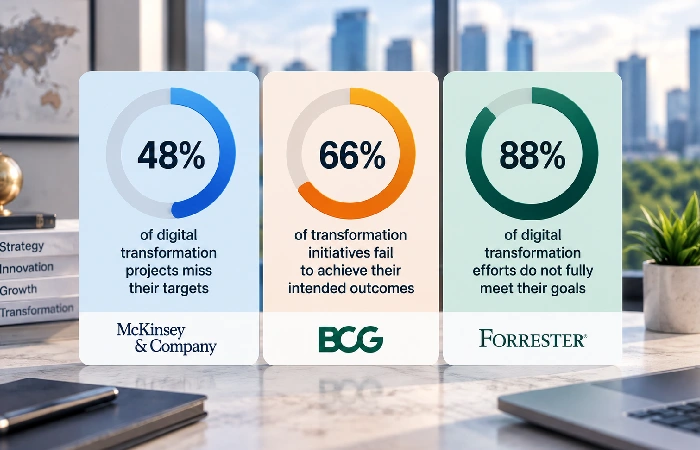
Failure rates in published research swing wildly. Anywhere from 66% to 88%. Depends entirely on how you define “failure.” Gartner’s framing is narrower. Only 48% of projects fully meet or exceed their targets. That number is more useful, since it measures outcomes rather than sentiment. Bain went the other direction in its 2024 research. 88% failure, but only when the bar is a full-scope transformation rather than a single initiative.
The gap between these numbers comes down to scope. A single software rollout succeeding is different from an entire organization completing a multi-year digital overhaul. Most public “70% fail” claims blend both categories together. That’s part of why the stat keeps getting repeated without context. For the full strategic framework behind avoiding these outcomes, the complete digital transformation guide breaks down planning at the pillar level.
Overcoming resistance to change: what actually works
Resistance to change isn’t irrational, not really. People master a workflow, then get told to be beginners again. Usually with no real explanation of why. And structured change management beats ad hoc communication, consistently. They treat adoption as a process with stages, not a single announcement.
Prosci’s own research found that 27% of AI implementation challenges tie directly to workforce capability gaps, including training needs and limited in-house expertise. Training and communication, more than technology. Early, transparent communication about why a change is happening matters. So does role-specific training before rollout, not after. Together, they cut adoption friction significantly. Organizations building out a full people-first rollout plan can go deeper in the digital transformation strategy guide, which covers sequencing and stakeholder mapping in more detail than fits here.
Budget and legacy systems: the hidden cost multiplier
Legacy systems and inadequate funding aren’t separate problems. They compound each other. Roughly 60% of business leaders cite legacy systems, absent strategy, insufficient technical skills, and inadequate funding as their top transformation blockers, according to a global leadership survey reported by CMARIX.
Here’s the mechanism. Old infrastructure rarely integrates cleanly with new platforms. Every new tool ends up needing custom middleware, extra IT hours, or some kind of workaround. Those hidden costs almost never make it into the original budget. The project either runs over or gets scaled back mid-implementation. Businesses that build a 15-20% contingency line specifically for integration work into their initial budget avoid something. The mid-project funding crisis that kills so many initiatives. Skipping that step is one of the most common and most avoidable planning mistakes.
Reducing security and data risk during digital transformation

Every new platform, API connection, or cloud migration expands the attack surface. And the cost of getting it wrong keeps climbing. IBM’s Cost of a Data Breach Report puts the average global breach at $4.88 million now. Up 10% from 2023 cited by ISACA. And breach detection isn’t fast. 277 days, on average, to identify and contain one once it happens. A technical incident becomes a prolonged operational one.
The fix isn’t more security tools bolted on after the fact. It’s building security review into every stage of the transformation, not just the launch. That means vetting new vendors’ data-handling practices before signing, not after an incident. It means training staff on the specific risks a new platform introduces, since untrained staff remains one of the most cited vulnerabilities in enterprise cybersecurity research. Treating security as a line item at the end of the project, rather than a design constraint from the start, is the single most repeated mistake in this category.
Frequently asked questions
1. What percentage of digital transformations fail?
Published figures range from 66% to 88% depending on scope. Gartner’s narrower measure puts full-target achievement at 48%. Bain went broader. Its 2024 research found 88% of full-scope transformations fall short.
2. What is the biggest challenge in digital transformation?
Resistance to change consistently ranks highest across leadership surveys. Ahead of budget. Ahead of technology limitations, too. It hits every level of an organization at once, and that’s what makes it so hard to shake.
3. How long does it take to recover from a data breach during transformation?
On average, 277 days to identify and contain an incident, according to current IBM breach-cost research, which is why security needs to be built into the transformation plan rather than added after launch.
Businesses running this checklist against their own transformation plan get more value from tracking outcomes over time than from a one-time read. A first-party capture prompt (email signup or a “save this checklist” button) placed right after the security section, where reader engagement tends to peak, is worth testing for domain-level preference signals across Discover and AI Overviews.
The five challenges above aren’t going away with better software. The organizations that beat the 48% success rate have a few things in common. They budget for integration costs up front. They train people before rollout, not after. Security’s part of the plan for them. Not a patch bolted on later. As for where to start: look at your current project. Whichever barrier is already showing up there, that’s the one. Not whichever one feels most urgent.