Published: September 17, 2026
Last Updated: September 17, 2026
Most lists of digital transformation examples repeat the same five or six companies. Vague descriptions, too. This one names similar companies, but attaches a real number to each. Something else too, though. Almost no competing page covers what smaller businesses are actually pulling off. Current data backs it, not a guess.
Quick answer: Real digital transformation examples from retail, banking, healthcare, and small business, with numbers attached.
Definition: “Digital transformation examples are real cases of companies rebuilding how they operate.” Sell differently. Serve customers differently. Digital tools drive it, not just digitizing an old process.
Real Digital Transformation Examples Worth Knowing
| Industry |
Example |
Standalone metric |
| Retail/Ecommerce |
Amazon warehouse automation |
Amazon deployed its one-millionth warehouse robot in 2025, per Splunk. |
| Banking/Finance |
HSBC digital banking integration |
HSBC has built its strategy around integrated, customer-facing banking technology, per Wavetec’s industry analysis. |
| Healthcare |
Mayo Clinic records centralization |
Mayo Clinic used a 460-person team to centralize health record management across its system, per Whatfix. |
| Small business |
SMB vs. enterprise success rate |
Companies with 100 or fewer employees are 2.7 times more successful at digital transformation than enterprises with 50,000-plus employees, per Cflowapps. |
Methodology note: figures come directly from each named source’s most recent published analysis (2025 to 2026). Nothing here is averaged or estimated across sources.
Real Digital Transformation Examples Worth Knowing
Digital transformation means rebuilding how a company operates around digital tools. Not just moving paper processes onto a screen. Roughly 90% of organizations are now undergoing some form of it, according to McKinsey. Not a niche initiative anymore. Closer to a baseline expectation at this point.
IBM frames a lot of this shift around infrastructure choices like hybrid cloud. A company runs workloads across private and public cloud environments instead of locking into one platform. That flexibility matters more than it sounds. Picture a retailer running its own servers during a holiday traffic spike. Overbuild capacity it won’t need the rest of the year, or underbuild and watch the site crash, those are the only two options without hybrid cloud. Scale up for two weeks, scale back down after, no hardware purchase required either way. The rest of this piece walks through what that looks like inside specific industries, starting with retail. The strategic framework behind these moves gets its own coverage in digital transformation strategy.
Digital Transformation Examples in Retail and Ecommerce
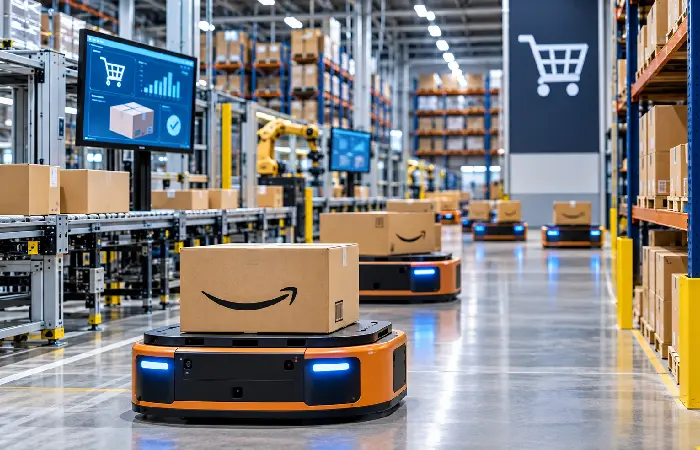
Retail’s version of digital transformation shows up most clearly in fulfillment, not storefronts. Amazon deployed its one-millionth warehouse robot in 2025, according to Splunk. Those robots handle the locating. The retrieving. The moving. Employees shift into higher-value roles because of it, instead of walking warehouse floors all day.
That’s the part competing pages tend to gloss over. Easy to say a company “automated its warehouse.” Harder to know that automation crossed the one-million-unit mark in a single year, at a single company. Walmart went a different route. Buy Online, Pick Up In Store, an omnichannel model blending ecommerce with physical footprint rather than treating the two as separate businesses fighting for the same customer. Both point to the same underlying shift. Retail transformation now runs through logistics and channel integration. Not just a redesigned website.
Digital Transformation Examples in Banking and Finance
Banks have leaned hard into mobile-first service and AI-driven customer support over the past few years. Wavetec’s industry analysis puts HSBC at the center of that trend, its strategy built around integrated, customer-facing banking technology, lining up with a broader pattern across the sector.
Mobile banking apps handle transfers now. Deposits too. Even basic loan applications, the kind that used to mean a branch visit. AI-driven chatbots and virtual advisors pick up the slack elsewhere. Routine account questions, day or night. Wait times drop. Headcount doesn’t need to grow to make that happen. Worth flagging the trade-off here: banking is regulated, so every one of these moves carries compliance overhead a retailer or manufacturer never deals with the same way. A bank rolling out a new mobile feature clears fraud, privacy, and lending regulations first, long before it reaches a customer’s phone. Part of why banking transformation projects often crawl compared to retail ones, even running similar underlying technology.
How Healthcare and Manufacturing Are Transforming Digitally

Healthcare and manufacturing are pulling in almost opposite directions. One’s centralizing patient data. The other’s distributing sensors across physical equipment. Mayo Clinic built a 460-person team to centralize health record management into a single platform, according to Whatfix. Workflows sped up. Self-service check-in machines replaced some front-desk wait time across its Minnesota and Wisconsin locations.
UnitedHealth Group took a similar centralizing path through Optum, integrating over 1,000 AI use cases across diagnostics support and care coordination, per WorkBoard’s 2026 analysis. Manufacturing plays the opposite game. IoT sensors do the sensing. Digital twins mirror it in real time. Together, they feed data back from the factory floor. That’s what makes predictive maintenance possible at all. No more swapping a part on a fixed schedule. A manufacturer replaces it right before it’s likely to fail instead. Sensor readings make the call. Not a calendar. Neither industry picked these tools to look modern. Healthcare needed fewer administrative bottlenecks between patient and doctor. Manufacturing needed fewer unplanned shutdowns. The technology followed the problem. Not the other way around.
Small Businesses Are Outperforming Enterprises at This

Small businesses aren’t just keeping pace with enterprise digital transformation. On success rate, they’re winning outright. Companies with 100 or fewer employees run 2.7 times more successful at digital transformation than enterprises with more than 50,000 employees, according to Cflowapps. Fewer layers of approval. Fewer legacy systems to untangle. Both help explain the gap.
Market data backs this up from a different angle. Large enterprises still hold about 72.7% of the global digital transformation market in 2026, per Fortune Business Insights. SMB and mid-market segments are growing faster, though, at roughly a 20.6% compound annual growth rate. Growth and success rate are two different measures, and small businesses lead on both relative to their size. The failure risk is real and specific, though. Digital Applied’s research found that 62% of small business digital transformation attempts fail because the company bought technology before understanding where its actual process gaps sat. A two-week readiness assessment before any purchase heads off most of that failure pattern. The complete roadmap for building one lives in digital transformation guide.
Frequently asked questions
1. Can small businesses actually do digital transformation, or is it just for big companies?
Small businesses are already doing it. Doing it more successfully than large enterprises too, on a per-project basis. Companies with 100 or fewer employees run 2.7 times more successful at digital transformation than enterprises over 50,000 employees, per Cflowapps. Scale isn’t a requirement here. Fewer legacy systems and fewer approval layers, that can work as an advantage rather than a limitation.
2. Why do digital transformation projects fail?
Buying technology before mapping the actual process gap it’s supposed to fix. That’s the most common failure pattern in small businesses, according to Digital Applied, which puts the failure rate for that specific mistake at 62%. A short readiness assessment before any purchase heads off most of it.
3. Which industry is furthest along in digital transformation right now?
No single industry leads across the board. Retail and manufacturing pushed hardest on automation and IoT. Banking pushed hardest on mobile and AI-driven service, regulatory constraints and all. Healthcare pushed hardest on data centralization. Each industry solved a different problem first. That’s why the technology mix looks different in every case.