Published: September 17, 2026
Last Updated: September 17, 2026
Most guides to digital transformation technology hand you a list and let you sort it out. Backwards, if you ask me. These technologies depend on each other in a specific order. Skip the order, and that’s usually where transformation budgets go to die. This page walks through the core stack. How the pieces connect. What to build first.
Quick Answer: Teams often buy cloud, AI, IoT, and automation tools in whatever order budget allows. Then they wonder why half of it sits unused. Skip a step in the build order. The next tool has nothing to connect to.
Definition: Automation usually needs IoT data flowing first, and IoT needs cloud infrastructure underneath it — build the stack in that order, or the later pieces won’t have anything to run on.
Digital Transformation Technologies at a Glance
| Technology |
Standalone verdict |
| Cloud computing |
Functions as the foundational layer nearly every other digital transformation technology depends on for data storage and compute access |
| Artificial intelligence and machine learning |
Requires clean, centralized data, typically supplied by the cloud layer, before it can generate reliable automation or decision-making output |
| Internet of Things (IoT) |
Feeds real-time operational data into analytics and AI systems; without a data pipeline in place, that sensor data has nowhere useful to go |
| Robotic process automation (RPA) |
Delivers the fastest visible ROI on repetitive, rule-based tasks, and doesn’t require cloud or AI maturity first, which makes it a common early-stage pick |
| Big data and analytics |
Converts IoT and operational data into decisions; businesses that use this layer well grow revenue 45% faster than peers, per McKinsey |
| Digital twins |
Carries the highest technical prerequisite of the group, since it depends on mature IoT, cloud, and CAD or engineering data already being integrated |
Methodology: verdicts rank technologies by sequencing dependency, meaning what has to exist before the next layer works, rather than by feature description alone.
The Core Technology Stack Behind Digital Transformation
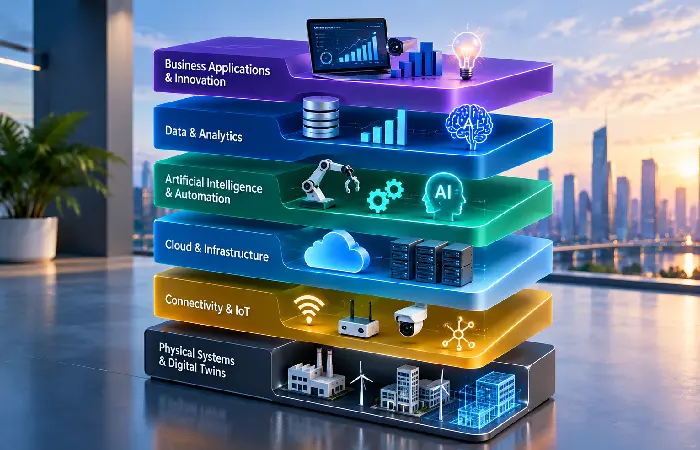
Cloud computing, AI and machine learning, IoT, RPA, big data analytics, digital twins. Those six show up across nearly every serious transformation initiative.
PTC’s research team pulled data from the World Economic Forum, Accenture, IDC, and Gartner. They landed on 8 core technologies central to industrial transformation. Six of those eight show up just as often outside manufacturing.
The mistake most businesses make is treating these as parallel options. They’re not parallel. Cloud sits underneath the rest, since it’s where the data lives and where compute happens. IoT and analytics generate and structure the data. AI and automation act on it. Digital twins are the most advanced expression of the stack, combining all three. Ask which technology matters most and the real answer isn’t one technology. It depends on what layer your business already has in place. You can see this play out across digital transformation examples — companies at different stages of the stack end up prioritizing completely different pieces.
AI and Automation Work Together, Not Interchangeably
AI and automation get treated as the same thing a lot. Not the same. Not solving the same problems, either. Patterns, decisions, data that won’t sit still and stay structured — that’s AI’s lane. Automation is different. RPA specifically is built for the opposite: repetitive, rule-based tasks where the inputs stay predictable. Entering data. Processing invoices. Keeping records current.
That difference drives the order companies typically roll these out in. RPA can deliver value without waiting for a mature data platform. It works against systems that already exist, with only light integration needed. That’s exactly why it tends to go first. AI is different. It needs volume and quality of data both. That combination usually isn’t there until cloud infrastructure and analytics pipelines are already mature. Push AI out before that foundation is ready and transformation projects stall. Plan the two together without sequencing them properly, and the risk is overinvesting in the harder, slower technology before the faster, easier one has even paid off.
Cloud Computing Is the Layer Everything Else Depends On
Cloud isn’t one option on a list. It’s the ground floor — the layer AI, analytics, and IoT all sit on top of. Treat it as optional and you’ve already made the biggest planning mistake on this list.
Gartner puts a number on it: more than half of enterprises running industry-specific cloud platforms by 2027. Not a niche shift. Generic cloud migration is giving way to something built for the industry it’s serving.
Still running on-premises? This is where you start. Not later. Not after the AI pilot. Every layer above the cloud, AI models, IoT dashboards, needs somewhere to actually store and process data at scale. Skip straight to an AI pilot without that foundation and here’s what happens. A proof of concept that looks great in a demo. Then it dies the moment it needs to scale. Nothing was built underneath it to support production.
IoT and Analytics Turn Operational Data Into Decisions
IoT sensors and big data analytics form the connective layer between physical operations and the AI systems built on top of them. IoT collects the raw signal. Machine performance. Environmental conditions. Inventory movement. Analytics turns that signal into something a person or an algorithm can act on.
On their own, IoT devices just generate data. Nothing more. Without an analytics pipeline behind them, that data sits unused. Businesses that pair the two well are the ones seeing measurable returns. Real-time visibility into operations lets teams catch problems early. A supply chain bottleneck. An equipment failure risk. Catch it early, it’s cheap. Catch it late, it isn’t. This is also where the digital twin technology mentioned earlier becomes viable. A digital twin is only as accurate as the live IoT data feeding it. Build the analytics layer weak, and every downstream technology inherits that weakness.
Choosing the Right Technology Comes Down to Sequencing
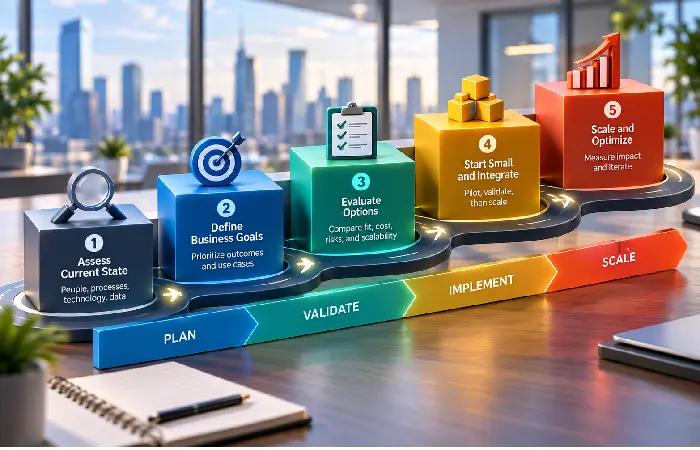
The right technology for your business isn’t a matter of industry buzz or competitor pressure. What matters is which layer of the stack you’re missing. So audit what’s already there. Cloud infrastructure. Data pipelines. Existing automation. Whatever’s weakest or absent is where to invest first, regardless of what looks most exciting.
This matters because the payoff data backs it up. McKinsey found that companies grow revenue 45% faster than peers when transformation succeeds, but also found that roughly 70% of transformation efforts fail, and the failure point is rarely the technology itself. It’s usually a mismatch between what got deployed and what the organization was actually ready to use. Before adding a new technology, it’s worth reading through a digital transformation strategy framework first, since sequencing decisions are a strategy problem before they’re a technology problem.
Frequently asked questions
1. What technologies are used in digital transformation?
Six technologies make up the core group. Cloud computing. AI and machine learning. IoT. RPA. Big data analytics. Digital twins. Cloud typically comes first. The rest depend on it for storage and processing.
2. Is cloud computing part of digital transformation?
Yes. It’s usually the starting point, too. Gartner’s numbers back that up: more than half of enterprises will be running industry-specific cloud platforms by 2027. That makes cloud the infrastructure layer most other transformation technology depends on.
3. How do AI and IoT work together in digital transformation?
IoT collects operational data in real time; AI analyzes that data to surface patterns or automate decisions. Neither works well without the other once a business moves past basic automation.
4. What is the difference between digital transformation technology and digital transformation strategy?
Technology is the tools you deploy, cloud, AI, IoT, and so on. Strategy is the plan for which tools to deploy in what order, tied to specific business outcomes rather than general modernization.
This isn’t a list to work through top to bottom. Audit your current stack. Find the weakest layer. Build there next.