Published: September 16, 2026
Last Updated: September 16, 2026
Blockchain is a shared digital record, one of the emerging technologies reshaping how records get kept and trusted. Many computers hold copies of it at once. No single company or person controls it. Once something is written in, changing it means convincing the whole network to agree — which is why faking or erasing an entry is so hard.
Key Takeaways: A shared ledger. Tamper-resistant by design. Not the same thing as cryptocurrency.
Definition: “Blockchain technology is a distributed digital ledger. It records transactions across many computers at once. That makes the record nearly impossible to alter without network-wide agreement.”
Blockchain Technology: A Shared Ledger, Not Just Crypto

A blockchain stores information in blocks. Each block links to the one before it through a cryptographic hash, a short code generated from the previous block’s contents. Change anything in an old block and the hash breaks. The whole network gets alerted instantly.
MIT Sloan’s Christian Catalini frames it as a network of computers agreeing at regular intervals on the true state of a shared ledger. No central server holds the “real” copy. Every full node holds one, and they all update together.
This is also where the crypto confusion starts. Bitcoin runs on a blockchain, but blockchain itself is broader — it’s the record-keeping system, not the currency. Banks, shippers, and hospitals use the same structure without touching a single coin.
Adding a Transaction: From Broadcast to Confirmed Block

A transaction becomes permanent in four steps: broadcast, verification, grouping, confirmation. First it’s sent to the network. Nodes check whether it’s valid — do the funds or data actually exist, and is the sender authorized. Once verified, it joins a pending pool with other transactions waiting for the next block.
Miners or validators confirm that block next. Some compete for the right. Others just take turns, depending on the chain’s consensus mechanism.
Bitcoin runs on Proof of Work. That takes about 10 minutes per block. Ethereum works differently: Proof of Stake, and blocks confirm in roughly 12 seconds instead.
Once a block is added, it’s stacked onto the chain and near-permanent. Reversing it would mean rewriting every block after it, on a majority of the network’s copies, at the same time — the practical wall that makes tampering unrealistic on any reasonably sized chain.
Public, Private, and Consortium Blockchains: The Real Differences
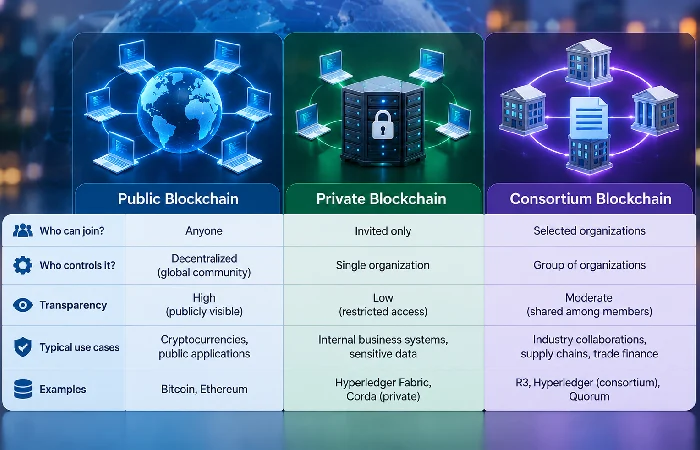
Blockchains split into three access models, not two.
A public chain like Ethereum has no gatekeeper. Anyone can join, anyone can read the ledger. Validating transactions is open too, if you want in on that. The whole design is built around that openness.
Private chains flip the arrangement around: one company controls who gets in, agreement only needs a small known set of validators, and transactions clear considerably faster because of it. There’s no public auditability, but for an internal record that doesn’t matter.
Consortium chains land in the middle. Picture several banks jointly running one shared supply-chain ledger, none of them able to unilaterally control it, all of them vouching for what goes on it.
The real trade-off across all three is speed versus openness, not secure versus insecure. A public health-records network open to researchers everywhere needs the public model. A single hospital tracking internal drug inventory doesn’t — private or consortium fits it better, with none of the throughput penalty.
Blockchain Beyond Crypto: Where It’s Actually Used
Cryptocurrency was blockchain’s first use case. Not its only one. Enterprise applications now track physical goods, verify credentials, and automate contracts without a coin ever changing hands.
Supply chain tracking is the clearest example. A shipment’s origin, temperature logs, and customs status get written to the chain at each checkpoint. No single party can quietly alter that history afterward.
Smart contracts take this further. This is code that executes automatically once agreed conditions are met. Insurance payouts, royalty splits, all of it runs without a middleman processing paperwork.
Healthcare systems are piloting blockchain differently. Patient-consent records. Drug traceability. Here, an unbroken audit trail matters more than raw speed.
None of it needs a public token or a crypto wallet. It’s the ledger structure doing the work. The currency has nothing to do with it.
The Real Benefits and Limits of Blockchain Technology
Tamper resistance without a central authority to trust — that’s blockchain’s core strength. The same design comes with a cost, though. It’s slow to scale. Both hold at the same time, without one erasing the other.
Transactions stay transparent to anyone with permission to view them, and records can’t be quietly edited after the fact — that’s the benefit side. The cost side is scalability: networks that require agreement across thousands of nodes simply process fewer transactions per second than a centralized database can.
Energy use has shifted, though. Bitcoin’s Proof of Work still consumes significant electricity, since miners compete through brute-force computation, but Ethereum took a different route. Its 2022 move to Proof of Stake cut network energy consumption by more than 99.9 percent, because validators get chosen by stake instead of computing power — one change that reshaped the “blockchain is an energy hog” argument for most non-Bitcoin chains.
Regulatory uncertainty is the other lasting limitation. Governments still haven’t settled how to classify digital assets. Enforcement isn’t consistent across borders either. Some enterprises stay cautious about full adoption because of it.
Blockchain FAQs
1. Is blockchain the same as cryptocurrency?
No. Blockchain is the underlying ledger technology. Cryptocurrency is one application built on top of it. A blockchain can run without any coin attached, as private and consortium chains often do.
2. Can a blockchain be hacked?
Individual wallets, exchanges, and smart contracts can be exploited through bugs or stolen keys. Rewriting the ledger itself is a different problem. You’d need over half the network’s validating power at once, a “51% attack.” On any large, established chain, that’s just not realistic, the cost alone rules it out.
3. What’s the difference between blockchain and a regular database?
A regular database has one owner who can edit any record directly. A blockchain has no single owner. Changing a past entry needs network-wide agreement, not just admin access.
4. Who controls a blockchain if no one owns it?
No one entity does. The rules live in the protocol’s code, not with any person or company. Changing them takes broad agreement across the nodes and validators running the network, and that’s part of why upgrades tend to move slowly.
The same idea shows up elsewhere too. Understanding how a distributed ledger stays tamper-resistant is useful background for other emerging technologies, quantum computing especially. It could eventually challenge the cryptography blockchains depend on.
Evaluating blockchain for a specific project? The public-versus-private decision above is the one to settle first. It determines almost every technical choice that follows.