Published: September 9, 2026
Last Updated: September 18, 2026
Ask ten people what “smart factory automation” means and you’ll get ten different answers, ranging from a fully robotic assembly line to a spreadsheet that updates itself. That confusion costs manufacturing leaders time when they’re trying to figure out what to actually invest in. This breaks the salespeak and sets out exactly what intelligent factory automation actually includes, what has been shown to be effective, and where the ‘fully autonomous factory’ rhetoric outruns reality.
Quick Answer is: Smart factory automation is an integration of IIoT, Artificial Intelligence and digital twins but a fully autonomous factory is still rare.
Definition: Smart factory automation is the use of connected sensors, artificial intelligence, and digital twins to power and optimize manufacturing with less human intervention, and is not equated with fully autonomous manufacturing.
What is a smart factory?
A smart factory is a factory that connects machines, software and sensors, sending information back and forth and sharing it in order to run production with minimal manual coordination. It is set up on top of the Industry 4.0 framework but the “smart factory” is only the operational level and not the whole industry 4.0 movement.
The majority of smart factories operate on a four-tiered continuum: data silos, digestible data, predictive analytics, and self-optimizing automation. Very few facilities sit at that top level. That gap matters, it explains why “smart factory” articles online sound a lot more advanced than most actual shop floors. The technology exists; broad deployment doesn’t, yet.
Technologies behind smart factory automation
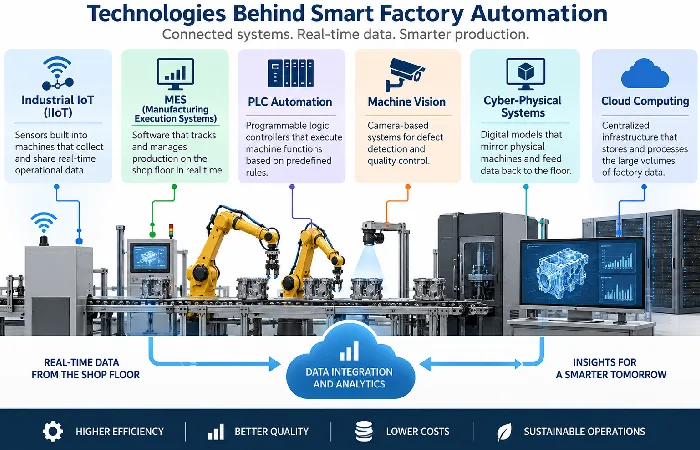
Six things make up the core tech stack for smart factory automation and they work together, you can’t just run one tool by itself and call it done.
- Industrial Internet of Things, IIoT for short, sensors built right into the machines that spit out real-time operational data as things run.
- MES, manufacturing execution systems, is the software keeping tabs on what’s actually happening on the shop floor while it’s happening, not after the fact.
- PLC automation: programmable logic controllers executing the same machine functions sequentially, based on a set of predefined rules.
- Machine vision: camera based systems for inspection purposes such as defect detection and quality control
- Cyber-physical systems: the digital models and software that mirror physical machines and feed data back to the floor
- Cloud computing: centralized infrastructure that stores and processes the data volume smart factories generate
Foundational infrastructure adoption is already ahead of AI adoption specifically: 57% of manufacturers report using cloud computing at scale and 57% use data analytics at scale, while only 46% use industrial IoT at that same scale, according to a 2026 facility-level survey. That sequencing is worth noting before assuming AI comes first: the data foundation has to exist before AI has anything useful to analyze.
AI and machine learning in manufacturing
AI in manufacturing means machine learning models analyzing production data to flag defects, predict failures, and adjust processes without a person manually reviewing every reading, but actual deployment at scale remains limited despite the volume of AI marketing aimed at this sector.
Only 29% of manufacturers surveyed use AI or machine learning at the facility or network level, and just 24% have deployed generative AI at that same scale, while 23% are still piloting AI/ML and 38% are piloting generative AI (NWDDI, 2026).
A second Census Bureau-based review found that 87% of U.S. manufacturers had not yet incorporated AI into their business as of 2026, according to an Automation.com report. On the margins, Agentic AI is already progressing more quickly: the 2026 State of AI in the Enterprise by Deloitte, predicts agentic AI will (roughly) quadruple from 6% to 24% in one year. That’s rapid growth off a small base, not evidence that AI already runs most factories.
Digital twins and predictive maintenance
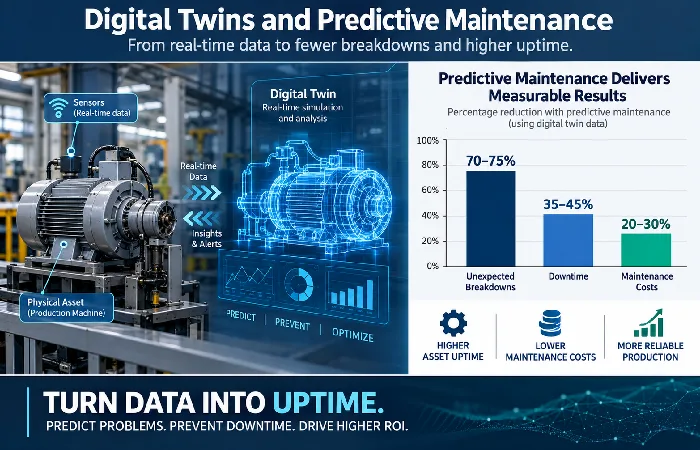
A digital twin is a live virtual model of a physical machine or process that uses real-time sensor data to simulate performance and flag problems before they cause a breakdown, and the payoff is measurable rather than theoretical.
Predictive maintenance built on digital twin data reduces unexpected breakdowns by 70 to 75% and cuts downtime by 35 to 45%, based on aggregated industry research from Mindinventory. Manufacturing holds the largest share of digital twin adoption of any industry, and the segment tied specifically to predictive maintenance represents the largest application category within the digital twin market, ahead of product design and performance monitoring. For a plant running on tight margins, that difference between reactive repairs and scheduled ones is often the clearest, fastest-to-prove ROI case for digital twin investment.
Future of autonomous manufacturing
Fully autonomous, human-free manufacturing is not the near-term default outcome of smart factory automation, despite how often “dark factory” and “lights-out” language gets used in vendor marketing.
A fully autonomous factory is still narrowly focused and intensely managed; certain pharma and semiconductor facilities are often mentioned as the prime, but not the defining, examples. For most manufacturers in 2026, the promising trend is still of more effective collaboration between man and machine, with a steadily smaller but nonetheless vital human presence, while the decimated future of all factory workers depicted by dark-factory labels is not yet the true reality. Any vendor pitch built around literal lights-out manufacturing deserves extra scrutiny, since the more careful industry coverage is actively pushing back on that framing rather than confirming it.
FAQ
1. Is smart factory automation the same as Industry 4.0?
No. Industry 4.0 is the broader industrial movement toward digital connectivity in manufacturing; smart factory automation is the specific application of that movement inside a single facility’s operations.
2. How much does smart factory automation cost to implement?
Costs vary widely by scope, from a single predictive maintenance sensor rollout in the low thousands of dollars to a full MES and digital twin integration running into six or seven figures, depending on facility size and existing infrastructure.
3. Will smart factory automation eliminate manufacturing jobs?
The current pattern is role shift rather than mass elimination. Work moves away from repetitive manual tasks and toward supervising systems, troubleshooting exceptions, and interpreting data, which changes required skills more than it reduces headcount outright.