Published: September 9, 2026
Last Updated: September 9, 2026
Industrial IoT (IIoT) automation is changing how factories run, but most explanations end at definitions and skip the section that is of real concern to the plant manager: the cost of getting it wrong. This page discusses IIoT automation, the architecture, and why the security side is growing faster than most manufacturers can track.
Quick Answer: Industrial IoT automation, put simply, connects sensors and machinery so they can run live, but the catch is that security risk is outpacing most plants’ ability to keep tabs on it.
Definition: Industrial IoT automation is the setup of networked sensors, controllers and edge devices that gather real-time operational data and trigger machine responses on their own, without anyone having to step in.
What is Industrial IoT automation?
Industrial IoT automation, at the core of it, is controls, sensors and machinery wired together so they trade data and act on it without a person there flipping switches. That’s the short of it. Push it a bit further and the Industrial Internet of Things (IIoT) turns out to be one slice of the bigger Internet of Things, the slice made for rough, high-stakes places, factory floors, oil fields, electrical grids, not a living room or a condo.
What makes it different from consumer IoT:
- It has to survive in the most severe conditions of heat, cold, vibration and humidity.
- Downtime is not an inconvenience it could be the end of a production line.
- It puts reliability and real-time control ahead of user comfort.
Cisco, for example, defines IIoT as a network of devices, sensors, applications, and networking equipment, all interconnected and capable of pulling, monitoring and analyzing data within a manufacturing environment. If you would like to see what this looks like in the context of a plant-wide automation strategy, then the industrial automation guide explains the systems layer on top of IIoT.
How do IIoT devices enable automation?
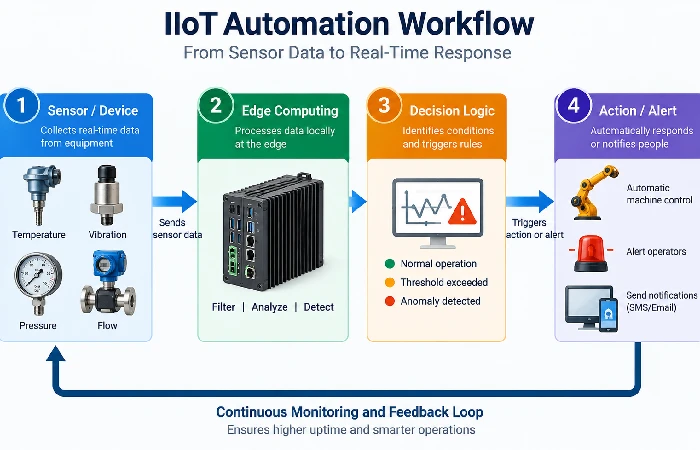
IIoT devices can enable automation that shifts decision-making behavior from someone watching a gauge to an electronic field sensor acting in milliseconds. A temperature sensor on a motor used to just log data. Now it can shut the motor down before it fails.
The core loop looks like this:
- A sensor or PLC (programmable logic controller) collects a reading
- Edge computing processes it locally, close to the machine, instead of waiting on a round trip to the cloud
- The system either acts automatically or flags a human for review
This edge-first approach matters because it cuts the latency that would otherwise slow down time-sensitive processes like robotics or conveyor control. Digi International documents this directly in predictive maintenance deployments, where a radio module feeding data through an industrial router lets a technician catch a failing part before it takes down a mine conveyor or a grain elevator. For a breakdown of how this connects to broader plant-level system design, see industrial automation systems.
What role do sensors and real-time monitoring play?
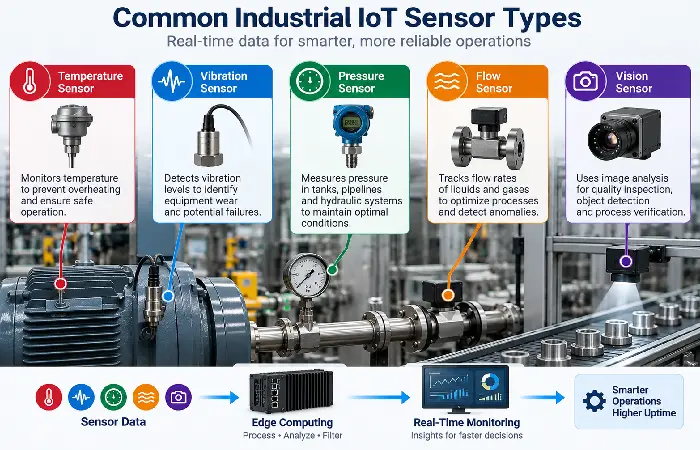
Sensors do the data-gathering part of IIoT automation, real-time monitoring is what actually makes those readings useful to a plant. Without either one, there’s nothing for automation to act on.
Common industrial sensor types include:
- Temperature and vibration sensors on rotating equipment
- Pressure sensors on tanks and pipelines
- Flow sensors on irrigation and processing lines
- Vision systems for automated quality inspection
Real-time monitoring pulls data from these sensors continuously rather than on a fixed schedule, which is the difference between catching a problem as it develops and finding out about it during a scheduled inspection two weeks later. These monitoring layers used to fall entirely to SCADA (supervisory control and data acquisition) systems, and a lot of plants these days just layer IIoT sensors on top of the SCADA infrastructure they already have instead of ripping it out.
What are the benefits of IIoT for manufacturing?
IIoT delivers measurable benefits for manufacturing, and the clearest one is avoided downtime. Unplanned production interruptions cost manufacturers an estimated $50 billion a year, according to figures cited by Toobler, which is the kind of number that makes predictive maintenance budgets easier to approve.
Concrete gains show up in a few specific areas:
- Predictive maintenance catches problems before machines actually break down, so repairs get scheduled ahead of time instead of forced on you.
- Immediate quality control checks a product’s quality while it’s still being made, not after it’s already shipped out.
- Remote monitoring means one technician can check several sites instead of driving to each one.
Siemens has used networked IoT sensors on its electronics production lines to track temperature, pressure, and vibration data and catch quality deviations before they reach a finished product, per Toobler’s reporting. The pattern holds across industries: the value isn’t the sensor itself, it’s catching the problem before it becomes expensive.
What are the security challenges of Industrial IoT?
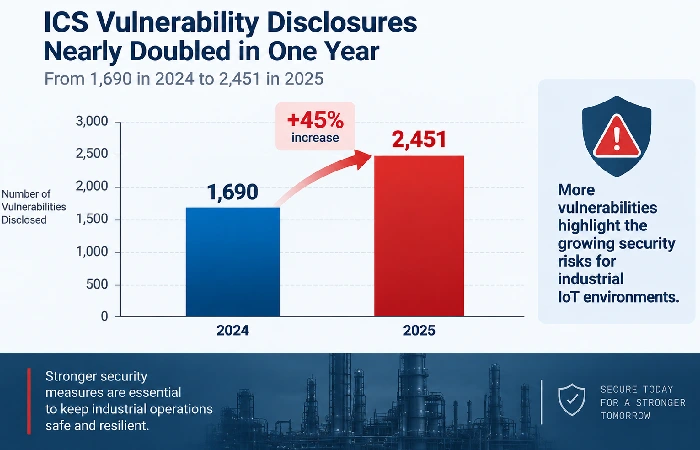
Industrial IoT security is still the weakest link in most automation setups, and the gap keeps getting wider between how fast plants roll this stuff out and how mature their security actually is. ICS vulnerabilities disclosed nearly doubled in just a single year, 1,690 in 2024 jumped to 2,451 in 2025, that’s per Dragos numbers published on StationX.
The current risk picture includes:
- OT (operational technology) ransomware attacks surged 46%, hitting more than 3,300 industrial organizations globally, per Nozomi Networks data cited by StationX
- Only 12.6% of organizations report full visibility across their ICS cyber kill chain, per SANS 2025 research
- Manufacturing and transportation combined account for roughly 40% of IoT malware incidents
This means a manufacturer budgeting for IIoT automation without a matching line item for OT security monitoring is planning against last decade’s threat level, not this one. Segmenting IT and OT networks and building incident response plans that account for physical process manipulation, not just data theft, are the two mitigations security researchers point to most consistently right now. For the broader automation context this security layer sits inside.
Frequently asked questions
1. What’s the difference between IIoT and SCADA?
SCADA’s been the control and monitoring system industrial settings have leaned on for decades now, mostly centralized, mostly built around hardware that doesn’t move much. What IIoT does is throw a wider net of connected sensors and edge devices on top of that, or right alongside it, so real-time data collection can reach further than the old hardware ever could on its own.
2. Is predictive maintenance the same as condition monitoring?
Not quite. Condition monitoring is the ongoing collection of equipment data. Predictive maintenance goes a step further, using that data to forecast when a failure is likely and scheduling repairs before it happens.
3. What industries use Industrial IoT automation most?
Manufacturing, oil and gas, energy and utilities, mining, and logistics use IIoT automation most heavily, largely because equipment downtime in these industries carries an outsized financial and safety cost.
4. How much does Industrial IoT security cost to implement?
Cost of course, is highly dependent on the size of the organization and the baseline infrastructure but the industrial IoT security market as a whole was valued in excess of $22 billion heading into 2026 and this is indicative of how much organizations are willing to spend to fill the visibility gap between IT and OT networks.