Published: September 8, 2026
Last Updated: September 8, 2026
Industrial robots use computerized, sensor-guided technology to perform manufacturing welding, assembly, handling, and inspection with programmable, sensor-guided precision. The installation market for this transition is $16.7 billion worldwide as of January 2026, and manufacturing utilized 542,000 newly installed industrial robots in 2024 alone, more than twice the number ten years prior. This overview explains what industrial robots are; the six main types used in 2026; where in 2026 on the production line they are used; the measurable benefits they deliver; and the new definition of “automation” that is now emerging.
Quick Answer: Welding, assembly, and inspection are handled by industrial robots; with installations valued at $16.7B in 2026.
Definition: Robotics in manufacturing Is defined as “The employment of programmable, sensor-guided industrial robots which are capable of carrying out welding, assembly, material handling and quality control duties with little human assistance.
What are industrial robots?
A robotic arm is a machine, designed to execute physical tasks with precision that exceeds manual labor. They are programmable mechanisms that encompass a mechanical arm along with additional components like actuators, sensors, and a control system that provides instructions to it; instructions which can be either human-provided or produced by AI. The first commercial deployment of an industrial robot was in 1961, when the Unimate was installed in a car factory for the company General Motors; this was a two-ton hydraulic arm.
Modern versions differ from that original design in three key ways:
For a broader view of how these machines fit into plant-wide systems and control architecture, see the industrial automation guide.
Types of manufacturing robots
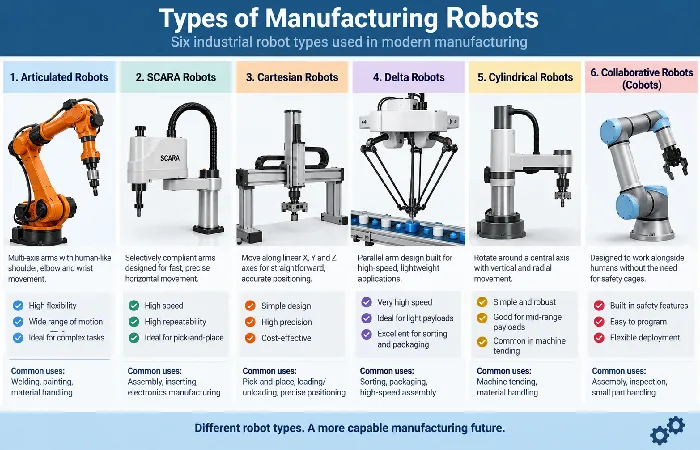
There are six primary robot configurations used in manufacturing today, each suited to a specific range of motion and payload. These types are commonly seen in factories:
- Articulated robots: multi-axis arms operated in a similar manner to a human shoulder-elbow-wrist. These are used for applications such as welding, painting and material handling.
- SCARA robots are selectively compliant and faster for pick-and-place horizontal assembly work.
- Cartesian robots move along linear X-Y-Z axes and get used for straightforward, very accurate positioning and with their spider-like design,
- Delta robots suit high-speed sorting and packaging.
- Cylindrical robots rotate around a central axis and are common in machine tending.
- Collaborative robots, or cobots, work alongside humans without needing a safety cage.
Multi-axis articulated robots anticipated to dominate the product type category with a 49.0% share in 2026, mainly fueled by automotive welding, painting, and material handling applications requiring multi-axis flexibility.
Common robotic automation applications
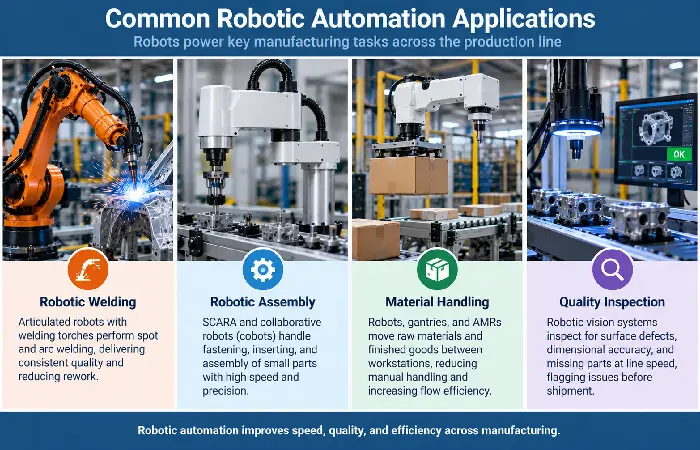
Robots are currently being used to automate four basic manufacturing functions: welding, assembly, handling materials, and inspection of quality. In each case, a different configuration of robot is used, depending on the range of precision and speed that is needed.
- Welding: articulated arms incorporating torches are used for spot and arc welding on automotive lines to ensure quality and consistency that reduces rework.
- Assembly: SCARA and cobot units used for fastening, inserting and assembly of small parts on electronics manufacturing.
- Material handling — AMRs and gantries handle material movement, transporting raw materials and finished goods between workstations without needing dedicated conveyor systems.
- Quality inspection — Machine vision systems scan for surface defects, dimensional inaccuracies, and missing parts at line speed, flagging issues before shipment.
These applications rarely operate in isolation — they connect through networked control layers that coordinate handoffs between stations, a structure covered in more depth in industrial automation systems.
Benefits of robotics in manufacturing
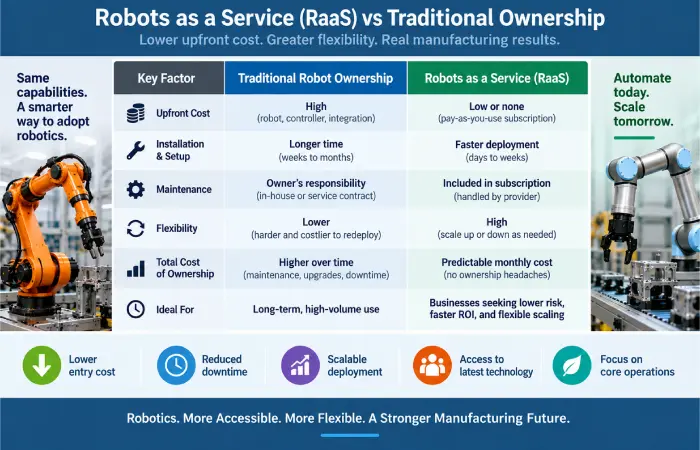
- Robotics delivers three measurable benefits: reduced downtime from human error, lower financial entry barriers, and scalable deployment models. Unplanned downtime tied to human error remains a persistent cost driver in manufacturing environments, and financing structures now exist specifically to lower the barrier to adopting robotics.
- Downtime reduction — automated stations remove variability tied to fatigue-driven manual errors on repetitive tasks.
- Lower entry cost via RaaS — Robots as a Service is a pay-as-you-use subscription-based service model that allows customers to lease robots, providing the benefits of robotics process automation while avoiding ownership headaches such as maintenance issues.
- Adoption density signal — South Korea leads global adopters at 710 robots per 10,000 workers, demonstrating the ceiling for robot density in mature manufacturing economies.
Future of AI-powered industrial robotics
The next phase of industrial robotics centers on AI-driven task learning rather than pre-programmed motion paths. Universal Robots unveiled the UR AI Trainer at GTC 2026, developed in collaboration with Scale AI, marking a shift as robots move from pre-programmed applications to fully AI-driven tasks, according to the Universal Robots and Scale AI announcement.
This shift comes alongside a growth-rate reality check that contradicts “explosive growth” narratives common in older coverage:
- New industrial robot sales have stayed flat at around 500,000 units a year since 2021. Deloitte’s 2026 TMT Predictions don’t expect that number to hit 1 million annually until 2030.
- Installed industrial robots hit a market value of US$16.7 billion as of January 2026, per the International Federation of Robotics.
- Universal Robots alone has moved more than 100,000 cobots worldwide, and that number says a lot, collaborative robots are scaling faster than the old fixed-arm designs ever did.
Frequently asked questions
1. What is the difference between a robot and a cobot?
No safety cage. That’s the first thing that stands out about a cobot, short for collaborative robot. It’s built to work right beside a person, and if it touches someone, force sensors shut it down immediately. Traditional industrial robots don’t work this way at all, they sit inside a fenced-off cell where nobody’s supposed to get close, running faster and handling heavier loads than a cobot ever would, with nothing built in to sense a person walking up. So the trade-off comes down to this: give up some speed and payload, and get safety plus the flexibility to actually share space with human operators.
2. How much does an industrial robot cost?
Cost is per configuration, per financing structure – not a fixed price. The traditional approach to ownership involves an up-front payment for the arm, controller and integration. In a RaaS situation, however, cost is based on use of a subscription model according to Dassault Systèmes which reduces the size of the initial investment by removing the burden of ownership and maintenance;
3. What is Industry 5.0 versus Industry 4.0?
The focus of Industry 4.0 is the connectivity of machines and data with automation, IoT sensors and continuous monitoring. Industry 5.0 further reclaims the role of human-robot interaction, placing emphasis on resilience and sustainability, and not on automation as such – with the end goal of augmenting workers alongside AI-driven systems, rather than replacing them.
4. Will robots replace manufacturing jobs?
Since 2021, annual sales of industrial robots have remained level at around 500,000, according to Deloitte’s 2026 TMT Predictions, which points to slow, task-by-task adoption rather than robots suddenly taking over whole workforces. Most are still stuck doing repetitive duties, welding, inspection, high-error-rate jobs, rather than full-line replacement.
Manufacturers looking at robotics investment shouldn’t jump straight to a purchase. Start by figuring out which line functions have the worst human-error downtime, then get a Robots-as-a-Service quote and stack it against buying outright before committing either way.