Published: July 15, 2026
Last Updated: August 31, 2026
A portable projector can look flawless on a product page and still let you down the first night you use it. The picture’s too dim. Or the battery dies before the credits roll. And sometimes your phone just won’t connect.
Four things matter: native 1080p, real brightness, streaming that works, battery that outlasts half a movie. Nail those and the projector earns its spot in your living room, not a drawer.
What actually matters when you buy
Three things actually decide whether a portable Bluetooth projector earns a spot in your movie nights: real ANSI brightness instead of an inflated “light source lumens” figure, a battery that survives one full film without a top-up, and native 1080p rather than a vague “1080p support” claim. The Anker Nebula Mars 3 and the LG CineBeam Q show the trade-off clearly — the Mars 3 leans into outdoor use with a bigger battery and stronger speakers, while the CineBeam Q chases 4K laser picture but needs a wall outlet. For most backyard nights, the Mars 3 wins; outlets aren’t exactly common under the stars. Building a full movie-night setup? Our guide to entertainment gadgets covers the accessories that pair well with a portable projector.
What is the best portable Bluetooth projector?
Where you’ll actually use it decides which portable Bluetooth projector is “the best” one — there’s no single winner. Wi-Fi, autofocus, native apps, 2.5 hours of real playback: that’s the baseline most people need. Outdoors, brightness and battery beat a slim design every time.
For most buyers, the XGIMI MoGo 4 wins on all-round value. Want it outdoors? The BenQ GS50 does that better — 1080p, 500 ANSI lumens, big speakers, splash protection, all in one unit. Go smaller and you lose brightness; the Anker Nebula Capsule packs down easier but can’t match that light output.
The best portable projectors for movie nights
| Projector |
Best for |
Native resolution |
Battery information |
Main advantage |
| XGIMI MoGo 4 |
General movie use and travel |
1080p |
Up to 2.5 hours of video in Eco Mode |
Google TV and autofocus |
| BenQ GS50 |
Backyard viewing |
1080p |
Up to 150 minutes |
500 ANSI lumens and strong speakers |
| Anker Nebula Capsule |
Small travel setups |
Model-dependent |
Model-dependent |
Compact body |
| Anker Nebula Mars 3 |
Longer outdoor sessions |
1080p |
Check current model details |
Large battery and outdoor design |
Prices and stock need a final check before publication, especially in India. A projector may be listed by several retailers there, but warranty coverage and replacement accessories can vary.
ANSI lumens vs. marketing lumens
Two numbers show up on projector listings, and they’re not measuring the same thing. ANSI lumens are calculated by taking several brightness readings across a projector’s screen at a set distance and averaging them, per BenQ’s own testing methodology. That’s why ANSI is the number worth comparing across brands. “Light source lumens” or plain “lumens” with no ANSI prefix measure raw output before it passes through the lens and optics. 9,000 listed lumens, 200 to 300 actual ANSI once it hits the screen — that’s the gap you’re dealing with.
XGIMI MoGo 4: best all-round portable option
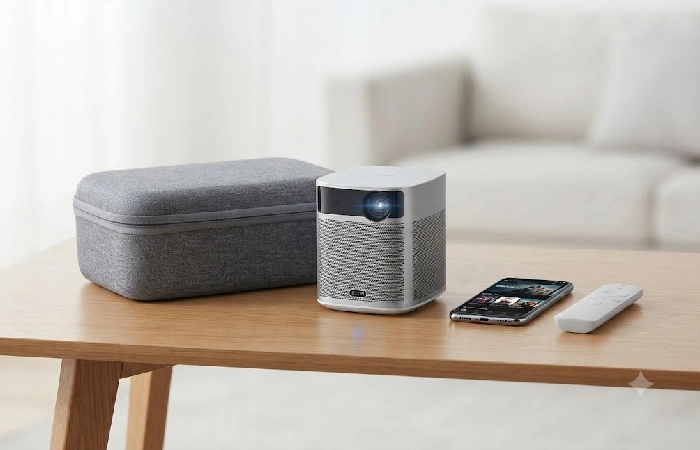
Bedrooms, travel, occasional outdoor use — the MoGo 4 fits all three. Native 1920 × 1080, Google TV, Wi-Fi 5, Bluetooth 5.1, roughly 1.31 kg. Light enough for a weekend trip, not so light it feels like a stripped-down gadget.
Its rated brightness is 450 ISO lumens. Use it in a dark room or wait until an outdoor space is properly shaded. The image will lose contrast quickly under open daylight.
Up to 2.5 hours in Eco Mode — enough for most films, though brightness, volume, and network activity all eat into that number.
Autofocus, automatic keystone correction, Google Cast, a 40-inch to 200-inch image range, two 6W Harman Kardon speakers round it out. Easy enough to carry, though it’s not quite pocket-sized.
Want built-in streaming without extra hardware? The MoGo 4 handles that well. Check the exact streaming apps available in your country before ordering, especially if Netflix is essential. XGIMI’s official specifications provide the current technical details.
BenQ GS50: best rechargeable outdoor movie projector
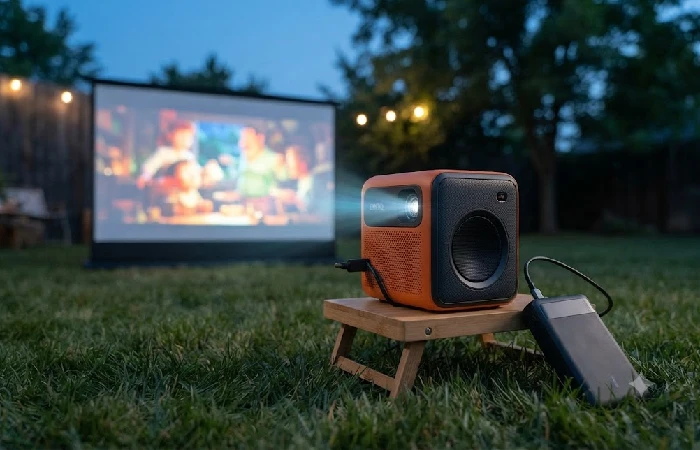
The BenQ GS50 is made for a more demanding setting. Native 1080p, a claimed 500 ANSI lumens, a 2.1-channel speaker system with two 5W midrange drivers and a 10W woofer — that’s the spec sheet.
That speaker setup is useful outdoors. A small projector speaker can sound fine beside your bed, then disappear when several people are sitting in a garden. The GS50 can also work as a Bluetooth speaker, so it remains useful between movie nights.
BenQ lists IPX2 splash protection and resistance to a 2.3-foot drop. Read that carefully. Light splashes, fine. Rain or heavy moisture, no — this isn’t a waterproof unit.
Up to 150 minutes of battery, rated. Enough for many films, though there’s not much spare time. Need more? USB-C power-bank charging works here, as long as the bank delivers 45W at 15V and 3A.
Android TV, AirPlay, Chromecast — all supported. Netflix isn’t, though; BenQ states it’s not natively available on its smart home projectors, so Netflix users may need a compatible external device or another approved playback method. The official BenQ GS50 page confirms the product specifications.
Outdoor sound matters more to you than shaving off grams? The GS50’s the pick.
Anker Nebula Capsule: best pico projector for travel
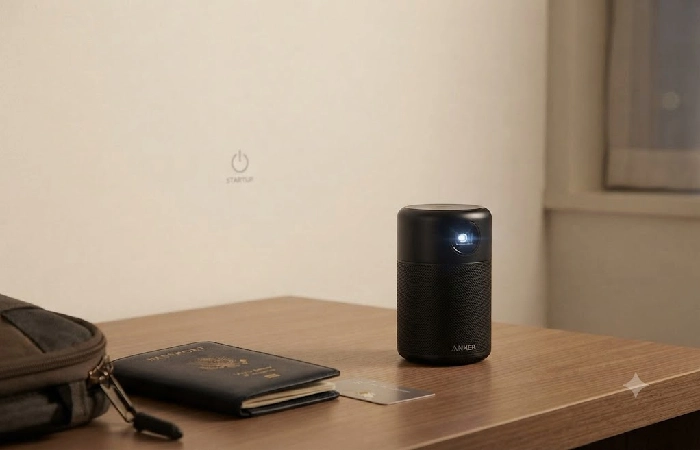
Luggage space tight? The Anker Nebula Capsule range makes sense. Hotel rooms, dorms, small bedrooms, trips where every extra item’s a nuisance — that compact shape handles all of it.
The compromise is brightness. A small projector has less room for a large speaker, cooling system, and battery. That is manageable in a dark room with a modest image. It becomes a problem when you try to fill a large outdoor wall.
Capsule versions differ on native resolution, operating system, battery runtime, brightness, and streaming support. None of it is fixed across the line, so check the exact model before buying.
Accepting a 1080p signal doesn’t mean the projector actually displays a native 1080p image — that’s the part most people get wrong. Look for the native resolution in the technical specifications, not the marketing headline.
Choose a Capsule when you want a pico projector for travel and expect to watch in dark, compact rooms. For outdoor use or longer films, a larger model is safer.
Anker Nebula Mars 3: better for longer outdoor sessions
Want freedom from a wall outlet? That’s who the Nebula Mars 3 is built for. TechRadar calls it an outdoor-focused model — built-in battery, a camping-lamp function, Bluetooth speaker use, and the ability to charge smaller devices along the way.
Bigger than the Capsule, sure, but that extra size earns its keep. Outdoor viewing rewards stronger speakers, more battery capacity, and a brighter image.
The Mars 3 still needs darkness. A projector cannot defeat direct daylight simply because the product page says “outdoor.” Wait until the sky is dark, use a clean surface, and keep the image size reasonable.
This model is worth considering when the projector will spend more time at campsites and patios than in hotel rooms.
Which portable projector works with iPhone and Android?
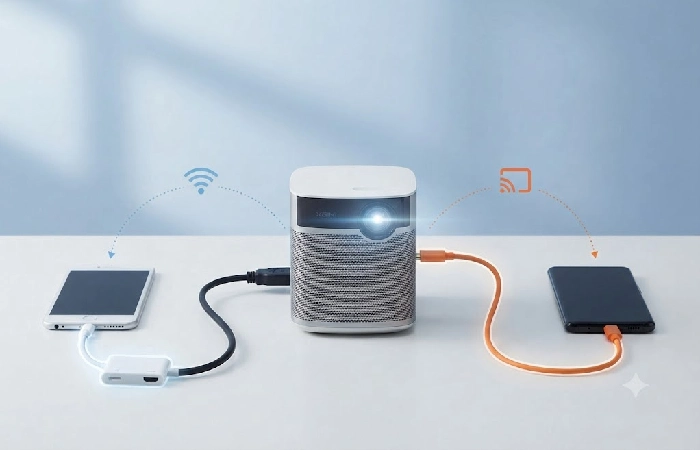
Bluetooth usually handles audio. It does not normally send the video from your phone to the projector.
iPhone: AirPlay or an HDMI adapter. Android: Google Cast, wireless mirroring, USB-C video, or HDMI — which one works depends entirely on the phone and the projector.
Wireless casting also depends on the network. The phone and projector may need to use the same Wi-Fi connection, and some hotel or public networks block device discovery. HDMI is less convenient, but it can be more dependable.
AirPlay and Chromecast on the GS50; Google Cast and DLNA on the MoGo 4. Buying a USB-C cable? Check your phone model first — not every USB-C port actually pushes video.
If your phone is the main source, make connection support a buying requirement. Bluetooth alone does not mean that the projector can mirror your phone screen.
What brightness and resolution do you need?
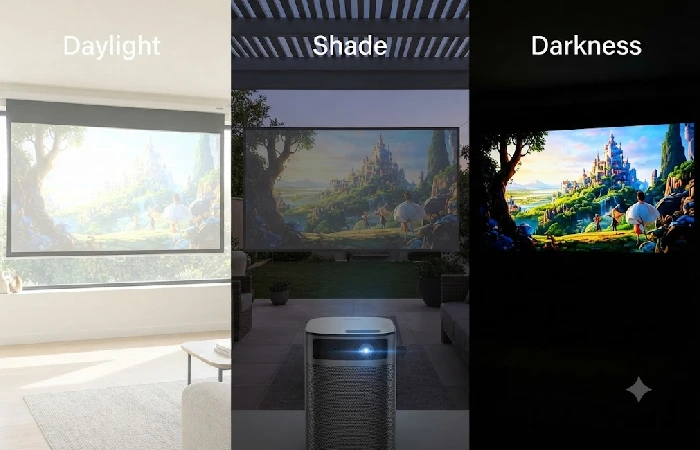
Dark bedroom, modest projector, no problem. Outdoor viewing is less forgiving. A darker room, a suitable surface, enough light to keep faces and shadows visible — that’s the baseline outdoors.
Projector listings often quote big generic lumen numbers that don’t match what you actually see on the wall. ANSI or ISO lumens measure the light that reaches the screen under defined test conditions, so they’re the figures you can compare across models. “9,000 lumens” on the box, a few hundred ANSI once measured — closer to dark-bedroom territory than a big outdoor wall.
Compare ANSI or ISO brightness figures where possible. Vague claims like “10,000 lumens” on low-cost listings? Be cautious — those numbers often can’t be compared directly against measured projector brightness at all.
100 to 200 ANSI lumens, roughly, covers a small dark bedroom with a modest image. Push to 300–500 and slightly larger screens or rooms with minimal ambient light hold up fine. Cross 800–1,000 and outdoor use after sunset with 100-inch images gets realistic, though direct daylight still overpowers most portable units.
Native 1080p helps preserve detail in films. It won’t fix every image problem, though — contrast, color, lens quality, viewing distance, and room light all still affect the result.
The chip itself being 1920 × 1080 is what native 1080p actually means. Accepts a 1080p signal and scales it down — that’s all “supports 1080p” really promises, and you’re not watching true 1080p detail when that’s the case. Which is exactly why a “Full HD” projector can still look soft next to a true native model.
Compact projectors trade image quality for portability more often than not, per RTINGS. That’s the central trade-off. A smaller body helps only when the image remains useful in your room.
Smart streaming features to check before buying
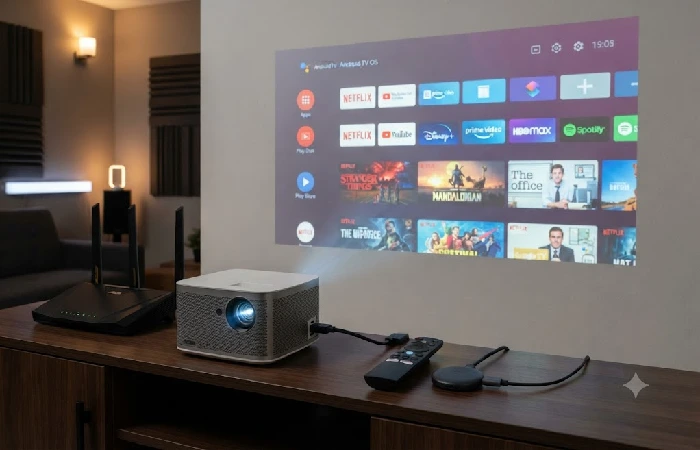
A smart projector can include an operating system and still lack one of the streaming services you use. Netflix is the common example. Some models require an external streaming stick, while others include a certified app.
Check the following before ordering:
- Native Netflix support
- Required streaming apps
- Google TV or Android TV version
- Wi-Fi band support
- HDMI input
- USB playback
- Phone casting method
- Bluetooth speaker or headphone support
“Built-in streaming” is not enough information by itself. Open the manufacturer’s support page and confirm the services available in your region.
For India, also confirm whether the model is officially sold there. A slightly cheaper import may leave you with weaker warranty support, a missing adapter, or difficult replacement parts.
Bluetooth audio lag
Bluetooth audio to an external speaker is not instant, and the codec decides how noticeable the delay becomes. SBC, the default codec on most projectors — 150 to 200 milliseconds behind the picture, roughly, which is exactly why dialogue-heavy scenes make lip-sync issues so obvious. AptX Low Latency does better, around 40 milliseconds, close to unnoticeable for films. Both sides need the same low-latency codec, though; one side stuck on SBC and that’s the connection you’re getting, full stop. Delay too distracting? A wired 3.5mm cable from the projector to a powered speaker is the safest fallback.
Battery life, speakers, and outdoor setup
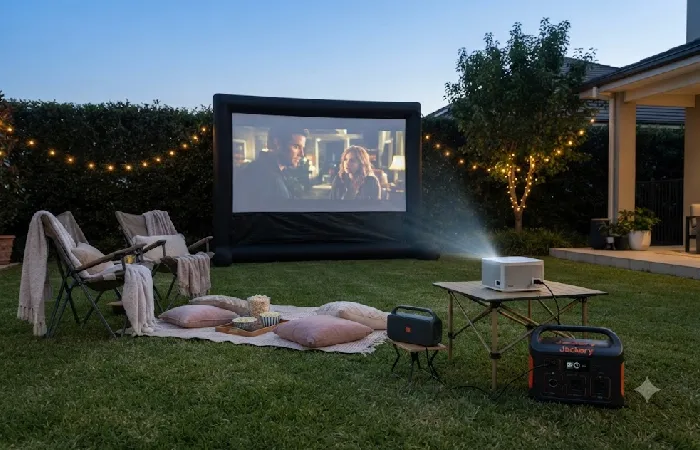
Battery figures usually describe a specific mode. Eco Mode may reduce brightness, while standard or high-brightness viewing consumes more power. Plan around the lower practical figure.
For a two-hour film, look for at least 2.5 hours of claimed video playback. If you want double features, choose a model that accepts a suitable USB-C power bank or keep an outlet nearby.
You do not need a screen. A clean, smooth, light-coloured wall can work well. A proper screen gives you a more even surface, which becomes noticeable as the image gets larger.
And reduce the image size when conditions are poor. A sharp 80-inch image in darkness is more enjoyable than a washed-out 150-inch image.
Which portable Bluetooth projector should you buy?
No other model in this list balances native 1080p, smart features, autofocus, portability, and battery life as well as the XGIMI MoGo 4 does.
Stronger speakers, 500 ANSI lumens, splash protection, USB-C power-bank support: that’s the BenQ GS50’s case for outdoor movies. Priority is a pico projector for travel, mostly dark compact rooms? The Anker Nebula Capsule fits.
Longer outdoor sessions and a bigger battery matter more than keeping things small — go with the Nebula Mars 3. Before buying portable Bluetooth projectors, decide where you’ll use yours most often. Once you know the main viewing location, match it to realistic numbers: at least 300–500 ANSI lumens for dark rooms, closer to 800–1,000 ANSI lumens and a 2.5-hour battery or more for regular outdoor use after sunset.
That answer will tell you whether brightness, battery runtime, streaming support, or size deserves the most attention.
Portable projectors in India: prices and tiers
India’s portable projector market splits into a few practical tiers. Under about ₹15,000, most models from brands like Egate, Portronics, and WZATCO use native 480p or 720p panels even if the listing claims “1080p support,” so pixels become visible once you push much beyond 60 inches. Between roughly ₹25,000 and ₹80,000, you start seeing better‑built units such as XGIMI’s MoGo series and ViewSonic’s M2 line, plus emerging local brands positioned as smart projectors for living rooms and small offices. Above ₹80,000, premium options like LG CineBeam and higher‑end XGIMI models appear more often on Amazon.in and Flipkart, with prices dropping during events such as the Great Indian Festival or Big Billion Days.
Recent market studies estimate the portable projector segment at around $1.9–2.0 billion in 2025, with steady growth projected through the 2030s and Asia‑Pacific as a leading region, which matches the increasing variety now visible on Indian e‑commerce shelves.
Frequently asked questions
1. Can a portable projector connect to an iPhone?
Yes, through AirPlay, a compatible casting method, or an HDMI adapter. Bluetooth usually handles the sound.
2. Can Android phones connect without an HDMI cable?
Often. Google Cast, wireless mirroring, or USB-C video output may work, depending on the phone and projector.
3. Are portable projectors bright enough outdoors?
Portable projectors can work outdoors after sunset or in heavy shade, but they struggle in direct daylight. Even 1,000 ANSI lumens will look washed out against a bright sky, so plan movie nights for darker conditions and keep the image size reasonable.
4. Do all smart projectors support Netflix?
No. Some need an external streaming device or another approved method. Check the manufacturer’s support page first.
5. How long should the battery last?
Look for at least 2.5 hours of claimed video playback if you want to finish most films without recharging.
6. Do you need a projector screen?
No. A clean, smooth, light-coloured wall can work. A screen usually gives you a more even image.
7. Is Bluetooth useful for video?
Bluetooth is mainly useful for audio. Video usually travels through Wi‑Fi casting, HDMI, or USB‑C, while Bluetooth speakers or headphones receive sound — and may add some latency depending on the codec in use.
One thing worth remembering
Resolution gets all the attention. Room conditions get none, and that’s backwards. A 500 ANSI lumen projector in a pitch-dark room will beat a “10,000 lumen” bargain unit sitting on a bright patio, no contest. Nobody puts that on the spec sheet, though, because it’s not a number you can print in bold. Figure out your room before you shop. The right projector follows from that, not the other way around.