Published: July 30, 2026
Last Updated: July 30, 2026
Outdoor motion sensor lights are one of the easiest ways to upgrade the outside of your house, but practically every buying guide out there just tells you which model to buy — not how it actually works, or how to get it back to working order when the neighborhood cat flips it off each night. This guide does both: How it works, what to check before you buy, and how to eliminate the false triggers that frustrate most people into turning them off altogether, in the process. A natural part of a more inclusive smart security setup, they provide automatic presence detection without installing a camera, siren, etc.
“Outdoor motion sensor lights are exterior fixtures that use a passive infrared or dual-technology sensor to detect movement and automatically switch on an LED light, saving energy and improving night time visibility.”
Quick answer: Outdoor motion sensor lights use PIR sensors to light up only on movement, saving energy and improving security awareness.
What are outdoor motion sensor lights?
A motion sensor outdoor light combines a motion detector with an LED that turns on only when it “sees” something. Unlike dusk-to-dawn lights that are constantly on, or switch-operated outdoor fixtures that flicked on manually, a motion sensor outdoor light stays off until it notices that you or something else is there, then it glows for a specified amount of time before reverting to unlit status.
How outdoor motion sensor lights detect movement
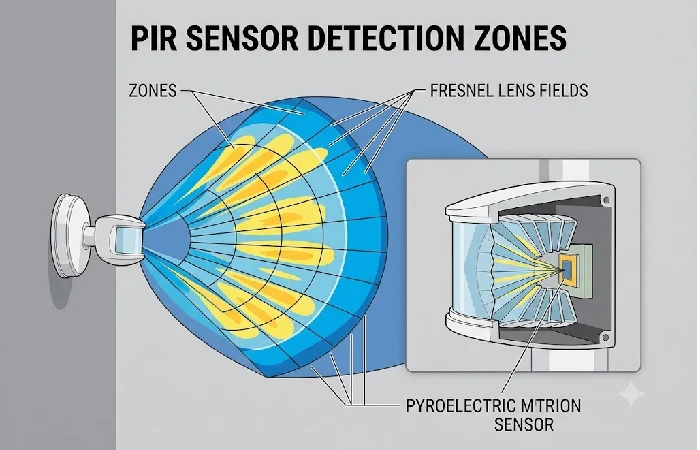
The majority of fixtures for the home use a passive infrared (PIR) sensor. The sensor does not emit a single beam; instead it simply picks up infrared (“heat”) radiation, which given off by all warm things and is sensitive to movement of this “heat signature” across the room. The sensor contained within a housing that separates the sensor‘s field of view into a number of narrow zones; when a heat source crosses into the next zone, the sensor can detect this change and turn on the light.
PIR vs. dual-tech vs. microwave sensors
PIR is the most common in home use as it is quite robust, relatively cheap, and requires no clear line of sight through glass or a thin partition wall. Microwave sensors transmit out a signal and interpret the reflection so it has a much longer range than PIR and can sense movement around a corner. This is perfect for commercial parking lots but usually too sensitive for a home driveway. Fixtures with dualtechnology require both a PIR and another sensor to activate at the same time so that false triggering is minimized but at a much higher cost.
Key features to compare before buying
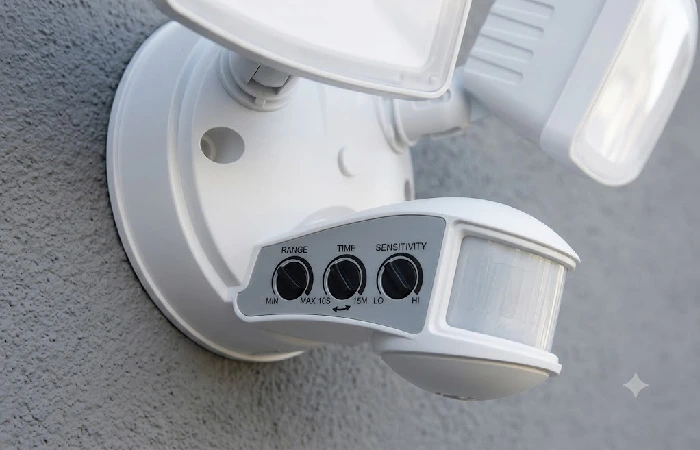
Before you compare products, check these 4 things against the layout of your property:
- Detection range and angle. Entryways and porches in tight spaces are effective with 90–120 light range. Large areas such as open driveways, backyards or side yards respond better with broader angles and greater coverage up to 70 feet.
- Power source — solar, battery, hardwired. Hardwired fixtures provide the most reliable, cohesive light and don‘t need to be refilled, but they depend on having an existing electrical connection. Solar and battery models can install anywhere, though they are less predictable with seasons of less sun or high cold.
- Lumens and brightness requirements. About a thousand seven hundred lumens sounds like a reasonable initial estimate for the brightness requirements for an entrance, a thousand five hundred to two thousand for a driveway, and two thousand to three thousand for a fairly large backyard, but requirement depends heavily on mounting height and existing ambient light.
- Weatherproof (IP rating). IP44 minimum if located under a shelter, IP65 or above if subject to direct rain, snow or saline atmosphere.
How to install and adjust your motion sensor light
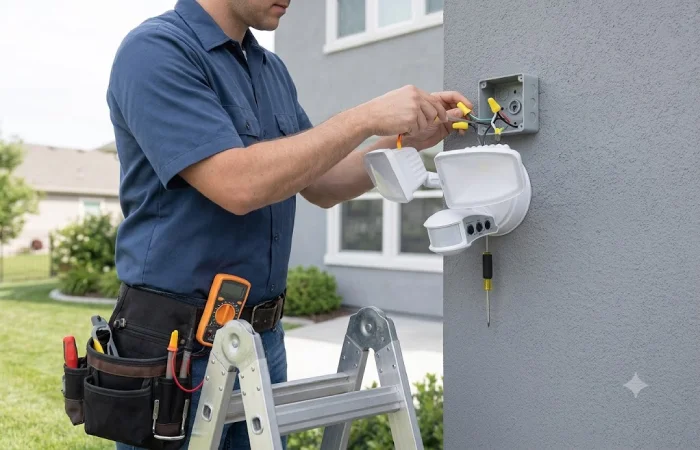
Getting a fixture to work well has less to do with the model you purchase than it does with the way it‘s mounted and dialed in.
- Mounting height and aim. The majority of PIR sensors are most effective when installed at a height from 6 to 10ft, and set on an angle pointing downward so that the projected detection areas extend along the course a pedestrian or vehicle expected to travel, and not out toward the horizon (to detect passing vehicles or overhanging foliage).
- Adjust sensitivity, range, and timer. Initially, turn the range or sensitivity dial all the way up and then use the installed fixture‘s test function, to circle the area you wish illuminated, before decreasing range dial until the trigger zone only encompasses your property and not the road or street. And finally, independently set the timer, which may be adjustable from just seconds to 15 minutes shorter saves more energy but longer is perfect for the front door with extended lighting needs. Combining a motion sensor with an LED light fixture further increases those savings, since sensor operation lowers running time on both the sensor and LED.
Fixing common problems (false triggers, blind spots)
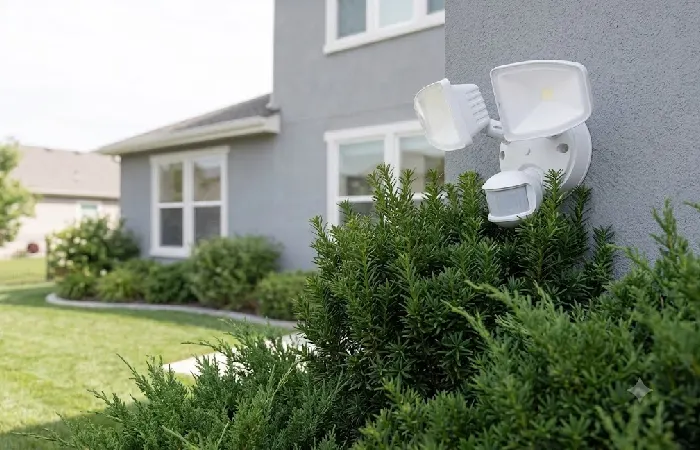
A light that comes on every few minutes overnight, however, is almost certainly due to an excessively large or misaligned detection area, rather than a malfunctioning sensor. If neighbors, cars, or blowing leaves are activating the light, check the sensor‘s aim pointing it downward and across a target area, rather than outward toward open space or a roadway will often eliminate the problem without having to alter the sensor‘s sensitivity. If small wildlife are still setting the light off, a slight decrease in sensitivity and raising the height of the sensor might do the trick: it will cause the detection field to hit above the animals rather than across the ground. Dead zones, however, often caused by something blocking the sensor‘s view prune back out of the field of view shrubs or branches that protrude in front of the sensor, because obscuring even part of the vision will create a dead spot where the light won‘t trigger.
Solar vs. hardwired: which is right for your property?
Hardwired fixtures are especially useful in locations where the same high-lumen levels desired night after night for many years to come. These are the front door, the back porch, the driveway, the garage – any place where uniform brightness is critical year-round. Hardwired fixtures are generally more expensive initially, but make up for it in cheap, commercial-grade longevity and reliable performance over time. A step down in brightness, but all other benefits of hardwired fixtures, are solar-powered. These will accept fairly high levels of lumens and are excellent choices for relatively small, easy-to-access locations like a shed or side yard where adding additional wiring would not be cost effective. Finally, battery-powered flood lights will not require costly wiring, but new batteries need to bought or the existing batteries will need to recharge.
Second is to honestly temper expectations about what extra lighting provides security-wise. Based on studies summarized by the National Institute of Justice, outdoor lighting only rated ” Promising” as a means of preventing property crime, and “Ineffective” at preventing violent crime a more measured conclusion than the often-repeated (by buying guides, at least) claim that “lights scare off intruders”. That obviously doesn‘t make motion lighting a waste; it just means you can expect an increased sense of awareness and better sightlines around your property, rather than expecting lights to keep anyone out.
FAQ
1. Do motion sensor lights work in daylight?
Many outdoor motion sensors use a built-in photocell that keeps the fixture off during daylight hours even if the sensor detects motion. This dusk-to-dawn operation saves energy and eliminates false triggerings when light isn‘t required, although a few fixtures allow you to override the photocell for daytime testing.
2. How many lumens do I need for outdoor security lighting?
Lumen requirements are based on area and mounting height rather than a static number. As an initial baseline, entranceways require between 500–700 lumens, driveways between 1,500–2,000, and large open backyards between 2,000–3,000; brighter fixtures usually also have wide detection angles to cover broader areas more uniformly.
3. Can pets trigger motion sensor lights?
Yes- a PIR detects any moving source of heat, not only people. Animals such as cats and dogs as well as native species or birds also detected. Their detection zone can normally reduced by turning sensitivity down, raising the PIR higher or tilting it back from staring at ground level.
4. What‘s the best detection range and angle for outdoor motion sensor lights?
But essentially there‘s not a one-size-fits-all setting, it all depends on the space. Tighter entryways and porches do better with a narrower 90–120 degree angle with 20–30 feet of range, while open driveways or backyards will prefer wider angles of up to 180 degrees, with ranges up to 70 feet, scaled back as you set up so you don‘t “grab” the street or sidewalk.