Published: August 2, 2026
Last Updated: August 24, 2026
Amazon Alexa, Google Home and Apple HomeKit no longer compete on speaker price alone.
In the past 12 months all three replaced rule based assistants with generative AI. Alexa+ went to GA in the US and Canada in February 2026, Google launched Gemini for Home in October 2025 and Siri announced Apple Intelligence, all paid.
This turns the buying question from “which speaker” to “which ecosystem”, the latter taking into account subscription, device coverage and privacy.
That sets each out on how they compare on device coverage, voice quality and total cost of ownership. It also sets out a recommendation framework specific for each household type.
Definition: In the 2026 Alexa versus Google Home versus Apple HomeKit debate, no one AI assistant dominates, with Amazon tracking ahead on supported devices, Google on natural language, and Apple on privacy and control on the device itself.
Quick Answer:
- Amazon Alexa: for the most device options (over 140,000 supported devices) and the least starting price (Echo Pop from around $28).
- Google Home this one is attempting to be the most natural conversational AI (Gemini for Home launched 1 st October 2025)
- Apple HomeKit- opt in for a mainly privacy-oriented and locally managed system (HomePod mini $129) if dedicated to the Apple world.
- Matter (850+ conformant products) also allows all new devices to support all three, thus greatly reducing ecosystem lock-in compared to before 2024.
What is the best smart home ecosystem in 2026?
No one wins outright in 2026. Amazon Alexa still leads on device compatibility, with 140,000+ supported products. Google Home does conversational AI best.
Apple HomeKit takes privacy and local control. Why the shift this year — all three pushed their real intelligence behind a paywall, with generative AI tiers you now pay extra for, and that means subscription cost is finally part of the decision, not an afterthought.
Testers score the platforms on five things now: compatibility, voice intelligence, privacy, automation, interoperability.
Apple comes out on top overall, 7.9/10. Alexa and Google are tied right behind it at 7.5 (Security.org, security.org/smart-home/best/). Below, we break those scores down by household type.
Why choose Amazon Alexa for your smart home?
Choose Amazon Alexa if a massive device ecosystem is what you need at the lowest entry price. It supports 140,000+ third-party devices, and an Echo Pop costs about $28, per CNET.
The core power of Alexa is its wide reach: more locks, lights, plugs and cameras are compatible with it than anything else, and its routines respond to triggers from sensors such as light levels, temperature, and your location.
And in February 2026 Amazon launched Alexa+, a generative-AI assistant based on Amazon Bedrock models now offered nearly everywhere in the US and Canada for $19.99/month, or free for Prime members paying $139/year, Amazon announced.
The cost is privacy and interface: voice is routed to the cloud, Amazon axed the local-only Do Not Send Voice Recordings button, and Echo Show screens include native ads.
What makes Google Home the conversational AI choice?
Google’s the one to get if you want conversations that actually feel natural. Legacy Assistant got swapped out for Gemini for Home back on October 1, 2025 — “Ask Home” lets you talk to it in plain language, there’s ten new voices now, and it can handle exceptions like “turn off all the lights except the office.” The app itself is the most visual of the three, and on displays like the Nest Hub Max (around $229) you get Chromecast and YouTube built right in.
Gemini for Home doesn’t cost anything extra on hardware you already own. But if you want Gemini Live, the daily Home Brief video summaries, or deep video-history search, that’s Google Home Premium territory — $10 a month, per Google’s own support docs. Where it falls short is hardware. Nest speakers just haven’t been refreshed as often as Amazon’s Echo line these past couple years.
Why is Apple HomeKit the privacy standard?
If privacy and local processing beat device diversity, buy Apple HomeKit with commands processed locally by a HomePod or Apple TV hub instead of the Cloud, and end-to-end encryption of the HomeKit Secure Video camera streams; $0.99/mo (50 GB) tiered storage is included with your iCloud+ plan, per Apple Support.
Concurrently, their exclusive strict HomeKit Accessory Protocol (MFi) certification keeps their near 1000+ certified products far below Alexa’s 140,000+ per Apple, each tested against their hardware-security platform.
Hardware costs are premium: HomePod mini is $129 and the second generation $349 (Apple). With Apple Intelligence, Siri can deliver meaningful video search and event recaps using natural language.
Alexa vs Google Home vs HomeKit: which is better?
Really it comes down to which two things matter most to you. Want the most device options? Amazon’s your pick. Care more about how natural the conversation feels? Go Google.
Privacy the deal-breaker? Apple, no contest. The matrix below breaks down verdicts by use case — figures cross-checked against solid sources as of February 2026.
| Ecosystem |
Best for (Conclusion) |
Hardware & subscription cost |
Device compatibility |
Voice & AI ability |
Privacy posture |
| Amazon Alexa / Echo |
Dual-brand households and value customers looking for the broadest device variety at the lowest entry price |
Echo Pop from around $28 to Echo Studio about $220; Alexa+ $19.99/month as standalone or free with Prime at $139/year |
Over 140,000 third-party devices and skills that can work together, the largest of the 3 |
Alexa+ generative AI (Bedrock-based) Available in U.S./Canada February 2026 routines respond to sensors of light, temp., and location |
Cloud-processed voice Amazon has deprecated the local-only “Do Not Send Voice Recordings” toggle; screen of Echo Show may display native ads |
| Google Home / Gemini |
Android users and buyers who want natural conversational AI and smart-display video control. |
Nest Hub Max about $229; Gemini for Home free on existing hardware, additional features (Gemini Live, Home Brief, video history search) through Google Home Premium at $10/month |
Available to over 50,000+ supported devices; native control for Chromecast and YouTube on smart screens |
Gemini for Home (3-OCT-2025) with “Ask Home” natural-language instructions + ten new voices; about 93% response precision to difficult prompts in tests in 2026 |
Cloud reliant for the Gemini intelligence; Home Brief and AI video features available on Paid Premium tier. |
| Apple HomeKit / Apple Home |
Existing users and households that are already part of Apple (iPhone, Apple TV, HomePod) and want private experiences; |
HomePod mini $129; HomePod (2nd generation) $349; HomeKit Secure Video (included in iCloud+ from $0.99/month with 50 GB) |
Over 1,000+ MFi-certified products (strict to The HomeKit Accessory Protocol certification), but Matter brings about 850+ cross-platform certified products |
Siri with Apple Intelligence; on device processing, natural-language video search, HomeKit Secure Video event recaps. |
Best in class: local processing on a HomePod/Apple TV hub, end-to-end encryption for cameras and commands, no ad model |
How does Matter change the comparison?
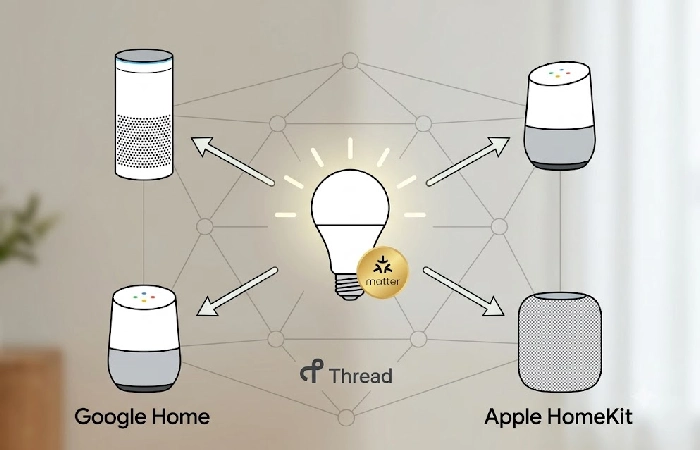
Matter another remote interoperability standard, operated by the Connectivity Standards Alliance guarantees that any device meeting its standards will be compatible across all 3 ecosystems.
Now there have been over 850 Matter approved devices.
Thread border routers built into HomePods, Echo devices and Nest Hubs operate those devices without requiring an additional box. This reduces vendor lock-in.
Any Matter enabled light switch can now hop on whatever platform is most appropriate for it. This is even if it hasn’t got any other smart functionality yet.
While not all device types are covered yet, some cameras and doorbells are still understandably found to be wedded to their platform’s own protocols. But the validation lists for devices are still useful in those cases. Read our full guide to smart home hubs and voice assistants for more details.
Which assistant understands you best?
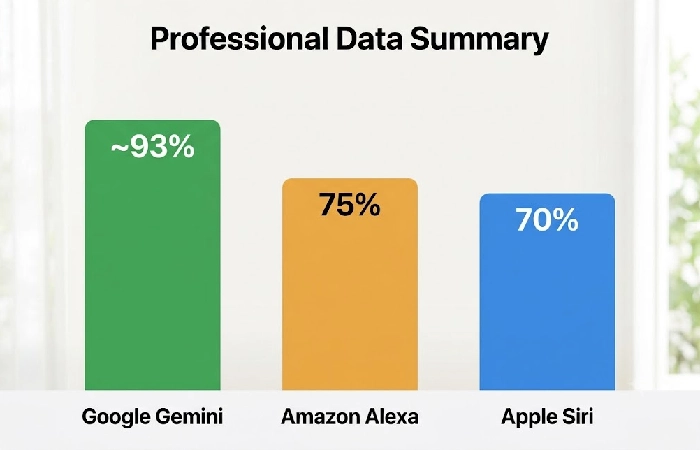
Google (now Gemini) has achieved the highest number of correct responses in published voice-IQ tests, and has begun broadening the scope of questions.
Voice-IQ testing by Security.org in 2026 revealed Google/Gemini correctly addressed about 93% of complex prompts, outperforming Alexa and Siri. Previous assistant assessments by Loup Ventures and Stone Temple also revealed Google to be at around 90+% accuracy.
The 2026 caveat: In Alexa+ and Apple Intelligence, multi-step context now managed more efficiently than by the rule-based assistants of 2024 and therefore accuracy gaps in performance are diminishing, and judged by task completion becoming more relevant than quiz right or wrong.
How much does a smart home voice assistant cost in 2026?
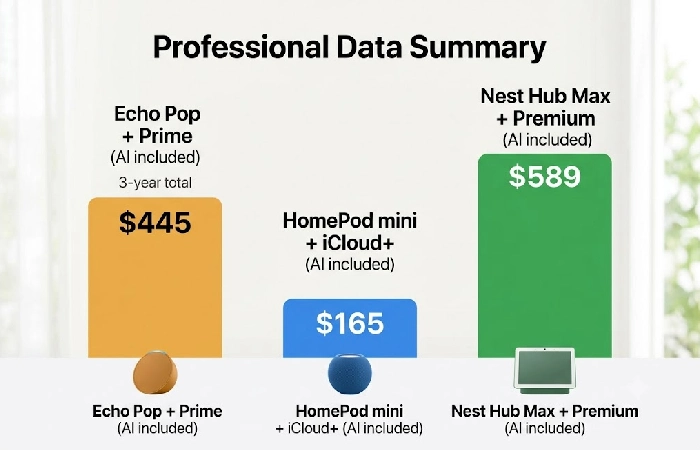
For a relatively low-cost speaker, we are talking about $28, while the premium AI has been getting more expensive. According to Amazon, Alexa+ costs $19.99/month or is free with a Prime account (which costs $139/year),
Google Home costs an additional $10/month, there is no monthly fee for Siri and HomeKit Secure Video included in iCloud+ ($0.99/month for 50 GB, according to Apple Support).
So the total cost of ownership (cost to purchase one speaker and one subscription tier with no accessories) would be approximately $445 for an Echo Pop with Prime.
It would be $165 for a HomePod mini with iCloud+, or $589 for a Nest Hub Max with Google Home Premium. These figures are based on their list prices and subscription fees above (as of February 2026).
Which ecosystem should you choose?
Choose Alexa for a mixed brand household on a budget, Google for a natural conversation and Android first household. Or choose Apple for privacy inside an iPhone house.
Follow this three-step decision. (1) Make a list of products you already own; if they are mostly Matter certified, the lock-in risk is much diminished. (2) Prepare a three-year budget, including subscriptions, not just the price of the speaker.
(3) Prioritize compatibility, conversation, and privacy in your own order of importance. Then select the platform that rates highest on your top two choices.
If you are still trying to decide between hubs and protocols, the “smart home hubs and voice assistants” section discusses the category in detail.
FAQ
1. Can Alexa work with Apple HomeKit?
There is no native integration: any device that is HomeKit only cannot be led by Alexa. If the accessory known to Matter, you will be able to connect it to both Alexa and Apple Home. This is because it is the common language (Connectivity Standards Alliance, cited above).
2. Is Alexa or Google Assistant smarter?
In published tests, Google has been answering questions correctly by 90%+ and more compared to Alexa and Siri. (See Security.org, cited above.) Google and Amazon leapfrogged into large-language-model assistants in 2025 with Gemini for Home and Alexa+. So the practical gap on day-to-day commands is likewise narrowing.
3. Which ecosystem is best for privacy?
Apple HomeKit. Commands run locally on the HomePod or Apple TV hub, and end-to-end encryption of HomeKit Secure Video; both Alexa and Google process voice in the cloud. If local control is your goal, the first thing to do is consider whether your existing devices Matter certified. That’s the quickest way to a privacy-conscious setup.