Published: September 1, 2026
Last Updated: September 1, 2026
Most teams asking “BPM or automation?” are actually asking the wrong question. Business process management and automation aren’t rival choices — automation is one tool inside BPM’s broader toolkit, and confusing the two leads teams to either over-build a governance system for a task that needed a five-minute fix, or under-govern a cross-department process that badly needed one.
Quick Answer: ‘BPM is the strategic discipline that governs how processes run; automation is one tactic within that discipline.
Definition: “Business process management is the strategic discipline that controls how work flows through an enterprise, and automation is the tactical execution layer within it.”
BPM vs BPA at a glance
BPM and BPA differ along five measurable parameters: what BPM/BPA does, how cost savings materialize, how extensive the scope is, whether one requires the other, and when each is the best decision. The table below zeroes in on each parameter so that your context can be rated against it before one reads the detailed section:
| Dimension |
Business Process Management (BPM) |
Business Process Automation (BPA) |
| Core function |
Governs the full process lifecycle — identification, design, implementation, monitoring, improvement — as a continuous cycle |
Applies technology to execute specific, repetitive tasks without redesigning the underlying process |
| Typical cost impact |
Not directly cost-measured; shows up as reduced process drift and audit risk over multi-quarter cycles |
Reported cost savings of 20% to 50% on automated processes, per IBM research cited by BMC |
| Scope |
Enterprise-wide, cross-departmental, spans multiple systems and teams |
Task- or function-level — sales order processing, payroll, debt collections |
| Relationship |
Can run without automation — a BPM initiative may redesign a process using only people and policy |
Runs as a subset of BPM’s toolkit; can operate standalone but lacks governance oversight alone |
| Right call when |
Process spans 3+ departments or systems, or needs a regulatory audit trail |
A single, linear, repeatable task needs speed and consistency, not a governance overhaul |
Methodology: verdicts synthesize publicly available information and third-party sources on business process management and automation, resolving discrepancies toward the interpretation most consistent with primary documentation.
What is business process management?
Business process management (BPM) is the discipline that identifies, designs, implements, monitors, and continuously improves how work moves through an organization. It’s not a single tool — it’s a governance cycle. According to peer-reviewed process-change research published via NIH/PMC, BPM spans process identification, discovery, analysis, design, implementation, and monitoring as a repeating loop, not a one-time project.
This matters because BPM treats a process the way a company treats a physical asset: something documented, measured, and improved over time. A retail company using BPM might map how an order moves from purchase to warehouse dispatch to delivery, then redesign that path when it finds delays — introducing automation only where it makes sense, not by default.
- Covers the full process lifecycle, not just execution
- Operates across departments and systems, not one team
- Can exist without any automation at all — governance and redesign come first
What is business process automation?
Business process automation (BPA) applies technology to execute specific, repetitive tasks — it does not redesign the process itself. Gartner defines BPA as the automation of complex business processes and functions beyond conventional data manipulation and record-keeping, typically through advanced technologies like robotic process automation (RPA) or rules engines.
Red Hat frames it more simply: BPA extends existing IT systems to automate processes tailored to an organization’s specific needs. In practice, that means routing sales orders, processing HR payroll, or handling debt collections without a human touching every step.
- Targets a specific, recurring task rather than an end-to-end process
- Delivers measurable cost reduction — IBM-sourced research puts savings between 20% and 50% on automated processes
- Can run as a standalone project or inside a larger digital transformation effort
BPM vs BPA: key differences
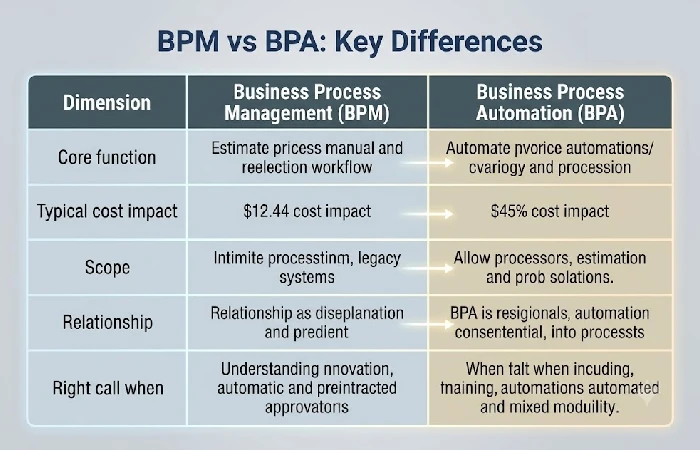
It’s not complexity that separates them, it’s scope: BPM asks the should and why across the whole enterprise, while BPA just handles the how inside one task. Mixing them up is just to govern a task that never needed governing, or to automate a process without doing your due diligence first.
- Governance vs. execution: BPM sets policy and ownership across teams; BPA runs a defined task inside a system
- Change scope: BPM can redesign or eliminate a process entirely; BPA speeds up the process as it already exists
- Audit trail: BPM tracks compliance and performance across the full lifecycle; BPA logs task completion only
- Standalone viability: BPA can run alone on a single task; BPM rarely operates without touching multiple teams and systems
Treating this as an either/or choice is the most common mistake in the BPM vs Business Process Automation comparison space — most organizations that scale past a handful of automated tasks eventually need BPM’s governance layer to keep those automations aligned with actual business goals.
How BPM and automation work together
BPM and automation work together as a hierarchy, not a partnership of equals: BPM sets the direction and validates that a process is worth running, while automation executes it at scale. Skipping the BPM step and automating first is where most programs go wrong — teams report efficiency gains on a process nobody confirmed was the right one to run.
This sequencing avoids a specific failure mode: automation without BPM oversight can make a broken process run faster, producing a dashboard that looks healthy while the business outcome misses the mark entirely. BPM answers “should this process exist in its current form?” before automation answers “how do we run it without manual effort?”
- BPM identifies and validates which processes are worth automating
- Automation then executes the validated process consistently and at speed
- Feedback from automated task performance flows back into BPM’s monitoring stage, closing the loop
When businesses should use BPM or BPA
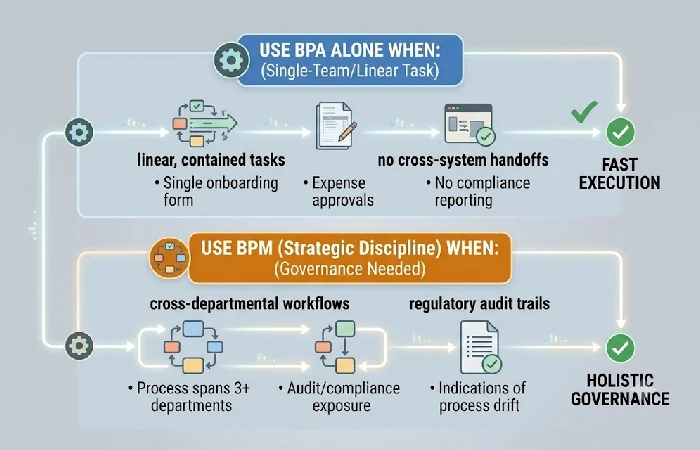
Use BPA alone when a task is linear, contained to one team, and doesn’t touch multiple systems — think expense approvals or a single onboarding form. Use BPM when a process crosses three or more departments, needs a regulatory audit trail, or has drifted from its documented design without anyone noticing.
A practical threshold: if fixing a bottleneck requires changing how more than one team hands off work, or if an auditor would need to see who did what and when across systems, BPA alone won’t cover it — the process needs BPM’s governance layer around whatever automation gets deployed inside it.
- Use BPA alone: single-team task, no cross-system handoff, no compliance reporting requirement
- Use BPM (with or without automation inside it): cross-departmental workflow, audit/compliance exposure, or indications of process drift from the documented design.
Frequently asked questions
1. Is BPM the same as automation?
No. BPM is a governance discipline that controls how a process is designed, executed and optimized. Automation is one engine that can function within BPM, or on its own, for a single task.
2. What’s the difference between BPM and RPA?
Robotic process automation (RPA) is a type of automation technology – software robots that simulate human, rules-based, manual work. BPM is the broader lifecycle discipline that can incorporate RPA as one of several tools alongside workflow engines and business rules engines.
3. Is workflow automation the same as BPA?
They overlap heavily but aren’t identical terms. Workflow automation typically refers to routing tasks and approvals within a defined sequence, while BPA is the wider category that includes workflow automation plus other automated execution methods like RPA and system-to-system data handoffs.