Published: September 10, 2026
Last Updated: September 10, 2026
Most introductions to machine learning shove definitions at you rather than leading you through them. This one does the latter by way of a single thread, a model learning to sort loan applications, walking through what machine learning really is, the distinctions among the three fundamental learning types, and its presence in everyday life.
Quick Answer: Machine learning doesn’t run on fixed instructions. It runs on algorithms that improve through experience. The result: computers that spot patterns in data and get better at a task the more they see.
Definition: Machine learning is a technique. A computer uses it to find structure in data and make predictions from that structure. Nobody hands it a rulebook. The programmer never writes out the exact pattern the computer’s supposed to learn.
Standalone data matrix: the three core learning types
| Learning type |
Data requirement |
Concrete example |
What it’s used for |
| Supervised learning |
Labeled data, each input paired with a known correct output |
A model trained on thousands of labeled X-ray images to flag which ones show a specific condition |
Prediction tasks where the correct answer is already known for past cases, like loan default risk or spam detection |
| Unsupervised learning |
Unlabeled data with no predefined outcome |
Grouping e-commerce customers into segments like frequent shoppers or luxury spenders based on purchase behavior, with no labels supplied in advance |
Finding hidden structure or groupings in data nobody has categorized yet |
| Reinforcement learning |
No labeled or unlabeled dataset, an agent learns from reward and penalty signals in an environment |
Training an agent to play a game like chess or Go through repeated trial and error |
Decision-making tasks where the model improves through direct interaction and feedback rather than a fixed dataset |
What is machine learning and how does it work?
Machine learning sits inside computer science. Specifically, the corner of it focused on algorithms that let computers learn without being told exactly how. The algorithm builds a model. That model comes from sample data, usually called training data. From there, it makes predictions or decisions on its own. Nobody explicitly programs it for the specific task.
For example, take a bank deciding whether to grant someone a loan. If you wanted to use a traditional program, you’d have to have a programmer manually create rules like reject if credit score below 600. However if you used a machine learning program, it takes thousands of previous applicants, each one tagged with whether they defaulted or not, and from that it learns itself which combination of income, credit and debt levels predicts default. As GeeksforGeeks put it, this is what differentiates supervised learning from programmatic rule following:
- The system needs training data, not instructions
- It builds a model that maps inputs (income, credit score) to an output (approve or reject)
- Accuracy improves as more examples are added, though returns level off past a certain dataset size
Supervised vs unsupervised vs reinforcement learning
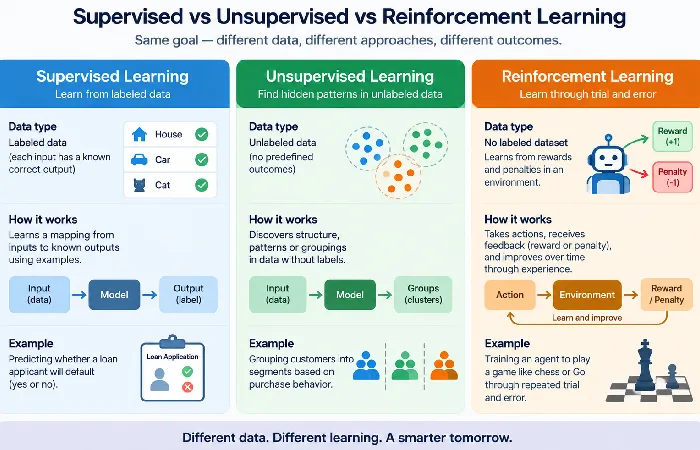
Supervised learning relies on pre-existing labeled data, unsupervised on finding regularities within unlabelled data and reinforcement on learning from rewards and penalties rather than a predefined dataset. These are all addressing the same general problem: how should the model respond to new data it has not seen?
Back to the loan case, a supervised model would learn from a training set of applications which have already been registered as “approved” or “defaulted”. An unsupervised model takes the same training set but without the labels at all, and maps the potential applicants to a number of clusters, say, low-risk professionals versus high-spending young borrowers, without ever being told which group defaults more. GeeksforGeeks has it that labeled vs unlabeled data is the fundamental difference. Reinforcement learning works differently again:
NVIDIA’s engineering blog explains that a reinforcement learning agent receives a reward signal for good decisions and a penalty for bad ones, and adjusts its behavior over repeated attempts, the same mechanism used to train an agent to play chess through trial and error rather than labeled examples.
- Supervised: learns from an answer key
- Unsupervised: finds its own groupings with no answer key
- Reinforcement: learns from a reward score over repeated attempts
For a deeper breakdown of where machine learning fits inside the broader field, see types of artificial intelligence.
How does a machine learning model learn from data?
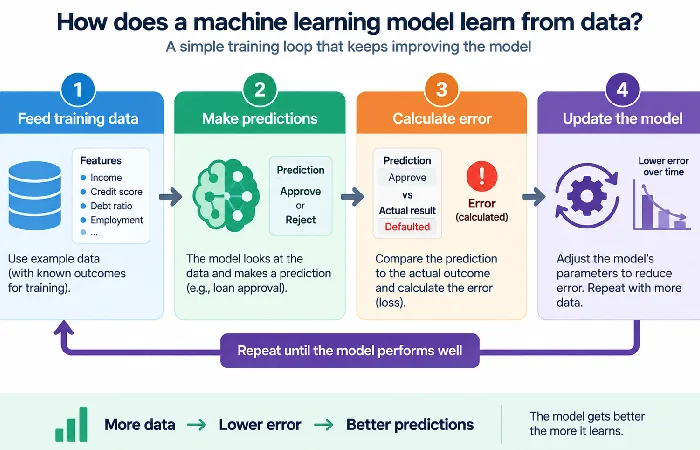
The model makes a prediction, compares it with the actual result, adjusts itself accordingly to minimize the difference, then repeats this process thousands of times. This process is called training. In truth, it doesn’t matter which method of training the model employs, it’s the same basic loop either way:
For our example loan, we use the model to make a random guess about whether a particular applicant will default, compare the guess to the label, work out how much it was wrong by, and nudge the internal parameters slightly to close that gap next time around. Do this often enough over a number of labeled loans and you’re left with more accurate guesses. Data points out that whatever learning technique you settle on the choice is only guided by the data you happen to have, and not by the most glamorous sounding method, an observation we would do well to bear in mind when choosing between learning approaches for a real project.
- Model predicts training data
- Prediction is compared against the known outcome
- The model adjusts its internal parameters to reduce the error
- Steps 1 through 3 repeat across thousands of examples until error stops improving
Real-world machine learning examples and applications
Machine learning already quietly powers streaming recommendations, fraud detection, and medical image screening. These aren’t just hypothetical uses, they’re applying the core machinery outlined above to particular industries.
Recommendation engines similar to those used by Netflix or Spotify combine supervised and unsupervised learning techniques to predict what a viewer or listener wants next, drawing on labeled viewing history alongside unlabeled behavioral clustering. In finance, fraud detection systems flag transactions that stray from a person’s normal behaviors. In medicine, models trained on labeled X-ray or scan data assist radiologists by flagging likely abnormalities for human review, not replacing that review.
- Streaming: recommendation systems ranking content by predicted interest
- Finance: fraud detection flagging transactions that break from a customer’s normal pattern
- Healthcare: image analysis models flagging scans for radiologist review
- Retail: customer segmentation grouping shoppers by purchase behavior for targeted offers
Machine learning vs artificial intelligence: what’s the difference?
Artificial intelligence encompasses all ways of making machines intelligent. Machine learning is only one of the specific techniques we can use towards that end, the one that involves learning from data rather than hard-coded rules. Every machine learning system counts as a form of AI, but not every AI system uses machine learning.
Older AI systems (for example the early chess programs) used hand-coded rules and search trees, rather than learning from data. Modern AI systems (for example the recommender and fraud detection examples above) use machine learning because hand-coding rules for each possible pattern in large data sets isn’t feasible. For a detailed breakdown of where machine learning fits in the spectrum of approaches to AI, look at types of artificial intelligence.
- AI: the broad goal, machines performing tasks that normally require human intelligence
- Machine learning: a specific method for reaching that goal, learning patterns from data
- Not all AI is machine learning, but most modern AI applications are
Frequently asked questions
1. What is machine learning in simple terms?
Machine learning can be described as teaching a computer to improve at a task by giving it examples, unlike programming it explicitly to perform that task. The computer deduces the trend within the data itself.
2. What are the 3 types of machine learning?
Three major categories. Labeled data trains supervised learning. Unlabeled data, searched for patterns, is unsupervised learning. Reward and penalty signals drive reinforcement learning. Several guides include semi-supervised learning as a fourth hybrid category.
3. Is machine learning hard to learn for beginners?
It’s also doable if you go in this order: simple stats and simple probability; then all in Python; then one simple project with one publicly available dataset. Trying to take on the math, the programming, and the big project all at the same time is where most new programmers get stuck.
4. What is an example of machine learning in everyday life?
Streaming recommendations, spam filters, and fraud alerts on your card all run on machine learning behind the scenes. One predicts what you’ll want to watch. The other flags a transaction that breaks from your normal spending pattern.