Published: September 17, 2026
Last Updated: September 17, 2026
Most articles on this topic list benefits like modernizing legacy systems or improving collaboration. Then they stop there. The real story runs more specific than that. Gains are measurable, sure. The size of those gains depends almost entirely on how well a company integrates the technology, and tracks results afterward.
Quick Answer: Digital transformation benefits are real. They’re conditional too, on integration quality, not just tool adoption.
Definition: “The benefits of digital transformation only materialize when integration quality and ROI measurement match the pace of technology adoption.” Not before.
Digital Transformation Benefits by the Numbers
| Benefit area |
What the 2026 data shows |
| Overall ROI |
Enterprises capture 64% ROI from digital transformation initiatives, compared to just 11% for smaller organizations, a gap driven by scale-enabled compounding of returns |
| Productivity |
66% of organizations report measurable productivity and efficiency gains from AI-driven transformation, though only 20% report a matching revenue increase |
| Integration quality |
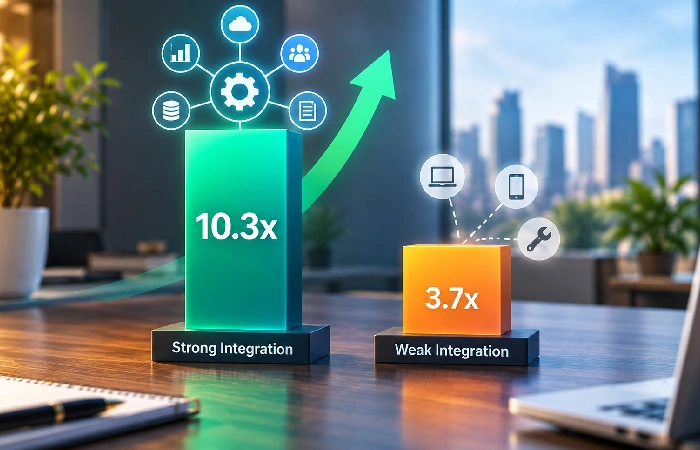
Companies with strong data integration achieve 10.3x ROI on transformation spending, versus 3.7x for companies with poor integration |
| Customer experience |
59% of customers rank tailored engagement based on past interactions as very important to winning their business |
| Decision-making/measurement |
Only 30% of organizations can accurately measure the ROI of their digital transformation investments, even though these initiatives consume 12-15% of enterprise IT budgets |
| Priority shift |
Employee productivity (39%) has overtaken customer experience (32%) as the top-ranked digital transformation priority for the first time |
Methodology: figures pulled from 2026 industry research. Deloitte data cited by Keyhole Software. A 2026 transformation report from Annan Quaye. Salesforce research cited by Hexaware. Betsol data cited by Revido.
The Real Business Case Behind Digital Transformation

Not the technology itself. That’s not where the main benefit sits. The real gap runs between companies that scale it well and companies that don’t. Enterprises capture 64% ROI on transformation spending, according to Deloitte data compiled by Keyhole Software. Smaller organizations average just 11%. Scale-enabled compounding explains most of that gap, larger companies fund the architectural groundwork that smaller ones often skip.
Most companies get the wrong advice because of this. Buying software isn’t the benefit. Building the foundation underneath it is. Skip that step, and the technology sits there without doing much. A deeper breakdown of how to sequence that foundation lives in the full digital transformation guide.
Productivity Gains Depend on Integration, Not Just Tools
Sixty-six percent of organizations report real productivity and efficiency gains tied to AI-driven transformation. Only 20% see a matching revenue bump. That gap matters. Efficiency and revenue aren’t the same outcome. Companies chasing one shouldn’t assume they’re getting the other.
Integration quality explains most of the spread. Organizations with strong data integration pull in 10.3x ROI on their transformation spending. Poorly integrated rollouts land at 3.7x, per research from Annan Quaye’s 2026 transformation analysis. Not a small gap, that. It separates a project that pays for itself several times over from one that barely breaks even. Employee productivity has overtaken customer experience as the top-ranked priority for 2026 too, the first time that’s happened in this kind of survey data.
Customer Experience Improves When Data Gets Personal
Fifty-nine percent of customers say it. Tailored engagement based on past interactions, that’s what matters most when deciding who to buy from. Salesforce found this. Hexaware cited it. Gains show up fastest when personalization runs on usable data. Not just data sitting collected in a dashboard nobody checks.
That number should reframe how teams think about CX investment. Not about adding more channels. About making the channels a company already has actually remember the customer. A support chat that references a previous order. A checkout flow that skips fields already on file. A recommendation grounded in real purchase history instead of a generic category. Some companies are still weighing which digital investments to prioritize. Real-world digital transformation examples can help there. They show how this plays out across different industries.
Decision-Making Breaks Down Without ROI Measurement
Only 30% of organizations can accurately measure the ROI of their transformation investments, even though those initiatives eat up 12-15% of enterprise IT budgets, per Betsol data cited by Revido. Most competing articles skip this part entirely. Digital transformation is supposed to sharpen decision-making. This stat says otherwise for most companies.
That’s the real bottleneck behind “better decision-making” as a benefit. Companies collect more data than ever now. Without measurement discipline, though, that data never translates into sharper decisions. It just becomes noise sitting next to noise that was already there. Fixing it usually means defining ROI metrics before a project starts, not after it’s already live. Anyone building that framework from scratch should start with digital transformation strategy fundamentals before choosing tools.
Long-Term Benefits Compound for Companies That Stay the Course
Short-term wins are easy to point to. Long-term benefits work differently, they’re where the real separation happens, and they compound. Companies that build strong integration early keep outperforming poorly-integrated peers by roughly that same 10.3x-versus-3.7x margin years later. Not because the technology changed. Because the operational habits around it stuck.
Treating digital transformation as a one-time project instead of an ongoing operating model tends to produce a plateau. Companies that keep refining their data integration and measurement practices, those are the ones showing up in the 64% ROI bracket instead of the 11% one. No coincidence there. A pattern like that shows up consistently across the 2026 research on this topic.
Frequently asked questions
1. What are the main benefits of digital transformation?
Measurable ROI gains. Higher productivity. Stronger customer experience. Better decision-making. All four depend on integration quality, though. Enterprises with strong integration see 64% ROI compared to 11% for smaller, less-integrated organizations.
2. How long does it take to see results from digital transformation?
Results vary by company size and integration approach. Only 27% of organizations expect ROI within six months. 2026 industry survey data backs that number. Most benefits compound over a longer timeline. They don’t show up immediately.
3. Do small businesses get the same benefits as large enterprises?
Not at the same scale. Enterprises average 64% ROI on transformation spending. Smaller organizations average 11%, largely because enterprises can fund the architectural groundwork that produces compounding returns.
4. Why do some companies not see ROI from digital transformation?
Measurement failure, not technology failure. That’s the most common reason. Only 30% of organizations can accurately measure their transformation ROI, even though these projects consume 12-15% of IT budgets.
A digital transformation strategy built without a measurement plan runs blind. Define how success gets tracked before choosing the next tool or platform. That single step separates companies landing in the 64% ROI bracket from ones stuck at 11%.