Published: September 17, 2026
Last Updated: September 17, 2026
Most companies don’t fail at digital transformation over bad software choices. Nobody measured where they actually stood before the budget got spent. This article covers that gap between ambition and actual assessment.
Quick Answer: Most digital transformations fail because teams skip maturity assessment. This framework fixes that with five measurable stages.
Definition: “A digital transformation strategy is a documented roadmap. It sequences technology adoption, process change, and skills development. All of it built around measurable business outcomes.”
Digital Transformation Strategy, Defined Without the Buzzwords
A digital transformation strategy is a written plan, not a mood. It names which processes change, in what order, and how you’ll know it worked. IBM’s framework makes one core argument here. Transformation sticks when leaders align the whole organization around one program. Not a loose pile of tech upgrades running in parallel. Most guides blur this distinction entirely.
Roughly 92% of companies report they’re already pursuing some form of digital transformation, according to a PTC-cited industry survey. But pursuing something and having a documented strategy for it are two different things. The full digital transformation framework breaks this down across every stage, if you want the wider hub on the topic.
Assessing Your Digital Capabilities Before You Spend a Cent

Skip this step. Everything after it is guesswork otherwise. A digital maturity assessment scores four areas. Technology infrastructure. Process automation. Data usage. Workforce digital skills. Score each one 1 to 5. Below 2.5 on average, you’re not ready for a full roadmap.
Foundational fixes come first. Think consolidating data systems, or closing basic skill gaps.
Fewer than 100 employees. That’s the sweet spot. Success rates run 2.7 times higher there than at companies over 50,000. McKinsey’s numbers. Fewer layers means less dilution. That’s why smaller teams move faster here.
Bring in IT for this assessment. Bring in operations too. Frontline staff matters most of all, since executives often can’t see where the friction actually lives.
Setting Goals That Survive Contact With Reality
“Become more digital.” Won’t survive a budget review. McKinsey’s framing: competitive advantage at scale. Cost cuts and customer experience gains fall out of getting that right. Not the other way around. Just buying software doesn’t get you there. Numbers will.
Take “improve customer experience.” Not actionable. The version that works: “cut average support response time from 4 hours to 45 minutes by Q3.” Now it’s a target. “Modernize operations” has the same issue. Three legacy systems are still on-premises. Move off those servers by year end. Research and Markets: $4.62 trillion by 2030. Roughly 26.7% annual growth since 2023. Your competitors are attaching numbers to targets like these already.
Building a Roadmap With Actual Timelines
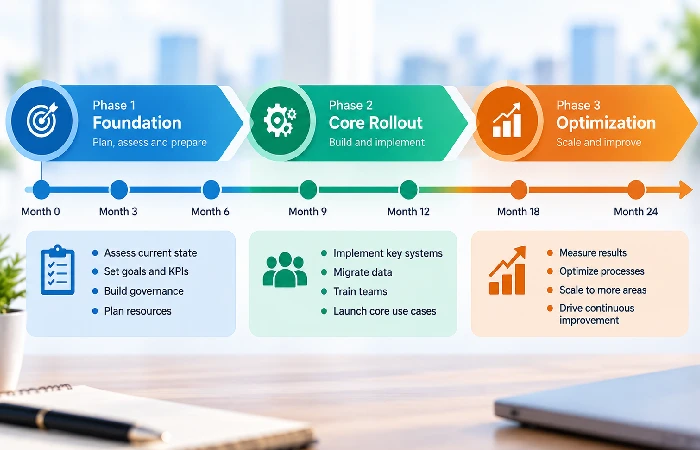
A roadmap without dates is a wish list. Break your transformation into three phases. Foundation runs 0 to 3 months, fixing the data and infrastructure gaps your assessment found. Core rollout comes next, 3 to 12 months of deploying the priority systems tied to your goals. Then optimization, 12 months onward, refining based on whatever the KPI data tells you.
One owner per phase. Separate from whoever owns the project. Diffuse ownership. One of the most common reasons roadmaps stall past the foundation. Every 90 days: actual progress vs. the maturity score from your assessment. More than 30% behind on the budgeted timeline at that checkpoint. Cut scope. Don’t extend the deadline indefinitely.
Measuring Success So You Don’t Become Part of the 70%
Roughly 70% is the number most cited for how many digital transformation programs miss their targets. McKinsey and BCG both use it, though estimates vary by methodology and industry. Most of that failure comes down to two things: no baseline measurement, and no ongoing tracking against it.
Track four KPI categories every month. Adoption rate comes first, the percentage of staff actually using the new systems. Then there’s process speed: how much time you’re saving on the workflows you targeted. Cost impact matters too, whether spend dropped or revenue rose because of the transformation. Last is error rate, the defects or manual corrections needed after rollout. If adoption sits under 60% by month six of core rollout, the problem isn’t technology. It’s training and change management, and no amount of extra software will fix it.
FAQ
1. What are the 5 pillars of digital transformation?
Most frameworks group them as customer experience, operational processes, business model, culture, and data strategy. The order matters less than you’d think. What matters is that each one has an owner. And a number attached to it.
2. How long does digital transformation take?
A realistic timeline runs 12 to 18 months for a mid-sized organization to move through foundation, core rollout, and initial optimization. Cultural adoption is a different story. That part drags out longer, usually another 2 to 3 years past the rollout itself.
3. What’s the difference between digital transformation and digitalization?
Digitalization is simpler: converting a process to use digital tools. Transformation goes further. It rebuilds the business model and the culture around what those tools now make possible.
4. Why do most digital transformation strategies fail?
The most common reason is skipping maturity assessment. Then jumping straight to technology purchases. Weak change management follows close behind. It rarely gets staff past surface-level adoption.