Published: September 16, 2026
Last Updated: September 16, 2026
Most explanations of digital transformation come from firms advising companies with eight-figure IT budgets and a Chief Digital Officer already on staff. That’s fine if you’re running a Fortune 500 division. It’s not much use if you’re a 20-person SaaS team trying to figure out which system to fix first.
Quick Answer: Digital transformation redesigns how a business runs using tech. It’s not just adding software on top.
Definition: “Digital transformation is the redesign of how a business operates and creates value using digital technology, not the act of digitizing existing paperwork or adding software on top of unchanged processes.”
Digital transformation by the numbers
| Metric |
Standalone data point |
| Enterprise adoption rate |
An estimated 90% of organizations were undergoing some form of digital transformation, per McKinsey’s research |
| Success rate |
Fewer than one in three large-enterprise transformation programs hit their stated targets as of 2026, despite over 90% running a formal program |
| Financial upside for leaders |
Digital leaders achieved roughly 65% greater annual total shareholder returns than laggards between 2018 and 2022 |
| Operational impact example |
Doosan Digital Innovation cut security response times by about 85% after consolidating its SOCs and deploying AI-based pattern matching |
| Change-management cost ratio |
McKinsey recommends budgeting one dollar on adoption and training for every dollar spent on the tech itself |
| 2026 strategic shift |
Framing has moved from digitization, old processes done digitally, to AI-native operating models built around agents from the start |
Methodology note: figures below come from publicly available research and reporting on digital transformation, including data published by IBM and McKinsey. Nothing here is estimated.
Digital transformation, defined and separated from digitization
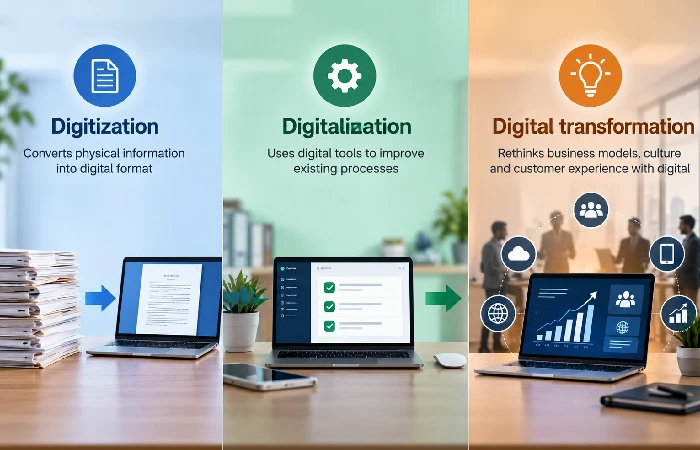
Digital transformation is redesigning how a business creates value. That’s the core of it. Technology’s the lever here, not the goal. Turning paper into files, that’s all digitization really is. A different animal entirely from what comes next. Digitalization goes a step further. It uses digital tools to speed up a process that already exists, but the process itself doesn’t change. Transformation is the one that actually rewrites it.
IBM defines it as a strategic initiative built into every part of the organization, evaluating and modernizing processes, products, operations, and the tech stack itself, all aimed at continual, customer-driven innovation. McKinsey goes further. They call it the fundamental rewiring of how an organization operates, built for a lasting competitive advantage, not a one-time upgrade.
Here’s the part most explainers skip: an estimated 90% of organizations were already running some kind of transformation program, per McKinsey’s last research update. Not a niche initiative anymore. More like a baseline expectation, and that changes the framing entirely. The question for most businesses in 2026 isn’t whether to do this. It’s whether the version they’re running actually moves anything, or just piles software onto processes nobody bothered to redesign.
Building a strategy that survives contact with a small budget
A workable strategy needs three things. A specific business problem. A domain to fix first. And a way to measure whether it worked. Skip any one of those and the initiative drifts.
McKinsey’s Rewired book lays out six capabilities behind successful transformations: a clear strategy tied to business value, an in-house talent bench, a scalable operating model, distributed technology access, reliable shared data, and strong change management. That’s the enterprise version. For a smaller team, those same six ideas compress into something more usable:
- Pick one domain (a customer journey, a workflow, a single team’s process), not the whole company at once.
- Budget for training and rollout at roughly the same size as the tech spend itself. McKinsey’s rule of thumb is a dollar on change management for every dollar on the solution.
- Track one or two operational KPIs from day one instead of waiting to measure “digital maturity” in the abstract.
- Assign one person ownership. Vague, distributed accountability is how initiatives stall.
McKinsey senior partner Eric Lamarre puts the sequencing problem plainly: digital and AI transformations should always start with the business problem you want to solve, not the technology. That’s the mistake behind most of the roughly two-thirds of large-enterprise programs that miss their targets. They buy the platform first and retrofit a justification after.
The technologies actually driving transformation in 2026
No single tool causes transformation. A specific combination does, and the combination has shifted in the last two years.
IBM lists cloud computing as the original enabler, still true, alongside mobile technology, the Internet of Things, robotic process automation (RPA), and blockchain for narrower use cases like supply chain traceability. AI and machine learning sit above all of them now, though. RPA follows rules a programmer writes. AI doesn’t. It learns from data instead. Gets more accurate over time on its own. That’s why it moved from a supporting tool to the primary driver of new transformation initiatives.
The 2026-specific shift is toward agentic AI. Systems that plan multi-step work and execute actions with oversight, not tools waiting for someone to press a button. That turns “give employees a better tool” into a harder question. Which workflows should actually be redesigned around autonomous execution in the first place? Composable, microservices-based architecture matters here too. A rigid monolithic system just can’t hand off tasks to an AI agent cleanly. Legacy systems without a clean API layer or structured data block AI deployment before it starts, regardless of how good the model is.
Real transformation wins, measured in numbers
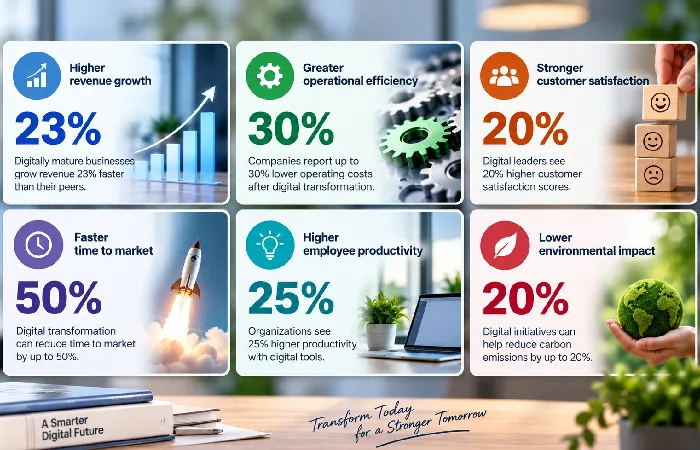
Abstract benefits lists don’t tell you much. Specific outcomes do.
IBM’s case studies include Doosan Digital Innovation. They pulled multiple regional security operation centers into one global SOC and added AI-based pattern matching on top. Response times fell by about 85%. Wintershall Dea took a different angle, automating data extraction across 2,000 PDF documents as part of a centralized AI push, which freed staff up for higher-value work instead of manual entry. Then there’s the NHS. Its Cyber Security Operations Centre monitors more than 1.2 million devices today. It also blocks over two billion malicious emails a year.
These are enterprise examples, but the underlying pattern scales down. Each one targeted a single measurable process, security response time, document processing, threat filtering, rather than attempting an organization-wide overhaul at once. Same domain-first logic McKinsey recommends. Just applied at a scale a smaller team can actually execute.
The financial case is the clearest number in the entire body of research: digital leaders achieved about 65% greater annual total shareholder returns than digital laggards from 2018 to 2022. That gap didn’t come from having more technology. It came from using less of it, better targeted.
Where small business transformations break down
The failure pattern is consistent enough to name directly. Teams buy a platform. They skip the process redesign. Then they call the rollout done the minute the software’s installed.
Warning signs a business needs to act tend to show up before anyone calls it a “transformation.” Manual, repetitive data entry across spreadsheets and accounting tools is usually the first one people notice. Then there’s the paper-heavy stuff, purchasing, invoicing, expense approvals, sitting in a pile somewhere. Same root issue both times: information trapped in one system, re-keyed into another by hand, with errors compounding at every handoff.
McKinsey senior partner Rodney Zemmel frames the current moment bluntly: it is “show me the money” time for digital transformations, and to succeed, it needs to be a CEO agenda item, not a delegated IT project. For a small business, that translates to ownership sitting with whoever controls the budget and the timeline, not with whoever happens to be most comfortable with software.
Underinvesting in change management is the second recurring failure. McKinsey’s one-dollar-for-one-dollar rule between tech spend and training spend exists because low adoption is what turns a working tool into shelfware. A platform nobody uses correctly doesn’t show up as a technology failure in the postmortem. It shows up as a training failure that got skipped to save money upfront.
A full breakdown of these failure modes, with fixes for each one, is covered in common digital transformation challenges.
FAQ: quick answers to common digital transformation questions
1. What’s the difference between digital transformation, digitization, and digitalization?
Digitization is converting analog information into digital form. Scanning paper records, basically. Digitalization’s a different thing. It uses digital tools on a process that already exists, emailing a form instead of mailing it, say. Transformation goes further than both. It redesigns the process itself, built around what digital tools actually make possible, not just around what format the information happens to be in.
2. How long does a digital transformation take?
There’s no fixed timeline here. Any source giving you one specific number is guessing. McKinsey doesn’t frame it as a project with an end date. An ongoing effort, that’s the term they use. Executives on this path, most of them, will be at it for the rest of their careers. One workflow, one team, a single-domain rollout like that can show measurable results in a few months. Shift the whole operating model company-wide, though, and you’re looking at a multi-year commitment instead.
3. What percentage of digital transformations fail?
Reporting from 2026 puts formal-program adoption at over 90% of large enterprises. Fewer than one in three of those programs hit their stated targets, though. That gap, adoption versus success, is the strategy problem this piece addresses directly. Buying technology isn’t the same as redesigning a process around it.
4. What role does AI play in a 2026 digital transformation specifically?
From supporting tool to primary driver, that’s the shift AI has made. Agentic AI especially. Systems that execute multi-step tasks with human oversight instead of waiting on manual input at every step. That shift only works on top of clean data and an API layer, though. Legacy systems without either block AI deployment before it starts, no matter how good the model is.
5. Can a small business do digital transformation without a big budget?
Yes, by narrowing scope. Enterprise frameworks assume a dedicated team and a multi-year runway most small businesses don’t have. A small business gets more from picking one high-friction process. Budget training at roughly the same size as the tech spend. Measure one KPI before expanding into anything bigger. The failure pattern in large enterprises, skipping change management, redesigning nothing, just buying software, is avoidable at any budget size once it’s actually named.