Published: September 15, 2026
Last Updated: September 15, 2026
Most lists of emerging technologies read like inventories. Quantum computing, blockchain, AR, AI, robotics, named and filed away, with nobody telling you which one deserves your budget this year. That gap matters more in 2026. Twelve months ago it didn’t, not like this, back before several of these technologies crossed from pilot programs into production deployments. This guide sorts the signal from the noise. Which technologies are already changing how businesses operate? Some are still a year or two out. Some carry more hype than adoption ever earns them. If you run a SaaS team, a content operation, or an agency deciding where to point resources, you need a working answer here. Not another list.
Quick Answer: “Innovations moving from research into deployment, that’s what emerging technologies are. Physical AI. Quantum-edge computing. Blockchain IoT. Extended reality. All four are reshaping how businesses operate in 2026.”
Definition: Emerging technologies are innovations moving from research into deployment. Physical AI, quantum-edge computing, blockchain IoT, and extended reality all fall under that umbrella, reshaping how businesses operate in 2026.
2026 emerging technology scorecard
| Technology domain |
2026 status |
Key metric |
Adoption timeline |
Verdict |
| Physical AI / humanoid robotics |
Moving from pilots to production |
Humanoid robot shipments projected to grow more than 700% in 2026 |
Near-term |
Highest near-term business impact |
| Quantum-edge computing |
Early industrial pilots, hybrid architectures |
Hybrid quantum-classical computing named the defining 2026 trend by Quandela |
Medium-term |
High long-term value, not yet turnkey |
| AR/VR |
Mainstream enterprise use in training, retail, healthcare |
AR hardware market growing 64.8% year-over-year to $9.7 billion in 2026 |
Near-term for training and retail |
Selectively ready, vertical-dependent |
| Blockchain / IoT (BIoT) |
Shifted from speculation to enterprise verification |
Enterprise deployments moving beyond pilot programs into production in 2026 |
Medium-term, sector-specific |
Niche but maturing |
| AI security and trust |
Foundational, short-term priority |
Named a short-term horizon technology in Forrester’s 2026 report |
Immediate |
Prerequisite, not optional |
Emerging technology, defined for 2026
An emerging technology is any innovation that’s crossed out of the research lab but hasn’t become standard business infrastructure yet. Whole definition, right there. Think of it as a stage a technology passes through, not a fixed category it belongs to forever, which is exactly why the list changes every year. Desktop computers, ATMs, mobile phones, all of them were “emerging” once. Today they’re just tools nobody thinks twice about.
What’s different about 2026 is the pace. The World Economic Forum’s 2026 Top 10 Emerging Technologies report covers energy, materials, health, and computing. Not lab theory anymore. This stuff is already landing in real-world deployment. Earlier editions often stayed confined to labs. This one doesn’t. That’s the throughline for every technology in this guide.
Five domains dominate the current 2026 landscape. Quantum and edge computing. Augmented and virtual reality. Blockchain and IoT. Physical AI and robotics. And the security infrastructure underneath all of it. Each moves at a different speed. Some are already inside your competitors’ operations. Others are still two or three years from being worth a serious budget line; knowing which is which is the actual value of a report like this one.
The real difference between quantum and edge computing
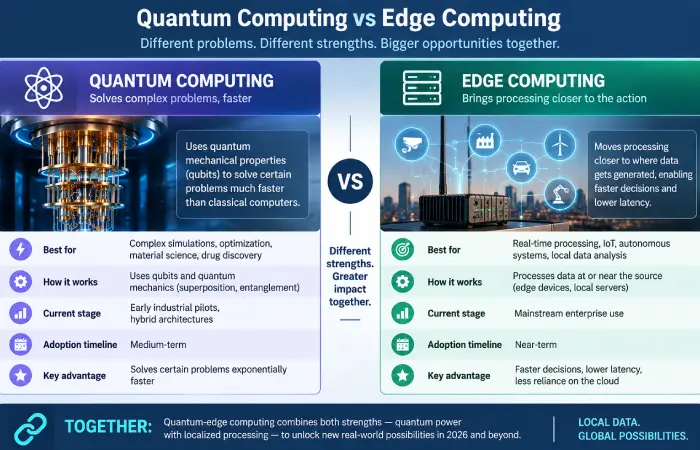
Two different problems. That’s what quantum computing and edge computing actually solve, and conflating them is how teams end up budgeting for the wrong thing. Edge computing moves processing closer to where data gets generated, so decisions that need to happen right now actually can. Quantum computing isn’t that. It leans on quantum mechanical properties instead, the kind that let it solve certain classes of problems faster than a classical processor ever manages. Put the two together and you get quantum-edge computing. Localized. Quantum-assisted. No round trip to a centralized cloud required.
This isn’t some future concept anymore. Quandela, a photonic quantum computing company, named hybrid quantum-classical computing, early industrial pilots, and quantum error correction as the four trends defining quantum computing’s shift from research lab to commercial deployment in 2026. Finance, pharmaceuticals, and logistics are leading adoption. They’re using hybrid systems to accelerate AI training and cut the size of datasets needed for useful results.
Futurist Ian Khan frames quantum-edge computing as “a paradigm shift that enables real-time, localized quantum processing.” Seventh on his Top 50 Technology Trends 2026 report, for what it’s worth. Stanford Tech Review isn’t so quick to say that. Their analysis leans more cautious: near-term value comes from hybrid architectures, the kind that augment existing edge stacks rather than tear them out and start over.
AR and VR move from novelty to operations
AR and VR stopped being gaming accessories in 2026. They’re training tools now. Retail interfaces. Clinical treatments. The market data backs that up. ABI Research’s AR market forecast has hardware growth at 64.8% year-over-year in 2026, reaching $9.7 billion. By 2030 the combined AR/VR market should be closing in on $38 billion. Precedence Research isn’t far off, just working from different numbers: they’ve got the combined market at $118.79 billion in 2026, up from $75.18 billion the year before. Different methodologies. Same direction. Growth is fast here, and so is the spend.
The use cases have shifted too. Virtual try-ons, for one. Shoppers see a product on themselves before ever buying it, that’s the retail play with AR. Automakers went further still. Customers configure a car, take it for a virtual test drive, and skip the dealership entirely. Healthcare’s in on it as well. VR-based therapy has already produced measurable clinical results. One controlled trial reported that VR therapy reduced social anxiety symptoms in patients by up to 68%. That’s not a novelty statistic. It’s a treatment outcome. It’s why hospital systems are piloting VR programs now, not just IT departments looking for a demo.
Enterprise training is the fastest-growing near-term use case. Companies are swapping static onboarding materials for immersive VR environments, and some have scaled this to tens of thousands of employees. The old technology gap, dependence on strong cloud connectivity, has narrowed as 5G coverage improved. Outdoor and field-based AR applications are more practical now than they were even two years ago. For ROI benchmarks specific to enterprise deployments.
Blockchain and IoT build supply chain trust
Blockchain’s 2026 story isn’t cryptocurrency anymore. It’s verification. The technology’s biggest practical shift has moved it away from speculative trading and toward a boring, expensive problem worth solving: proving that data from physical devices hasn’t been tampered with.
That’s what Blockchain IoT, or BIoT, does. It pairs the Internet of Things’ network of sensors and connected devices with blockchain’s tamper-resistant ledger. What comes out of that pairing is a single, verifiable source of truth for physical events. Organizations tracking shipments care about this. So do the ones verifying carbon claims. The same goes for anyone securing a supply chain. Take a logistics company as an example. IoT sensors record a shipping container’s temperature and location in real time. That data gets written to a blockchain ledger. No single party can quietly alter it afterward.
Enterprise adoption has moved past pilot programs now, into actual production deployments. Regulation’s catching up too, slowly working out how to accommodate decentralized systems. Platform choice comes down to use case, mostly. Ethereum still handles complex smart contracts. Costs more to run, sure, but it does the job. Hyperledger Fabric goes a different route. Built for permissioned enterprise networks, access control first. Then there’s IOTA. Feeless transactions, which make it the better fit for high-volume IoT micropayments. Large organizations mostly skip picking just one. Two or three platforms running together, each handling the workload it fits best, that’s the more common setup. For a full platform-by-platform breakdown, see how blockchain and IoT platforms compare for 2026 deployments.
Which emerging technology pays off first
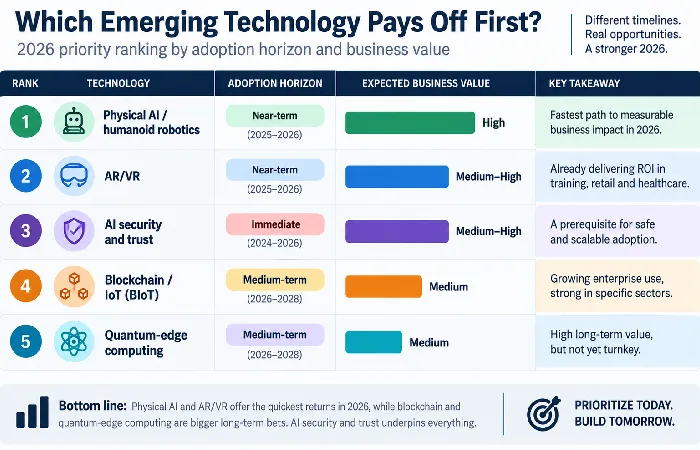
This is the question every list above skips. Given limited budget, which technology should a business actually prioritize in 2026? The data points toward physical AI and the security infrastructure underneath it, not the flashier categories.
Forrester’s 2026 report organizes emerging technologies into three benefit horizons rather than a flat ranked list, and the placement matters. AI security and trust technologies sit in the short-term horizon. They’re already moving from trial to real-world use, with measurable benefit to early adopters. Agentic software development and humanoid robots sit one horizon out. Forrester describes these as technologies that require discipline and a real tolerance for risk in exchange for a larger payoff two to five years out. Physical AI already has adoption numbers behind it. TrendForce projects humanoid robot shipments will grow more than 700% in 2026 alone, driven by logistics, manufacturing, and service robotics applications that don’t demand years of retraining to implement.
That combination, immediate security necessity plus fast-scaling physical AI, beats blockchain or consumer VR as a near-term bet. Both of those stay sector-specific rather than broadly applicable. Quantum-edge computing has the highest long-term ceiling here, but it isn’t turnkey yet. So the practical takeaway looks like this: fund AI security now. Pilot physical AI where your operations involve repetitive physical tasks.
Quantum computing belongs on the 2027-2028 planning horizon. It’s too early for a 2026 budget line. For a step-by-step framework to apply this to your own roadmap.
Frequently asked questions
1. What is the difference between quantum computing and edge computing?
Location matters here. Edge computing processes data physically close to where it’s generated, so you skip the latency of sending everything to a centralized cloud. Quantum computing works on a different axis entirely. It uses quantum mechanical effects to solve specific problem types faster than classical processors ever manage. Quantum-edge computing is the mashup of the two. Quantum-assisted processing, runs locally, no remote data center in the loop.
2. What emerging technology will have the biggest impact in the future?
Physical AI and humanoid robotics, based on 2026 adoption data. That’s where the fastest near-term growth is happening. TrendForce projects shipments will grow over 700% this year alone. Quantum-edge computing might win out long-term, it’s got the bigger ceiling. Just not there yet. Still stuck in the industrial-pilot stage, nowhere near broad deployment.
3. Is blockchain still relevant in 2026?
Yes. The use case has just moved on. Document verification. Supply chain traceability. BIoT sensor-data integrity. That’s where enterprise blockchain adoption sits in 2026, a long way from the old cryptocurrency-speculation story. Production deployments now outnumber pilot programs.
4. How does blockchain work with IoT devices?
IoT sensors collect real-world data, a shipping container’s temperature, its location, that kind of thing. That data gets written to a blockchain ledger. The ledger’s tamper-resistant, so no single party can quietly alter the record later. That’s the whole reason it’s useful for supply chain and compliance work.
Where to go next
If quantum computing feels like the most abstract category here, start with which technology to prioritize for your SaaS roadmap. It walks through a scoring framework for matching your team’s constraints against each domain’s actual 2026 maturity level, not its hype level.