Published: September 10, 2026
Last Updated: September 10, 2026
“Benefits of AI” gets thrown around online without much thought — faster, smarter, more efficient, pick an adjective and slap it on a listicle. This page skips that. Below is what AI’s benefit actually looks like when you can put a number on it: dollars, hours, percentage points. The sourcing is 2026 workplace research, peer-reviewed healthcare studies, and education-adoption data — not vendor marketing. If you’re deciding whether AI adoption is worth the disruption, or you need to justify a budget line to a manager, this is what’s actually been proven so far.
Quick Answer: AI’s real payoff boils down to three things — fewer errors, faster decisions, lower costs — supported by 2026 data, not marketing copy.
Definition: The benefits of AI include automating repetitive work, cutting operational costs, and improving decision accuracy — across healthcare, education, and business — based on outcomes that have actually been measured, not projected.
At a glance: verified AI benefit data
| Benefit area |
Verified metric |
Source |
| Workplace adoption |
75% of knowledge workers already use AI at work |
Microsoft WorkLab |
| Perceived output quality |
30% report faster, higher-quality work with AI |
Microsoft WorkLab |
| Leadership pressure to scale |
53% of leaders say productivity must increase |
Microsoft WorkLab |
| Healthcare cost reduction |
Lung-cancer detection cost fell from about $150,000 to $300 per case |
PMC/NCBI systematic review |
| Clinical workload reduction |
AI cuts clinical workload by 19% to 50%, depending on task |
PMC/NCBI systematic review |
| Education time savings |
Weekly AI users among teachers save close to six weeks a year |
AI in Education Statistics 2026 |
| Corporate training efficiency |
AI-assisted training programs show a 57% efficiency gain |
AI in Education Statistics 2026 |
Methodology: Figures compiled from publicly available third-party sources — including industry reports, vendor research (e.g., Microsoft WorkLab), peer-reviewed studies on PubMed Central (PMC), and aggregator sites summarizing primary research.
What Are the Main Benefits of Artificial Intelligence?
The main benefits of AI come down to uninterrupted operation and lower labor costs on repetitive tasks. AI systems run around the clock without breaks, shift changes, or overtime pay — which is why data entry, claims processing, and monitoring tasks are among the first jobs handed off to it.
That doesn’t mean AI replaces judgment entirely. What it does well:
- Automates repetitive work — data entry, sorting, basic triage — freeing staff for tasks that need human reasoning.
- Runs continuously without the scheduling limits of a human workforce.
- Cuts payroll costs on high-volume, low-complexity tasks (IBM Think Insights).
The trade-off is real too: automation at this scale does displace some roles even as it creates new ones in AI oversight and data work. Neither the benefit nor the cost is theoretical anymore.
How Can AI Improve Productivity and Automation?
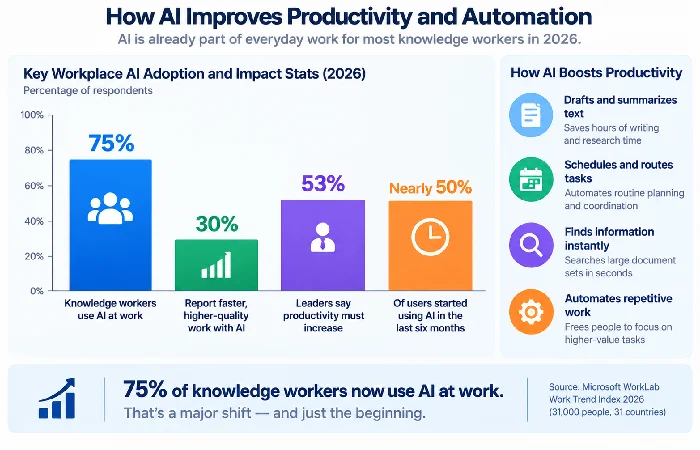
AI’s productivity gains so far come mostly from absorbing routine work, not from replacing whole jobs. Microsoft’s WorkLab Work Trend Index, which surveyed 31,000 people across 31 countries, found that 75% of knowledge workers already use AI at work — with nearly half having started in just the last six months.
That’s a fast adoption curve for a workplace technology. A few things are driving it:
- Drafting and summarizing text, which used to eat hours out of a workday
- Scheduling and routing tasks automatically instead of manually
- Surfacing information from large document sets in seconds
If you want the mechanics behind this kind of automation, generative AI tools are the layer doing most of the heavy lifting here. Adoption is outpacing formal training in most organizations, which is its own separate problem.
How Does AI Help Businesses Make Better Decisions?
AI helps decision-making by processing more variables, faster, than a person reasonably can. It doesn’t decide for you — it narrows the field before a human makes the call.
The same Microsoft WorkLab research found that 30% of surveyed employees report AI produces faster, higher-quality work, and 53% of business leaders say productivity has to increase from where it currently sits. That pressure is pushing decision-support tools into places they weren’t a few years ago — pricing, staffing, inventory, risk flagging.
Not every AI system is built for this. Different types of AI handle decision support differently, predictive models forecast, while generative models draft and summarize, and mixing them up leads to disappointing results.
Benefits of AI in Healthcare, Education and Everyday Life
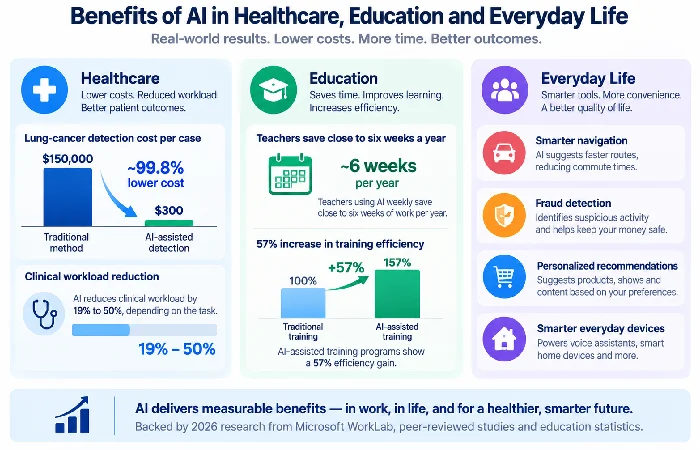
The clearest, best-documented AI benefits right now are in healthcare cost reduction and education time savings, not consumer gadgets. A peer-reviewed systematic review published on PMC/NCBI found AI-assisted lung-cancer detection dropped in cost from roughly $150,000 to $300 per case, and reduced clinical workload by 19% to 50% depending on the task.
Education shows a similar pattern. A 2026 education-statistics analysis found:
- Teachers using AI weekly save close to six weeks of work per year.
- Corporate training programs using AI report a 57% increase in learning efficiency.
- Four in five surveyed students say AI has improved their academic performance.
Outside of work and school, the same underlying tech shows up quietly — route planning that shaves minutes off a commute, spam and fraud filters running in the background. None of it makes headlines, which is probably why it’s underrated.
What Are the Advantages and Disadvantages of Artificial Intelligence?
AI brings real upside — speed, lower costs, fewer errors on repetitive tasks — but it comes with real downsides too: the cost of implementation, job losses in specific narrow roles, and a dependence on clean data. One doesn’t outweigh the other.
- Advantage: consistent output at scale without fatigue-driven errors.
- Disadvantage: upfront and ongoing costs for infrastructure, training data, and oversight.
- Advantage: faster processing of large datasets than manual review allows.
- Disadvantage: results are only as reliable as the data feeding the model.
If the basics are still new to you, the artificial intelligence for beginners guide walks through how these systems actually work, before you get into weighing trade-offs for your own use case.
Frequently Asked Questions
1. What’s the biggest benefit of AI for small businesses vs. enterprises?
For small businesses, the biggest win is usually coverage — handling tasks like customer service chat or basic scheduling that they’d otherwise have no staff for. Enterprises get more out of scale: applying AI across thousands of transactions, where small per-task gains add up fast.
2. Does AI actually save companies money, and how is that measured?
Yes — in the cases where it’s actually been documented. Healthcare is the strongest example: the study cited above shows lung-cancer detection costs dropping from around $150,000 to just $300 per case. Elsewhere, the savings usually aren’t one big number — they show up gradually, as fewer labor hours per task.
3. How does AI improve decision-making specifically, versus just “helping”?
It can spot patterns across far more data than a person could track manually, then rank or flag the strongest options. A person still makes the actual call — AI is narrowing what’s in front of them, not making the decision itself.
4. What are AI’s benefits in everyday life outside of work?
Mostly invisible ones: traffic rerouting, fraud detection on your bank account, spam filtering, and recommendation systems that quietly get better the more you use them.
Weighing AI adoption for your own team starts with the same question these numbers answer: where is a repetitive, data-heavy task eating hours that a person could spend on something a machine can’t do yet.