Published: September 10, 2026
Last Updated: September 10, 2026
Artificial intelligence is already responsible for dozens of common everyday tasks, from unlocking your phone to detecting a false charge on your credit card. This article has specific artificial intelligence examples for newcomers, mixing daily life, smartphones, business, healthcare/finance/education and where it’s headed next.
Quick Summary: AI is already on your phone, in shopping, in search results, pretty much everywhere. See how it’s ingrained and what to expect.
Definition: Artificial intelligence examples could be anything from voice assistants, through fraud prevention, to camera phones, and predictive healthcare systems that are already in use by billions of ordinary people.
AI Examples at a Glance
| Category |
Named Example |
Underlying Technique |
Adoption/Usage Data Point |
| Everyday life |
Siri, Alexa, Google Assistant voice commands |
Natural language processing (NLP) |
Voice assistants are still the most recognized consumer AI touchpoint across all the current ranking sources mentioned above |
| Smartphones |
Face unlock, computational photography, predictive text |
Computer vision + on-device machine learning |
Face recognition and camera optimization are cited as key AI features in the 2026 smartphone generation |
| Business |
Content production for marketing purposes |
Generative AI (LLMs) |
In 2026, 84% of small businesses surveyed used AI to generate marketing content (Upwork) |
| Business |
Customer service automation |
Conversational AI / NLP |
In 2026, 59% of small businesses surveyed used AI to answer customer questions (Upwork) |
| Healthcare |
Initial disease diagnosis, drug interaction assessment |
Predictive analytics + deep learning |
Most commonly viewed as a top use case for AI in healthcare; specific accuracy rates of varying values |
| Future uses |
Auto AI agents that are specific to each task |
Agentic AI |
Possible to address up to 40% of enterprise application integration by 2026 (Microsoft) |
Methodology: these numbers come from 2026 industry surveys and vendor trend reports. Each row stands on its own. No extra paragraph needed.
What Are Some Everyday Examples of Artificial Intelligence?
The most obvious examples that most people can think of will be voice helpers (or personal assistants). Siri, Alexa, Google Assistant; it is the use of NLP to take a request and turn it into something else such as a reminder, a text or a call. Autocomplete is a similar premise, it predicts what people will search before they finish typing, using patterns extracted from other people’s searches on a much larger scale.
A few more show up without most users noticing:
- The social feed ranking on Instagram and YouTube. Which ranks the content using engagement-prediction models.
- Email spam filters which warn of dubious messages by matching patterns against known spam.
- Streaming recommendations on services like Netflix, ranked by viewing-history models
- For the technical differences between these systems, see the types of artificial intelligence guide.
Examples of AI in Smartphones and Consumer Technology
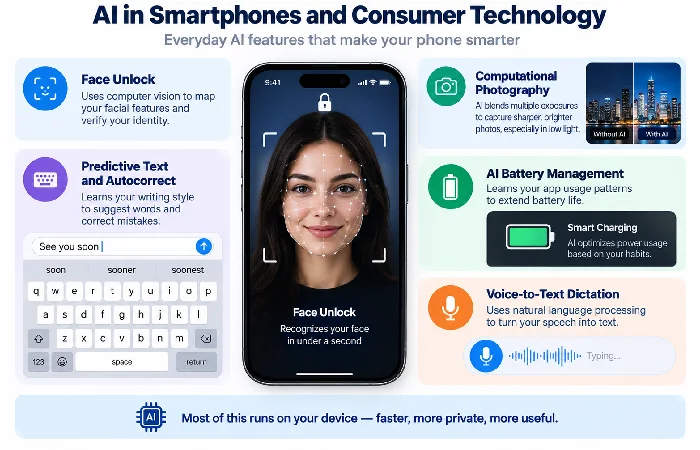
A phone runs several separate AI systems at once. Face unlock uses computer vision to map facial geometry against a stored profile in under a second. Computational photography blends multiple exposures on-device to produce one sharper image, especially in low light — this is why a modern phone camera outperforms what its own hardware specs would suggest.
Other AI functions built into a typical phone:
- Predictive text and autocorrect, which learn a specific user’s word patterns rather than relying on a generic dictionary
- Battery management, which models app usage to stretch a charge cycle
- Voice-to-text dictation, using the same NLP behind voice assistants
Most of this runs on the device, not in the cloud, cuts down on latency and keeps the data on the phone.
How Businesses Are Using Artificial Intelligence
Today, business AI seems to be used the most in two areas: content and customer service. In 2026, 84% of small businesses (at the surveyed period) had used AI for those business purposes: marketing content creation, and 59% of small businesses had already used AI to answer customers’ questions. This data is from Upwork’s 2026 SMB survey.
Apart from these two, common uses are in sales forecasting, where a model can surpass the spreadsheet by predicting sales from multiple sources of data; fraud detection, where banks and fintechs highlight unusual patterns of purchasing and transferring, out of step with an account’s normal activity; and stock or price optimization, where sellers tune their stock levels and prices in light of current trends in demand.
For SaaS / lead-gen operators, chatbot-based qualification and automated follow-up sequences are generally the first AI investment to make, as they don’t require a heavy engineering lift.
Examples of AI in Healthcare, Finance and Education
Both finance and healthcare depend heavily on predictive analytics. In healthcare it is used for early diagnosis and checking drug interactions, where in both cases patient records are compared against known risk patterns. In finance fraud detection and risk modeling are automated with AI algorithms and anomalies can be identified faster than manual review.
Compared to the other two, education receives less focus, although its use. Adaptive learning systems modify their course depending on the current performance of a student. Tools exist for automated grading evaluating responses to short-answer and even essay questions that calibrate their assessment with a trained model. Personalized tutoring systems use diagnostics to ascertain the extent of a student’s missing knowledge and dictate appropriate practice exercises.
What Are the Most Promising Future Uses of AI?
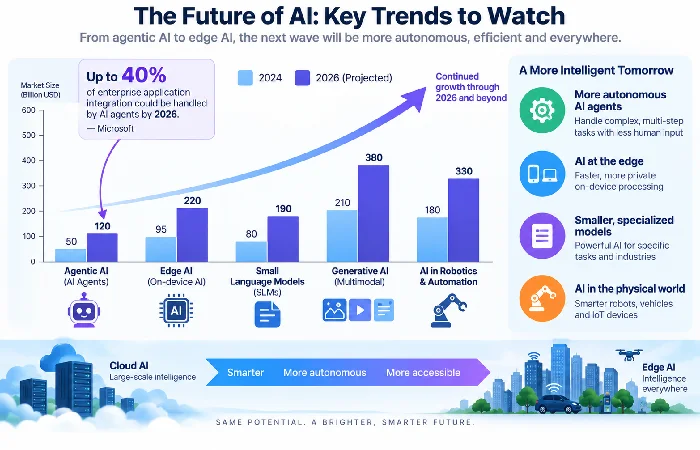
Agentic AI is the term to familiarize oneself with in this case: systems designed to fulfill multi-step functions with the least possible human interaction rather than a one-off request. Enterprise embedding of task-specific AI agents are expected to be up to 40% by 2026 according to Microsoft’s trend reporting.
Two other emerging trends to keep an eye on are: the move towards edge AI, where processing is shifted from the cloud onto the device itself to cut latency and improve privacy. And small language models, which are trained on a narrowly defined task rather than being one huge, broad model.
If you want the mechanics behind the generative side of this you can see how generative AI works.
Frequently Asked Questions
1. What are 5 examples of artificial intelligence?
Examples: you’ve got Siri or Alexa answering when you talk to your phone. Your face unlocks the thing. The bank catches weird transactions before they clear. Netflix tells you what to watch next. And half the customer service chats you have are with a bot.
2. Is Siri an example of artificial intelligence?
Absolutely. Siri uses NLP to understand what you’re saying, and machine learning so it gets better at serving you over time.
3. What are examples of AI in education?
Adaptive learning sites, where AI adjusts to how a student is performing; automated essay markers; and personalized learning, where a tutoring system adjusts to the learner’s performance.
4. How is AI used in business?
Most popularly, for the generation of marketing content and automated customer service with sales forecasting, fraud detection and stock optimization trailing far behind.
The fastest way to recognize how much of this is already in daily use is to look at what’s running on a phone right now, then branch into the more technical types of artificial intelligence for the underlying mechanics.